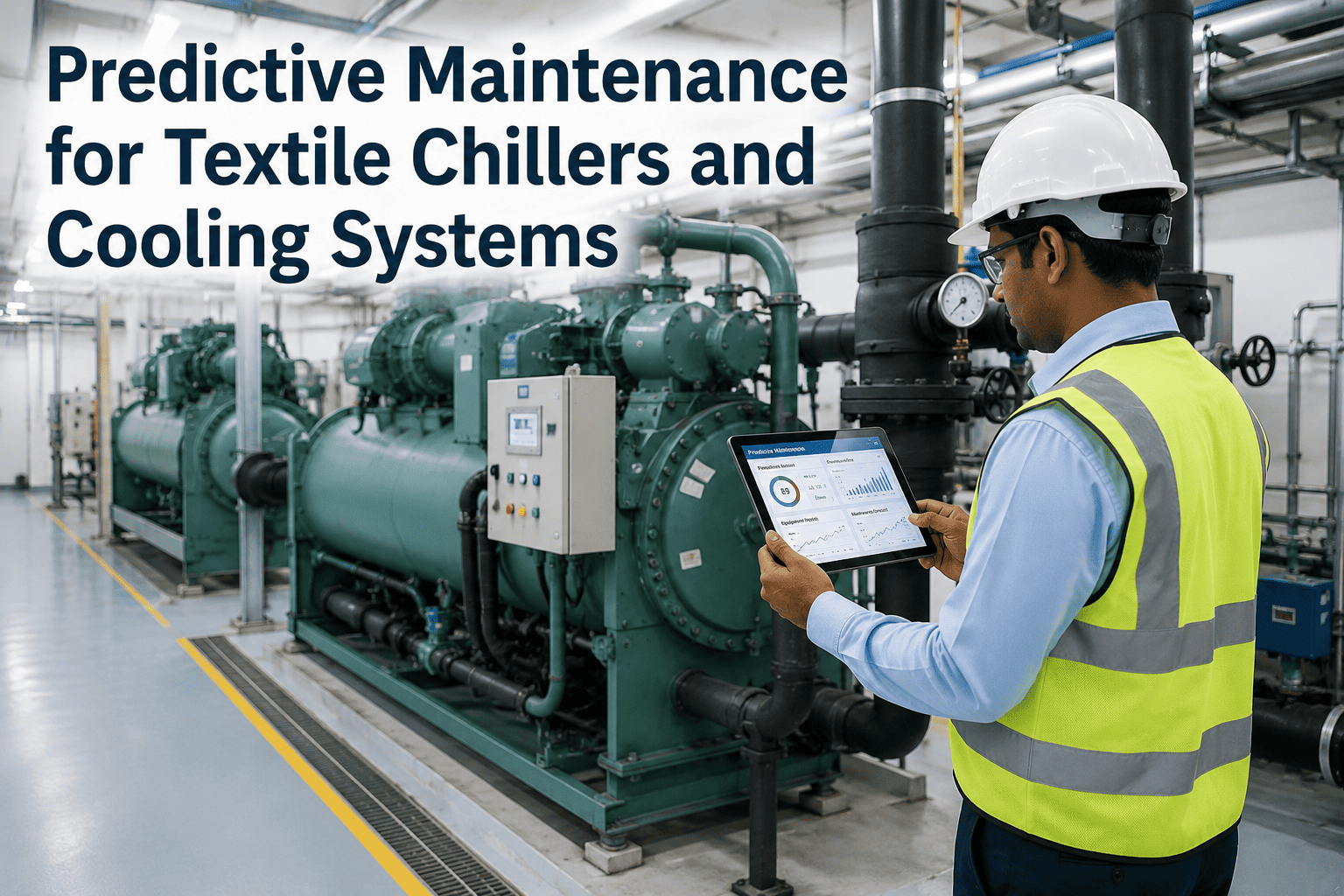
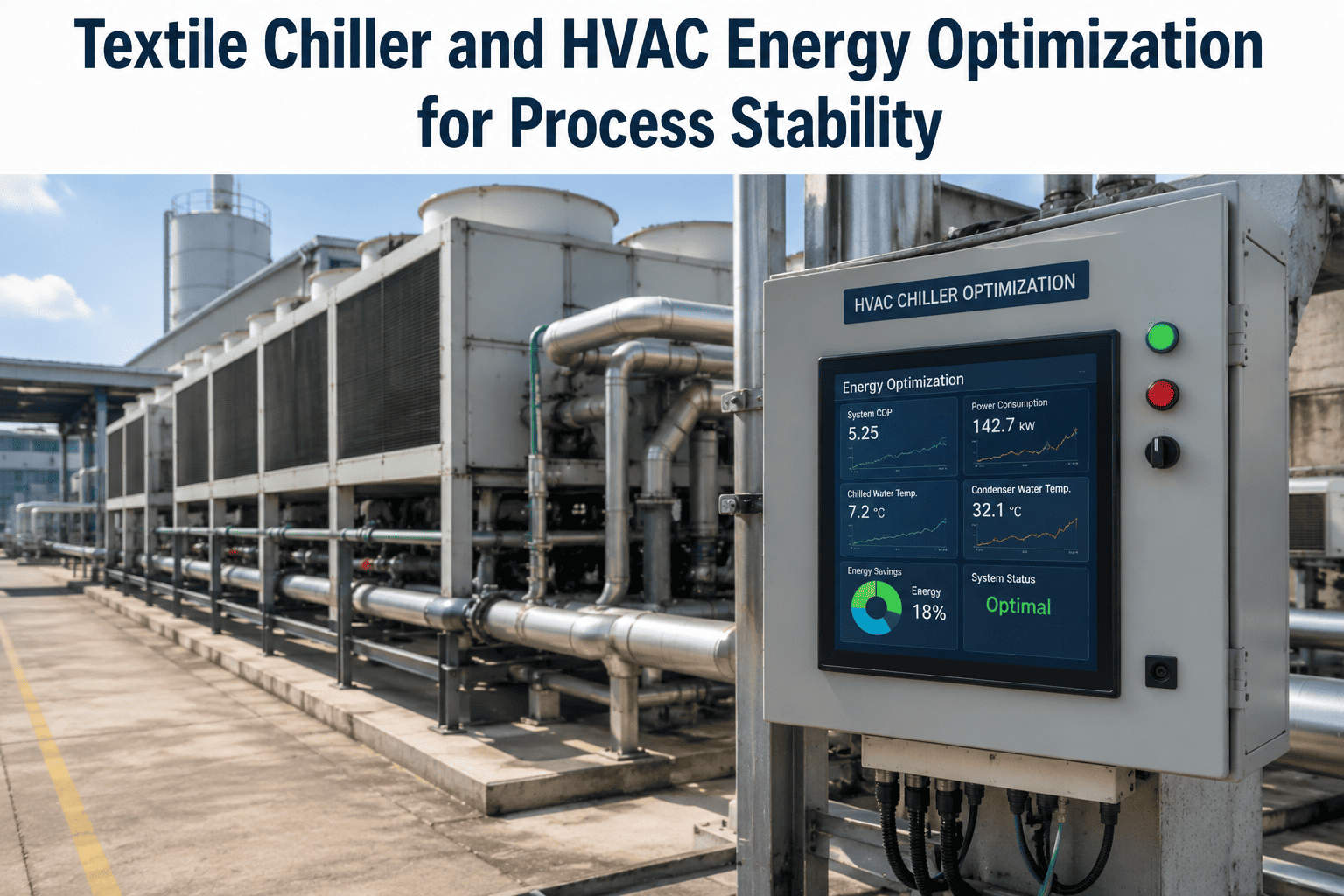
A chiller failure in the middle of a summer production run does not just cost the price of the repair — it can force an entire dye house or air-conditioned spinning hall to slow down or stop, since process cooling and comfort cooling both depend on the same compressors, condensers, and cooling towers running reliably around the clock. Chillers rarely fail without warning; rising condenser approach temperature, falling superheat, and increasing compressor amperage typically show up days or weeks before a breakdown, but these signals are scattered across gauges nobody checks unless something has already gone wrong. iFactory's predictive maintenance platform for textile chillers and cooling systems watches these signals continuously, flags the wear patterns that precede failure, and gives maintenance teams the lead time to schedule a repair instead of reacting to a shutdown. Book a Demo to see how much warning your chillers are already giving before every failure.
PREDICTIVE MAINTENANCE · CHILLERS · COOLING SYSTEMS · TEXTILE PLANTS
Chillers Almost Never Fail Without Warning — Most Plants Just Are Not Watching for the Warning
iFactory's AI platform tracks condenser approach, superheat, compressor amperage, and vibration continuously, catching chiller degradation weeks before it becomes an unplanned shutdown.
THE COST OF A COLD SURPRISE
What an Unplanned Chiller Failure Actually Costs a Textile Plant
Cooling failures do not stay contained to the mechanical room — they cascade into production delays, quality issues from temperature-sensitive dye processes, and rushed emergency repairs at a premium price. The figures below outline the scale of that impact.
4-12 Hrs
Typical production disruption time following an unplanned chiller shutdown before cooling capacity is restored
2-4x
Cost multiplier for emergency after-hours chiller repair compared to a planned maintenance intervention
1-3 Weeks
Typical lead time between the first detectable warning signs and an eventual major chiller failure
15-30%
Energy efficiency loss commonly found in chillers operating with undetected fouling or refrigerant issues
WARNING SIGNS TRACKED
Six Early Indicators iFactory Monitors on Every Chiller
Most chiller failure modes announce themselves through a gradual shift in one or more operating parameters well before the unit actually trips or fails, and catching that shift early is the entire basis of predictive maintenance.
1
Condenser approach temperature — a rising gap between refrigerant condensing temperature and cooling water temperature signals fouling or scaling on the condenser tubes
2
Evaporator superheat and subcooling — deviation from normal ranges often indicates refrigerant charge loss or expansion valve malfunction
3
Compressor motor amperage and vibration — rising current draw or abnormal vibration signatures typically precede bearing or motor winding failure
4
Cooling tower water quality and flow — poor water treatment accelerates condenser fouling and reduces overall system efficiency over time
5
Oil pressure and return trends — declining oil pressure or erratic oil return patterns often point to developing compressor lubrication issues
6
Cycle frequency and run time balance — short cycling or uneven load balancing across multiple chillers accelerates wear on the units carrying excess load
By the Time a Chiller Trips on High Head Pressure, the Warning Signs Have Usually Been Visible for Weeks
iFactory's predictive maintenance platform catches the early drift in condenser approach, superheat, and compressor load before it becomes a shutdown. See it running on your own chiller data.
REACTIVE VS PREDICTIVE
How Predictive Maintenance Changes the Chiller Maintenance Cycle
The table below compares how the same maintenance events play out under a traditional reactive approach versus a predictive maintenance program built on continuous monitoring.
| Factor | Reactive Maintenance | iFactory Predictive Maintenance |
|---|
| Repair Timing | After failure occurs | Scheduled during planned downtime |
| Parts Availability | Emergency sourcing | Ordered ahead of need |
| Production Impact | Unplanned disruption | Minimal to none |
| Repair Cost | Premium emergency rate | Standard planned rate |
| Energy Efficiency | Degrades until failure | Maintained near design point |
MEASURED IMPACT
Outcomes From Predictive Chiller Maintenance Deployments
The figures below reflect sustained improvements reported by textile plants after implementing continuous chiller monitoring, measured over a minimum six month operating period.
62%
Reduction in unplanned chiller downtime events after predictive alerts replaced reactive troubleshooting
14%
Average energy efficiency improvement from earlier detection and correction of condenser fouling and refrigerant issues
35%
Reduction in emergency repair spend as failures shifted from reactive after-hours callouts to planned maintenance windows
FREQUENTLY ASKED QUESTIONS
Questions Maintenance Teams Ask About Chiller Predictive Maintenance
Do we need to install new sensors on our chillers, or can the system use the data our chiller controller already collects?
Most modern chiller controllers already track the core parameters needed for predictive monitoring, including refrigerant pressures, temperatures, and compressor amperage, and iFactory connects to this data directly through standard building automation or chiller controller protocols wherever it is available. For older chillers with limited digital instrumentation, iFactory recommends a targeted set of additional sensors focused on the highest-value warning signals rather than a full retrofit, keeping the deployment proportionate to what each unit actually needs.
Contact our support team to assess your current chiller instrumentation.
How much advance warning does the system typically give before a chiller component actually fails?
Warning lead time varies by failure mode, but most mechanical degradation patterns such as condenser fouling, bearing wear, and refrigerant loss develop gradually over one to three weeks before reaching a critical point, and iFactory's models are tuned to flag these trends as early in that window as the data reliably supports. Sudden electrical failures such as a motor winding short are harder to predict with the same lead time, but these represent a smaller share of total chiller failures compared to the gradual mechanical and thermal degradation patterns the platform is built to catch.
Book a Demo to see typical warning windows for your chiller types.
Can this system help us balance load better across multiple chillers running in parallel?
Yes, load balancing across parallel chillers is a common secondary benefit once continuous monitoring is in place, since the platform can compare run hours, efficiency, and wear indicators across all units and recommend a sequencing strategy that avoids overloading any single chiller while others sit underutilized. This is particularly valuable at plants that have added chillers over time and never formally re-balanced their sequencing logic to reflect the actual condition and capacity of each unit.
Contact our support team to discuss load balancing for your specific chiller plant configuration.
What is the typical payback period for predictive chiller maintenance at a textile plant?
Most textile plants recover the cost of predictive chiller monitoring within the first year, driven primarily by avoided emergency repair premiums and the production disruption cost of even one or two prevented unplanned shutdowns, since a single avoided emergency failure often covers a significant share of the annual platform cost on its own. Ongoing energy efficiency gains from earlier fouling and refrigerant issue detection continue to add savings well beyond the initial payback period.
Book a Demo for a savings estimate based on your chiller plant size and current maintenance history.
Your Chillers Are Already Telling You What They Need — The Only Question Is Whether Anyone Is Listening Before They Stop
iFactory's predictive maintenance platform gives your team the early warning to schedule repairs on your terms instead of the chiller's. Book a demo and see the early warning signals on your own equipment.