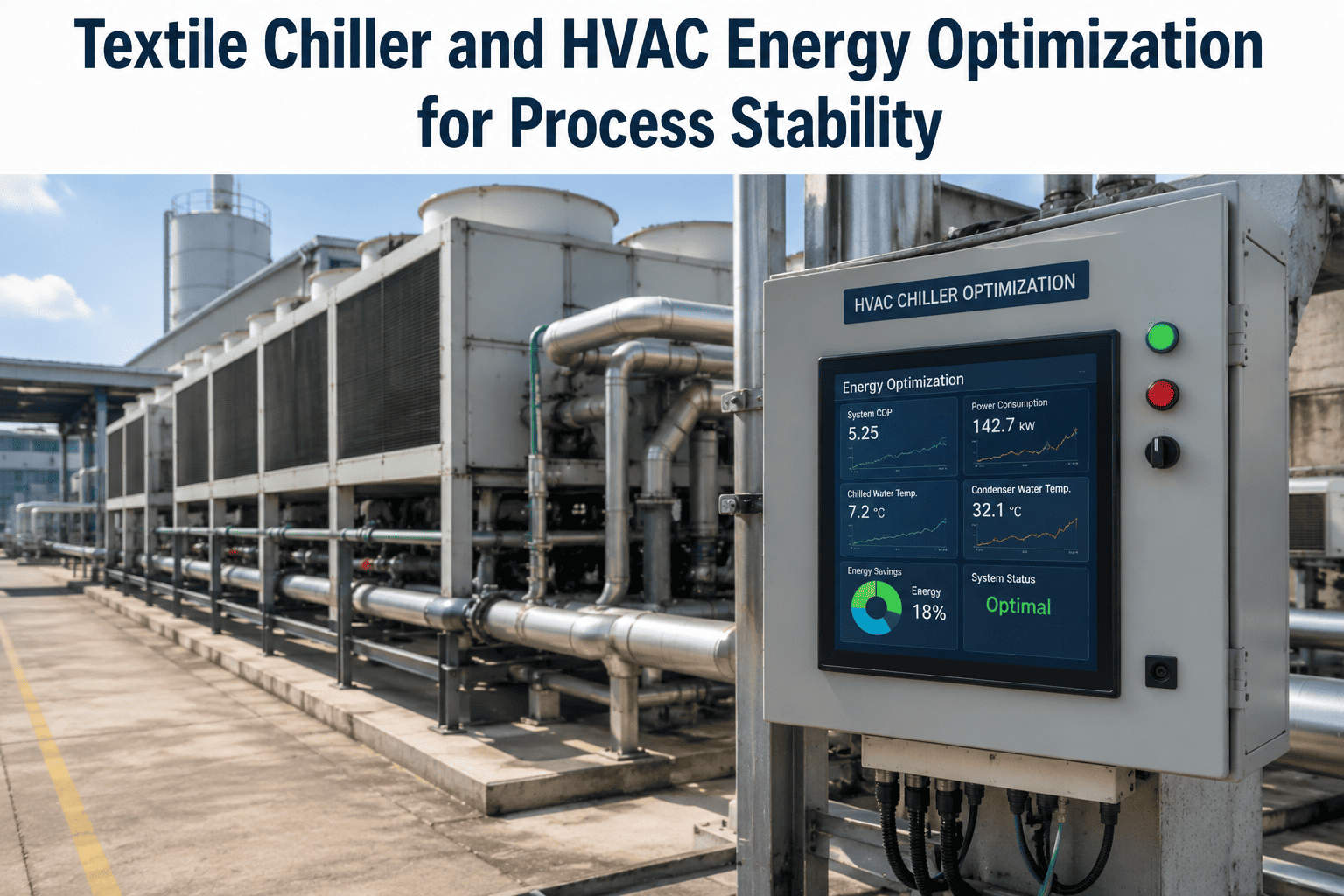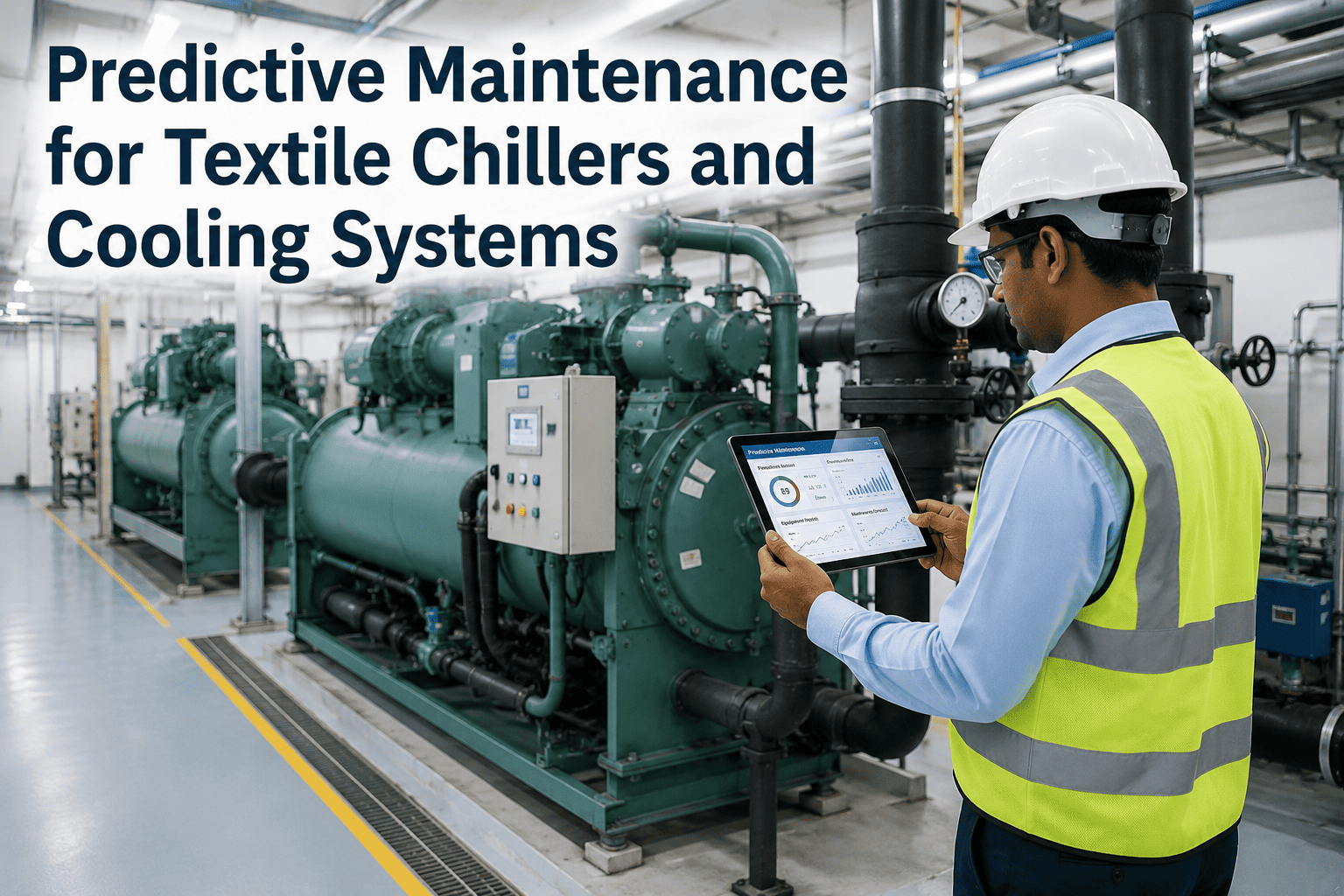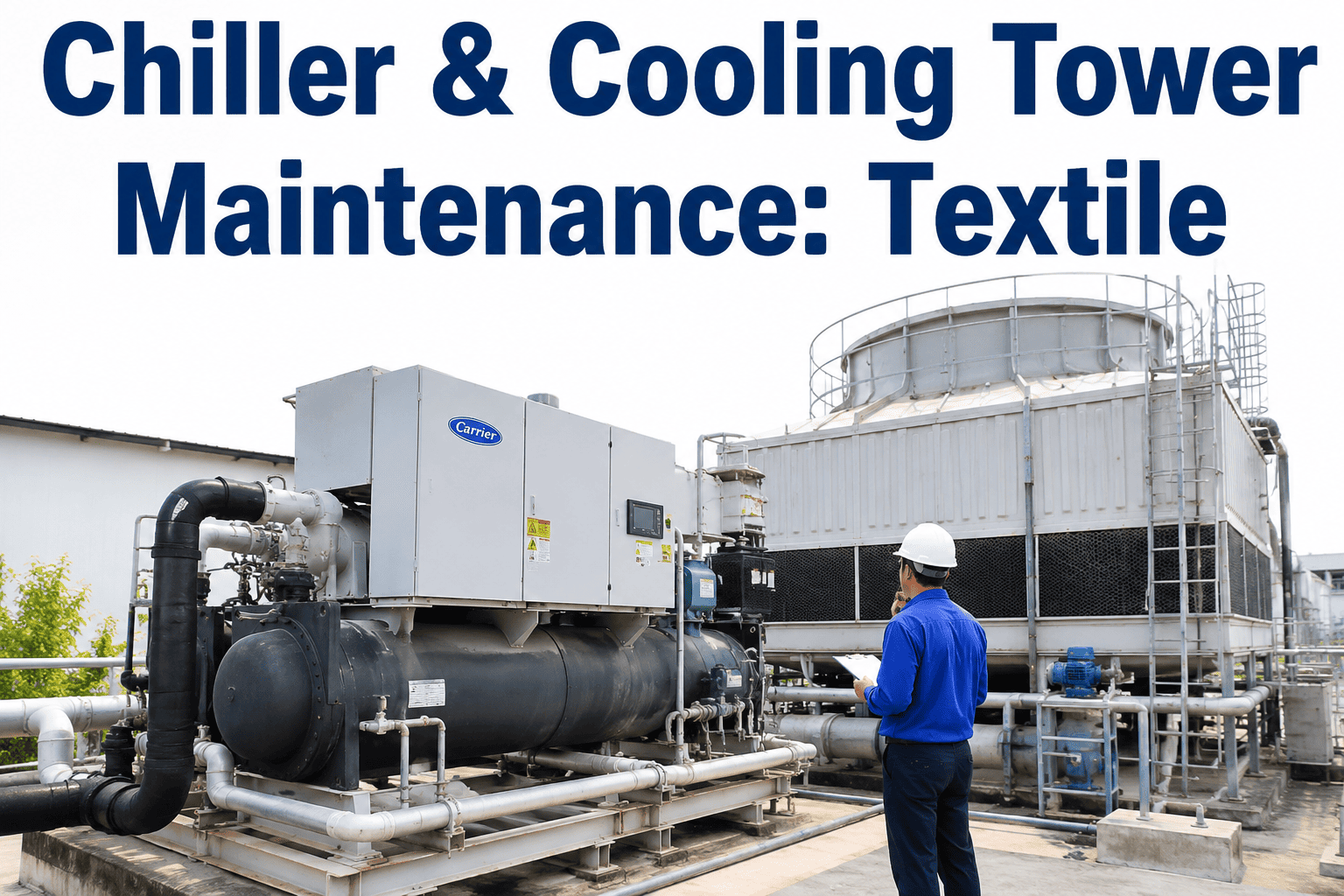
Process cooling rarely gets the maintenance attention it deserves until it fails, and when a chiller or cooling tower system degrades in a textile plant, the consequences ripple into dyeing consistency, printing quality, and equipment protection across the entire facility. A chiller running with a fouled condenser doesn't announce itself with an alarm — it announces itself gradually, through rising energy consumption, process temperatures that drift slightly out of specification, and compressor wear accelerating from conditions nobody flagged as urgent. Cooling tower water chemistry problems are even easier to overlook, quietly degrading heat transfer efficiency and risking equipment damage from scale, corrosion, or biological growth long before a visible failure forces attention. Maintenance teams responsible for these systems are managing a genuinely interconnected loop — chiller, condenser, cooling tower, and water treatment — where a problem in one component shows up as a symptom somewhere else entirely.
Why Chiller and Cooling Tower Maintenance Can't Be Treated Separately
A textile plant's process cooling system is a closed loop, not a set of independent machines. The chiller rejects heat to a condenser, the condenser transfers that heat to the cooling tower's circulating water, and the cooling tower dissipates it to the atmosphere before the cycle repeats. A maintenance problem anywhere in this loop shows up as a symptom somewhere else — a fouled condenser makes the chiller work harder and consume more energy, degraded cooling tower water chemistry reduces heat transfer efficiency at the condenser, and either problem eventually shows up as process temperature instability that operators notice long after the underlying cause began developing.
This creates a genuine diagnostic challenge for maintenance teams, because the symptom an operator actually notices — a dyeing process running a few degrees warmer than target, for instance — is often several steps removed from the actual root cause. Tracing that symptom back through the loop to determine whether it originates from cooling tower water chemistry, condenser fouling, or an actual chiller mechanical issue requires understanding the whole system's interdependencies, not just expertise in any single component viewed in isolation.
This interconnection is exactly why maintenance teams that treat chiller service and cooling tower water treatment as separate programs, managed by different vendors on different schedules, often struggle to diagnose recurring cooling performance issues. The most effective maintenance approach treats the entire loop as a single system, tracking how conditions in one component affect performance in the others.
Following Heat Through the System — Chiller to Cooling Tower
Understanding where maintenance attention matters most starts with tracing how heat actually moves through a typical textile process cooling system, from the point it's absorbed from process equipment to the point it's finally rejected to the atmosphere. Each of these four stages has its own characteristic failure modes and its own maintenance rhythm, but because they're connected in series, degraded performance at any single stage forces every downstream stage to work harder to compensate. Book a demo to see how monitoring applies across your specific cooling system configuration.
Condenser Fouling — The Efficiency Killer Hiding in Plain Sight
Condenser fouling is one of the most common and most quietly expensive maintenance issues in a process cooling system, because its effects show up as gradually rising energy consumption rather than an obvious failure event. Scale, biological growth, and sediment accumulation on condenser tube surfaces insulate the heat transfer surface, forcing the chiller's compressor to work harder to achieve the same cooling output. Because this efficiency loss develops gradually — often over weeks or months — it's easy for a facilities team to absorb the rising energy cost without connecting it to a specific, addressable maintenance cause, particularly if overall plant energy consumption is already fluctuating for other seasonal or production-volume reasons.
Of these four fouling mechanisms, biological and scale fouling tend to develop fastest in facilities with inadequate water treatment discipline, while sediment accumulation is more directly tied to the ambient environment surrounding the cooling tower — a facility in a dusty or high-particulate industrial area will generally see faster sediment-related fouling than one in a cleaner environment, regardless of water chemistry quality. Understanding which fouling mechanism is most active in your specific facility helps prioritize where cleaning and treatment resources will have the greatest impact.
Cooling Tower Water Chemistry — The Parameters That Actually Matter
Cooling tower water treatment is a chemistry discipline as much as a mechanical maintenance one, and getting the balance wrong in either direction creates real problems — under-treatment allows scale and corrosion, over-treatment wastes chemical cost and can create its own operational issues. Book a demo to see how water chemistry trends connect to your actual condenser performance data.
These four parameters interact closely, which is why effective water treatment programs monitor them together rather than tracking any single measurement in isolation. Cycles of concentration and pH, for instance, interact directly — pushing cycles of concentration higher to reduce water usage concentrates dissolved solids further, which can shift pH balance and increase scale risk if corrosion inhibitor and biocide dosing aren't adjusted accordingly. A water treatment program that adjusts one parameter without accounting for its effect on the others tends to trade one problem for another rather than achieving genuine chemical balance.
Reading the Signs — What Declining Cooling Performance Usually Means
Cooling system efficiency loss rarely announces itself clearly. It shows up as a collection of secondary symptoms that maintenance teams have to learn to connect back to a specific root cause, since the same underlying issue can present differently depending on where in the loop someone happens to be looking. A facilities engineer reviewing energy bills sees a different symptom than a process technician monitoring dye bath temperature, even when both are downstream effects of the exact same condenser fouling problem.
Notice that three of these four symptoms can be traced back to essentially the same underlying condenser or water chemistry issue, simply observed from different vantage points in the loop. This is precisely why a maintenance team investigating process temperature instability benefits from checking condenser approach temperature and cooling tower performance data early in the investigation, rather than assuming the chiller itself is malfunctioning and starting the diagnostic process there — a mistake that can lead to unnecessary chiller service work when the actual root cause sits elsewhere in the loop entirely.
Why Continuous Loop Monitoring Changes the Maintenance Equation
Traditional chiller and cooling tower maintenance relies heavily on scheduled inspections, periodic water testing, and reactive response to alarm conditions. This model works, but it's fundamentally limited by the same timing gap that affects any interval-based approach — water chemistry can drift meaningfully between weekly test cycles, and condenser fouling accumulates gradually enough that it's easy to dismiss early efficiency loss as normal seasonal variation rather than a developing maintenance issue. A water sample taken Monday morning tells you nothing definitive about Wednesday afternoon conditions, and in a system where chemistry can shift meaningfully within days depending on makeup water quality, evaporation rate, and biological growth conditions, that gap represents real blind spot risk.
Continuous monitoring of energy consumption, approach temperatures, and water chemistry parameters closes that gap by comparing live data against established baselines across the entire loop simultaneously — not just within a single component viewed in isolation. This makes it possible to see, for instance, that a gradual rise in compressor energy consumption correlates with a specific water chemistry trend, connecting cause and effect in a way that separately monitored, separately maintained systems rarely reveal on their own. Book a demo to see how this fits into your existing cooling system maintenance program.