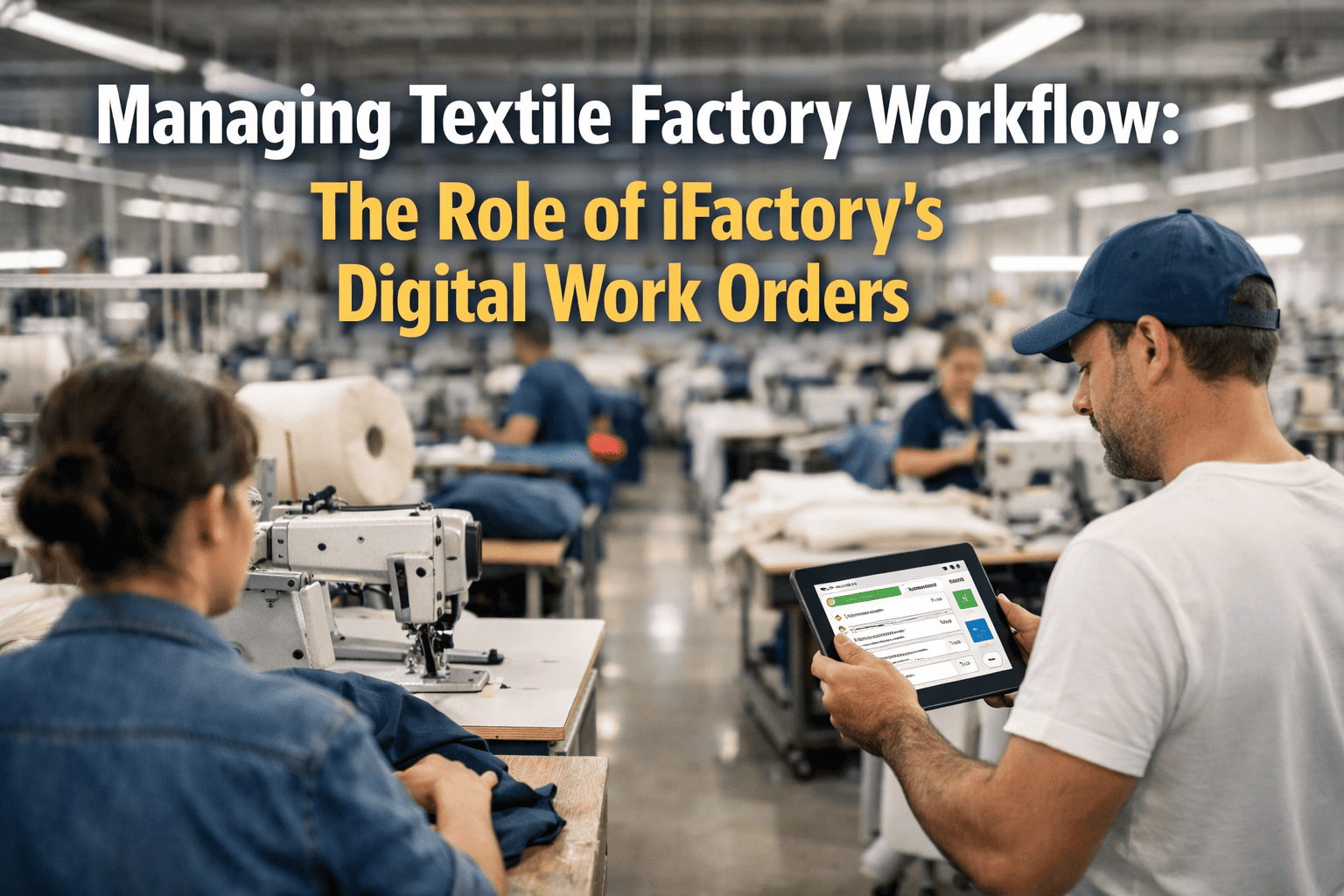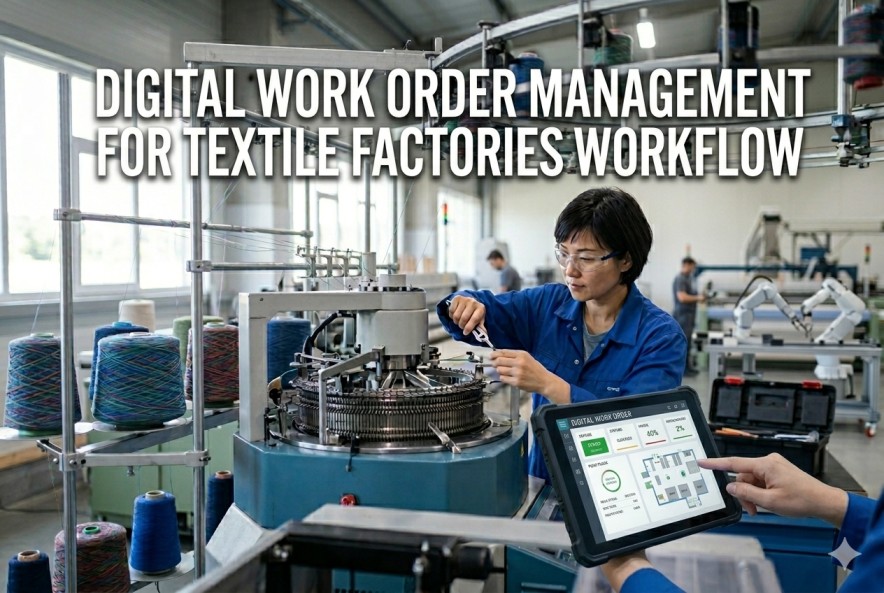
Paper job cards still manage maintenance work in most textile mills today. A fixer detects a machine stop, walks to the supervisor office, describes the problem verbally, the supervisor writes a job card by hand, and the card sits on a desk until a fixer returns from another job. By the time the work order reaches the right technician, 30 minutes to 4 hours have passed, and the machine has been idle the entire time. Mills that replace paper job cards with digital work order management systems reduce work-order lag time from hours to an average of 12 minutes, increase fixer productive time by 35 to 45 percent, and eliminate the data loss that happens when paper cards are misplaced or illegible. A digital work order system captures every maintenance event as structured data, assigns work to the nearest available fixer automatically, and creates an audit trail that connects every repair action to a specific machine, component, and technician.
Go Paperless with Digital Work Orders in Your Mill
iFactory replaces paper job cards with mobile-first digital work orders that capture every maintenance event as structured data. Automated assignment, real-time status tracking, and full audit trails. Deployed in 7 to 14 days.
Work Order Lifecycle from Detection to Closure
Every maintenance event in a textile mill follows a six-stage lifecycle. The process flow below shows how a digital work order system moves each event through detection, triage, assignment, execution, verification, and closure without paper, verbal handoffs, or manual data entry.
Machine stop detected by sensor or operator report
AI classifies issue type, priority, and required skill
Auto-dispatched to nearest available fixer via mobile
Fixer performs repair, logs actions and parts used
Machine restart confirmed and repair outcome recorded
Work order closed, data stored, KPI updated
Paper Job Cards versus Digital Work Orders
The table below compares key performance metrics between paper-based work order systems and digital work order management across textile mill maintenance operations.
Paper Job Cards
Digital Work Orders
Live Work Order Ticket Feed
A digital work order system displays all active work orders in a real-time feed. Each ticket shows the machine, department, priority level, current status, and elapsed time. Supervisors see the complete maintenance workload at a glance and can drill into any ticket for details.
See Work Orders Flow in Real Time Across Your Mill
iFactory digital work orders give every supervisor and fixer a live view of all active maintenance work across spinning, weaving, knitting, and finishing departments. Automated assignment, priority-based escalation, and real-time status tracking. Deployed in 7 to 14 days.
Department SLA Response Time Targets
Each department in a textile mill requires different response time targets based on machine criticality and repair complexity. The bars below show target SLA response times alongside current achievement rates for each department.
Spinning
Target: 8 minRing and rotor frames are the highest-value machines in a spinning mill. Digital work order routing to zone fixers achieves 91 percent SLA adherence within the 8-minute target window.
Weaving
Target: 5 minWeaving looms stop production immediately on faults. Sub-5-minute response is required to maintain OEE above 90 percent. Digital work orders achieve 88 percent adherence.
Knitting
Target: 10 minKnitting machines have slower stop-to-impact curves. Ten-minute response target allows fixers to batch nearby issues. Digital system shows 79 percent SLA adherence.
Dyeing & Finishing
Target: 12 minDyeing and finishing processes have longer batch cycles, allowing a 12-minute response target. Digital dispatch improves adherence from 54 percent baseline.
Priority Escalation Matrix
Digital work order systems use a priority escalation matrix to determine response time, resolution time, and escalation path for every maintenance event. The table below shows the standard escalation framework used by top-quartile textile mills.
| Priority | Response Target | Resolution Target | Escalation Path | Example Events |
|---|---|---|---|---|
| Critical | 2 min | 1 hr | Shift supervisor → Plant engineer → OEM support | Drive failure, electrical fire, safety guard breakage |
| High | 8 min | 2 hr | Zone fixer → Shift supervisor → Maintenance manager | Pick insertion fault, spindle failure, temperature drift |
| Medium | 20 min | 4 hr | Zone fixer → Shift supervisor | Sensor drift, belt tension adjustment, minor oil leak |
| Low | 60 min | Next shift | Assigned fixer | Lubrication due, cleaning task, visual inspection |
Frequently Asked Questions
Replace Paper Job Cards with Digital Work Orders
iFactory gives textile mills a complete digital work order management platform with automated assignment, real-time tracking, priority escalation, and full audit trails across every department. Deployed in 7 to 14 days.