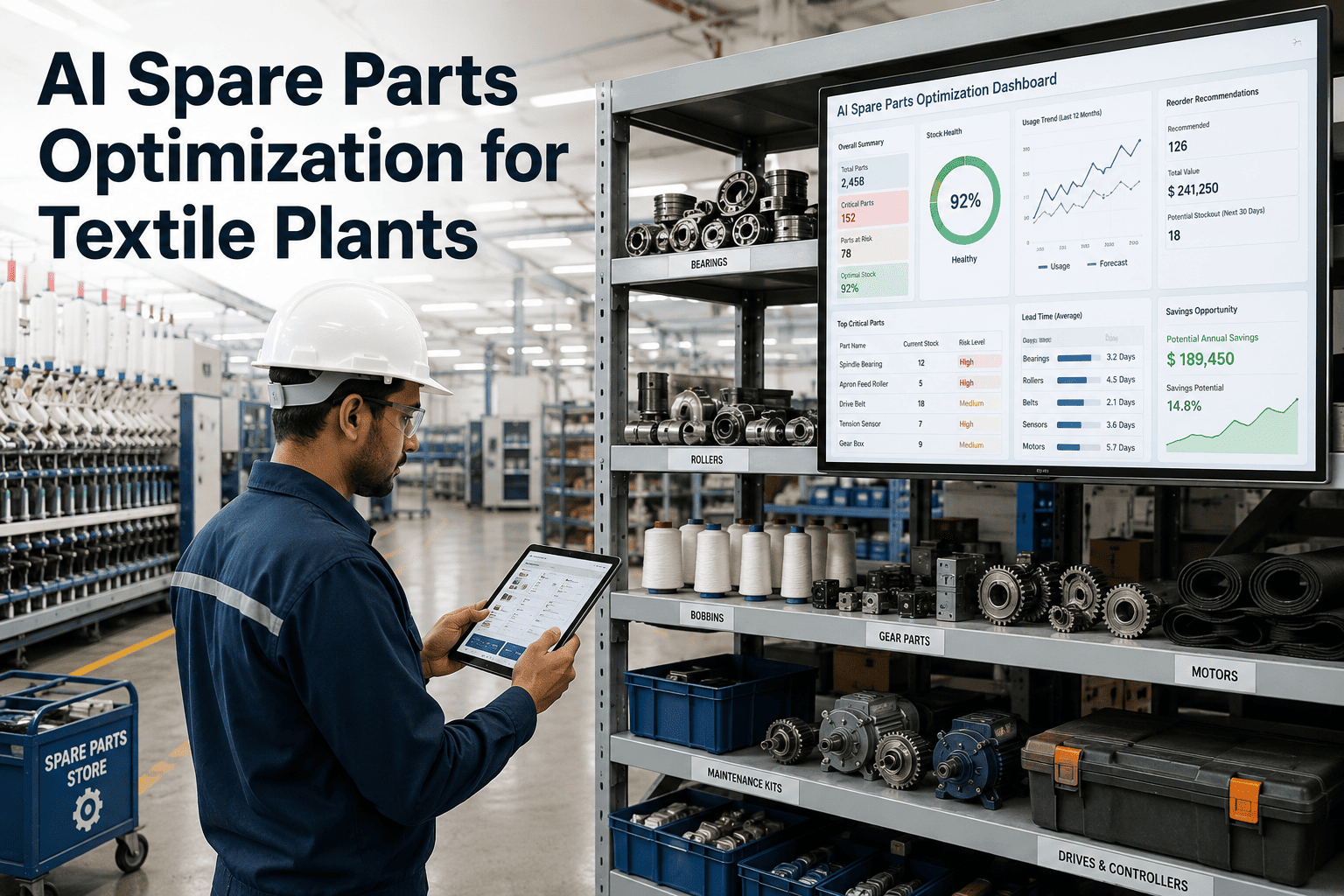
Textile mills carry between 8,000 and 15,000 distinct spare parts across their inventory, from high-value spindles and gearboxes to low-cost travellers, needles, and lubricants. Industry data shows that 30 to 40 percent of this inventory never turns over within a calendar year, tying up working capital that could fund production capacity or process improvement. The challenge is structural: mills order spare parts based on maintenance intuition rather than failure probability, carry safety stock based on worst-case assumptions rather than data-driven lead time analysis, and lose visibility into what sits on warehouse shelves the moment the part number leaves the procurement system. Mills that have adopted AI-driven inventory optimization report 35 to 45 percent reduction in total inventory value while simultaneously reducing stockout incidents by 60 percent. The approach replaces intuition-based stocking decisions with probabilistic demand forecasting, automated reorder point calculation, and real-time inventory health monitoring across every part category.
Get the Complete AI Spare Parts Inventory Playbook
iFactory’s AI inventory optimization module analyzes usage patterns, calculates optimal stock levels, automates reorder points, and provides real-time inventory health dashboards for every spare part in your mill. Deployed in 7 to 14 days.
The True Cost of Unoptimized Spare Parts Inventory
Unoptimized spare parts inventory affects mill finances through three distinct channels. Each represents capital that could be redeployed to productive use with AI-driven inventory management.
ABC-XYZ Parts Classification Matrix
AI-driven inventory optimization starts with classifying every spare part along two dimensions: consumption value and demand predictability. The matrix below shows how different part categories require different inventory strategies.
Frequent, predictable demand. Use just-in-time replenishment with low safety stock. Automate reorder at 95% service level.
Spindles, ring travelers, gearboxesPredictable but slow demand. Carry moderate safety stock. Review quarterly for obsolescence risk.
Motor bearings, drive beltsUnpredictable demand, high value. Highest stockout risk. Use AI demand forecasting with 30-day forward look.
Circuit boards, specialized sensorsFast-moving medium-value parts. Minimum safety stock. Weekly replenishment cycle.
Lubrication filters, oil sealsStandard inventory policy. Quarterly review. Moderate safety stock based on lead time.
V-belts, air hosesSlow-moving medium parts. Low stock level with rapid replenishment capability.
Specialized valves, gaugesHigh-volume low-value consumables. Bulk ordering with monthly replenishment.
Travellers, needles, threadSimple min-max system. Quarterly review. Low administrative priority.
Standard nuts, bolts, washersErratic demand, low value. Shift to vendor-managed inventory or consignment stock.
Infrequent specialty consumablesAI-Driven Inventory Reduction Pathway
The progressive pathway below shows how AI optimization reduces total inventory value step by step, from baseline to fully optimized. Each step targets a specific category of waste within the spare parts inventory.
Baseline inventory
Current inventory value with all inefficiencies including obsolete stock, excess safety stock, and emergency premiums.
100%Eliminate obsolete and duplicate parts
AI identifies parts with zero consumption in 12 months, duplicate entries, and superseded part numbers. Immediate removal from active inventory.
-22%Optimize safety stock levels
AI recalculates safety stock based on actual lead time variability and demand patterns, replacing rule-of-thumb multipliers with probability-based buffers.
-18%Set dynamic reorder points
Automated reorder points adjust seasonally based on production schedules and historical failure patterns, preventing overstock accumulation.
-12%Target optimized inventory
Fully optimized inventory with AI-driven classification, dynamic stock levels, and automated procurement. 60% reduction in stockout incidents.
-40% totalCut Spare Parts Inventory 40 Percent Without Increasing Stockout Risk
iFactory’s AI inventory module classifies every part in your warehouse, calculates optimal stock levels, automates reorder points, and provides real-time inventory health dashboards. Deployed in 7 to 14 days.
Part Family Optimization Dashboard
The dashboard below shows how AI optimization applies to different spare part families. Each category has distinct consumption patterns and optimization levers that the iFactory platform addresses automatically.
Spindles & Bearings
Gearboxes & Drives
Travellers & Needles
Belts & Filters
Sensors & Electronics
Lubricants & Chemicals
Before and After AI Inventory Optimization
The metrics below compare a typical textile mill’s spare parts inventory performance before and after AI-driven optimization. Results are drawn from iFactory implementations across 50-plus textile operations.
Frequently Asked Questions
Stop Guessing What Parts to Stock. Start Letting AI Decide.
iFactory gives textile mills a complete AI spare parts inventory optimization platform with ABC-XYZ classification, dynamic safety stock calculation, automated reorder points, and real-time inventory health dashboards. Deployed in 7 to 14 days.