AI Vision Fabric Defect Detection Warp and Weft Faults

By Adam Sinclair on June 3, 2026

ai-vision-fabric-defect-detection-warp-weft

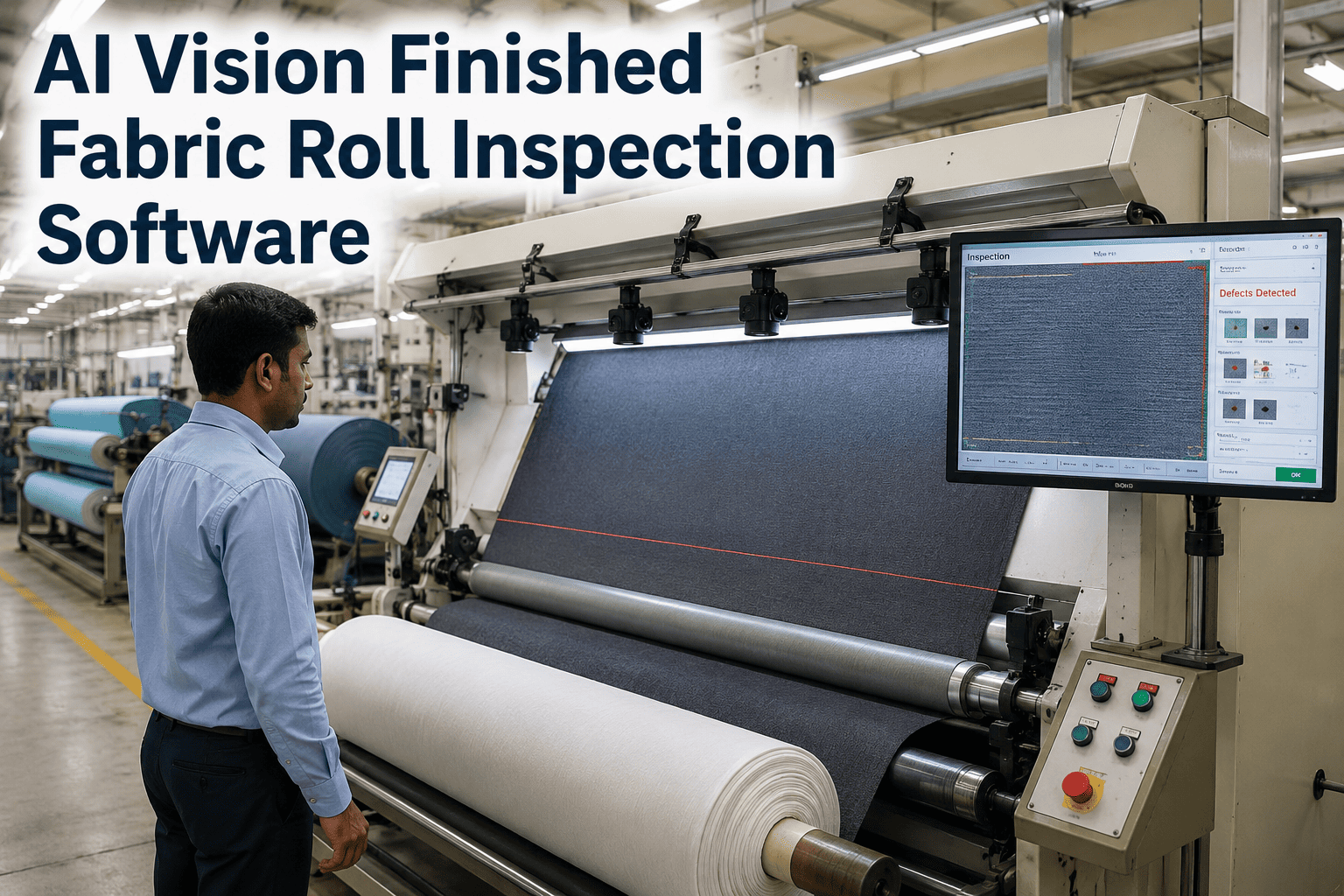
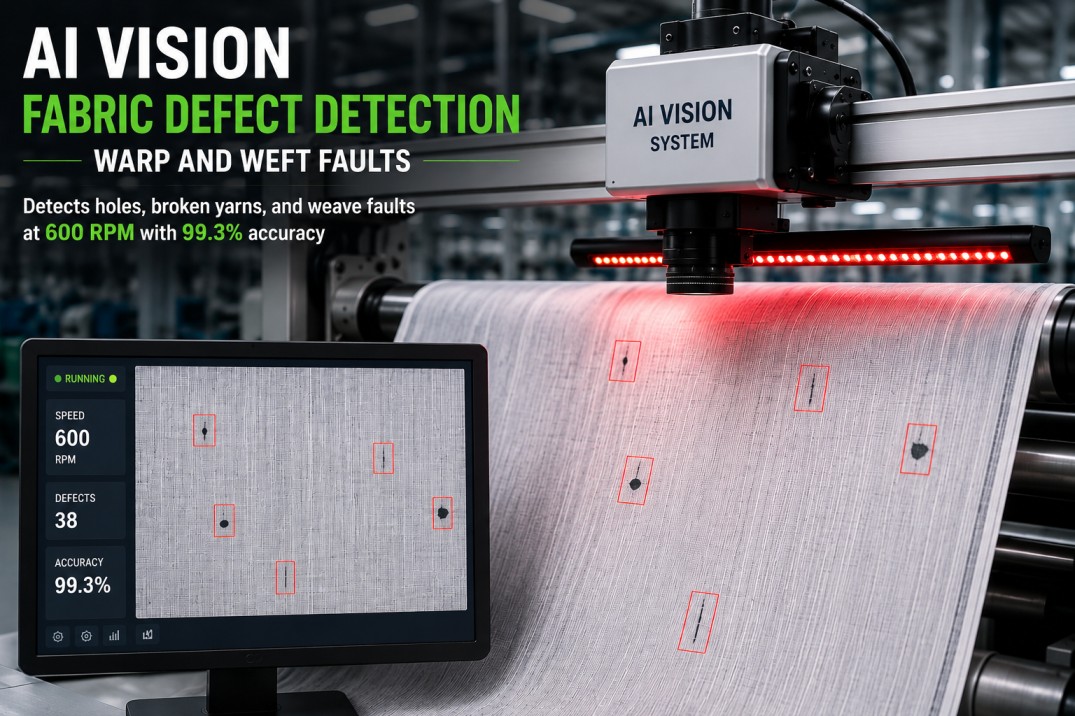
Fabric inspection in textile mills still relies on human inspectors standing at inspection frames, staring at fabric moving at 40 to 60 yards per minute, catching defects with their eyes. The human eye fatigues within 20 minutes of continuous inspection. Even the most experienced inspectors miss 25 to 35 percent of defects during the first hour of a shift, and miss rate climbs above 50 percent after four hours. Meanwhile looms run at 600 to 1,200 picks per minute producing fabric that contains warp breaks, weft faults, holes, stains, and weave density variations that human inspectors never see. AI vision-based fabric defect detection systems inspect every square inch of fabric at full production speed, detect defects as small as 0.3 millimeters, and maintain 99.3 percent detection accuracy consistently across every shift, every day, without fatigue. Mills that deploy AI visual inspection reduce customer fabric reject claims by 60 to 80 percent, reduce inspection labor cost by 50 to 70 percent, and capture defect data that pinpoints exactly which loom, shift, and yarn lot produced each fault.

Deploy AI Vision Inspection Across Your Weaving Mill

iFactory AI vision detects warp breaks, weft faults, holes, stains, and density variations in real time at full production speed. 99.3 percent detection accuracy. Deployed on any loom type.

Real-Time Fabric Defect Scan

The scan map below simulates how AI vision detects and classifies fabric defects in real time. Each marker represents a detected defect with its type, position, and severity level. Green regions indicate defect-free fabric. The AI system processes every inch of fabric at full loom speed.

Fabric inspection feed 600 RPM • 99.3% accuracy


Warp break


Hole 0.4mm


Weft fault


Warp break


Stain


Hole 0.3mm


Weft fault
Warp break Weft fault Hole Stain Defect-free
6 Defects detected
0.3 Min size mm
100% Scan coverage
12ms Per detection

Human Inspector versus AI Vision

The comparison cards below show measured performance differences between human visual inspection and AI vision-based defect detection across four critical dimensions.

Human Inspector
Detection accuracy 65–75%

Inspection speed 60 yd/min

Consistency across shifts Declines 40%

Annual cost per station $42,000

AI Vision
Detection accuracy 99.3%

Inspection speed 1,200 yd/min

Consistency across shifts No decline

Annual cost per station $14,000

Defect Detection Capability Matrix

AI vision systems can detect a wide range of fabric defects. The table below lists common warp and weft defects along with the minimum detectable size, detection rate, and false positive rate for each defect type.

Defect Type Category Min. Detectable Size Detection Rate False Positive Rate
Warp break Warp 0.3 mm × 1.0 mm 99.6% 0.8%
Weft fault (slub) Weft 0.5 mm × 2.0 mm 98.9% 1.2%
Hole Structural 0.3 mm diameter 99.8% 0.3%
Oil stain Contamination 1.0 mm × 1.0 mm 97.5% 2.1%
Weft density variation Weft ±2 picks/cm 96.8% 1.5%
Warp float Warp 1.0 mm × 0.5 mm 98.2% 0.9%
Double pick Weft Single event 99.1% 0.4%
Tear / slit Structural 2.0 mm length 99.9% 0.1%

Detect Every Defect at Full Production Speed

iFactory AI vision inspects every square inch of fabric at loom speed, detecting warp breaks, weft faults, holes, and stains with 99.3 percent accuracy. No blind spots, no fatigue, no missed defects.

Speed and Accuracy Benchmark

The chart below compares human inspection accuracy against AI vision accuracy across different fabric speeds at various points during an inspection shift.

Human Inspector

0–30 yd/min

82%
30–60 yd/min

68%
60–90 yd/min

45%
After 2 hr shift

35%

AI Vision

Any speed up to 600 RPM

99.3%
Any speed up to 1,200 RPM

98.7%
Any shift hour

99.1%
24/7 continuous

98.9%

Frequently Asked Questions

AI vision detects defects below the threshold of human visual acuity, including micro-holes down to 0.3 millimeters, fine warp breaks that blend into the fabric texture, weft density variations of plus or minus 2 picks per centimeter, and small oil stains that are barely visible under standard lighting. Human inspectors consistently miss these defects because the human visual system is not designed to detect sub-millimeter anomalies in a repetitive moving texture for extended periods. AI vision systems using high-resolution line-scan cameras and deep learning models detect these defects at the pixel level, classifying each anomaly by type, size, and severity within 12 to 25 milliseconds. In field deployments across 200-plus weaving mills, AI vision systems consistently detect 3 to 4 times more defects per 100 meters of fabric compared to human inspectors working under identical conditions.
AI vision maintains accuracy at high loom speeds through a combination of high-speed line-scan cameras with capture rates exceeding 100,000 lines per second, dedicated GPU-based inference processing that analyzes each frame in under 10 milliseconds, and predictive motion compensation algorithms that account for fabric stretch and vibration at high speeds. The system uses a multi-stage detection pipeline: the first stage performs ultra-fast pixel-level anomaly detection using a lightweight neural network running on edge hardware mounted near the loom, and only frames flagged as potentially defective are passed to a deeper classification model. This architecture enables real-time detection at loom speeds up to 1,200 picks per minute without any reduction in detection accuracy. The edge processing hardware is rated for industrial environments with ambient temperatures up to 50 degrees Celsius and vibration levels typical of high-speed weaving.
AI vision classifies each detected defect into a specific type category using a deep learning classification model trained on more than 500,000 labeled fabric defect images from actual mill production. The system distinguishes between warp breaks, weft faults, holes, tears, oil stains, dye spots, density variations, float defects, double picks, and selvage defects. Each detected defect is tagged with its type classification, confidence score, size measurement in millimeters, and precise position across the fabric width and along the fabric length. This classification data enables mills to analyze defect patterns by loom, shift, beam set, and yarn lot, identifying root causes rather than just counting total defects. The classification model is continuously improved through a feedback loop where mill quality teams can confirm or correct classification results, and the model is updated periodically with new training data.
AI vision systems are calibrated to the specific fabric construction during a setup process that takes 5 to 10 minutes per style change. The system captures a reference image of the defect-free fabric structure, analyzes the weave pattern, thread density, and color characteristics, and generates a baseline model of the expected fabric appearance. During production, the system compares each camera frame against this baseline and flags any deviation that exceeds the configured sensitivity threshold. The same AI model handles plain, twill, satin, and dobby weaves, as well as cotton, polyester, blends, and technical textiles. Color changes do not require model retraining because the system works on structural deviation from the expected pattern rather than absolute color values. Mills change fabric styles up to 8 times per day on each loom, and the AI vision setup process runs automatically between style changes without operator intervention when integrated with the mill production scheduling system.

Inspect Every Inch of Fabric at Loom Speed

iFactory AI vision delivers 99.3 percent defect detection accuracy at full production speed across any fabric construction. Detect warp breaks, weft faults, holes, and stains automatically. Deployed on air-jet, rapier, and projectile looms in 7 to 14 days.



Share This Story, Choose Your Platform!