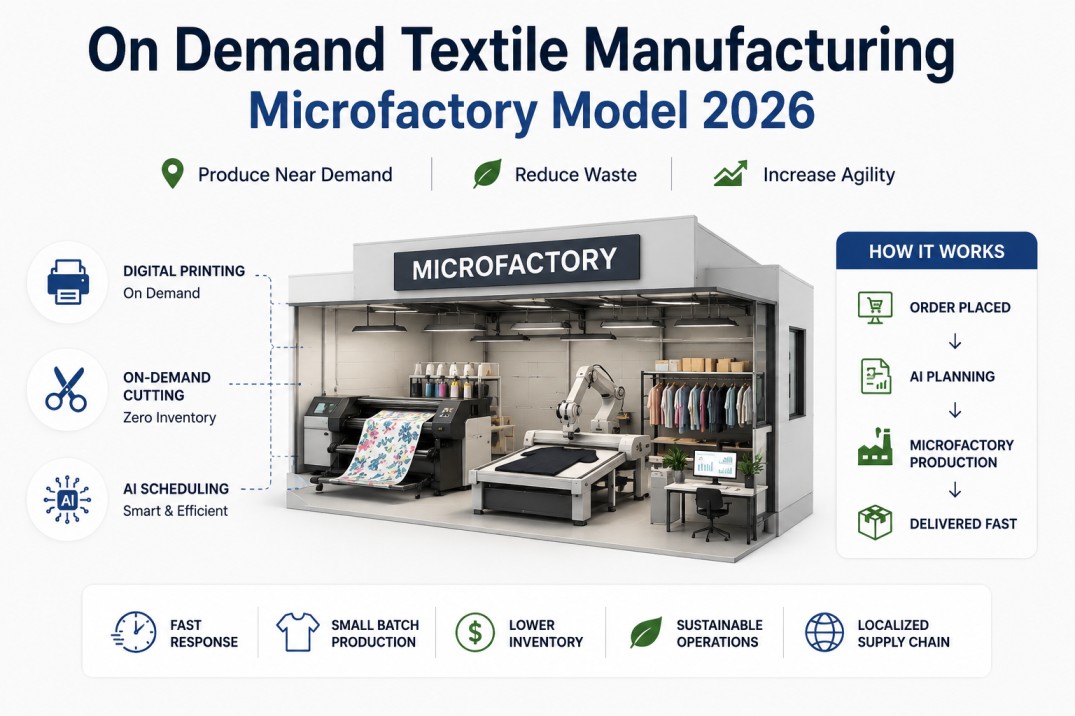
The microfactory model represents a fundamental rethinking of textile manufacturing scale and location. Instead of a single large facility producing millions of units for global distribution, a microfactory is a compact production unit — typically 2,000 to 5,000 square feet with 5 to 15 workers — equipped with digital printing, single-ply cutting, automated sewing, and cloud-connected production management software, capable of producing small batches (1 to 500 units) in 5 to 14 days from order to shipment. The model is enabled by three converging technologies: digital textile printing eliminates screen-making and minimum color quantities; single-ply cutting systems cut directly from digital pattern files without marker nesting waste; and cloud-based production scheduling optimizes machine loading across multiple simultaneous orders. Brands including Uniqlo, Adidas, and Hugo Boss have piloted microfactory networks in Europe, Japan, and North America, and the market for on-demand textile production is projected to grow from $3.8 billion in 2025 to $12.5 billion by 2030 at a compound annual growth rate of 22 percent. For textile mills, the microfactory model offers a path to diversify from high-volume commodity production into higher-margin, closer-to-market, responsive manufacturing.
Design Your Microfactory with iFactory
iFactory Microfactory Suite provides production scheduling, digital workflow management, and real-time cost analytics purpose-built for on-demand, small-batch textile manufacturing operations.
How the Microfactory Model Works — Order to Ship in 14 Days
The microfactory compresses the traditional 12- to 20-week apparel supply chain into a digital-first, demand-driven workflow. Every step from design through finishing is executed in a single facility or coordinated across a distributed network of microfactories.
Traditional Factory vs Microfactory — Ten Dimensions Compared
The microfactory model is not a scaled-down version of a traditional factory — it is a fundamentally different production logic optimized for speed, flexibility, and proximity to demand rather than for unit cost at scale.
| Dimension | Traditional Factory | Microfactory |
|---|---|---|
| Floor Space | 50,000–200,000 sq ft | 2,000–5,000 sq ft |
| Workforce | 50–500 operators | 5–15 operators |
| Typical Batch | 5,000–50,000 units | 1–500 units |
| Lead Time | 60–120 days | 5–14 days |
| Setup Cost per SKU | $500–$2,000 (screens, markers) | $5–$50 (digital file preparation) |
| MOQ per Color | 500–2,000 units | 1 unit |
| Fabric Waste | 15–25% (marker nesting) | 2–8% (single-ply, no nesting) |
| Capital Investment | $2M–$10M | $200k–$500k |
| Location | Low-labor-cost region | Near demand (urban, nearshore) |
| Inventory Risk | High (forecast-driven MOQs) | Low (make-to-order, zero inventory) |
Core Equipment Profile — What Goes Inside a Microfactory
A textile microfactory requires a specific set of digital equipment chosen for small footprint, rapid changeover, and the ability to process single-unit orders profitably.
Model Your Microfactory Investment and Returns
iFactory Microfactory Planner calculates equipment mix, space requirements, labor needs, and projected unit economics for your target product categories and order profiles.
Batch Size Economics — Cost per Unit at Different Scale Points
The microfactory cost structure is fundamentally different from traditional mass production. Fixed costs per SKU are near zero (no screens, no markers), but variable costs per unit are higher due to smaller material purchases and less automated sewing. The breakeven point against traditional offshore production depends on batch size and speed premium.
| Cost Component | Batch = 1 | Batch = 50 | Batch = 500 | Traditional (5,000+) |
|---|---|---|---|---|
| Setup per SKU | $5 | $5 | $5 | $800 |
| Material | $8.00 | $5.50 | $4.20 | $3.50 |
| Digital Print | $3.50 | $2.80 | $2.20 | $0.80 (screen) |
| Cutting | $1.20 | $0.90 | $0.65 | $0.30 |
| Sewing Labor | $5.00 | $4.00 | $3.50 | $2.00 |
| Finishing & QC | $1.50 | $1.20 | $0.90 | $0.50 |
| Shipping (near-shore) | $2.00 | $1.50 | $1.00 | $1.50 (ocean) |
| Total per Unit | $21.20 | $16.90 | $13.45 | $9.80 |
| Speed Premium | 10–14 day delivery | 10–14 day delivery | 10–14 day delivery | 60–120 day delivery |
| Inventory Risk | Zero | Zero | Zero | High (forecast driven) |
Five-Stage Microfactory Maturity Model
Building a profitable microfactory operation is an incremental process. The maturity model below describes the progression from basic capability to fully autonomous, demand-driven production.
- Single digital printer, manual cutter
- Spreadsheet-based order management
- Samples and small batches only
- Dedicated sewing cell added
- Basic digital order tracking
- Batch sizes up to 100 units
- AI-driven order batching and scheduling
- Real-time production tracking per order
- Batch sizes up to 500 units
- 3–5 microfactories in different markets
- Load balancing across sites
- Brand-facing order portal
- Direct integration with brand e-commerce APIs
- Automated production from order to shipment
- Predictive capacity planning
Frequently Asked Questions
What is the minimum viable investment for a textile microfactory?
A minimum viable microfactory requires approximately $200,000 to $350,000 in capital. The equipment package includes one digital textile printer ($30,000 to $80,000 depending on width and print speed), one single-ply cutting system ($40,000 to $120,000 depending on bed size and whether knife or laser), three to five industrial sewing machines ($5,000 to $15,000 total, used or entry-level), and finishing equipment (steam press, labeling, packing — $10,000 to $20,000). Facility preparation including HVAC (digital printers require temperature and humidity control), electrical upgrades, and compressed air adds $50,000 to $100,000. Software costs for order management and production scheduling range from $1,000 to $5,000 per month depending on the platform. The total does not include working capital for fabric inventory — a make-to-order microfactory can operate with $20,000 to $50,000 in raw material stock, significantly lower than the $200,000 to $500,000 required for traditional manufacturing working capital.
What products are best suited for microfactory production?
Products with high SKU variability, short lead time requirements, and low-to-medium unit volumes are best suited for microfactory production. T-shirts and basic knitwear with custom prints are the highest-volume microfactory category — digital printing enables single-unit personalization at near-bulk economics. Team uniforms, corporate apparel, and promotional merchandise are well-suited because orders are typically 10 to 500 units with frequent design changes. Fashion brands use microfactories for quick-response (QR) collections that replenish best-selling styles in 2 weeks instead of 12 weeks. Performance and outdoor apparel with complex prints benefit from digital color accuracy and zero-minimum color quantities. Products requiring frequent size runs (e.g., children's wear with 6+ sizes) avoid the inventory risk of traditional MOQs. Products not well-suited include basic white t-shirts at commodity pricing (unable to compete with mass production under $3/unit) and heavy outerwear requiring specialized bonding or lamination equipment that exceeds the typical microfactory footprint.
How does a microfactory compete on cost with offshore mass production?
A microfactory does not compete on unit cost at high volume — it competes on total cost to serve, which includes inventory risk, markdowns, working capital, and speed to market. A traditional $9.80 T-shirt produced offshore typically carries $2 to $4 in inventory carrying cost (20 to 40 percent of wholesale value held for 6 to 12 months), 2 to 5 percent markdown risk from overproduction, and 8 to 12 cents per week in opportunity cost from delayed market entry. When these factors are included, the true cost to serve for a microfactory-produced T-shirt at $13.45 is often 10 to 20 percent lower than the offshore alternative at $9.80 factory gate. For brands selling at direct-to-consumer margins (50 to 70 percent gross margin), the microfactory enables full-price sell-through by eliminating forecast error and ensuring the right product is available in the right quantity at the right time. The unit cost gap narrows further as microfactory batch sizes increase from 1 to 500 units — at batch 500, the cost gap is approximately 30 percent versus 50 percent at batch 1.
What skills are needed to operate a microfactory workforce?
The microfactory workforce is smaller and more cross-trained than a traditional factory. Instead of specialized operators performing one task (e.g., sleeve setter, collar finisher), microfactory workers typically handle multiple stations. A 10-person microfactory might include one digital print operator (trained in RIP software, color management, printer maintenance), one cutter operator (CAD file handling, blade selection, nesting optimization), three to four sewing operators (each capable of running multiple machine types — overlock, coverstitch, flatbed), one finishing operator (pressing, labeling, quality inspection), one production manager (order scheduling, customer communication, supply ordering), and one person handling intake, packing, and shipping. The key difference from traditional factories is digital literacy — operators must be comfortable with tablets, digital order screens, and basic troubleshooting of connected equipment. Training time for a traditional sewing operator to become microfactory-ready is typically 4 to 8 weeks for cross-training, compared to 2 to 4 weeks for single-task training in a traditional factory. iFactory's Microfactory Suite includes role-specific training modules and digital work instructions that reduce the ramp-up time by approximately 40 percent.
Can a microfactory handle quality and compliance requirements?
Yes — microfactories can meet brand quality and compliance requirements through digital traceability and inline quality checks. Each unit produced in a microfactory can be tracked individually through the production flow, with digital records of print parameters, cut quality, sewing operator, and inspection results. This level of traceability is difficult to achieve in traditional mass production but is native to the digital workflow of a microfactory. Compliance challenges include chemical management (digital textile inks must meet bluesign and OEKO-TEX standards, and the smaller scale means mills must maintain compliant chemical inventory without the purchasing power of large factories), waste management (ink waste, fabric scraps, and packaging must be documented for ESG reporting), and labor standards (microfactories in high-wage countries typically exceed labor compliance requirements, but the smaller workforce means a single compliance gap affects a higher percentage of production). iFactory's compliance module is designed specifically for microfactory scale, providing automated documentation for brand compliance audits and certification renewals.
From Large-Scale to Right-Scale — The Future Is Smaller
iFactory Microfactory Suite gives you the production scheduling, cost analytics, and workflow management tools to build and scale an on-demand manufacturing operation profitably.