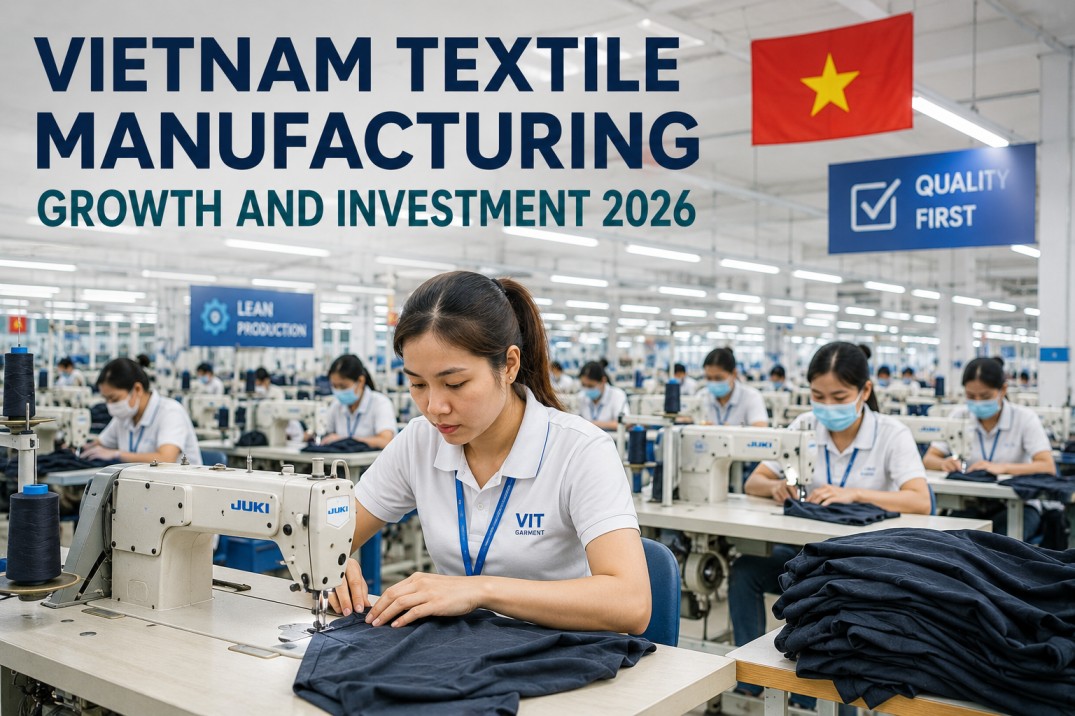
Vietnam's textile and apparel industry exported $44 billion in 2025, making it the world's third-largest exporter after China and Bangladesh, with foreign direct investment in textile manufacturing reaching a record $2.8 billion as global brands accelerated their China-plus-one sourcing strategies. The sector employs 2.8 million workers across 6,000 factories, with the highest concentration in the southern economic zone around Ho Chi Minh City, Binh Duong, and Dong Nai provinces. Vietnam's competitive advantages — political stability, a skilled workforce with average manufacturing wages of $320–$450 per month, 15 free trade agreements including the EVFTA and CPTPP, and modern deep-water port infrastructure — have attracted investments from leading brands including Nike, Adidas, Lululemon, Uniqlo, and Decathlon. This page presents the six key growth metrics driving Vietnam's textile sector, profiles four major investment zones — the Northern, Southern, Central, and Mekong Delta regions — with their installed capacity, labor costs, and infrastructure capabilities, maps the five-year growth trajectory from 2022 to 2027 showing export milestones and FDI inflows, and summarizes the four competitive advantages that position Vietnam as the primary beneficiary of the global textile supply chain shift from China. Mills and manufacturers using iFactory's textile analytics platform gain real-time visibility into OEE, labor productivity, and quality metrics benchmarked against Vietnam's top-quartile manufacturers.
Vietnam Textile Manufacturing — Growth and Investment Landscape
Vietnam's textile sector has transformed over the past decade from a low-cost assembly base into a vertically integrated manufacturing hub producing everything from yarn and fabric to finished garments and technical textiles. Sector growth is fueled by three structural factors: the China-plus-one diversification strategy adopted by major brands after the US-China trade war, Vietnam's extensive free trade agreement network providing preferential access to the EU, Japan, South Korea, and CPTPP markets, and the government's strategic focus on developing domestic fabric production to reduce reliance on Chinese raw material imports.
Evaluate Vietnam's Textile Investment Potential
iFactory's textile analytics platform provides real-time benchmarks for production efficiency, labor productivity, and quality across Vietnam's key manufacturing zones. Book a demo to see how Vietnamese manufacturers compare globally.
Key Growth Metrics — Vietnam Textile Sector
The six metrics below capture the scale and trajectory of Vietnam's textile and apparel sector. Each indicator is tracked annually by the Vietnam Textile and Apparel Association and reflects combined output across all sub-sectors including woven garments, knitwear, footwear, and technical textiles.
Four Key Investment Zones in Vietnam's Textile Sector
Vietnam's textile manufacturing is concentrated in four geographic zones, each with distinct labor markets, infrastructure quality, product specializations, and cost structures. Understanding the differences between these zones is critical for investors, brand sourcing teams, and factory owners planning capacity expansion. The profiles below show each zone's key operating metrics and competitive positioning.
Hanoi, Nam Dinh, Hai Phong, Thai Binh. Proximity to Chinese suppliers. Focus: woven garments, yarn spinning, synthetic fabric. Emerging technical textiles hub. Hai Phong deep-water port access. 8 industrial parks dedicated to textile.
Ho Chi Minh City, Binh Duong, Dong Nai. The heart of Vietnam's textile industry — 65% of all factories. Best infrastructure, largest labor pool. Focus: high-end garments, footwear, brand-name apparel. Port access through Cat Lai and Cai Mep.
Da Nang, Quang Nam, Quang Ngai, Hue. Growing industrial park infrastructure with government investment incentives. Focus: knitwear, home textiles, basic garments. Da Nang deep-water port. Lowest factory density but fastest employment growth.
Can Tho, Vinh Long, Tien Giang, An Giang. Lowest labor costs in Vietnam. Government targeting this region for new textile park development — 10 industrial parks planned by 2028. Focus: basic garments, cotton processing, agricultural fiber.
Which Vietnam Zone Fits Your Manufacturing Strategy?
iFactory's textile analytics platform provides zone-specific benchmarks for labor productivity, energy costs, and quality performance across Vietnam's four key manufacturing regions. Book a demo to compare operating metrics across zones.
Five-Year Export and FDI Trajectory — 2022 to 2027
Vietnam's textile sector has delivered consistent year-over-year growth driven by trade agreement benefits, Chinese FDI inflows, and factory capacity expansion. The milestone cards below track the key data points from 2022 through the 2027 target, showing how each year's tariff reductions, investment commitments, and factory openings build toward the $50 billion export goal.
Post-pandemic recovery phase. Employment restored to 2.5 million workers. FDI inflows of $1.6 billion as global brands formalized China+1 strategies. 75 new factories opened across all zones.
EVFTA tariff reductions reached 65% elimination on textile products. Major Korean and Taiwanese fabric mills announced $800M in new Southern zone investments to capitalize on EU rules of origin.
120 new factories opened. FDI increased to $2.2 billion, led by Chinese textile manufacturers establishing Northern zone fabric mills to bypass US tariffs on Chinese-origin goods. Port capacity expansion began.
Record FDI of $2.8 billion. Digital adoption initiatives launched by VITAS with World Bank support. 40% of factories now use digital production tracking, up from 22% in 2022. Fabric import dependency declined to 55%.
Full EVFTA tariff elimination on 77% of textile categories. 50+ new factories in Mekong Delta parks. Government targets 50% domestic fabric production. CPTPP market access expanded to Canada and Mexico.
Five-year export target. EVFTA tariffs fully eliminated on 99% of textile products. Digital adoption target of 55% of factories. 30% renewable energy in textile manufacturing. Fabric import dependency target: 40%.
Four Structural Advantages Driving Vietnam's Textile Growth
Vietnam's textile sector has emerged as the primary beneficiary of the global supply chain shift from China, driven by four structural competitive advantages. Each advantage is quantified below using data from the Vietnam Textile and Apparel Association and international trade organizations.
Vietnam's manufacturing wages of $320–$450 per month are 30–50% lower than China's $650–$900. Electricity at $0.07–$0.09/kWh is among the lowest in Asia. Corporate income tax of 10–15% for FDI projects. Net operating cost advantage: 18–25% vs comparable Chinese factories.
85% of Vietnam's textile factories meet international quality and social compliance standards (WRAP, BSCI, SA8000, ISO 9001), compared to 55% in Bangladesh and 65% in India. Vietnam has 210 LEED-certified factories — more than any other sourcing destination globally.
Deep-water ports in Ho Chi Minh City, Hai Phong, and Da Nang provide direct routes to the US, EU, and Japan. Transit to Los Angeles: 12–14 days vs 25–30 from Bangladesh and 20–25 from India. Air freight to Europe: 8–10 hours from Tan Son Nhat.
Vietnam leads emerging markets in sustainable textile manufacturing with 150+ LEED-certified facilities and 200+ factories using rooftop solar. The government targets 30% renewable energy in textile manufacturing by 2030. EU buyers prioritize Vietnamese suppliers for ESG compliance.
Frequently Asked Questions About Vietnam Textile Manufacturing
Why is Vietnam attracting so much textile FDI from Chinese manufacturers?
Chinese textile manufacturers are the largest source of FDI in Vietnam's textile sector, accounting for 38% of total textile FDI in 2025, up from 15% in 2020. Three factors drive this trend. First, US Section 301 tariffs on Chinese-origin goods — garments made from Chinese fabric face 7.5–25% tariffs when exported to the US, while garments made from fabric produced in Vietnam or other FTA partner countries enter duty-free. Chinese manufacturers are establishing fabric mills in Vietnam to change the country of origin and qualify for preferential tariff treatment. Second, rising labor costs in China's traditional textile provinces — Jiangsu, Zhejiang, and Guangdong — have pushed wages to $650–$900 per month, making Vietnamese wages 30–50% lower. Third, China's environmental regulations for textile dyeing and finishing have become increasingly stringent since 2018, forcing many smaller mills to relocate to jurisdictions with less aggressive enforcement. The practical implication is that Chinese FDI is accelerating Vietnam's domestic fabric production, reducing dependence on Chinese fabric imports — currently 55% of fabric used in Vietnamese garment factories comes from China. This FDI-driven vertical integration strengthens Vietnam's ability to claim preferential tariff treatment under the EVFTA and CPTPP, further enhancing its competitive position.
How do Vietnam's labor costs compare to other major textile manufacturing countries?
Vietnam occupies the middle position in the global textile labor cost hierarchy. Average monthly manufacturing wages inclusive of benefits: Bangladesh $180–$250 (lowest), India $190–$260, Vietnam $320–$450, Indonesia $280–$380, China $650–$900, and Mexico $550–$750. Vietnam's wage advantage over China is narrowing — Chinese textile wages grow 4–6% annually while Vietnamese wages grow 6–8%, meaning the gap closes by approximately 2% per year. At current trends, Vietnam's wage advantage over China will decline from 50% in 2025 to approximately 40% by 2030. Vietnam compensates for higher wages relative to Bangladesh and India through higher labor productivity — Vietnamese sewing operators achieve 65–75% line efficiency on average compared to 50–60% in Bangladesh and 55–65% in India. Lower electricity costs ($0.07–$0.09/kWh vs $0.10–$0.14 in Bangladesh) further offset the wage gap. The net effect is that Vietnam's total manufacturing cost per garment is 5–10% higher than Bangladesh but 10–15% lower than China, making it the preferred sourcing destination for buyers seeking a balance between cost, quality, and speed.
What is the impact of the EU-Vietnam Free Trade Agreement on textile exports?
The EU-Vietnam Free Trade Agreement, effective August 2020, is the most significant trade agreement for Vietnam's textile sector after WTO accession. The EVFTA eliminates tariffs on 77% of EU textile and apparel imports from Vietnam immediately upon ratification, rising to 99% elimination over a 7–10 year phase-out schedule. By 2027, essentially all Vietnamese textile products will enter the EU duty-free versus the 8–12% duties that competitors like Bangladesh and India face. The EVFTA includes strict rules of origin requiring fabric to be produced in Vietnam or an EU member state to qualify for preferential treatment — this rule is the primary driver of Chinese fabric mill investment in Vietnam, as fabric made in Vietnam by Chinese-owned mills qualifies under EVFTA rules. EU exports have grown from $4.5 billion in 2019 to $7.8 billion in 2025, a 73% increase directly attributable to EVFTA tariff preferences. The UK-Vietnam FTA provides identical terms. The next growth phase will come from the EU's Carbon Border Adjustment Mechanism, which favors Vietnamese suppliers that can demonstrate lower carbon intensity, giving Vietnam an additional advantage over competitors with higher carbon footprints.
What are the biggest challenges facing Vietnam's textile industry in 2026?
Vietnam's textile industry faces five significant challenges in 2026. The first and most critical is fabric import dependency — 55% of fabric used in Vietnamese garment production is imported from China, creating supply chain vulnerability and limiting the ability to claim preferential tariff treatment under FTAs that require locally sourced fabric. The second is labor market tightening — the Southern zone's textile workforce is shrinking as workers move to higher-paying electronics and semiconductor manufacturing, with annual attrition rates of 18–25% for skilled sewing operators. The third is rising wage pressure — minimum wage increased 22% cumulatively between 2022 and 2026, compressing margins for low-value garment segments. The fourth is infrastructure congestion — Ho Chi Minh City's ports operate at 95% capacity, creating shipping delays during peak seasons, and industrial park occupancy in the Southern zone exceeds 90%. The fifth is digital transformation lag — 40% of factories use some digital tracking but only 12% have integrated systems spanning production, quality, and energy management. The government's 2025–2030 Textile Development Strategy addresses each of these with targeted policy interventions including preferential credit for fabric mill investments, workforce training programs, and industrial park development in the Mekong Delta and Central zones.
How does digital technology adoption in Vietnam compare to other Asian producers?
Vietnam's digital technology adoption in textile manufacturing occupies a middle position in Asia, comparable to India's 31% but ahead of Bangladesh's 22% and significantly behind China's 55% and South Korea's 68%. VITAS estimates 40% of Vietnam's textile factories use at least one digital production tracking tool, 15% have deployed IoT-based machine monitoring, 28% use cloud-based PLM for sample management, and 8% have implemented AI-based quality inspection. Adoption varies significantly by zone and factory size — Southern zone factories with 1,000+ workers have 2.5x higher digital adoption than Central zone factories with fewer than 300 workers. The primary barrier is digital skills — fewer than 12% of production managers have received formal training on data-driven decision making. However, adoption is accelerating: digital technology investment grew 55% year-over-year in 2025, driven by buyer requirements for real-time production visibility and the government's Industry 4.0 promotion program providing 30% tax credits for technology investments. iFactory's platform is deployed in 18 Vietnamese textile factories across all four zones, providing a unified data infrastructure that addresses the skill gap through intuitive dashboards and automated reporting.
Optimize Your Vietnam Textile Operation With Data
iFactory's textile analytics platform provides real-time OEE, labor productivity, energy, and quality dashboards with Vietnam-specific benchmarks across all four investment zones. Book a demo to see how leading Vietnamese manufacturers use data to improve performance and satisfy buyer compliance requirements.
.jpg)