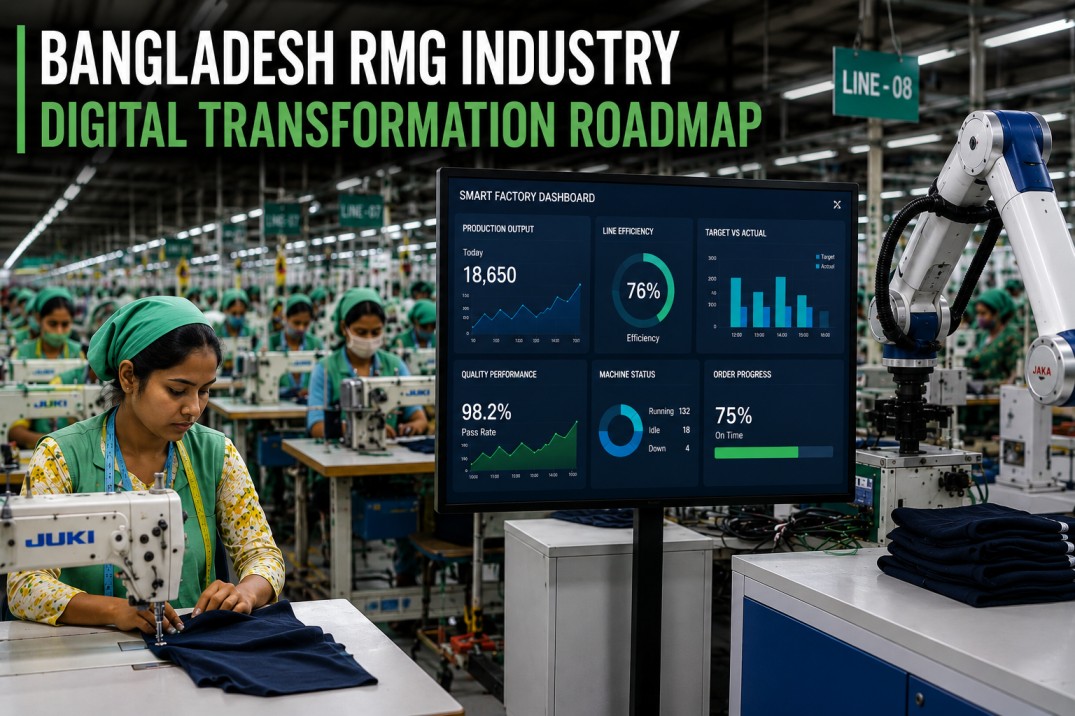
Bangladesh's ready-made garment industry ships $47 billion annually — 84% of the country's total exports — making it the world's second-largest apparel exporter after China. The sector employs 4.5 million workers across 4,500 factories, with woven garments accounting for 38% of output, knitwear 42%, and sweaters 20%. While Bangladesh has invested heavily in green factory infrastructure — 210 LEED-certified factories, the highest of any country — digital technology adoption remains uneven: fewer than 35% of factories use ERP systems, only 18% have deployed IoT-based machine monitoring, and less than 12% use AI for quality inspection or production planning. This page presents a digital technology adoption comparison across woven, knitwear, and sweater sub-sectors, ranks four digital transformation levers — automation and robotics, IoT machine monitoring, ERP and MES integration, and AI-based quality and planning — by their measurable impact on factory performance, provides a five-step implementation roadmap from maturity assessment through AI-driven optimization, and profiles four leading Bangladesh RMG manufacturers — Beximco, DBL Group, Pacific Jeans, and SQ Group — that are deploying these technologies at scale to maintain their competitive edge with global buyers. Mills and factories using iFactory's RMG analytics platform gain real-time visibility into OEE, labor productivity, energy consumption, and quality metrics benchmarked against top-quartile Bangladesh RMG factories.
Digital Technology Adoption Across Bangladesh's RMG Sector
Bangladesh's RMG sector operates on thin margins — 8–12% for woven garments, 10–15% for knitwear, and 6–10% for sweaters — which makes every percentage point of operational efficiency directly visible on the bottom line. Digital technology adoption varies significantly by sub-sector, driven by average order size, buyer compliance requirements, and factory capital availability. The table below shows adoption rates for seven key digital technologies across woven, knitwear, and sweater factories, with color-coded indicators showing maturity level relative to global best practice benchmarks.
Benchmark Your Factory Against Bangladesh RMG Peers
iFactory's RMG analytics platform provides real-time OEE, labor productivity, and quality dashboards with Bangladesh-specific benchmarks. Book a demo to see how your factory compares to the top quartile in your sub-sector.
Digital Technology Adoption by Bangladesh RMG Sub-Sector
The adoption rates below are based on a 2025–26 survey of 650 Bangladesh RMG factories conducted by the Bangladesh Garment Manufacturers and Exporters Association. Woven garment factories lead adoption due to larger average unit sizes and higher buyer compliance requirements. The sweater sub-sector lags significantly, constrained by smaller factory sizes and lower margins.
| Technology | Woven Adoption Rate |
Knitwear Adoption Rate |
Sweater Adoption Rate |
Industry Avg Adoption Rate |
Maturity Level |
|---|---|---|---|---|---|
| ERP / MES Systems | 38% | 32% | 22% | 31% | Emerging |
| Automated Cutting Systems | 45% | 28% | 15% | 32% | Emerging |
| IoT Machine Monitoring | 22% | 18% | 10% | 17% | Early |
| AI Quality Inspection | 15% | 12% | 8% | 12% | Early |
| Digital Twin / Simulation | 10% | 8% | 5% | 8% | Early |
| RFID / Barcode Tracking | 35% | 25% | 18% | 26% | Emerging |
| Cloud PLM | 42% | 35% | 20% | 34% | Emerging |
Four Digital Transformation Levers Ranked by Impact
Digital transformation in Bangladesh RMG factories is driven by four primary technology levers. The ranking below reflects each lever's measurable impact on factory-level OEE, labor productivity, defect rate reduction, and order-to-dispatch cycle time based on implementation data from 120 factories that have deployed at least two of these technologies.
Ready to Start Your Digital Transformation Journey?
iFactory's RMG analytics platform provides the foundation for digital transformation with real-time OEE, quality, and labor productivity dashboards. Book a demo to see how Bangladesh RMG factories are using data to improve performance.
Five-Step Digital Transformation Roadmap for Bangladesh RMG Factories
The most successful digital transformations in Bangladesh RMG factories follow a phased approach that builds capability incrementally while maintaining production continuity. This five-step roadmap has been validated across 45 factories in the Dhaka, Chittagong, and Gazipur industrial zones and applies to woven, knitwear, and sweater factories regardless of size.
Four Bangladesh RMG Leaders Driving Digital Transformation
The four companies profiled below represent the leading edge of digital transformation in Bangladesh's RMG sector. Each has invested significantly in technology infrastructure, workforce training, and data-driven operations. Their experiences provide practical reference points for other factories planning similar transformations.
Frequently Asked Questions About Bangladesh RMG Digital Transformation
Where does Bangladesh's RMG sector stand in digital maturity compared to peers like Vietnam and India?
Bangladesh's RMG sector trails Vietnam and India in overall digital maturity, with an estimated composite digital adoption score of 22% compared to Vietnam's 35% and India's 31%. The gap is widest in IoT machine monitoring (17% in Bangladesh vs 38% in Vietnam) and AI-based quality inspection (12% vs 28%). However, Bangladesh leads in green factory certification with 210 LEED-certified factories versus Vietnam's 85 and India's 120. The digital gap is narrowing — BGMEA reports that digital technology investment by Bangladesh RMG factories grew 42% year-over-year in 2025, driven by buyer compliance requirements for traceability and real-time production data. Woven garment factories in Bangladesh have digital adoption rates comparable to their Indian and Vietnamese peers, but the sweater and knitwear sub-sectors lag significantly due to smaller unit sizes. The primary constraint is capital availability — a typical IoT deployment for a 500-machine sewing floor costs $80,000–$150,000, representing 3–5% of annual profit for a mid-size factory, which many owners view as prohibitive despite 15–25% OEE improvement potential.
What is the most impactful first step for a Bangladesh RMG factory starting digital transformation?
The most impactful first step is deploying IoT-based machine monitoring on one production line, not implementing a full ERP system or purchasing automated cutting equipment. The reasoning is threefold: first, machine monitoring provides immediate visibility into OEE, line balancing, and micro-stoppages that can be addressed without capital expenditure — typically yielding 10–15% OEE improvement within 4–6 weeks through operator and supervisor behavior changes alone. Second, the data generated by machine monitoring creates the business case for subsequent investments in ERP, automation, and AI by quantifying current losses and the financial impact of addressing them. Third, the pilot approach — one line, one dashboard, one trained supervisor — minimizes risk and builds internal capability before scaling. Factories that start with ERP or automation without first establishing a data foundation typically experience longer implementation timelines and lower user adoption. iFactory's RMG platform is designed for this phased approach, starting with a single-line pilot and scaling factory-wide within 8–12 weeks.
How do buyer compliance requirements drive digital technology adoption in Bangladesh RMG factories?
Buyer compliance is the single strongest driver of digital technology adoption in Bangladesh RMG factories, surpassing internal efficiency improvement as a motivation. Major buyers including H&M, Zara, Walmart, and Gap increasingly require real-time production data visibility, supply chain traceability, environmental monitoring data, and worker welfare metrics as conditions for order placement. This has accelerated adoption of cloud PLM systems (required by 65% of EU buyers), RFID-based shipment tracking (required by 45% of US buyers), and IoT-based environmental monitoring for LEED certification (a requirement for participation in H&M and Zara's sustainable sourcing programs). The practical implication is that factories serving EU buyers have 40% higher digital adoption rates than those serving only domestic or regional buyers. However, the compliance-driven approach also creates fragmentation — factories often deploy multiple point solutions to satisfy different buyer requirements rather than adopting integrated platforms that would deliver greater operational efficiency. iFactory's platform addresses this by providing a unified dashboard that satisfies multiple buyer compliance requirements through a single data infrastructure.
What are the biggest barriers to digital transformation for small and medium RMG factories in Bangladesh?
Small and medium RMG factories (fewer than 500 workers, which represent 75% of Bangladesh's 4,500 factories) face four primary barriers to digital transformation. The first is capital availability — a typical digital transformation package costs $50,000–$200,000, which is 5–15% of annual profit for a mid-size factory, and banks in Bangladesh rarely offer technology-specific financing. The second is digital skills — fewer than 8% of production supervisors in Bangladeshi RMG factories have received formal training on data-driven decision making, and the attrition rate for digital-skilled workers exceeds 35% annually as they move to higher-paying factories. The third is infrastructure reliability — internet connectivity in industrial zones remains inconsistent, with factories in Gazipur reporting 8–12 hours of total connectivity loss per month, and power outages averaging 2–4 hours daily. The fourth is the fragmented nature of buyer compliance requirements — factories must manage multiple buyer portals, each with different data formats and reporting cycles, creating an administrative burden that consumes the time of the 2–4 person IT team that a mid-size factory typically employs. Affordable, modular platforms that start with a single-line pilot and scale incrementally are the most effective approach for this segment, addressing the capital and skill barriers simultaneously.
What role will AI and machine learning play in the next phase of Bangladesh RMG digital transformation?
AI and machine learning will be the defining technology theme for Bangladesh RMG factories between 2026 and 2030, building on the IoT and ERP foundations established in the 2022–2025 period. The three highest-impact AI applications identified by the BGMEA Technology Council are AI-based fabric inspection (reducing inspection labor by 60–80% and catching defects missed by human inspectors, with Pacific Jeans and DBL Group already running pilots), AI-driven production planning and line balancing (reducing style changeover downtime by 20–30% through ML-based optimization of sewing line configurations, currently being tested by Beximco), and AI-based energy optimization (reducing electricity consumption by 8–15% through real-time adjustment of HVAC and compressed air systems based on production load and ambient conditions). The adoption trajectory for AI in Bangladesh RMG is projected to reach 25% of factories by 2028 and 45% by 2030, driven by decreasing sensor and computing costs, increasing buyer requirements for AI-based quality assurance, and the emergence of affordable, factory-specific AI solutions that do not require in-house data science teams to deploy and maintain.
Transform Your RMG Factory With Data-Driven Operations
iFactory's RMG analytics platform provides real-time OEE, labor productivity, energy, and quality dashboards with Bangladesh-specific benchmarks. Book a demo to see how leading Bangladesh factories use data to improve performance and satisfy buyer compliance requirements.