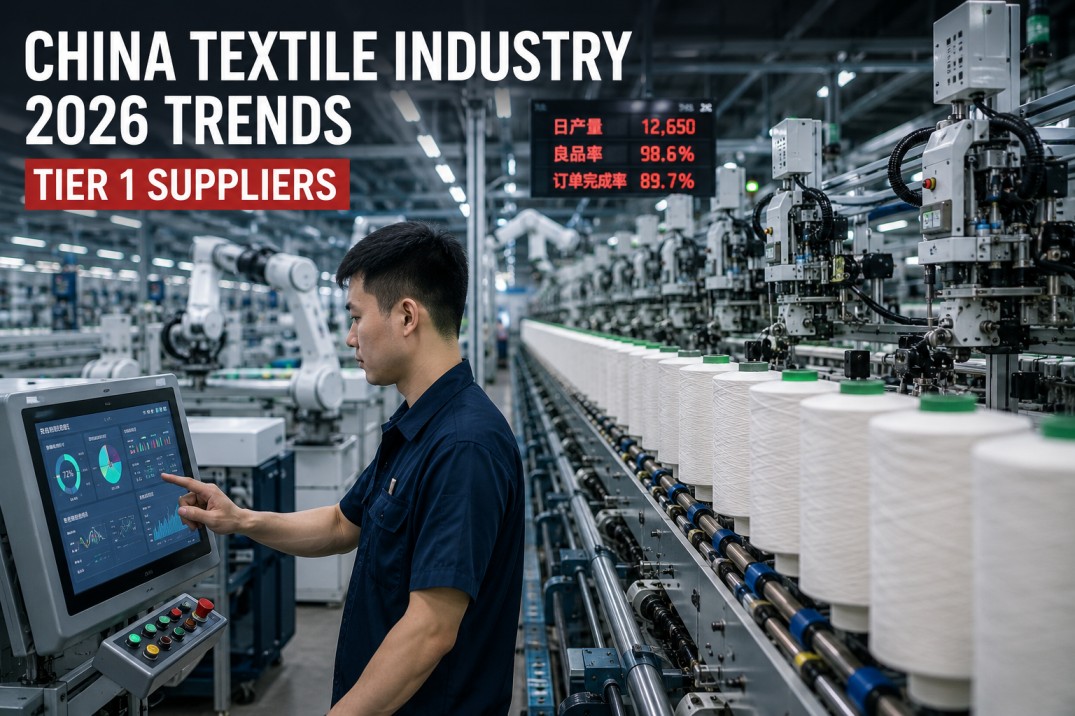
China remains the dominant force in global textile manufacturing and apparel production, controlling approximately 32 percent of worldwide textile exports with total shipments exceeding $238 billion in 2025 — more than the next four largest exporting nations combined. The country's textile sector employs 8.5 million workers across 45,000 factories, producing everything from commodity yarns and basic garments to high-end technical textiles and smart fabrics for the world's most demanding brands including Nike, Adidas, Uniqlo, H&M, Lululemon, and Ralph Lauren. While rising labor costs averaging $650–$900 per month in coastal manufacturing provinces have driven low-cost production to Bangladesh, Vietnam, and India, China's tier 1 suppliers have responded not by competing on price but by investing aggressively in artificial intelligence, collaborative robotics, digital twin simulation, industrial IoT, and full-stack manufacturing execution systems. This page examines China's global textile position through four key dominance metrics, profiles the three most influential Chinese tier 1 suppliers — Crystal Group, Esquel Group, and Shenzhou International — with their technology deployment strategies across eight smart manufacturing dimensions, and compares China's overall digital maturity against Vietnam, Bangladesh, and India across five capability dimensions including AI adoption, digital twin deployment, IoT connectivity, workforce skills, and sustainable manufacturing.
China Textile Industry 2026 — Trends and Tier 1 Suppliers
China's textile sector is undergoing a structural transformation driven by rising domestic labor costs, environmental compliance pressures, and the strategic shift by major brands toward supply chain resilience and transparency. The response from China's leading manufacturers has been a wave of technology investment that is reshaping global benchmarks for productivity, quality, and sustainability. The four dominance metrics below capture the scale, while the tier 1 supplier profiles reveal how China's most advanced factories are deploying Industry 4.0 technologies to maintain their competitive edge against lower-cost producing nations.
Benchmark Against China's Tier 1 Suppliers
iFactory's textile analytics platform provides real-time OEE, quality, energy, and automation benchmarks allowing you to compare your factory's performance against global leaders including Crystal, Esquel, and Shenzhou. Book a demo to see how your operations stack up.
China's Textile Export Dominance — Key Metrics
China's textile export dominance is best understood through four metrics that capture the scale of its production capacity, the breadth of its manufacturing base, the depth of its digital adoption, and the trajectory of its investment in automation and smart factory infrastructure.
Three Chinese Tier 1 Suppliers Defining the Industry Standard
China's tier 1 textile suppliers operate at a scale and technological sophistication unmatched by manufacturers in any other emerging economy. Crystal Group (woven shirts), Esquel Group (vertically integrated cotton shirting), and Shenzhou International (knitwear) collectively produce over 3.5 million garments daily across 43 factories. Each has invested more than $150 million in Industry 4.0 technologies since 2020, deploying AI visual inspection, collaborative robotics, digital twin simulation, industrial IoT, and full-stack MES platforms that push automation rates above 70% on core product categories. The profiles below show each company's scale, key operating metrics, and technology deployment focus areas.
World's largest woven shirt manufacturer, founded 1995, producing 600,000 shirts daily across eight factories in China, Vietnam, and Cambodia, serving over 2,000 brands including Ralph Lauren, Hugo Boss, and Tommy Hilfiger. Crystal's Guangdong smart factory features 40 AI-powered visual inspection systems that detect stitching defects at sub-millimeter resolution, collaborative robots for sleeve attachment and collar assembly, and a fully integrated MES that tracks each garment through 120+ production stages with real-time OEE dashboards. The "Crystal 4.0" program has invested $180 million in automation since 2020, achieving 92% automation on standard shirt styles.
World's largest vertically integrated cotton shirt manufacturer, founded 1978, employing 47,000 people across 15 factories in China, Vietnam, Malaysia, Mauritius, and Sri Lanka, supplying premium shirts to Brooks Brothers, Hugo Boss, Lacoste, and other global brands. Esquel operates six digital twin-enabled mills where every production line, machine, and material flow is simulated in real time, enabling what-if scenario testing before physical changes. Their 5G-connected Gaoyao smart factory uses AGVs for material transport, AI-based cotton grading that classifies 12 quality parameters in under 3 seconds, and a closed-loop zero-waste dyeing system reducing water 80% and chemicals 45%.
World's largest knitwear manufacturer and primary apparel supplier to Nike and Adidas, founded 1990 in Ningbo, producing over 2 million garments daily across 20+ factories in China, Vietnam, Cambodia, and Indonesia with $3.2 billion in 2025 revenue. Shenzhou deploys collaborative robots for fabric cutting, sleeve attachment, and hemming achieving 70% automation on core product categories, while AI-based fabric inspection systems scan 100% of production at 120 meters per minute detecting defects with 97.8% accuracy. Their digital infrastructure integrates MES, WMS, and cloud ERP across all locations providing real-time production visibility to brand customers through a unified portal.
Compare Your Factory to China's Best
iFactory's platform provides the same real-time OEE, quality, and energy dashboards used by tier 1 manufacturers. Deploy in weeks, not months — with prebuilt connectors for common textile machines and MES systems. Book a demo to see how your operations compare.
Smart Factory Technology Deployment — Tier 1 Suppliers
China's tier 1 suppliers have invested aggressively across the full spectrum of Industry 4.0 technologies. The matrix below shows deployment status across eight key technology categories for Crystal, Esquel, and Shenzhou, classified into three phases: fully deployed, pilot implementation, and planned evaluation. Esquel leads in breadth of deployment with seven of eight technologies in production, while Crystal and Shenzhou each have six technologies deployed with active pilot programs for the remaining categories.
| Technology | Crystal Group | Esquel Group | Shenzhou International |
|---|---|---|---|
| AI Visual Inspection | Deployed | Deployed | Deployed |
| Collaborative Robotics | Deployed | Deployed | Pilot |
| Digital Twin | Pilot | Deployed | Pilot |
| IIoT Machine Monitoring | Deployed | Deployed | Deployed |
| MES Platform | Deployed | Deployed | Deployed |
| Cloud ERP | Deployed | Deployed | Deployed |
| AGV / AMR Logistics | Pilot | Deployed | Deployed |
| 5G Private Network | Pilot | Deployed | Pilot |
Digital Maturity — China vs Other Major Textile Producers
China's digital maturity across five capability dimensions compared to Vietnam, Bangladesh, and India reveals a structural advantage in AI and automation adoption, IoT connectivity, and digital workforce skills, while sustainable manufacturing is the only dimension where Vietnam leads. Each bar below shows the percentage of factories in each country that have deployed the respective technology category in production operations, based on industry association surveys and multilateral development bank assessments.
Frequently Asked Questions About China's Textile Industry
Why is China still the dominant textile manufacturer despite rising labor costs?
China maintains its textile dominance through four structural advantages that offset higher labor costs. First, China has the world's most complete textile supply chain — from synthetic fiber production (68% of global capacity) and fabric weaving to garment assembly and trims manufacturing — which means shorter lead times and lower logistics costs compared to countries that import fabric and components. Second, China's tier 1 suppliers have invested heavily in automation, with leading factories achieving 70–92% automation rates on core product categories, directly reducing the labor cost disadvantage. Third, China's infrastructure for manufacturing is unmatched — deep-water ports, high-speed rail freight, industrial parks with integrated utilities, and a national 5G network that supports real-time factory connectivity. Fourth, China's skilled workforce of 8.5 million textile workers, combined with engineering talent from 200+ textile universities and research institutes, provides a productivity advantage — Chinese sewing operators achieve 75–85% line efficiency compared to 55–65% in Bangladesh and India. The net effect is that while China's labor cost per garment is higher, the total landed cost — factoring in raw material availability, logistics speed, quality consistency, and supply chain reliability — remains competitive for mid-to-premium product segments. China has ceded ultra-low-cost commodity production to Bangladesh and Vietnam but has strengthened its position in higher-value categories where automation, quality, and speed matter more than labor cost.
How do Crystal, Esquel, and Shenzhou compare to each other in technology adoption?
The three companies occupy different positions in the technology adoption spectrum. Esquel Group is the most advanced in digital twin simulation — operating six digital twin-enabled mills where every production process is modeled in real time — and leads in sustainable manufacturing with a zero-waste dyeing system and $250 million invested in Industry 4.0. Esquel's 5G-connected Gaoyao smart factory in Guangdong represents the current state of the art in textile manufacturing, with AI cotton grading, AGV logistics, and real-time digital twin synchronization. Crystal Group leads in AI-powered visual inspection with 40+ production AI lines detecting stitching defects at sub-millimeter resolution, and has the highest automation rate at 92% for standard shirt styles. Crystal's strength is depth of automation within a focused product category (woven shirts) rather than breadth across the supply chain. Shenzhou International leads in scale — 2 million garments daily across 20+ factories — and has the most sophisticated multi-location digital infrastructure with integrated MES, WMS, and cloud ERP providing real-time visibility to brand customers. Shenzhou's 70% robotics automation is slightly lower than Crystal's but applied across a wider product range including knitwear, sportswear, and intimate apparel. All three companies share full deployment of AI visual inspection, IIoT machine monitoring, MES platforms, and cloud ERP, while digital twin and 5G private network adoption varies. No single company leads across all dimensions — Esquel leads in digital twin and sustainability breadth, Crystal leads in automation depth and AI inspection density, and Shenzhou leads in multi-factory integration scale.
What specific AI technologies are Chinese textile factories deploying?
Chinese textile factories deploy AI across seven primary use cases, listed in order of adoption frequency. The most widespread is AI-based visual defect inspection, deployed by approximately 35% of mid-to-large factories, using high-resolution cameras and deep learning models to detect stitching defects, fabric flaws, color variation, and dimensional errors at production line speeds of 60–120 meters per minute with accuracy rates of 95–98%. The second most common is AI-powered fabric grading, where computer vision systems classify cotton quality across 10–15 parameters in under 3 seconds, replacing human graders who typically take 30–60 seconds per sample. Third is predictive maintenance, where machine learning models analyze vibration, temperature, and power consumption data from IoT sensors to predict bearing failures, belt wear, and motor faults 48–72 hours before occurrence, reducing unplanned downtime by 35–50%. Fourth is AI-driven production scheduling, where reinforcement learning algorithms optimize machine allocation, operator assignment, and order sequencing across hundreds of machines, improving OEE by 8–15%. Fifth is AI-based color matching, using spectral analysis and neural networks to formulate dye recipes that achieve target colors in fewer iterations, reducing dye and chemical consumption by 20–30%. Sixth is digital twin simulation, where AI models simulate production scenarios to optimize line balancing, material flow, and layout changes before physical implementation. Seventh and least common is AI-powered demand forecasting, where machine learning models integrate brand order history, fashion trend data, and macroeconomic indicators to predict order volumes 6–12 months ahead. The tier 1 suppliers profiled on this page deploy all seven categories, while the average Chinese textile factory has adopted two or three of the most common applications.
How does China's textile automation investment compare to other countries?
China's investment in textile automation far exceeds all other emerging market producers and is approaching parity with advanced manufacturing economies. The China Textile Machinery Association reports that Chinese textile mills invested $8.2 billion in automation and smart manufacturing equipment in 2025, compared to an estimated $1.1 billion in Vietnam, $0.6 billion in Bangladesh, and $0.8 billion in India. China's automation investment is 7.5 times Vietnam's and 13.7 times Bangladesh's. The cumulative effect of sustained investment since 2018 means Chinese factories now have a significantly younger machine park — the average age of weaving machines in China is 5.2 years, compared to 9.8 years in India, 11.5 years in Bangladesh, and 8.3 years in Vietnam. The gap is widest in AI-enabled equipment where China accounts for 68% of all AI-powered textile inspection systems installed globally. China also leads in collaborative robot density — 42 cobots per 10,000 textile workers compared to 8 in Vietnam, 3 in Bangladesh, and 5 in India. The investment is driven by three factors: government subsidies covering 15–30% of automation equipment costs through the "Made in China 2025" program, rising labor costs that reduce the payback period for automation (now 18–30 months versus 36–48 months in Vietnam), and brand requirements for digital traceability that force supplier factories to invest in compatible MES and IoT platforms. The practical consequence is that China's automation advantage over other producers is widening, not narrowing, despite rising wages.
Is China losing textile market share to Vietnam and Bangladesh?
China is losing market share in low-cost, high-volume commodity segments while simultaneously strengthening its position in mid-to-premium categories, creating a bifurcation of the global textile market. China's share of global textile exports declined from 38% in 2015 to 32% in 2025, with the absolute value still growing from $210 billion to $238 billion over the same period — meaning China is losing share in a growing market, not losing business in absolute terms. The share loss is concentrated in basic t-shirts, simple woven shirts, commodity knitwear, and price-sensitive fast fashion where buyers have shifted orders to Bangladesh and Vietnam to capture labor cost advantages of 30–50%. However, China's exports of technical textiles, functional fabrics, performance sportswear, and premium branded garments have grown 42% since 2020, more than compensating for the volume loss in commodity categories. The tier 1 suppliers profiled on this page illustrate this strategy — none competes on price for basic garments. Instead, each has invested in automation, quality systems, and digital infrastructure to serve brands that require consistent quality, rapid sample turnaround, supply chain transparency, and ESG compliance. The strategic implication for other textile-producing countries is clear: China is voluntarily exiting the low-margin commodity segment and using its capital and technology advantages to dominate the premium segment where barriers to entry are higher. Countries like Bangladesh and Vietnam that are capturing China's low-cost volume should concurrently invest in their own automation and digital infrastructure to avoid getting trapped in a race to the bottom on price.
Future-Proof Your Textile Operations With Data
iFactory's textile analytics platform helps mills and garment factories worldwide deploy the same real-time OEE, quality, energy, and automation dashboards used by tier 1 suppliers in China, Vietnam, and Bangladesh. Book a demo to see how your factory can benefit from Industry 4.0 monitoring and benchmarking.