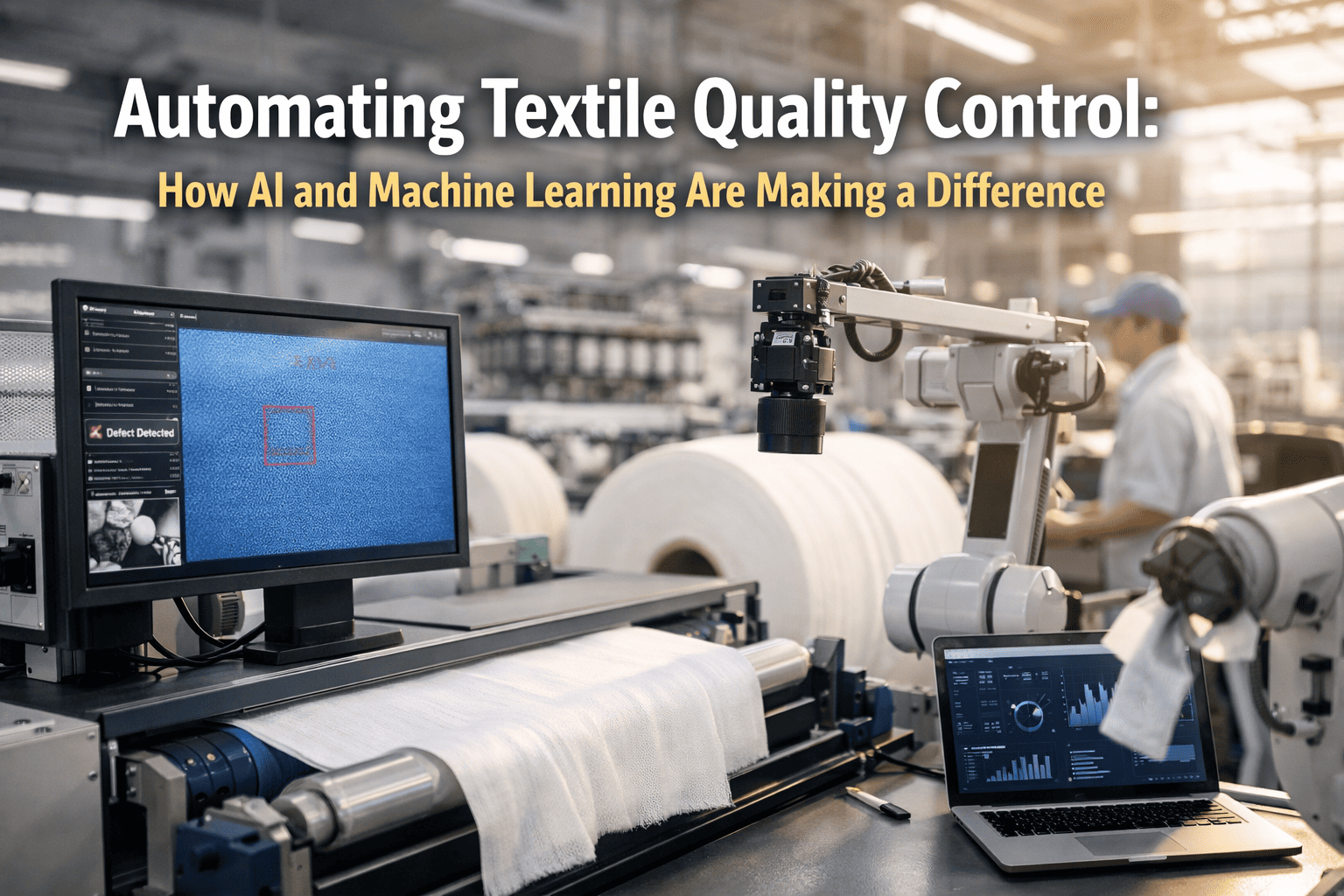
In 2019, a textile mill in Tirupur was running 480 looms across three shifts with 340 workers manually handling material transport, quality checks, and machine changeovers. By 2024, a comparable mill in the same region operates 520 looms with 190 workers — producing 28% more fabric, with 60% fewer defect rejections, and zero unplanned downtime in the last 14 months. The difference is not luck or cheaper labor. It is AI and robotics doing the work that humans were never designed to do with perfect consistency, 24 hours a day. The global AI in textile market is racing from $2.64 billion today to $43.77 billion by 2034 — and the mills that move now will set the cost structure that defines the next decade. If you are still running manual QC walkthroughs and paper-based changeover logs, book a demo with iFactory and see exactly how far behind the gap already is.
Transforming Textile Manufacturing with AI and Robotics
The textile factory floor is being rebuilt from the ground up. AI vision systems catch defects the human eye misses. Robotic arms handle material transfer at 3x human speed. Intelligent scheduling systems optimize every shift in real time. The result: more output, fewer errors, lower costs — and a competitive gap that widens every month between mills that have adopted these technologies and those that have not.
Book a DemoSix Areas Where AI and Robotics Are Replacing Manual Work in Textile Factories
These are not future-state visions. They are live deployments happening in mills across India, Bangladesh, Vietnam, and Europe right now.
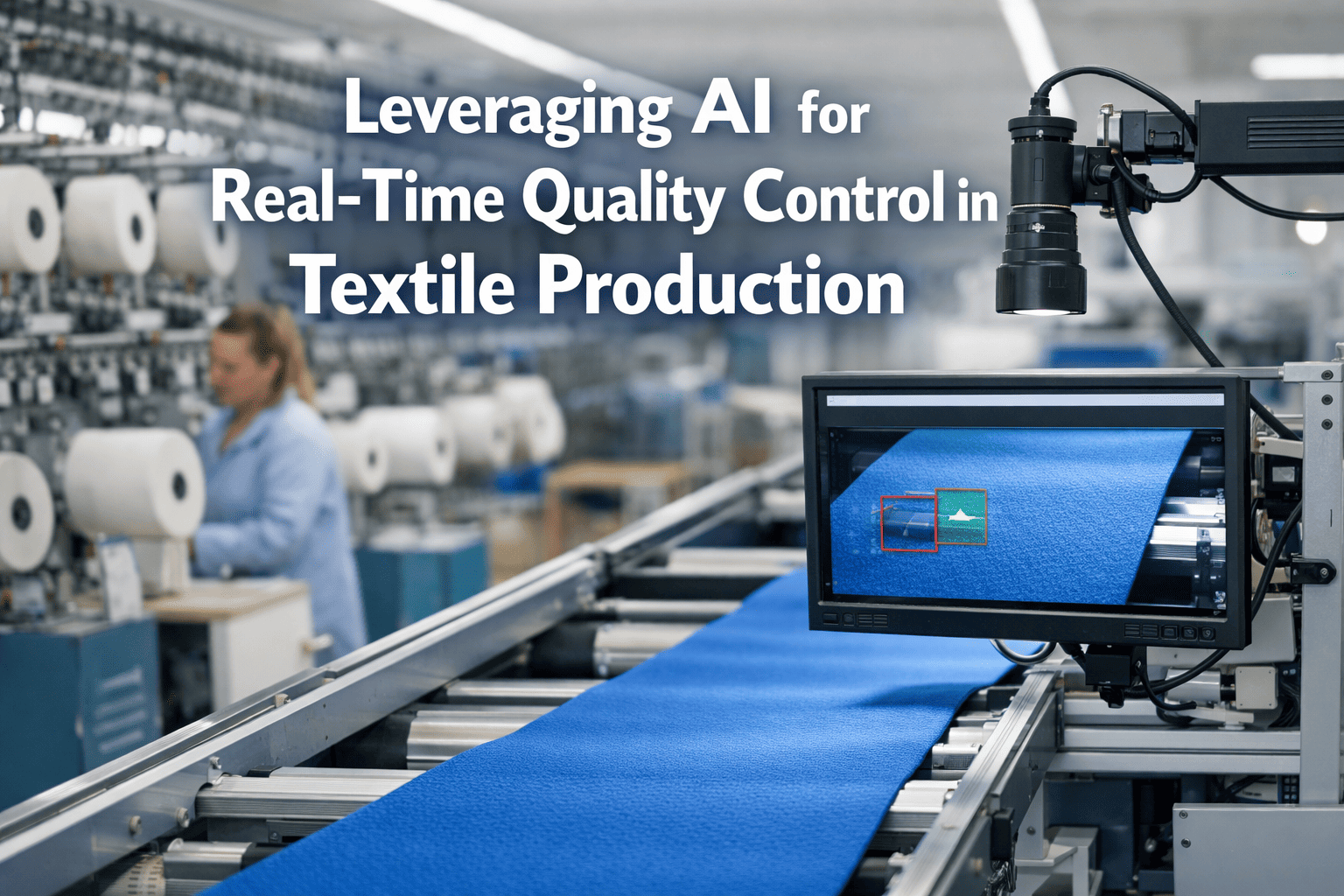
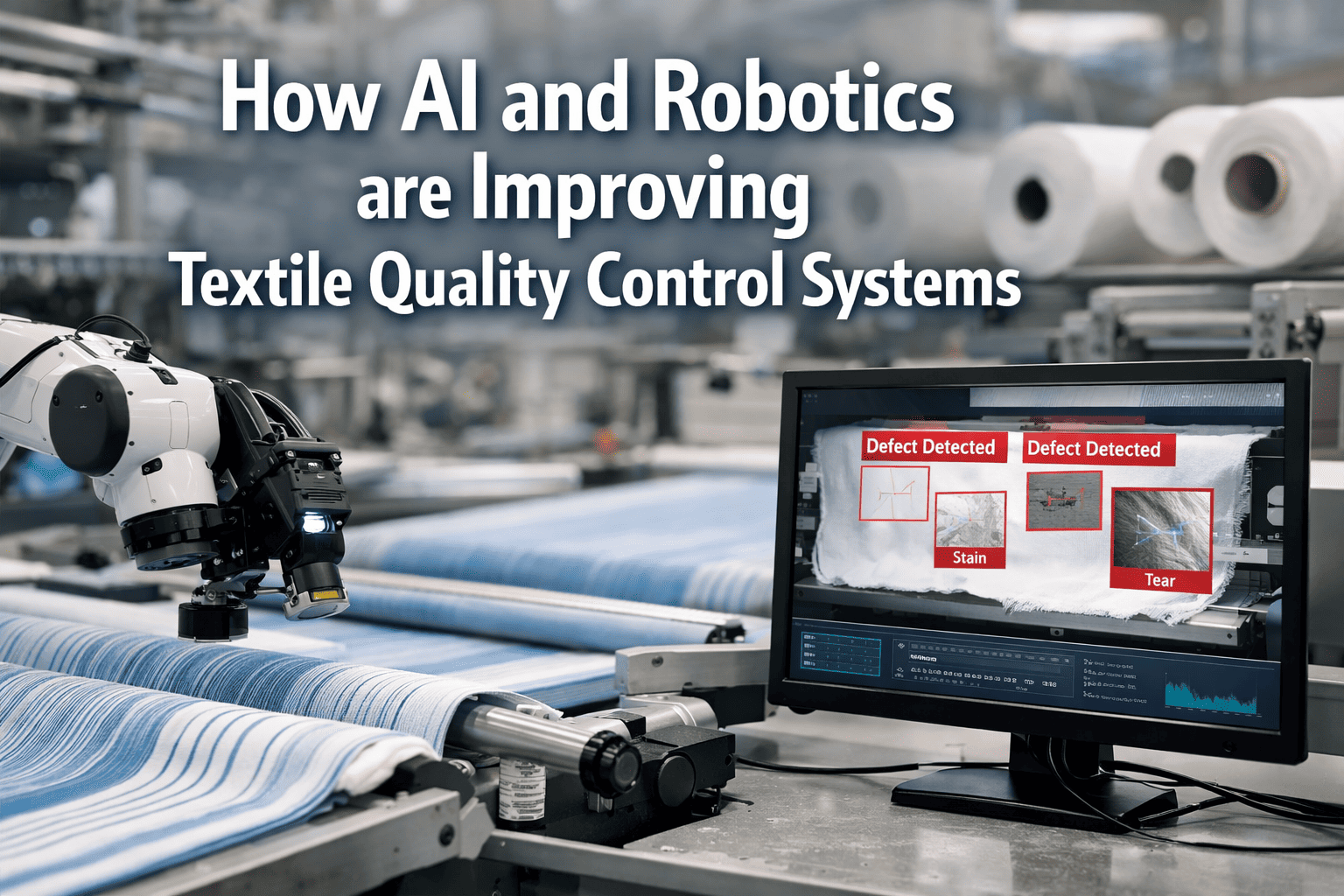
Computer vision cameras scan fabric at full production speed — detecting holes, knots, broken yarns, weave defects, and color inconsistencies at resolutions the human eye cannot match at line speed. AI-powered QC catches 200% more defects than manual inspection alone.
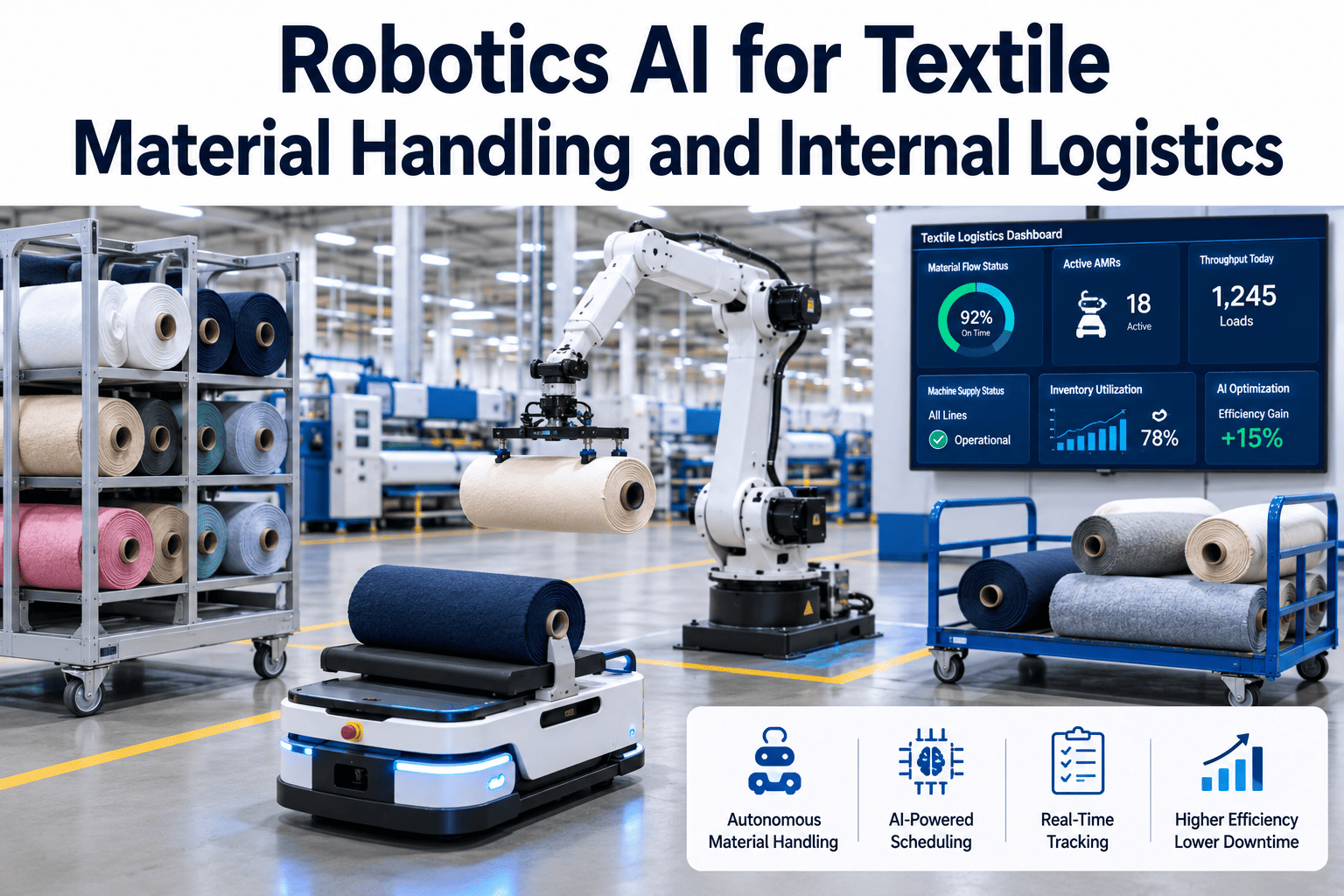
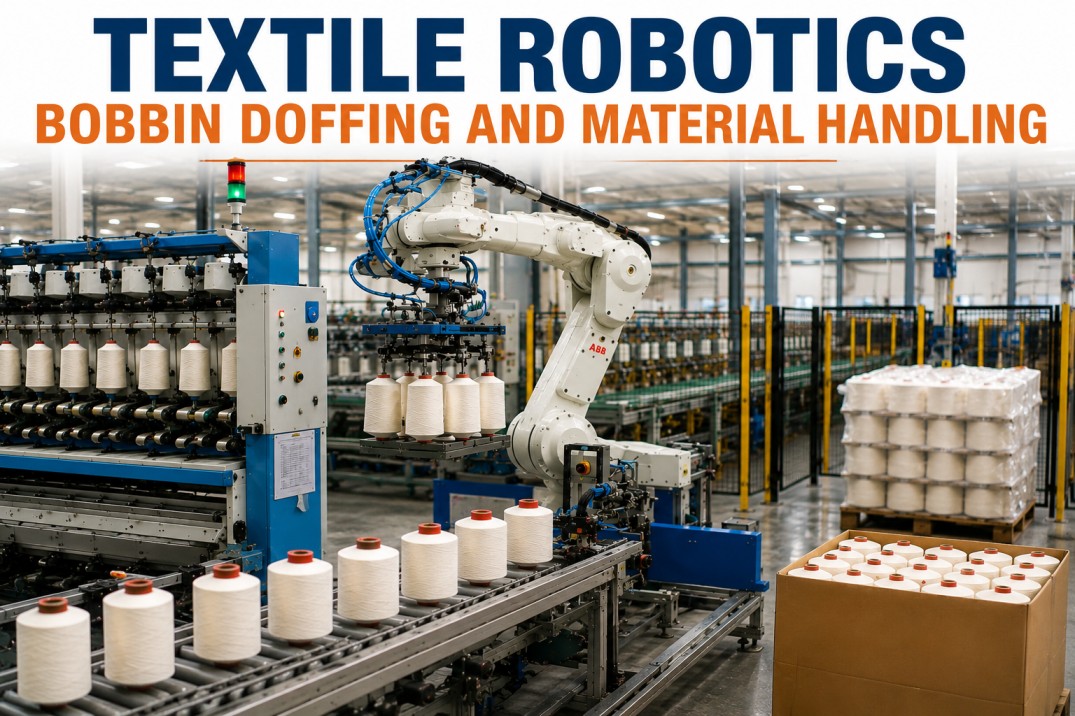
Automated Guided Vehicles (AGVs) and robotic arms handle yarn bobbin transfer, fabric roll movement, and dye batch loading — eliminating manual transport errors and freeing operators for higher-value tasks. AGV deployment in textile plants has seen consistent 20%+ efficiency gains.
Machine learning monitors vibration, temperature, current draw, and pressure across every machine in real time — detecting bearing wear, motor degradation, and belt loosening weeks before breakdown. Predictive maintenance reduces repair costs by up to 25% and unexpected downtime by 30%.
CNC cutting systems guided by AI lay marker plans calculate minimum fabric waste for every order. Material utilization improves by 5–8% compared to manual cutting — a significant saving when operating at hundreds of meters per shift across multiple orders simultaneously.
AI scheduling systems balance machine loads, anticipate bottlenecks 48–72 hours ahead, and auto-reschedule when equipment or material disruptions occur. Manual planners react in hours; AI re-optimizes in minutes. Mills using AI scheduling report up to 96% reduction in production lead time variance.
Automated dosing robots deliver precise chemical quantities to dyeing baths — eliminating human measurement error that causes shade variation and batch rejections. AI monitors bath temperature and pH in real time, adjusting parameters to maintain consistency across every meter of fabric.
The Four Layers of a Fully AI-Integrated Textile Factory
Each layer builds on the one below it. Most mills start at Layer 1 or 2. The competitive advantage lives at Layer 3 and 4.
AI makes real-time decisions across the entire factory — self-optimizing schedules, energy use, quality thresholds, and maintenance windows without human input. Digital twin simulations test changes before they hit the floor.
Where leaders operateAI forecasts failures, demand shifts, and quality deviations days or weeks in advance. Maintenance is condition-based. Scheduling responds to predicted events, not just current ones. Waste is addressed before it occurs.
Competitive advantage zoneIoT sensors feed real-time data from all machines to a central dashboard. Operators see live OEE, energy consumption, and production output. Alerts trigger when metrics drift from baseline.
Most mills are hereFixed-program machines run repetitive tasks. PLCs control basic machine sequences. No data integration, no AI. Maintenance is calendar-based. Quality is checked manually at end of line.
Where most mills startedAI vs Robotics vs Both — What Does What in Your Factory
Understanding which technology solves which problem helps prioritize your investment and deployment roadmap.
| Problem on the Floor | AI Software | Robotics Hardware | AI + Robotics Combined |
|---|---|---|---|
| Fabric defect detection | Vision AI catches defects at line speed | Cannot inspect without vision layer | Robotic arm removes defective fabric automatically |
| Machine failure prevention | Predictive alerts 2–6 weeks before failure | Cannot predict without data layer | Cobots perform micro-repairs on flagged assets |
| Material transport between stages | Software alone cannot move materials | AGVs transport yarn, rolls, dye batches | AI routes AGVs dynamically by production priority |
| Dyeing bath consistency | AI monitors temperature, pH, shade in real time | Robotic dosing delivers precise chemical quantities | Full closed-loop bath control — zero human input |
| Production schedule disruption | AI re-sequences jobs in minutes | Cannot adapt without scheduling layer | Robots and schedule update simultaneously |
| Energy consumption spikes | AI staggers high-draw equipment automatically | Fixed programs cannot adapt dynamically | AI-controlled motors self-adjust to optimal load |
Not sure which layer your factory is at — or what to deploy first?
Our support team will assess your current setup, identify the highest-ROI automation opportunity on your floor, and walk you through exactly what iFactory would deploy — in a free 30-minute session with your asset register in hand.
What AI and Robotics Deliver — By the Metric That Matters to You
Automated weaving and spinning systems deliver a consistent 20% increase in production efficiency — Karl Mayer's 2024 deployment data showed up to 30% improvement on flat knitting lines.
AI vision systems identify fabric inconsistencies, broken threads, and color deviations at accuracy rates that human inspection at line speed cannot approach.
Automated dyeing processes have seen a 25% increase in adoption rate — enabling mills to produce consistent quality at higher volume without adding skilled dye technicians.
Patagonia's 2024 automated denim production deployment reduced water consumption by 75% while improving production speed by 25% — a benchmark for sustainable textile automation.
SCADA integration, automated cutting, and smart sensor deployments rose 17% in 2024 — the fastest-growing segment of textile automation investment globally.
Operators using AI in manufacturing reported a 10–15% boost in production process performance and a measurable improvement in EBITA within the first operating year.
How iFactory Brings AI and Robotics Intelligence to Your Floor
iFactory is not a generic manufacturing platform. It is purpose-built for textile factory environments — with pre-configured models for spinning, weaving, knitting, dyeing, and finishing operations.
IoT sensors deploy across all machines in 7–14 days. iFactory connects to your existing SCADA, PLC, ERP, or MES — or runs standalone on legacy equipment. No production shutdown, no disassembly required.
Machine learning builds operating baselines for every asset. Anomaly detection runs 24/7 across vibration, temperature, current, pressure, and output quality — flagging deviations before they become failures.
When failure probability or quality deviation crosses a threshold, iFactory auto-generates a prioritized work order with fault type, recommended action, and urgency level — routed to the right team, instantly.
Every resolved alert, completed repair, and production shift makes iFactory's models sharper. Scheduling accuracy, defect prediction, and maintenance timing improve automatically with every production cycle.
Common Questions About AI and Robotics in Textile Manufacturing
The Gap Between AI-Enabled Mills and Manual Mills Is Growing Every Month
iFactory deploys AI-powered monitoring, predictive maintenance, and intelligent scheduling across your textile facility in 7–14 days. Pre-built templates for spinning, weaving, knitting, and dyeing equipment mean you are live fast — with a dedicated onboarding team from day one.
Book a Demo