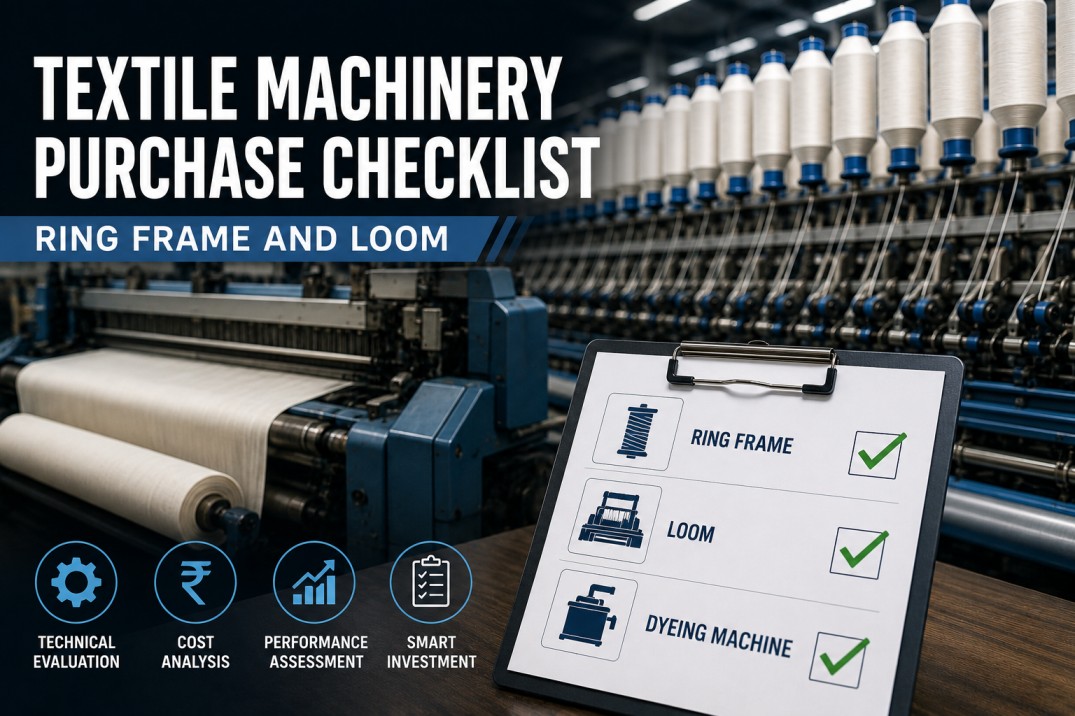
A ring frame, loom, or dyeing machine is a multi-crore investment that commits a textile mill to a production technology, operating cost structure, and product capability for 10–15 years. The difference between a well-evaluated purchase and one driven by vendor relationships alone is typically 15–25% in total cost of ownership over the machine's lifespan, making the purchase decision one of the highest-leverage financial choices a mill management team makes. Leading textile project consultants use a structured 27-point evaluation framework organized across six dimensions — technical specifications, financial evaluation, vendor assessment, operational fit, future-proofing, and commercial terms — that ensures every critical factor is assessed before the purchase order is signed. This page compares key specifications and investment ranges for ring frames, looms, and dyeing machines, presents the complete 27-point checklist as an actionable evaluation tool, compares ROI payback and lifecycle metrics across the three machine categories, provides a vendor evaluation scorecard framework, and outlines the five-step decision process used by professional procurement teams.
Textile Machinery Purchase Checklist — Ring Frame, Loom, Dyeing Machine
Capital equipment purchases in textile manufacturing require evaluation across multiple dimensions that go beyond the purchase price. A machine that is 10% cheaper but consumes 15% more energy, requires 20% more maintenance, or produces 5% more waste will cost more over its lifecycle than a higher-priced but more efficient alternative. The framework below provides a structured approach to machinery purchase decisions that balances upfront cost with long-term operational economics.
Make Smarter Machinery Investment Decisions With Data
iFactory's platform tracks machine performance, energy consumption, maintenance history, and production output across your entire fleet, providing the data you need to evaluate new machinery purchases against actual operational benchmarks. Book a demo to see how real-time machine data supports better capital investment decisions.
Ring Frame vs Loom vs Dyeing Machine — Key Specifications and Investment Range
Each machine category serves a distinct role in the textile production chain, with different cost structures, performance metrics, and evaluation priorities. Understanding the baseline specifications and investment ranges for each category is the starting point for any machinery purchase decision.
The 27-Point Machinery Purchase Evaluation Checklist
Professional textile project consultants evaluate new machinery purchases against 27 criteria organized into six categories. Each criterion is scored on a 1–5 scale, with a minimum acceptable score per category and an overall weighted score that determines whether the purchase proceeds, requires renegotiation, or is rejected in favor of an alternative.
Evaluate New Machinery Against Real Production Data
iFactory's platform captures actual machine performance, energy consumption, and maintenance costs across your existing fleet, giving you the baseline data needed to evaluate new purchases against real operational benchmarks rather than manufacturer claims. Book a demo to see how data-driven machinery evaluation improves capital allocation decisions.
ROI and Lifecycle Comparison by Machine Category
Payback period, return on investment, and useful life vary significantly across machine categories. Ring frames offer the longest lifespan and highest automation ROI, looms deliver the fastest payback through productivity gains, and dyeing machines provide the largest energy and water saving opportunity. Each metric is shown with the industry average range.
Vendor Evaluation Scorecard Framework
Comparing vendors across multiple weighted criteria requires a structured scorecard that captures both objective specifications and subjective assessments. The framework below shows six evaluation criteria with their recommended weightings, scored on a 1–5 scale for three vendor options.
| Criterion | Weight | Vendor APremium | Vendor BMid-Range | Vendor CValue |
|---|---|---|---|---|
| Technology & Specifications | 25% | 5 | 4 | 3 |
| Total Cost of Ownership | 20% | 3 | 4 | 5 |
| Service & Support Presence | 15% | 5 | 4 | 2 |
| Energy Efficiency | 15% | 4 | 3 | 3 |
| Automation & Digital Ready | 15% | 5 | 3 | 2 |
| Spares & Consumables Cost | 10% | 3 | 4 | 4 |
| Weighted Score | 100% | 4.25 | 3.70 | 3.15 |
Five-Step Machinery Purchase Decision Process
Leading textile project consultants follow a structured five-step process for major machinery purchases, with clear stage-gate criteria that prevent premature commitment and ensure all critical dimensions are evaluated before the purchase order is signed. Each step has defined inputs, outputs, and approval requirements.
Production gap analysis, capacity requirement definition, and technology review against current and future product mix. Output: approved purchase justification.
Detailed technical specification document including performance parameters, quality standards, utility requirements, and integration needs. Output: RFQ-ready spec sheet.
Market scan of qualified vendors, reference checks with peer mills, initial proposals evaluation. Downselect to 2–3 vendors for detailed technical and commercial evaluation.
Complete 27-point checklist scoring, trial run or factory visit, TCO modeling, and vendor scorecard completion. Output: ranked vendor recommendation.
Commercial negotiation on price, payment terms, warranty, performance guarantees, and penalty clauses. Final approval from management committee and purchase order issuance.
Frequently Asked Questions About Machinery Purchase Decisions
What is the most common mistake in textile machinery purchasing?
The most common mistake is making the purchase decision based primarily on the purchase price rather than total cost of ownership over the machine's lifespan. A machine that is 10–15% cheaper often consumes 15–25% more energy, requires 20–30% more maintenance, produces more waste, and has lower resale value. Over a 10-year lifecycle, the cheaper machine typically costs 20–30% more in total. The second most common mistake is inadequate technical specification — mills that do not define detailed performance requirements before inviting vendor proposals receive incomparable quotes and cannot make an apples-to-apples evaluation.
How should a mill prioritize between price, technology, and vendor support?
The recommended weighting depends on the mill's strategy, but a balanced framework widely used by consultants allocates 40% weight to total cost of ownership, 30% to technology and specifications, 20% to vendor support and service capability, and 10% to commercial terms. Mills pursuing premium-quality positioning should increase technology weight to 40% and reduce price weight to 30%. Mills in highly cost-competitive segments should reverse that weighting. The key is establishing weights before evaluating vendors to avoid biasing the scorecard toward a preferred vendor.
How important are digital integration capabilities when buying new machinery?
Digital integration capability has moved from a nice-to-have to a mandatory criterion for mills committed to Industry 4.0 adoption, and a strong differentiator for all mills. Machines that output production data via standard OPC UA or MQTT protocols, accept remote recipe downloads, and integrate with existing MES platforms without custom middleware deliver 5–10% higher effective OEE through reduced changeover time, real-time quality monitoring, and predictive maintenance alerts. Mills purchasing non-digital machinery today face significant retrofit costs ($5,000–$25,000 per machine) and capability limitations when they eventually digitize their operations.
Should a mill buy new or used textile machinery?
The new versus used decision depends on the mill's capital availability, technology strategy, and risk tolerance. New machinery offers the latest technology, full warranty, lower energy consumption, higher productivity, and 10–15 year useful life, but at 2–3x the cost of used. Used machinery from reputable sources (3–5 years old, well-maintained, from mills upgrading their fleet) costs 40–60% of new and can be a viable option for capacity expansion in commodity segments where technology differences are marginal. The critical factor is independent technical inspection before purchase — a used machine that requires $50,000–$100,000 in refurbishment within 12 months is rarely a good investment.
What should be included in a machine performance guarantee contract?
A comprehensive performance guarantee should specify measurable targets for production speed (picks per minute or kg per hour), energy consumption (kWh per kg or per meter), waste percentage, quality levels (Classimat defects per 100 km for ring frames, stop level per 100,000 picks for looms), noise levels, and delivery timeline. The contract should define the testing protocol — duration (typically 72 hours continuous), standard operating conditions, raw material specifications, and measurement methodology — and include liquidated damages for each parameter that falls below the guaranteed level. Leading mills also negotiate a service-level agreement covering response time (24–48 hours), spares availability (95%+ fill rate), and preventive maintenance schedule.
Evaluate New Machinery With Confidence — Backed by Real Data
iFactory's platform gives textile mills the machine performance data, energy monitoring, and maintenance history needed to make informed capital equipment decisions. Evaluate new purchases against actual operational benchmarks and negotiate performance guarantees with confidence. Book a demo to see how data transforms machinery investment decisions.