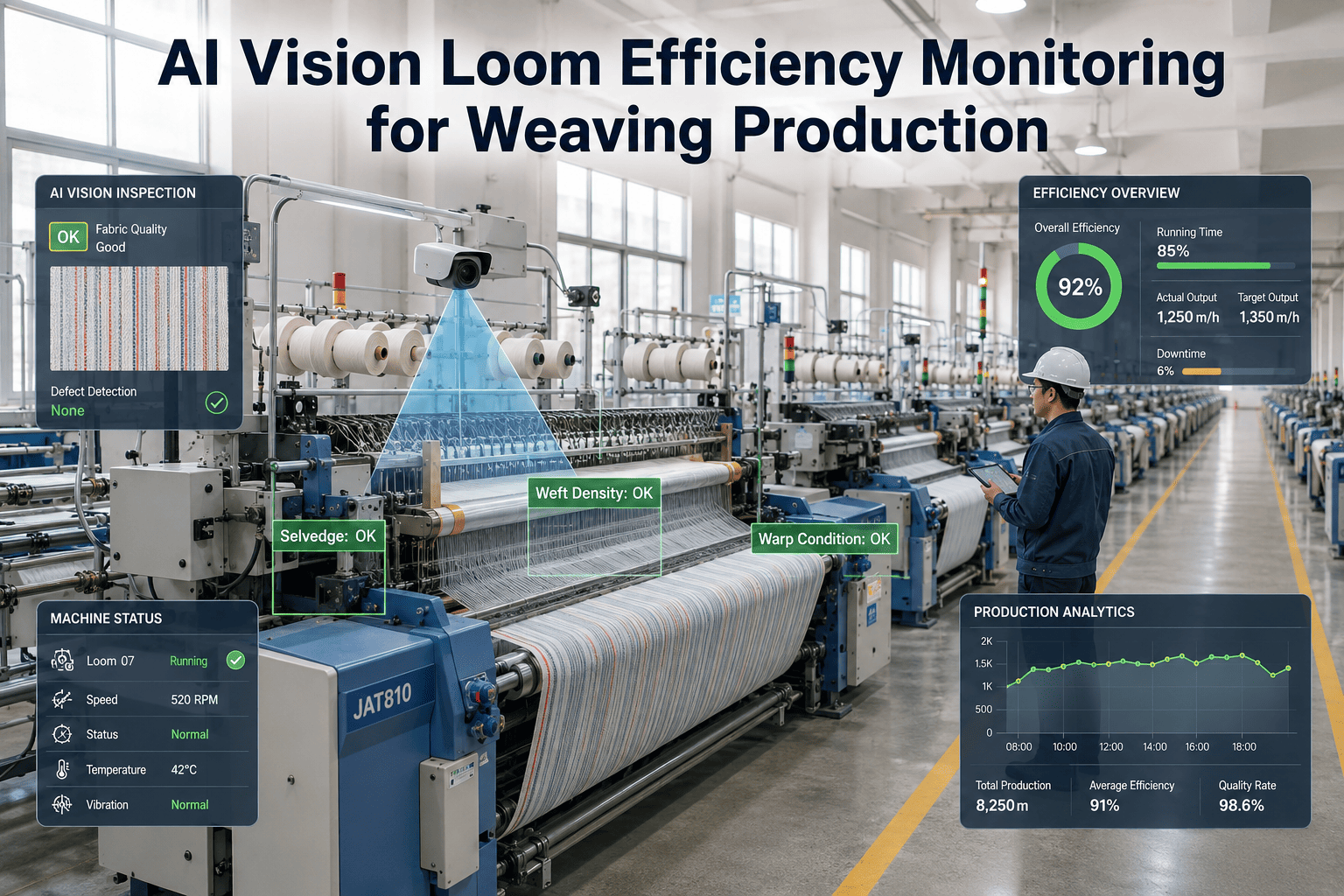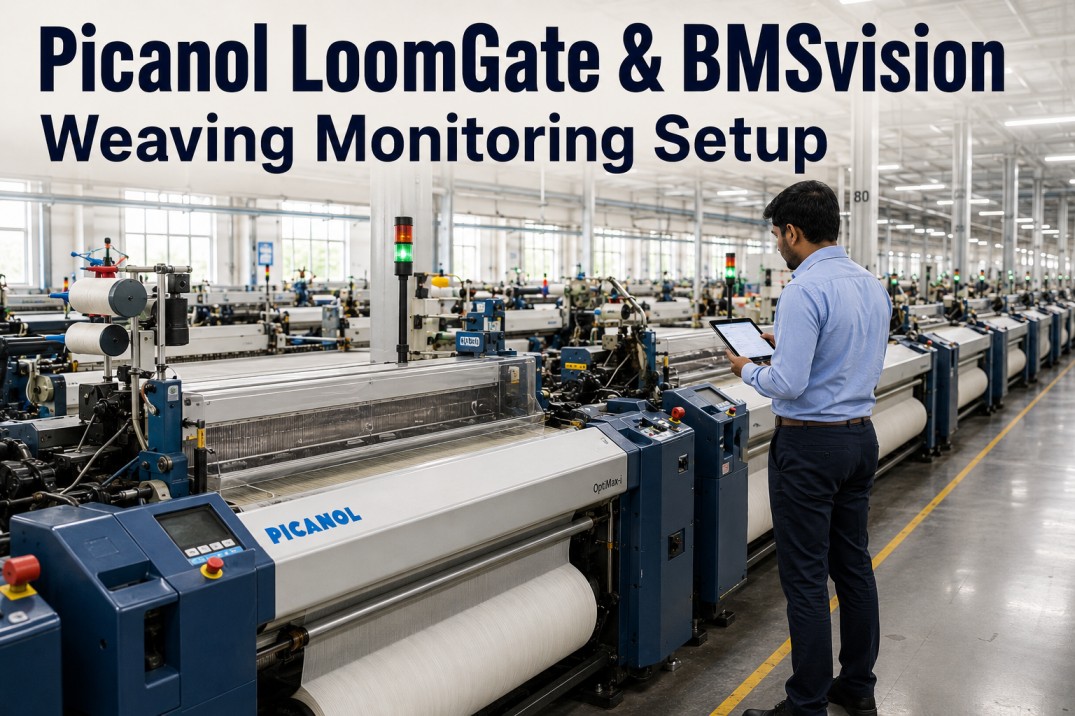
Picanol LoomGate and BMSvision are the two dominant platforms for weaving mill monitoring worldwide, yet most mills using them still export data to spreadsheets for reporting because neither system natively connects to MES, CMMS, or ERP platforms without expensive custom development. Picanol LoomGate collects real-time production data from Picanol air-jet and rapier looms — Terry, OmniPlus, GamMax, and OptiMax — tracking picks per minute, weft stops, warp stops, machine status, and efficiency at the individual loom level with sub-second granularity. BMSvision provides a vendor-agnostic weaving monitoring layer that collects data from looms of any brand through serial or Ethernet connections, making it the standard choice for mills with mixed-vendor weaving sheds that include Picanol, Toyota, Sulzer, Dornier, or Tsudakoma looms side by side. iFactory connects to both LoomGate and BMSvision through their native APIs, ingesting weaving data into a unified platform that enriches it with MES order context, CMMS maintenance history, and ERP material traceability — giving weaving managers a single pane of glass across every loom in the mill without custom API development or any modification to the existing LoomGate or BMSvision installation.
Connect LoomGate and BMSvision to Your Entire Tech Stack
iFactory integrates Picanol LoomGate, BMSvision, and direct OPC UA looms with MES, CMMS, and ERP — no custom development, no downtime, no vendor lock-in.
Loom Fleet Status — Live View of Every Machine on the Shed Floor
The iFactory loom fleet view displays every loom in the shed as a color-coded block with real-time status, efficiency, and stop count, updated every 10 seconds from LoomGate or BMSvision data. Weaving supervisors can spot underperforming looms instantly without scanning through spreadsheets or walking the entire shed floor.
Weaving Data Integration Maturity Model — Five Stages from Collection to AI
Most weaving mills operate at Stage 2 or Stage 3 of the data integration maturity model, using LoomGate or BMSvision for basic monitoring but lacking the cross-system integration needed for predictive analytics and automated decision-making. iFactory accelerates progression to Stage 5 without replacing existing systems.
System Capability Comparison — LoomGate, BMSvision, and iFactory Side by Side
Each system serves a different role in the weaving data ecosystem. LoomGate excels at Picanol-specific data, BMSvision provides universal loom coverage, and iFactory unifies everything with cross-system integration and AI analytics.
Unify Weaving Data Across Every Loom Brand and Model
iFactory connects to LoomGate, BMSvision, and direct OPC UA — normalizing weaving data from Picanol, Toyota, Sulzer, Dornier, and Tsudakoma into one unified platform with AI-powered analytics.
Measurable Impact — What Unified Weaving Data Delivers
Mills that unify LoomGate and BMSvision data with iFactory consistently achieve measurable improvements across four key dimensions within the first two quarters of deployment.
Frequently Asked Questions
Do I need both LoomGate and BMSvision, or can iFactory work with just one?
iFactory works with either system independently and with both simultaneously. Mills that run only Picanol looms typically use LoomGate as their primary data source, and iFactory connects directly to the LoomGate API to ingest weaving data without needing BMSvision. Mills with mixed-vendor weaving sheds that include Toyota, Sulzer, Dornier, or Tsudakoma looms alongside Picanol typically use BMSvision as their universal data collection layer because BMSvision supports looms from any manufacturer through serial or Ethernet connections. In mixed-vendor mills, iFactory can connect to both systems simultaneously — using LoomGate for detailed Picanol-specific data (warp tension, air consumption per loom, stop reason codes) and BMSvision for weaving data from non-Picanol looms — then merge the two data streams into a single unified view. iFactory's data normalization layer handles the mapping automatically, so the weaving manager sees every loom in the same dashboard regardless of which source system provides the data. For mills that have neither LoomGate nor BMSvision, iFactory can connect directly to loom PLCs via OPC UA, though this requires an OPC UA server that the loom PLC supports — most Picanol looms built after 2015 support OPC UA through their standard control system.
What specific data does LoomGate expose through its API that BMSvision does not?
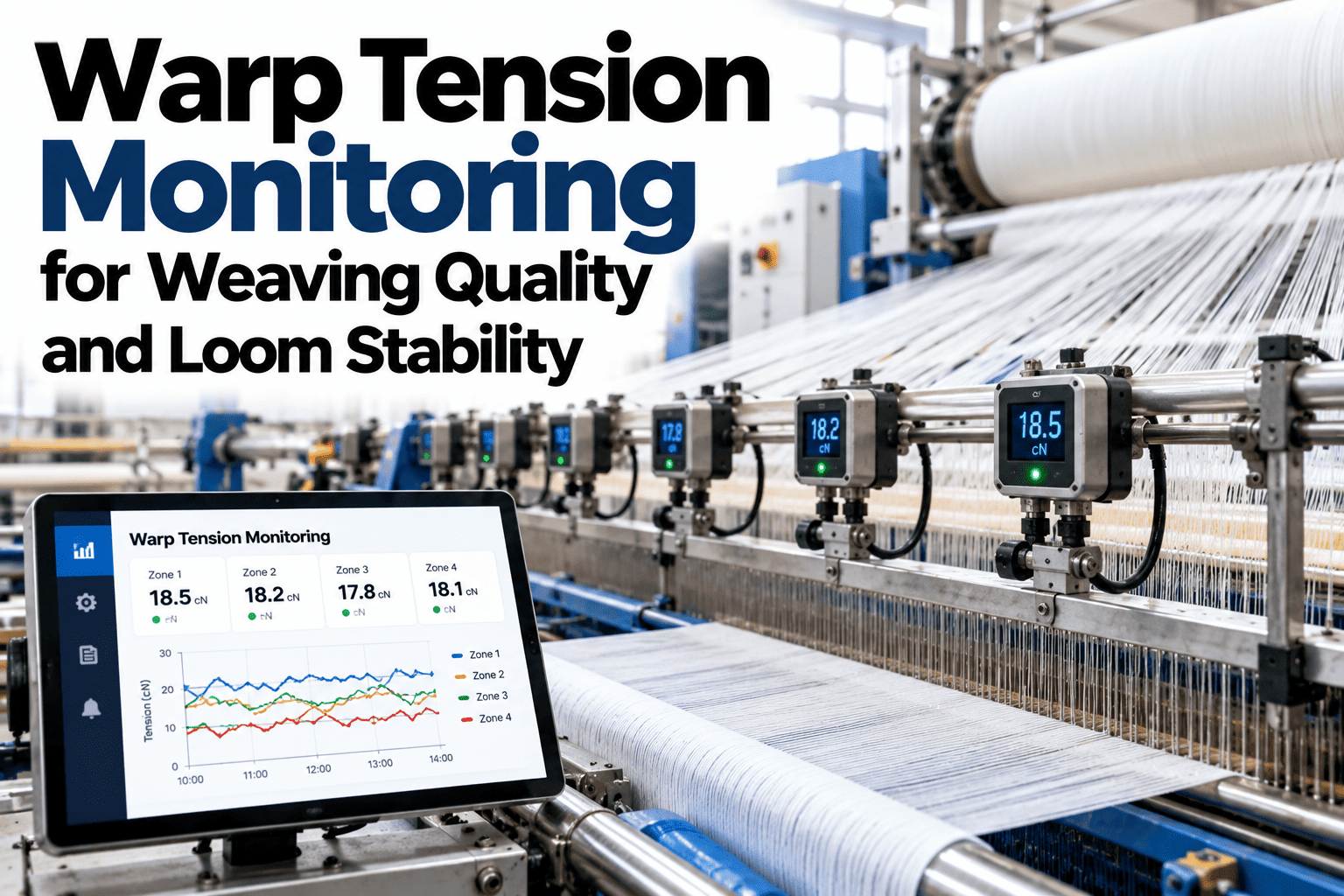
LoomGate exposes several Picanol-specific data points that BMSvision cannot access because BMSvision collects data at the machine interface level rather than through Picanol's internal control bus. The key differentiators are stop reason codes — LoomGate can report the specific cause of each stop (weft break, warp break, mechanical fault, scheduled maintenance, operator stop) because it reads the loom's internal error log through Picanol's proprietary protocol. BMSvision can detect that a loom stopped but typically reports the stop as "unknown" unless the loom provides a digital signal for the stop category, which many older looms do not. LoomGate also provides warp tension readings (on Terry and OptiMax models), actual air consumption per loom in liters per minute (on OmniPlus, GamMax, and OptiMax), and grease consumption data (on GamMax and OptiMax). These granular data points enable predictive maintenance use cases that are not possible with BMSvision alone — for example, detecting a gradual increase in air consumption that indicates a seal leak, or correlating warp tension variation with weft stop frequency to optimize warp let-off settings. BMSvision excels in areas where LoomGate does not — universal loom support regardless of brand, standardized data collection across mixed-vendor sheds, and a proven track record of reliability in mills running hundreds of looms from multiple manufacturers.
How does iFactory handle loom mapping when LoomGate and BMSvision use different loom numbering schemes?
Loom numbering is one of the most common integration challenges because LoomGate and BMSvision often assign different identifiers to the same physical loom. LoomGate typically uses Picanol's internal loom serial number combined with a mill-specific alias (e.g., "PIC-1047" or the mill's loom number like "W-32"), while BMSvision uses its own equipment registry with loom numbers assigned during the BMSvision system setup (e.g., "L-032" for the same physical loom). iFactory resolves this through a configurable loom mapping table that is created during the initial integration. The mapping table is a simple cross-reference: each physical loom gets one row with columns for LoomGate ID, BMSvision ID, and the canonical iFactory loom ID. The mapping is established by the mill's weaving supervisor during the first week of integration — typically by having both systems displayed side by side and matching looms by their fabric style and shift production numbers. Once the mapping is complete, iFactory merges data from both sources using the canonical loom ID, enabling cross-source queries like "show me stop reason codes from LoomGate alongside picks-per-minute from BMSvision for loom W-32." The mapping table can be imported from a spreadsheet or CSV, making bulk setup for a 200-loom shed a matter of hours rather than days.
Can iFactory send data back to LoomGate or BMSvision from the MES, or is it read-only?
The standard iFactory integration reads data from LoomGate and BMSvision through their APIs and does not write back to either system, which is the safest approach for mills that cannot risk disrupting their primary loom monitoring systems. However, iFactory supports write-back to the MES, CMMS, and ERP systems — publishing normalized weaving data to the MES for order progress tracking, creating work orders in the CMMS based on loom performance alerts, and sending production summaries to the ERP for cost allocation. For mills that want LoomGate or BMSvision to display MES context (such as the current order number, fabric style, or target efficiency visible on the loom floor display), iFactory can write selected data fields to the LoomGate or BMSvision database through a controlled, configuration-driven interface. This is a write-enabled feature that requires explicit configuration and testing during the integration phase. The most common use case is writing the current order ID and target picks per minute from the MES to BMSvision so that the loom-side display shows operators what they should be running — but this is entirely optional and disabled by default. iFactory's integration philosophy is read-first: ingest data from all sources, enrich it, and distribute it to the right destinations through iFactory's own dashboards and integrations, minimizing the risk of unintended changes to production systems.
What is the typical ROI timeline for a weaving mill that integrates LoomGate or BMSvision with iFactory?
Weaving mills that integrate LoomGate or BMSvision with iFactory typically achieve full ROI within 6 to 9 months, driven by three primary value drivers. The first and largest driver is efficiency improvement: weaving managers gain real-time visibility into every loom's performance with MES order context, enabling them to identify underperforming looms, shift patterns, or operator teams within the same shift rather than discovering issues the next morning from a paper report. Mills typically see a 2–4 percentage point improvement in weaving efficiency within the first quarter after integration, which for a 100-loom shed running at 92% efficiency translates to approximately 2,000–4,000 additional loom-hours per quarter. The second driver is maintenance cost reduction: predictive alerts based on stop frequency trends and air consumption baselines reduce unplanned downtime by 25–35%, with corresponding savings in emergency maintenance labor and rush spare parts procurement. The third driver is administrative efficiency: eliminating manual data collection and spreadsheet reconciliation for weaving reports saves 12–20 hours per week across the production management team. A detailed ROI analysis should include the mill's current efficiency baseline, loom count, operating shifts, fabric margin, and maintenance cost structure. iFactory provides a complimentary ROI assessment during the discovery phase that models these factors and projects the expected payback period based on the mill's specific parameters.
One Platform for Every Loom, Every Brand, Every System
iFactory connects Picanol LoomGate, BMSvision, and direct OPC UA looms to your MES, CMMS, and ERP — unified weaving data without custom development or downtime.