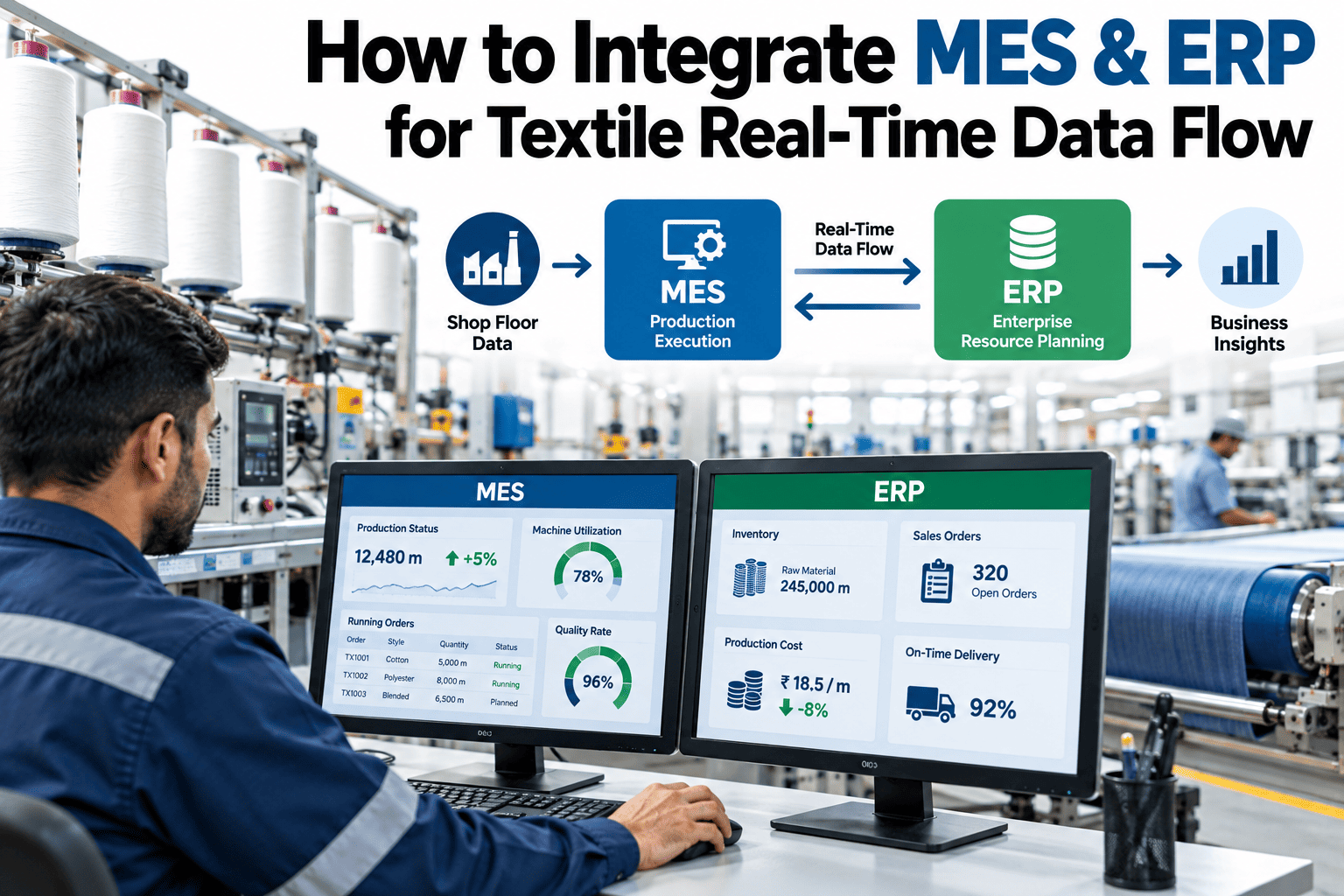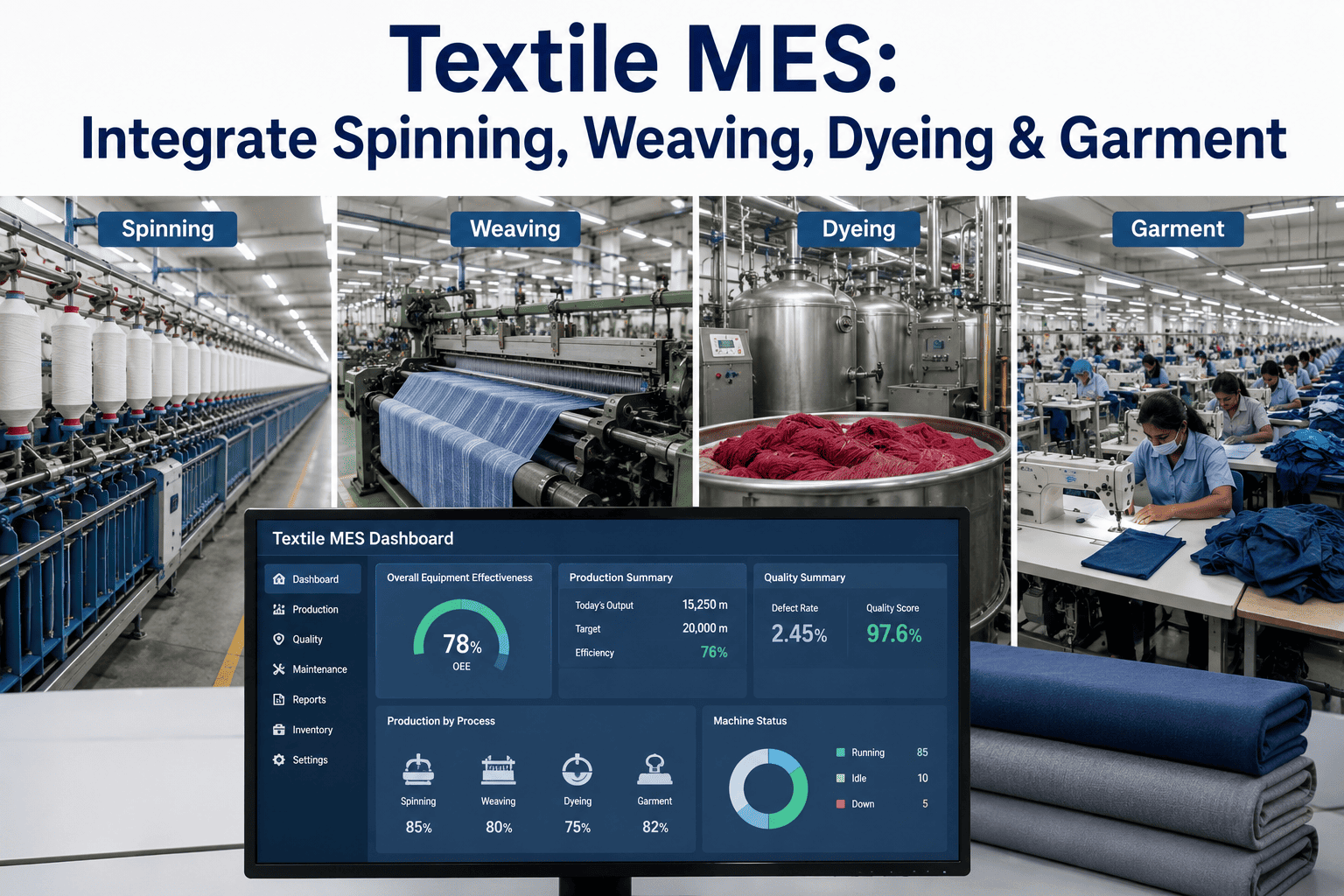
A cotton lot enters spinning as a single traceable batch. By the time it exits garment finishing, it has passed through four or five separate departments, each running its own paperwork, its own quality checks, and in most mills, its own disconnected spreadsheet or standalone machine log. Nobody upstream knows what happened downstream, and nobody downstream can see what happened upstream until a customer complaint forces someone to reconstruct the trail manually. A Manufacturing Execution System built for textiles closes that gap by carrying the same lot record, the same quality data, and the same production status across every department on one continuous thread. Mills evaluating what that actually looks like in daily operation can Book a Demo to see a live cross-department data flow.
The Island Problem: Why Textile Mills Stay Disconnected Longer Than Other Industries
Textile manufacturing is unusual in how physically and organizationally separated its process stages are. Spinning happens on ring frames and open-end machines that produce yarn as a semi-finished good. Weaving or knitting converts that yarn into greige fabric on an entirely different machine class, often in a different building or even a different facility altogether. Dyeing and finishing chemically transform the fabric's color and hand-feel using batch processing equipment that runs on recipe logic unrelated to anything upstream. Garment construction then cuts and sews that finished fabric into a product using labor-intensive assembly lines that track output in pieces, not meters or kilograms. Each stage has its own unit of measure, its own quality vocabulary, and historically, its own management team with little incentive to standardize systems with neighboring departments.
That organizational separation is precisely why textile mills lag other discrete and process manufacturing sectors in system integration. A single ERP-MES pairing works cleanly in an industry where one line produces one class of output. In textiles, the "line" is really four or five distinct production paradigms stitched together by physical material handoffs — a yarn beam moved by forklift, a fabric roll carried to a dye house, a cut piece bundle passed to a sewing floor. Each handoff is a point where digital continuity breaks unless something deliberately forces it to continue.
The cost of that break is not abstract. When a fabric defect surfaces in garment finishing, tracing it back to a specific dye lot, and further back to the yarn lot and spinning frame that produced the fiber irregularity underneath it, can take days of manual cross-referencing across paper logs and disconnected spreadsheets in a disconnected mill. In a mill running one continuous MES thread across departments, the same trace takes minutes because the lot identity never broke in the first place.
What a Unified MES Actually Connects
"Integration" is a vague word until it is broken into the specific data objects that need to move between departments without manual re-entry. In a textile MES built for cross-department continuity, four categories of information carry forward automatically at every handoff point, and each one closes a specific operational gap that disconnected mills live with every day.
The Handoff Points Where Data Continuity Breaks Today
Understanding where integration delivers value starts with understanding exactly where continuity fails in a disconnected mill. Four handoff points account for the overwhelming majority of lost traceability and delayed problem detection across a typical textile operation.
Disconnected Mill vs. Unified MES: A Side-by-Side Comparison
The practical difference between a mill running disconnected department systems and one running a unified MES is easiest to see in direct comparison, across the operational questions that come up on every production floor every single day.
Integration Architecture: How the Pieces Actually Connect
A unified textile MES does not require replacing every department's existing machine controllers or quality instruments. What it requires is a middleware and data layer that pulls structured data out of each department's local systems, standardizes it against a common lot identity, and makes it queryable from anywhere in the mill without a department having to change how its floor operates day to day.
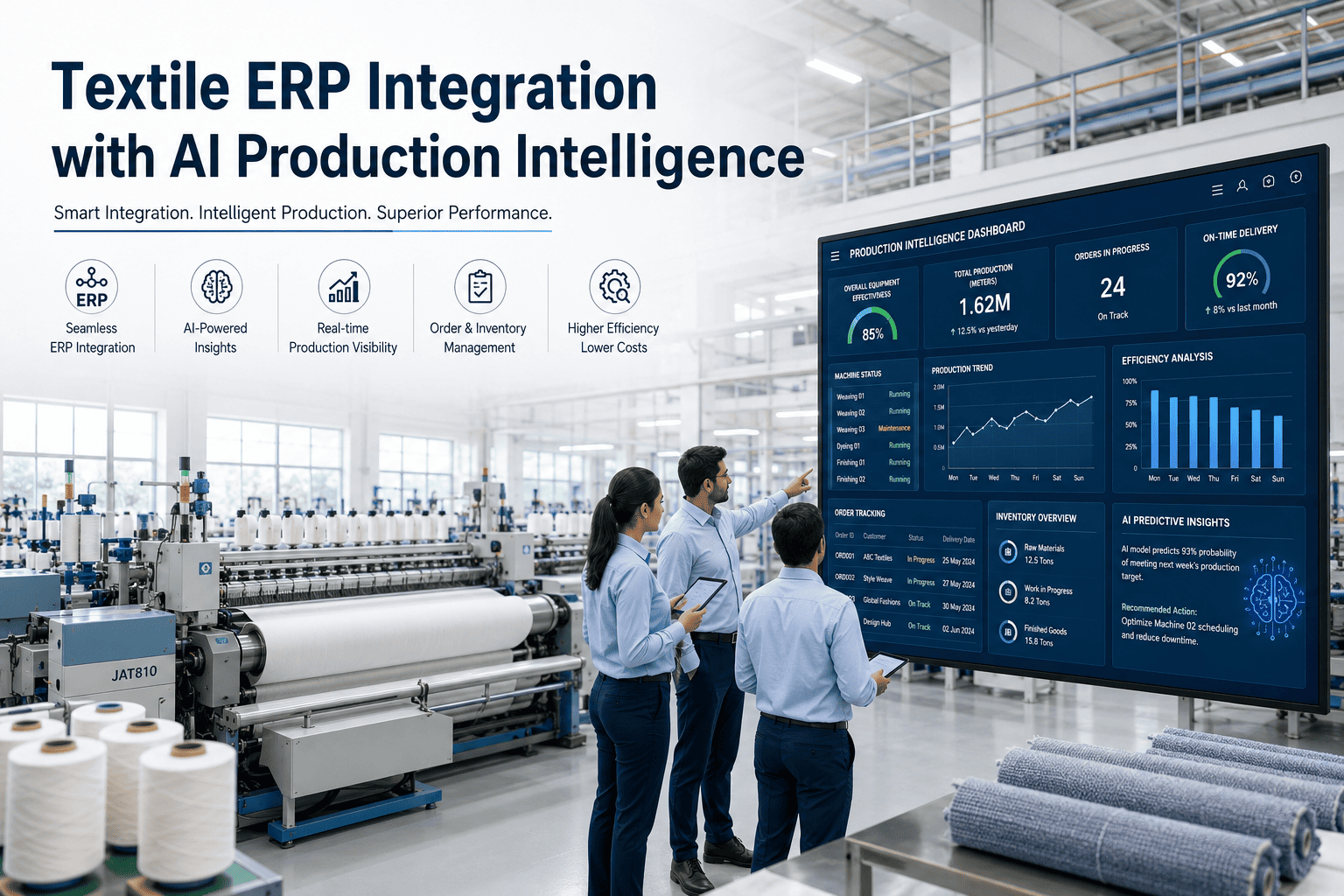
In practice, this means spinning frame data acquisition systems, weaving loom monitoring, dye house recipe management, and garment line tracking all continue operating as specialized tools suited to their department — but each one writes into a shared data structure keyed to lot identity, rather than remaining siloed in a local database only that department can query. ERP systems sit above this layer for planning and financials, while the MES layer handles the execution-level detail that ERP was never designed to track at the granularity a textile floor actually needs.
The rollout sequence matters more than most mills expect going in. Attempting to integrate all departments simultaneously tends to stall on the department with the least digital readiness, dragging the entire project timeline down to that department's pace. A phased approach — establishing lot identity continuity between two adjacent departments first, proving the value, then extending outward — consistently produces faster time-to-value than an all-at-once big-bang integration attempt, even though the phased approach takes longer to reach full mill coverage.
The Real Cost of Staying Disconnected
Mills that postpone cross-department integration rarely experience it as one large, visible cost. It shows up instead as a steady accumulation of small inefficiencies that never quite justify their own investigation individually, but which add up to a meaningful drag on margin and delivery reliability over a full production year. Rework from avoidable quality escapes, expedited freight to cover delivery slips caused by slow root-cause resolution, and the sheer administrative hours spent reconstructing lot histories by hand all sit on this list, and none of them appear as a single line item labeled "cost of disconnection" on a mill's profit and loss statement.
Quality escapes are the most visible category. When a shade or strength defect surfaces after fabric has already moved into garment construction, the cost of correction multiplies with every stage the defective material has already passed through. A defect caught at the dye house costs a fraction of what the same defect costs once it has been cut, sewn, and packed as a finished garment ready for a customer who now has to reject the shipment. Fast, accurate root-cause tracing — the kind a unified lot record enables — is what determines whether a defect is caught early or caught late, and that timing difference is where most of the avoidable cost actually lives.
Planning inefficiency is the second, less visible category. Without shared visibility into real-time lot status across departments, planners in each department tend to build in safety buffers to protect against uncertainty about what is actually happening upstream or downstream. Those buffers compound across four or five sequential departments into lead times considerably longer than the sum of actual processing time would suggest, and longer lead times mean more work-in-process inventory sitting idle on the floor, tying up working capital that a tighter, visible production flow would free up.
Labor spent on manual reconciliation is the third category, and often the easiest for a mill to underestimate because it is distributed across many people doing small amounts of it constantly rather than concentrated in one obviously expensive role. Quality staff cross-referencing paper logs, planners making phone calls to confirm status that a shared dashboard would show instantly, and supervisors reconstructing yesterday's production numbers from disparate sources — none of these tasks looks large on its own, but collectively they represent meaningful headcount hours that a connected data layer converts into a query instead of an investigation.
What to Evaluate Before Committing to an Integration Project
Not every mill is equally ready to begin a cross-department integration project, and starting before certain groundwork is in place tends to produce disappointing early results that undermine confidence in the broader initiative. A short readiness assessment before committing budget and timeline saves most of that frustration.
The first thing worth confirming is whether each department already has some form of digital data capture at the machine or process level, even if that data currently stays local to the department. Departments still running entirely on paper need a preliminary digitization step before cross-department integration has anything to connect — integration middleware cannot standardize data that was never captured electronically in the first place. Mills sometimes discover during this assessment that one department is significantly behind the others in digital readiness, which is valuable information for sequencing the phased rollout described earlier, since starting with the two most digitally mature adjacent departments produces faster early wins than starting with the department that needs the most groundwork first.
The second item worth confirming is organizational: whether department managers are aligned on sharing data across what have historically been independently managed operations. Technical integration is often the easier half of this kind of project — the harder half is getting a spinning department manager and a weaving department manager to agree on a common lot identity convention and a shared definition of what counts as an acceptable quality threshold at the handoff point between them. Projects that treat this as purely a technology rollout, without addressing the cross-department process agreement underneath it, tend to stall regardless of how well the software itself performs.