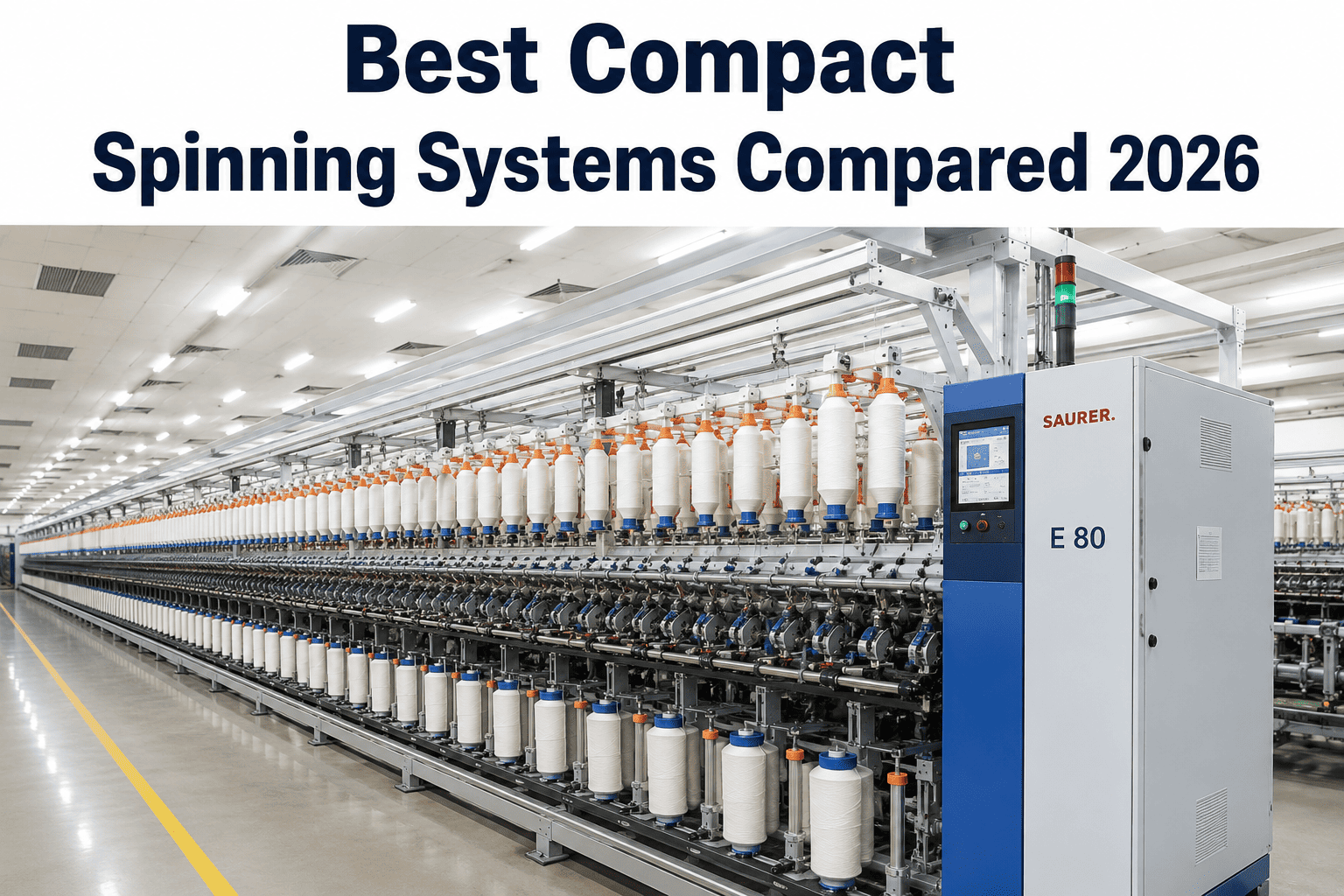
Compact spinning was adopted across premium yarn production for one reason — eliminating the spinning triangle that conventional ring spinning cannot avoid — but the three main compaction technologies achieve that elimination differently enough that choosing between them purely on brand reputation often leaves a mill paying for capability it does not need or missing a quality gain it does. Suction-based perforated drum systems compact fibres using negative pressure through a rotating perforated surface, Suessen's EliTe system uses a similar suction principle with its own apron and lattice configuration, and Muratec's EliTwist approach compacts using a different mechanical geometry entirely, and each produces measurably different hairiness reduction, strength gain, and maintenance demand. A mill selecting a compact spinning system based on what a competitor installed, without validating against its own fibre mix and target yarn specification, risks paying premium capital cost for a compaction improvement that a different, cheaper system would have delivered just as well for that specific application. iFactory's spinning technology analytics platform tracks hairiness reduction, strength improvement, and maintenance cost across compact spinning systems in operation, giving mills comparison data specific to their own fibre and count range rather than a generic vendor claim. Book a free compact spinning technology comparison assessment.
Suction-based compact systems like Rieter K44 and Suessen EliTe reduce hairiness by 30-40% and improve strength by 8-12% versus conventional ring spinning by condensing fibres before twist insertion, while Muratec's EliTwist mechanical approach achieves similar compaction with different maintenance and energy demands. iFactory tracks actual hairiness, strength, and maintenance cost outcomes across whichever compact system a mill runs, validating the technology choice against real production data. Average result: 32% hairiness reduction and 15% lower unplanned compact-attachment downtime when maintenance is condition-triggered rather than calendar-based.
Why the Spinning Triangle Is the Problem Compact Systems Solve
In conventional ring spinning, fibres emerging from the front roller nip form a triangular, unsupported zone before twist is fully inserted, and fibres at the edges of this triangle receive less twist than those at the centre, leaving them loosely bound and prone to standing proud of the yarn surface as hairs. This structural weakness is unavoidable in conventional ring spinning geometry regardless of how well twist multiplier, draft, and speed are otherwise optimized, which is why compact spinning was developed specifically to condense the fibre strand's width before it reaches the twisting point, eliminating or drastically narrowing the unsupported triangle. The practical result is yarn with meaningfully lower hairiness, higher strength for the same twist level, and better abrasion resistance in subsequent processing, all without changing the fibre or count — the gain comes entirely from geometry at the point twist is inserted, which is also why the specific compaction mechanism used matters enough to compare carefully rather than treat as interchangeable. This is also why compact yarn commands a genuine price premium in downstream markets rather than simply being a marketing label — weaving and knitting mills buying compact yarn measure the reduction in machine stoppages and fabric defects directly, and that measurable downstream benefit is what justifies the premium a spinning mill can charge for it, provided the compaction quality is actually delivered consistently rather than only at the point of initial machine commissioning.
iFactory tracks hairiness, strength, and maintenance outcomes across compact spinning systems so a technology decision reflects your actual fibre mix, not a generic vendor benchmark.
Compact Spinning Technology Comparison: Suction Drum, EliTe, and EliTwist
| Comparison Factor | Suction Perforated Drum (Rieter K44) | Suessen EliTe | Muratec EliTwist |
|---|---|---|---|
| Compaction Mechanism | |||
| Compaction method | Perforated rotating drum, suction | Apron and lattice, suction | Mechanical roller geometry |
| Compressed air or vacuum need | Vacuum source required | Vacuum source required | No vacuum source needed |
| Yarn Quality Outcome | |||
| Hairiness reduction | High, consistent | High, consistent | Moderate to high |
| Strength gain versus conventional | 8-12% | 8-11% | 6-9% |
| Maintenance and Running Cost | |||
| Component wear exposure | Perforated drum wear over time | Apron and lattice wear | Fewer suction-related wear points |
| Energy demand | Vacuum system power draw | Vacuum system power draw | Lower, no vacuum draw |
| Cleaning and fibre fly management | Perforations need regular cleaning | Lattice needs regular cleaning | Lower cleaning demand |
Figures are indicative and vary with fibre type, count, and machine generation; validate against your own yarn testing before final technology selection.
Fiber Compaction and Hairiness Control: What Actually Drives the Quality Gain
Regardless of which mechanism a mill selects, the quality gain from compaction is driven by the same underlying variable — how tightly and evenly the fibre strand is condensed immediately before the twisting point, and how consistently that condensation holds across every spinning position on the machine, not just on the units checked during commissioning. Suction-based systems depend on consistent vacuum level and a clean, unobstructed perforated surface or lattice, and any partial blockage from fibre fly accumulation reduces compaction locally on that position without necessarily showing up as a machine-wide alarm. Mechanical compaction systems like EliTwist depend instead on precise roller geometry and condition, where wear changes the compaction angle gradually rather than suddenly, producing a slow hairiness creep that is easy to miss without direct tracking against yarn test data. In both cases, the compaction technology's rated performance and its actual delivered performance on a given mill floor can diverge meaningfully once real operating conditions, fibre fly, and component wear are factored in, which is the strongest argument for validating any compact spinning investment against continuous quality data rather than a specification sheet alone. Vacuum level itself deserves separate attention beyond the compaction surface condition, since a shared vacuum system feeding many spinning positions can develop uneven suction distribution as ductwork accumulates fibre residue or as individual position valves wear, meaning some positions on an otherwise well-maintained frame receive systematically weaker compaction than others without any single fault triggering an alarm. Regular vacuum level verification at the position level, not just at the central pump, is therefore as important to sustained compaction quality as cleaning the compaction surface itself, and is frequently the overlooked half of an otherwise diligent maintenance routine.
Matching Compact Spinning Technology to Your Mill's Actual Profile
A mill already running a large fleet of vacuum-source equipment such as compact winding or existing suction compact frames has an infrastructure argument for staying with a suction-based system like Rieter K44 or Suessen EliTe, since the incremental vacuum capacity and maintenance skillset already exist on site rather than needing to be built from scratch for a mechanical alternative. A mill in a location where reliable, uninterrupted power for a vacuum system is a genuine operational concern, or where energy cost per unit is unusually high, has a stronger case for evaluating Muratec's EliTwist mechanical approach, since it removes the vacuum draw entirely at a modest trade-off in the achievable hairiness reduction ceiling. Fibre type also matters more than it is usually given credit for — coarser, higher-trash-content cotton tends to load a perforated drum or lattice with fibre fly faster than cleaner combed cotton, which shifts the maintenance cost equation toward whichever system has the lower cleaning frequency requirement for that specific fibre. None of these factors alone should decide the investment; the decision holds up best when a mill runs a controlled trial across a representative sample of positions using each candidate technology and compares hairiness, strength, and maintenance labour hours on its own yarn before committing capital across the full frame fleet.
The capital cost difference between suction-based and mechanical compaction systems is usually smaller than the ongoing operating cost difference over the equipment's working life, which is why a purchase decision weighted heavily toward upfront price alone often produces a worse total cost of ownership than one that accounts for vacuum system power draw, cleaning labour, and component replacement frequency across several years of operation. Mills that have already standardized on one compaction technology across most of their frame fleet also carry a switching cost in operator training and spare parts inventory that should be weighed explicitly against any quality or energy advantage a different technology might offer for a new installation, rather than treating each new frame purchase as an independent decision disconnected from the existing fleet.
iFactory's assessment reviews your compact attachment data against actual hairiness and strength outcomes to confirm the technology is delivering its expected gain.
Frequently Asked Questions
iFactory tracks compaction performance, maintenance condition, and yarn quality outcomes across whichever compact spinning technology you run, so the investment keeps delivering its expected gain. On-premise ready. First insights within weeks.