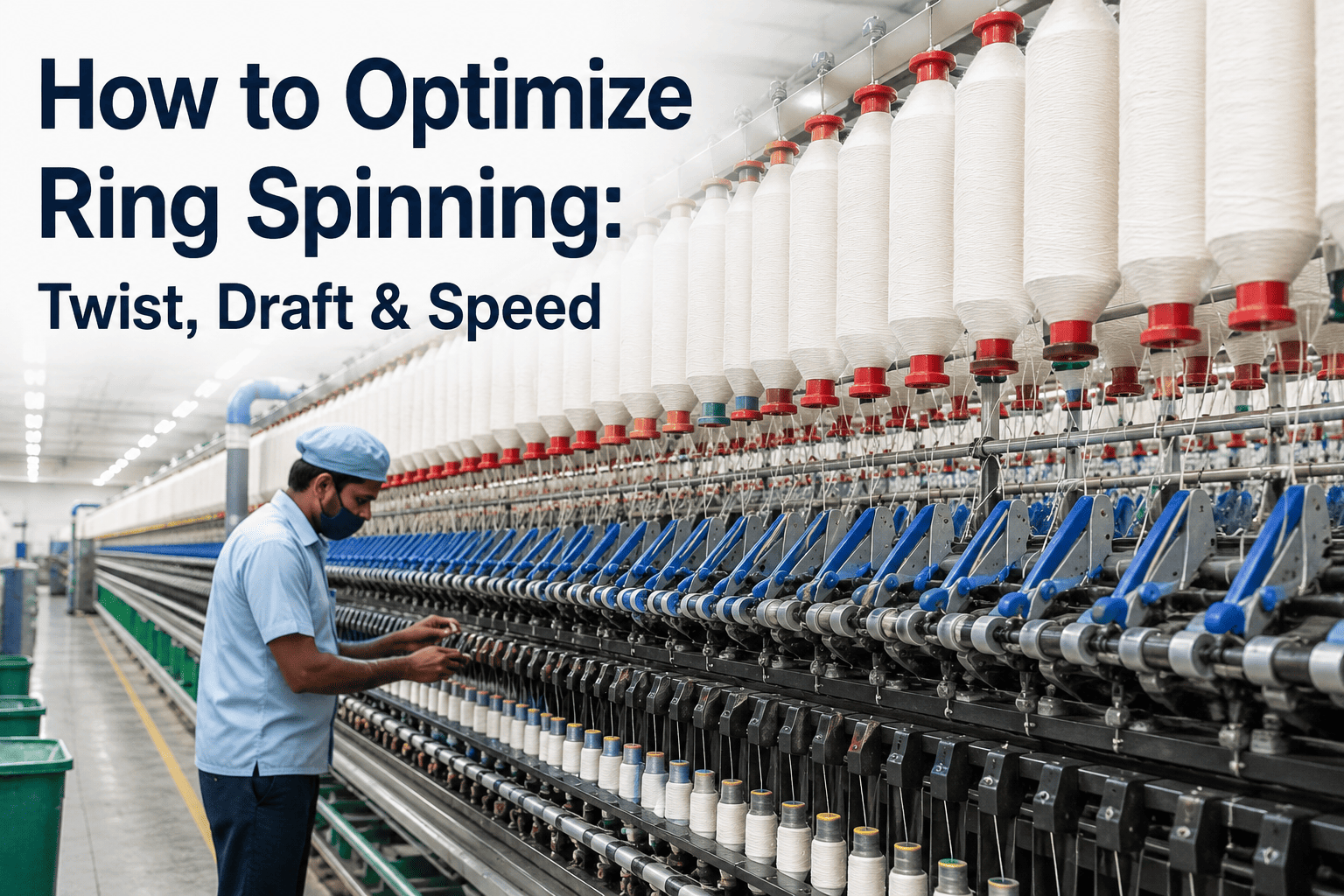
How to Optimize Ring Spinning: Twist, Draft & Speed
By James Smith on July 18, 2026
Ring spinning still produces more of the world's yarn than any other spinning system, yet most mills leave measurable quality and output on the table because twist multiplier, draft zone settings, and spindle speed were tuned once and never revisited since installation day. A few tenths of a twist multiplier or a poorly matched roller gauge can quietly raise end breakage, inflate hairiness, and cap production well below what the frame is actually capable of running. This guide walks through the exact parameters worth checking first, the ranges mills are running successfully today, and how to tell whether your ring frame is genuinely optimized or simply running. If your team wants a faster way to track these settings against live production data, our team can walk you through it at ifactoryapp.com/support.
Ring Frame Parameter Guide 2026
Optimize Ring Spinning: Twist, Draft and Speed
Small parameter shifts on the ring frame routinely recover 4 to 9 percent production without touching yarn strength or evenness targets.
17,000RPM achievable with matched TM and traveller mass
4.1Yarn twist multiplier found optimal in Box-Behnken trials
1.3Roving twist multiplier paired with high-speed spinning
Twist multiplier, draft zone geometry, and spindle speed interact with each other constantly. Change one without checking the others and a mill typically trades one quality problem for another, which is why isolated adjustments so often disappoint.
62%of end breakage incidents trace back to a spindle speed and traveller mass mismatch
30–40%roller pressure increase often needed after a break draft adjustment
9–15%typical production gain from correctly matched TM and RPM
5–1000tex range ring spinning covers when settings are properly tuned
The Three Parameters Worth Auditing First
These three settings account for the overwhelming majority of quality complaints and lost production on a ring frame. Work through them in this order, since each one changes the safe operating range of the next.
01
Twist Multiplier
Twist multiplier governs yarn strength, hairiness, and how the yarn behaves downstream in weaving or knitting. Set it too low and end breakage climbs; set it too high and both hairiness and energy consumption rise while feel and drape suffer. Trials using Box-Behnken response surface designs consistently land on a yarn TM near 4.1 with roving TM around 1.3 as the balance point for medium counts at higher spindle speeds, though fiber type and end use shift this window.
Working range: 3.7–4.4 TM for weaving, 3.7–3.9 for knitting
02
Draft Zone Setting
The break draft ratio and back roller gauge determine how evenly fiber is drawn out before final twist insertion. Too low a break draft leaves thick places because the twisted roving cannot be adequately drafted in the back zone. Too high a break draft, paired with a wide roller gauge, produces drafting waves that show up as periodic unevenness in the finished yarn. Roller pressure typically needs a 30 to 40 percent increase alongside any break draft change to keep fiber control consistent.
Working range: 1.2–1.4 break draft with gauge matched to fiber length
03
Spindle Speed
Spindle speed is the production lever, but it only pays off when traveller mass and top roller pressure move with it. Trials optimizing all three together found 15,000 RPM with 2.5 kg per square centimeter roller pressure and 50 ISO number traveller mass gave the best all-round result, while pushing to 17,000 RPM required dropping to a lighter 40 ISO number traveller to hold acceptable running performance without excess end breaks.
Working range: 15,000–17,000 RPM with traveller mass adjusted inversely
Optimized vs Unoptimized: What Changes on the Floor
This is the practical difference mills report after moving from inherited or default ring frame settings to parameters that have actually been tested and matched to their fiber and count, based on production data gathered across the first ninety days of a structured audit rather than a single trial batch.
Ring Frame Performance — Medium Count Cotton
Metric
Default / Unaudited Settings
Optimized Settings
Change
End breakage rate
18–24 breaks/1000 spindle hours
8–12 breaks/1000 spindle hours
Up to 55% lower
Yarn hairiness index
5.8–6.4
4.6–5.1
15–20% lower
Spindle speed achievable
13,000–14,000 RPM
16,000–17,000 RPM
Up to 21% higher
Yarn strength (CSP)
Baseline
+6 to +9%
Stronger yarn
Roving waste at back zone
2.1–2.6%
1.2–1.5%
40% less waste
A Four-Step Path to a Fully Audited Ring Frame
Parameter changes made in isolation rarely stick. This is the sequence mills follow to reach settings that hold up across shifts, fiber lots, and seasons.
Step 1
Baseline the current settings against actual output data
Pull end breakage logs, hairiness index readings, and CSP data for the last 90 days before touching a single dial. Without a real baseline, any improvement claim is guesswork.
Step 2
Adjust twist multiplier first, roving then yarn
Move roving TM in small increments and confirm the roving survives winding and unwinding without stretch before adjusting yarn TM. Twist changes ripple through every downstream setting.
Step 3
Match draft zone geometry to the new twist level
Recheck break draft ratio and roller gauge, and increase roller pressure 30 to 40 percent if the break draft moved. Run a trial lot and inspect for drafting waves before scaling up.
Step 4
Raise spindle speed in increments and track traveller wear
Increase RPM in 500 to 1000 unit steps, dropping traveller mass at each increment, and hold each step for a full shift before moving on. Log breakage rate at every stage.
How Fiber Type and Count Shift These Ranges
The working ranges above are starting points, not fixed targets. Fiber length, micronaire, and the count being spun all pull the optimal twist multiplier, draft zone, and spindle speed in different directions, and mills that ignore this end up applying one recipe to fibers that behave nothing alike, which is a large part of why the same nominal settings can perform well on one order and poorly on the next.
Coarse Counts (Below Ne 20)
Lower twist multipliers around 3.3 to 3.6 keep bulk and softness while draft zones can run wider gauges since coarser fiber bundles tolerate more aggressive drafting without breaking apart. Spindle speed is usually the binding constraint here rather than twist.
Medium Counts (Ne 20–40)
This is the range where the 4.1 yarn TM and 1.3 roving TM combination tested in response surface trials performs most consistently, and where the 15,000 to 17,000 RPM working window applies almost directly without major adjustment.
Fine Counts (Above Ne 40)
Fine counts need tighter roller gauges and higher twist multipliers, often 4.4 and above, to hold strength since there is less fiber mass per unit length to carry tension. Spindle speed typically has to come down slightly to protect end breakage rates.
Polyester and Blended Fiber
Synthetic and blended fibers with higher denier need a wider break draft roller gauge and a 30 to 40 percent roller pressure increase to avoid uneven drafting, along with twist settings tuned separately from pure cotton recipes since fiber-to-fiber friction differs.
See Your Own Frame Data
Book a 30-Minute Review of Your Current Ring Frame Settings
We will look at your existing twist multiplier, draft zone, and spindle speed settings against your actual breakage and hairiness data, and show where the fastest wins are sitting on your specific frames and fiber mix.
These four mistakes account for the majority of failed optimization attempts we see when mills try to raise output without a structured parameter review.
55%
Raising Speed Without Adjusting Traveller Mass
Pushing spindle RPM up while keeping the same traveller weight is the single most common cause of a sudden spike in end breaks after a "productivity" change, and it usually shows up within the very first shift, catching supervisors off guard before they connect the two events.
33%
Changing Break Draft Without Roller Pressure
Adjusting the break draft ratio alone, without lifting top roller pressure to compensate, is a leading cause of drafting waves showing up in finished yarn evenness data, particularly on fiber blends where roller grip is already marginal before the change.
26%
Copying Settings Across Different Fiber Lots
Twist and draft settings validated on one cotton lot are frequently applied unchanged to a new lot with different micronaire and staple length, quietly degrading quality over several weeks until a customer complaint or lab test finally traces the issue back to the frame.
19%
No Baseline Data Before Changing Anything
Without breakage, hairiness, and CSP figures recorded before a change, mills cannot tell whether an adjustment genuinely helped or whether other variables, like humidity or a fresh traveller batch, shifted the numbers at the same time and masked the real cause.
Quick Audit Checklist Before Your Next Parameter Change
Run through these six checks before making any adjustment to twist, draft, or speed. Skipping any one of them is where most avoidable quality complaints originate, and each item takes only a few minutes to verify on the shop floor.
1Confirm current breakage rate, hairiness index, and CSP are logged for at least the last two weeks of production, not just the last shift.
2Verify the fiber lot on the frame matches the lot the current settings were originally validated against, including micronaire and staple length.
3Check traveller mass and top roller pressure records against the last time spindle speed or break draft were changed.
4Inspect a small sample of current yarn for drafting waves or periodic unevenness before assuming the frame is running cleanly.
5Plan any speed increase in stages of 500 to 1000 RPM rather than jumping straight to the target speed.
6Hold each new setting for a full shift and compare breakage and hairiness data before locking it in as standard practice.
Frequently Asked Questions
What twist multiplier should I start with for medium count cotton yarn?
Trials using response surface methodology on cotton ring spinning consistently point to a yarn twist multiplier around 4.1 combined with a roving twist multiplier near 1.3 as a strong starting point for medium counts run at higher spindle speeds. From there, fine-tune within a 3.7 to 4.4 window based on whether the yarn is destined for weaving or knitting, since knitting yarns generally run slightly lower twist for softer hand feel. Reach out to our team if you want help mapping this to your specific counts.
How do I know if my spindle speed is too high for my current traveller mass?
The clearest signal is a rising end breakage rate that appears within days of a speed increase without any other process change. If breaks climb past roughly 15 to 18 per 1000 spindle hours after raising RPM, the traveller is very likely too heavy for the new speed and needs to drop to a lighter ISO number to restore stable running tension.
Why does my yarn show drafting waves after I changed the break draft?
Drafting waves usually appear when the break draft ratio and back roller gauge are increased together without a matching rise in top roller pressure. The fibers are not held firmly enough through the back zone, so they slip unevenly rather than drawing out smoothly, creating a periodic thick-and-thin pattern that downstream quality checks will flag immediately.
Can I run the same ring frame settings across different cotton lots?
Not reliably. Micronaire, staple length, and trash content vary between lots even within the same grade, and each of these shifts the ideal draft zone and twist settings slightly. Mills that copy settings unchanged across lots typically see hairiness or breakage creep upward within a few weeks. A short verification run on each new lot avoids this drift.
How long does a full ring frame parameter audit typically take?
A structured audit covering baseline data collection, twist multiplier adjustment, draft zone matching, and a staged spindle speed increase generally takes two to four weeks per frame group, since each stage needs at least a full shift of running data before moving forward. Book a 30-minute call to see how this maps onto your production schedule.
The Real Takeaway on Ring Frame Optimization
None of these three parameters can be optimized safely in isolation, and that is exactly why so many mills stall out after one promising change. Twist multiplier sets the strength and hairiness ceiling, draft zone geometry decides whether the yarn actually reaches that ceiling evenly, and spindle speed only pays off once the first two are locked in and matched to a traveller mass that can survive the friction. Mills that treat this as a repeatable, data-backed process rather than a one-time tweak are the ones reporting sustained production gains a year later, not just a good first week.
Stop Guessing at Ring Frame Settings
Get Your Twist, Draft, and Speed Parameters Matched to Real Production Data
iFactory connects to your ring frame data and flags exactly where twist multiplier, draft zone, and spindle speed are working against each other, so every adjustment is backed by evidence instead of habit. Most mills identify their first meaningful parameter mismatch within the first month of monitoring.