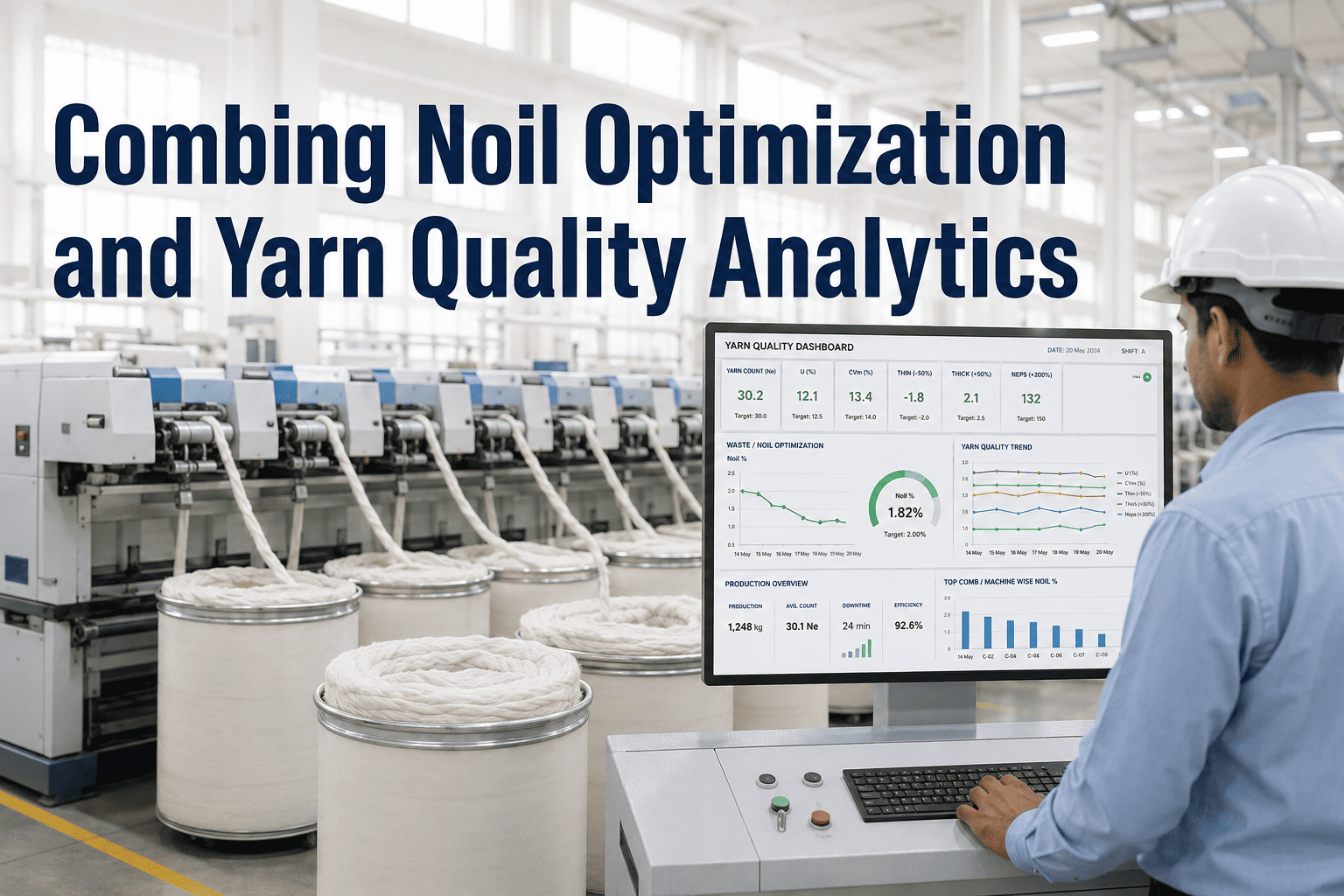
Every percentage point of noil removed at the comber is fiber that never becomes yarn, which makes noil percentage feel like a pure cost to minimize, right up until quality drops because too little noil means short fiber and neps stayed in the sliver. The comber's whole job is to strike a specific balance for a specific fiber quality target, and that ideal balance shifts depending on raw material, count, and the buyer's quality requirement for that particular order. Combing noil optimization software tracks noil percentage against nep removal and downstream yarn consistency together, so the balance gets set deliberately rather than left to whatever a machine operator adjusted last. Spinning and quality teams can book a demo to see the balance modeled against their own comber data.
SPINNING ANALYTICS · COMBING NOIL
Set Your Noil-to-Quality Balance Deliberately, Lot by Lot
Noil percentage, nep removal, and downstream yarn consistency get tracked together, so combing settings reflect a deliberate quality target instead of whatever was adjusted last.
Where a Lot Sits on the Noil-Quality Scale
Low Noil
More Neps Retained
High Noil
Higher Fiber Cost
Why the Right Noil Percentage Isn't a Fixed Number
A noil target that's correct for a coarse count running against a relaxed buyer specification is very likely too low for a fine count destined for a premium yarn where every nep matters. Mills that apply a single standard noil percentage across their full product mix are either wasting good fiber on orders that didn't need that level of combing, or under-combing premium orders that actually required it.
The comparison only becomes useful when noil percentage, nep removal rate, and the resulting yarn consistency are viewed side by side for each lot and count combination, since that's what reveals whether a given setting is actually hitting the target quality level or simply consuming more fiber than necessary to get there.
FIND YOUR OWN BALANCE POINT
See Noil and Quality Data Together for Your Comber
A working session using your own product mix and buyer specifications.
Matching Noil Settings to What the Order Actually Needs
| Product Target | Typical Noil Priority | What to Watch |
|---|
| Premium fine count yarn | Higher noil, prioritize nep removal | Diminishing quality gain past a certain noil level |
| Standard coarse count yarn | Lower noil, prioritize fiber yield | Nep count rising past buyer tolerance |
| Blended fiber yarn | Balanced, tuned per blend ratio | Different fiber components combing unevenly |
Lot-Specific
Noil targets are set per count and buyer specification, not a single mill-wide number
Fiber & Quality
Both sides of the tradeoff are visible together for every combing decision
Traceable
Downstream yarn consistency links back to the noil setting that produced it
What a Spinning Quality Manager Told Us
We were running the same noil percentage across almost our entire product mix out of habit, and it took seeing the data side by side to realize we were over-combing half our orders and slightly under-combing our premium count. Adjusting per product instead of using one blanket setting made a real difference to both cost and quality.
Spinning Quality Manager, Combed Cotton Yarn Mill
Modeling the Real Cost of a Noil Percentage Change
A one percentage point change in noil sounds small until it's translated into raw fiber cost across a full production run, and that translation is what actually makes a noil decision meaningful to a plant manager rather than just a quality engineer. Modeling projected fiber cost against projected quality outcome for a proposed setting change, before it's actually run on the floor, turns combing adjustments into a decision with a clear expected return rather than a change made on instinct.
This modeling becomes especially useful when fiber prices shift. A noil percentage that made sense at one raw material cost may no longer be the right tradeoff once fiber prices move, and having the cost and quality relationship modeled makes it far easier to re-evaluate the setting quickly rather than defaulting to whatever was set previously.
Working Directly From Buyer Specifications
Many nep and quality tolerances are defined explicitly in a buyer's specification sheet, yet those documents often live separately from the actual combing settings used to produce the order. Connecting buyer specification data directly to the noil and quality targets for that order removes the manual translation step where a specification requirement has to be interpreted and communicated to the floor separately, which is a common point where requirements get diluted or forgotten between departments.
Typical Noil Ranges Worth Knowing
| Reference Point | Typical Range |
|---|
| General combing noil extraction | Commonly falls between 10% and 25% of input fiber weight |
| Standard premium fine-count target | Often runs toward the 15% to 20% portion of that range |
| Starting point for trial-based optimization | Roughly half the mixing's short fiber content, then refined |
Frequently Asked Questions
How does the system know what noil level a specific order actually needs?
Buyer specifications and count-level quality requirements are configured against each order, and the system compares actual noil and nep removal results against that specific target rather than a single mill-wide standard. This makes it possible to see clearly when a lot is over-combed relative to what the order actually required, or under-combed relative to what it needed. Teams can
book a demo to see target configuration by order.
Can this help reduce fiber cost without a customer noticing a quality difference?
Yes, this is often where the biggest opportunity is, since orders with a relaxed quality tolerance are frequently combed at a higher noil percentage than necessary simply because settings weren't adjusted per order. Identifying that gap lets a mill reduce fiber cost on those specific orders while keeping premium orders combed at the level they actually require.
Does this work for blended fiber yarns, not just pure cotton?
Yes, blended fiber combing is tracked with its own baseline since different fiber components in a blend can respond differently to the same combing settings. The analytics accounts for blend ratio when comparing noil and quality results, rather than treating a blend the same as a single-fiber lot. Blend-specific configuration can be reviewed through
support.
How is nep removal actually measured and compared?
Nep count is captured from existing lab testing on sliver samples and connected to the specific comber setting and lot that produced it, giving a direct before-and-after comparison across setting changes. This connection between the setting and its measured outcome is what turns a one-time lab result into a usable trend for future decisions.
How long does it take to establish the right balance for our product mix?
Establishing an initial data-backed baseline across a mill's core product mix typically takes a few weeks of production data, with refinement continuing over the following months as more counts and blend combinations run through the system. Most mills start seeing actionable comparisons for their highest-volume products well before the full product mix is covered.
STOP COMBING EVERY ORDER THE SAME WAY
Match Noil Settings to What Each Order Needs
See how your own product mix could balance fiber cost against quality.