Static electricity does not appear on any maintenance checklist, yet it is one of the most common reasons a spinning department that ran fine all winter suddenly starts fighting itself the moment the dry season arrives. Relative humidity outside the 55 to 65 percent band changes how fiber behaves at a physical level — cotton stiffens, static builds, and end breaks climb — long before anyone thinks to check the psychrometer instead of the machine settings. See how continuous climate tracking connects to yarn break data with Book a Demo.
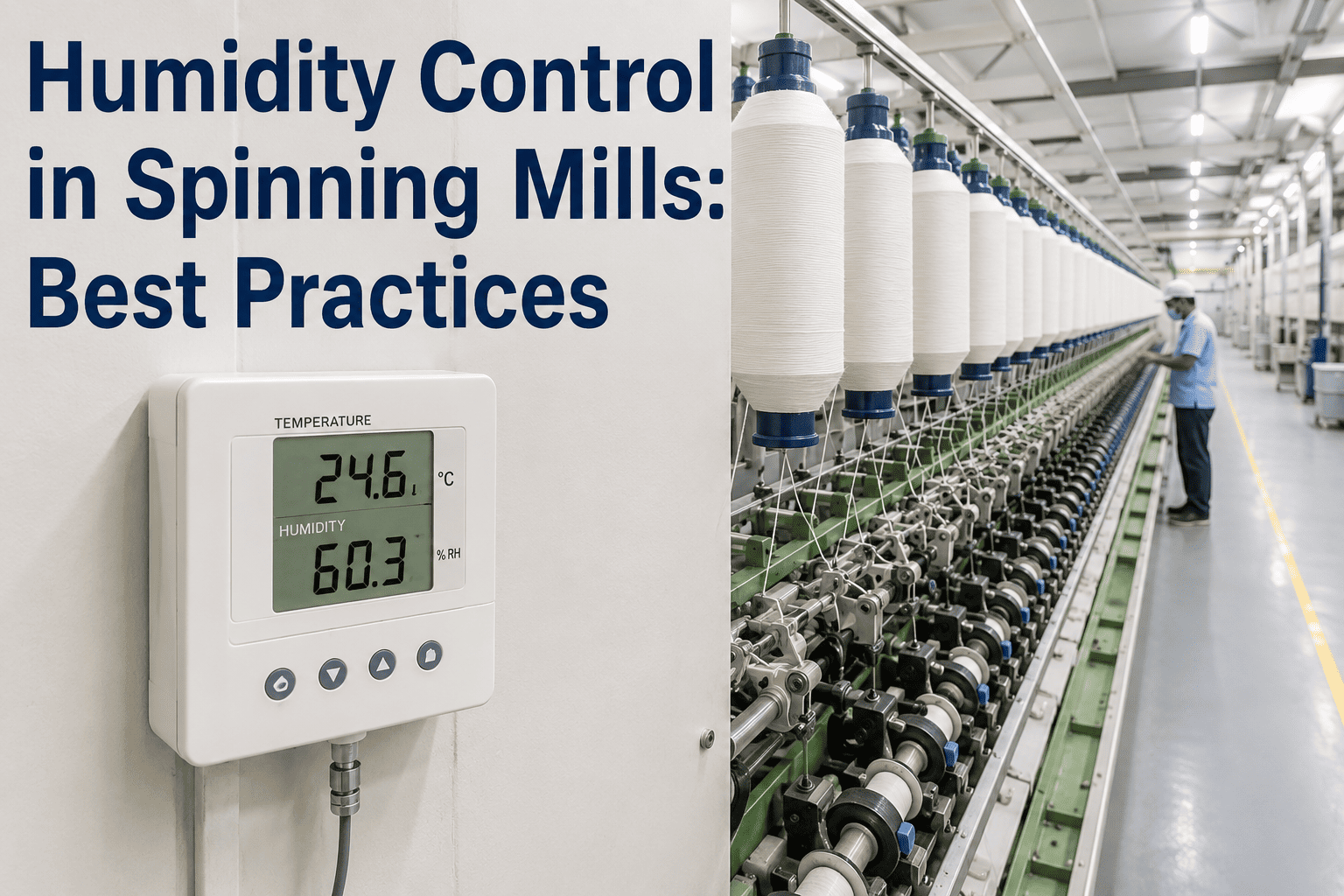
Humidity Control in Spinning Mills: Best Practices
A practical guide to maintaining optimal humidity and temperature across cotton, synthetic, and blended fiber processing, and how climate drift shows up in yarn breaks before anyone notices the room feels different.
Where Humidity and Temperature Should Sit, Department by Department
Each department along the spinning process has a slightly different optimal range, since fiber moisture sensitivity changes as material moves from raw form to finished yarn.
Blow Room
Lower humidity here reduces fiber clumping during opening and cleaning, keeping trash extraction efficient.
Carding
Moderate humidity prevents excess fiber-to-metal friction on card wire while still controlling static generation.
Ring Spinning
The most sensitive department, where humidity outside this band directly drives measurable shifts in end break rate.
Winding
Slightly higher humidity reduces yarn breakage during high-speed unwinding and improves package build quality.
Connect Climate Drift to Quality Loss Before It Compounds
See how continuous humidity and temperature tracking correlates with end break trends across your departments.
Low Humidity Versus High Humidity: Different Problems, Same Root Cause
Too Dry
Too Humid
Humidity Requirements Vary Significantly by Fiber Type
| Fiber Type | Optimal RH Range | Sensitivity to Deviation | Primary Risk |
|---|---|---|---|
| Cotton | 55–65% | High | Static and brittleness at low RH |
| Polyester | 50–60% | Low to Moderate | Static buildup, less moisture-driven |
| Viscose | 60–68% | High | Strength loss at low RH |
| Wool | 60–70% | Moderate | Fiber felting at high RH combined with heat |
Four Practices That Keep Climate Control Stable Through the Season
Calibrate humidification sensors on a fixed schedule, since sensor drift produces confidently wrong readings that mask a real problem.
Zone the department into monitoring sections rather than relying on a single reading, since humidity often varies meaningfully between the wall and center of a large floor.
Track humidity against end break rate over time to establish the actual sensitivity curve for your specific fiber mix and machinery.
Adjust humidification capacity ahead of known seasonal transitions rather than reacting after quality metrics have already shifted.
Frequently Asked Questions
Q: How quickly does end break rate respond to a humidity drop?
The response can be measured in hours rather than days, particularly in ring spinning where fiber cohesion depends directly on moisture content at the point of twist insertion. A department running comfortably at 60 percent RH that drops to 45 percent over a dry afternoon can see end break rate climb noticeably within that same shift, well before humidification systems typically catch up. This fast response time is exactly why continuous tracking matters more than periodic manual spot checks. Ask about continuous climate-to-quality tracking with Book a Demo.
Q: Why does humidity control matter more in ring spinning than in weaving?
Ring spinning involves fiber under active drafting and twist insertion, a mechanically demanding process where fiber cohesion and pliability directly determine whether the yarn holds together under tension. Weaving works with already-formed yarn, which is comparatively more tolerant of humidity variation since the fiber-to-fiber bonding was already established during spinning. This is why spinning departments typically justify tighter humidity control investment than downstream weaving or knitting floors.
Q: Can a mill run different humidity targets for different products on the same floor?
In practice this is difficult without physical zoning, since humidification and air handling systems typically control an entire floor or section rather than individual machine positions. Mills processing both cotton and synthetic fiber blends usually settle on a compromise range that serves both reasonably well, or invest in physical partitioning between departments with meaningfully different requirements. Product scheduling that groups similar-humidity-sensitivity orders together on the same shift can also reduce the practical need for zoning.
Q: What is the relationship between temperature and humidity control in a spinning department?
Temperature and relative humidity are directly linked, since RH is itself a function of both moisture content and air temperature — raising temperature without adding moisture lowers relative humidity even if absolute moisture content stays constant. This is why a department can experience a real humidity problem purely from a temperature swing, such as heat generated by running machinery during a hot shift, even without any change in the humidification system output. Reach out through Support Contact to review temperature-humidity interaction for your facility.
Q: Is manual psychrometer checking sufficient for most spinning mills?
Manual checking at fixed intervals catches sustained deviations but misses the shorter fluctuations that occur between checks, particularly during weather transitions or when humidification equipment briefly underperforms. Given how quickly end break rate can respond to humidity swings, mills producing higher-value or more humidity-sensitive products generally benefit from continuous automated monitoring that can flag deviation the moment it starts rather than at the next scheduled reading.
Stop Guessing Whether Climate Caused the Quality Dip
See continuous humidity and temperature monitoring correlated directly with your yarn quality data.