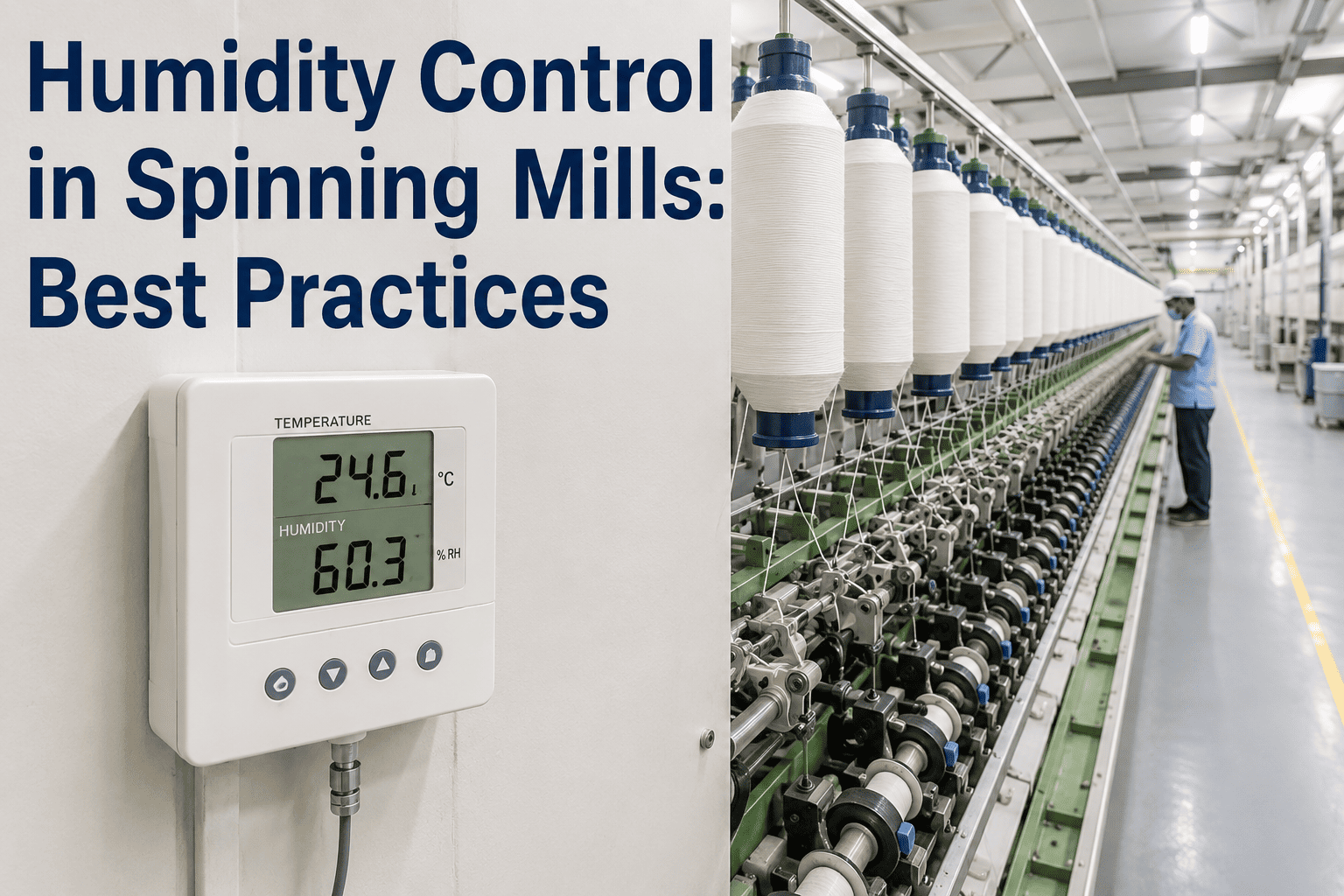
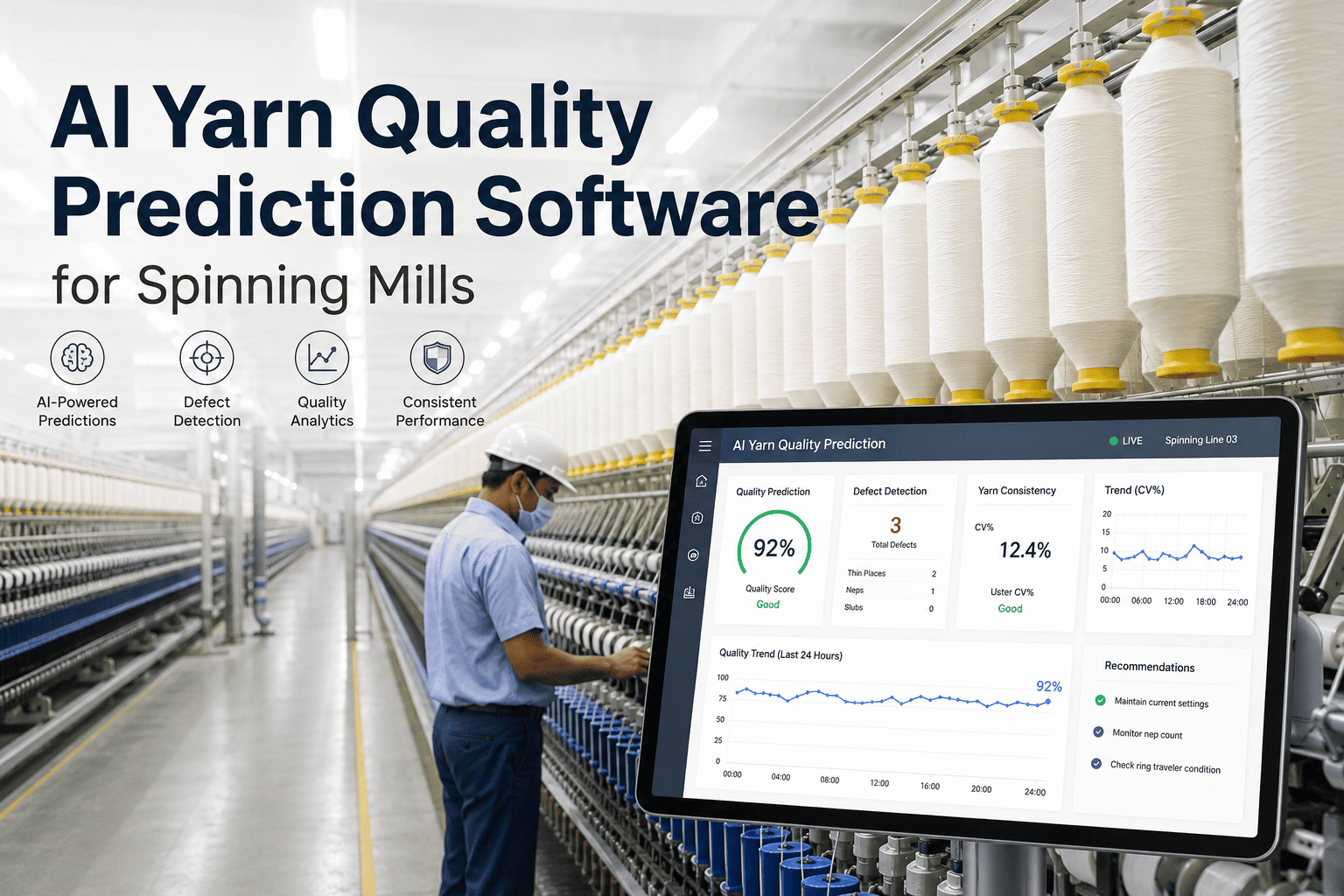
Relative humidity is the most influential environmental variable in a textile mill that no one can see. At 55 percent RH, cotton fibers carry optimal moisture for drafting and twisting — yarn breaks stay low, fly generation is minimal, and static charges dissipate harmlessly. At 45 percent RH, fiber strength drops, break frequency doubles, and the air fills with fly that clogs travelers, contaminates fabric, and increases respiratory loading on HVAC filters. At 65 percent RH, fibers become tacky, laps form on rollers, and corrosion accelerates on ring frames and reeds. Most mills set their HVAC systems to target 50 to 60 percent RH, but manual control strategies — thermostat-only, fixed humidifier output, or operator-adjusted dampers — drift outside the 2 percent tolerance band 40 to 60 percent of operating hours. The gap between an uncontrolled environment and a stabilized one shows up directly in yarn quality, machine efficiency, and conditioned power cost that runs 25 to 35 percent of a mill's total electricity bill.
Stop Letting Humidity Drift Into Your Margin
iFactory HVAC Monitoring connects humidity sensors, AHU PLCs, chilled water valves, and steam humidifiers into a single platform that holds each zone within 2 percent RH of target — automatically.
Humidity Tolerance by Production Stage
Each textile process requires a specific relative humidity band. Operating outside these tolerances degrades quality, increases waste, and lowers machine efficiency — often in ways that operators attribute to raw material or machine condition rather than the actual root cause.
Blowroom & Carding
48-52% RHBelow 45%: excessive fiber breakage, increased short fiber content. Above 55%: lap sticking, chute feed blockages, neps in carded sliver.
Ring Spinning
53-57% RHBelow 50%: yarn breaks per 100 spindle hours double, fly generation triples. Above 60%: roller lapping, traveler heating, increased ends down in high-speed spinning.
Rotor / Open-End
48-52% RHBelow 44%: yarn strength drops, rotor deposits increase. Above 56%: sliver cohesion problems, fiber wrapping on opening rollers, uneven yarn count.
Weaving Shed
78-85% RHBelow 75%: warp breaks increase 40 percent, reed abrasion accelerates, filling insertion defects rise. Above 85%: corrosion on heald frames and drop wires, fabric quality defects from condensation.
Winding & Packing
60-65% RHBelow 57%: static electricity causes poor package formation, yarn ballooning, and unwinding issues at downstream processes. Above 68%: package swelling, dye package density variation.
How Humidity Drift Affects Each Department
The same deviation — 8 percent below target — manifests differently in each process. Understanding these signatures helps operations teams identify humidity-related losses without relying solely on sensor readings.
- Fiber breakage up 25%
- Short fiber content increases
- More neps in sliver
- Lap sticking on calendar rolls
- Chute feed bridging
- Card clothing corrosion
- Ends down double
- Fly generation x3
- Yarn hairiness rises
- Roller lapping frequent
- Traveler over-heating
- Copolymer top arm marking
- Warp breaks +40%
- Reed wear accelerated
- Filling insertion defects
- Corrosion on heald frames
- Drop wire rusting
- Condensation on yarn paths
- Static electricity buildup
- Poor package formation
- Yarn ballooning at unwinding
- Package swelling
- Dye package density off
- Wax adhesion problems
See Which Zones Are Drifting Before Quality Does
iFactory maps humidity, temperature, and dew point per production zone against process-specific targets and sends alerts when any zone exceeds tolerance for more than 15 minutes.
Zone-by-Zone HVAC Configuration for Textile Mills
A textile mill is not one climate — it is five distinct zones with fundamentally different thermal loads, humidity requirements, and air-change needs. Treating the entire building as a single HVAC zone guarantees inefficiency in every department.
Spinning Zone
Weaving Zone
Winding & Packing
How HVAC Strategy Shifts With the Season
Ambient conditions in most textile-producing regions vary dramatically across the year. A fixed HVAC configuration that works in winter will over-humidify in monsoon and under-cool in summer. Seasonal tuning is essential to maintain 2 percent RH tolerance year-round.
| Parameter | Summer (35-45 deg C, 40-60% RH ambient) | Winter (15-25 deg C, 30-50% RH ambient) | Monsoon (28-35 deg C, 70-90% RH ambient) |
|---|---|---|---|
| Primary Challenge | Sensible cooling + dehumidification | Heating + humidification | Dehumidification without over-cooling |
| Humidifier Operation | Reduced to 30-50% capacity | Full capacity (80-100%) | Minimal to none; reheat may be needed |
| Chiller Load | Peak — 100% design capacity | Low — 20-40% capacity | Moderate — 50-70% capacity |
| Fresh Air Ratio | Minimized — 15-20% to reduce latent load | Maximized — 60-80% for free cooling | Moderate — 30-40% with dehumidification |
| Risk If Not Tuned | RH swings below 45% in spinning zones | RH drops below 50%; yarn breaks increase | RH exceeds 65%; roller lapping, corrosion |
| Energy Cost Impact | Highest — chillers operating at peak | Lowest — economizer mode possible | Moderate — reheat energy penalty |
Frequently Asked Questions
What is the ideal relative humidity for a spinning mill?
Ring spinning performs best at 50 to 55 percent RH with a tolerance of plus or minus 2 percent. Open-end spinning operates optimally at 48 to 52 percent RH. The blowing room and carding department should run slightly drier at 45 to 50 percent RH to maintain fiber opening efficiency. The most common mistake is treating the entire spinning floor as a single zone — departments that are 100 meters apart can need different setpoints based on machine density and heat load.
How much do yarn breaks increase when humidity is too low?
Published textile research and iFactory customer data consistently show that yarn breaks per 100 spindle hours double when relative humidity drops from 55 percent to 45 percent in ring spinning. At 40 percent RH, break frequency triples compared to optimal conditions. The mechanism is straightforward — cotton fibers at low moisture content have reduced tensile strength and higher rigidity, causing them to snap under the mechanical stress of drafting and twisting. Each additional 10,000 breaks per 100,000 spindle hours translates to approximately 2 to 3 percent lost machine efficiency.
How does iFactory control humidity across multiple mill zones?
iFactory deploys one or more humidity and temperature sensors per HVAC zone — typically every 200 to 300 square meters in spinning and every 150 to 200 square meters in weaving. The platform reads each zone independently and modulates AHU damper positions, chilled water valve openings, humidifier output, and fan speeds to maintain the zone-specific setpoint. The control loop runs every 30 seconds and uses a predictive algorithm that anticipates load changes from shift timing, outdoor weather data, and machine on-off status fed from the production schedule.
What is the energy cost of textile humidification?
HVAC and humidification together account for 25 to 35 percent of a textile mill's total electrical energy consumption, making it the second-largest load category after production machinery. The energy is split among three components: chillers (50 to 60 percent of HVAC energy), fans and pumps (25 to 30 percent), and humidification heat (10 to 20 percent). Mills that maintain tight humidity control with AI-driven optimization typically reduce HVAC energy consumption 12 to 18 percent compared to manual or PID-only control, primarily by minimizing reheat energy and optimizing fresh air intake.
Can existing HVAC systems be retrofitted with AI humidity control?
Yes. iFactory connects to existing AHU PLCs, VFDs, humidifier controllers, and chiller plant controllers using standard industrial protocols including Modbus, BACnet, and OPC-UA. No replacement of HVAC equipment is required. The platform overlays zone-level sensor data and algorithmic control on top of the existing control infrastructure. Typical deployment is 2 to 4 weeks per mill zone, starting with the spinning department where humidity sensitivity is highest and the ROI from break reduction is most immediate.
Every Zone at Its Ideal RH, Every Shift, Every Season
iFactory holds each production zone within 2 percent of target RH automatically — across spinning, weaving, winding, and finishing. Fewer breaks, less fly, lower energy cost, and consistent yarn quality regardless of outdoor conditions.