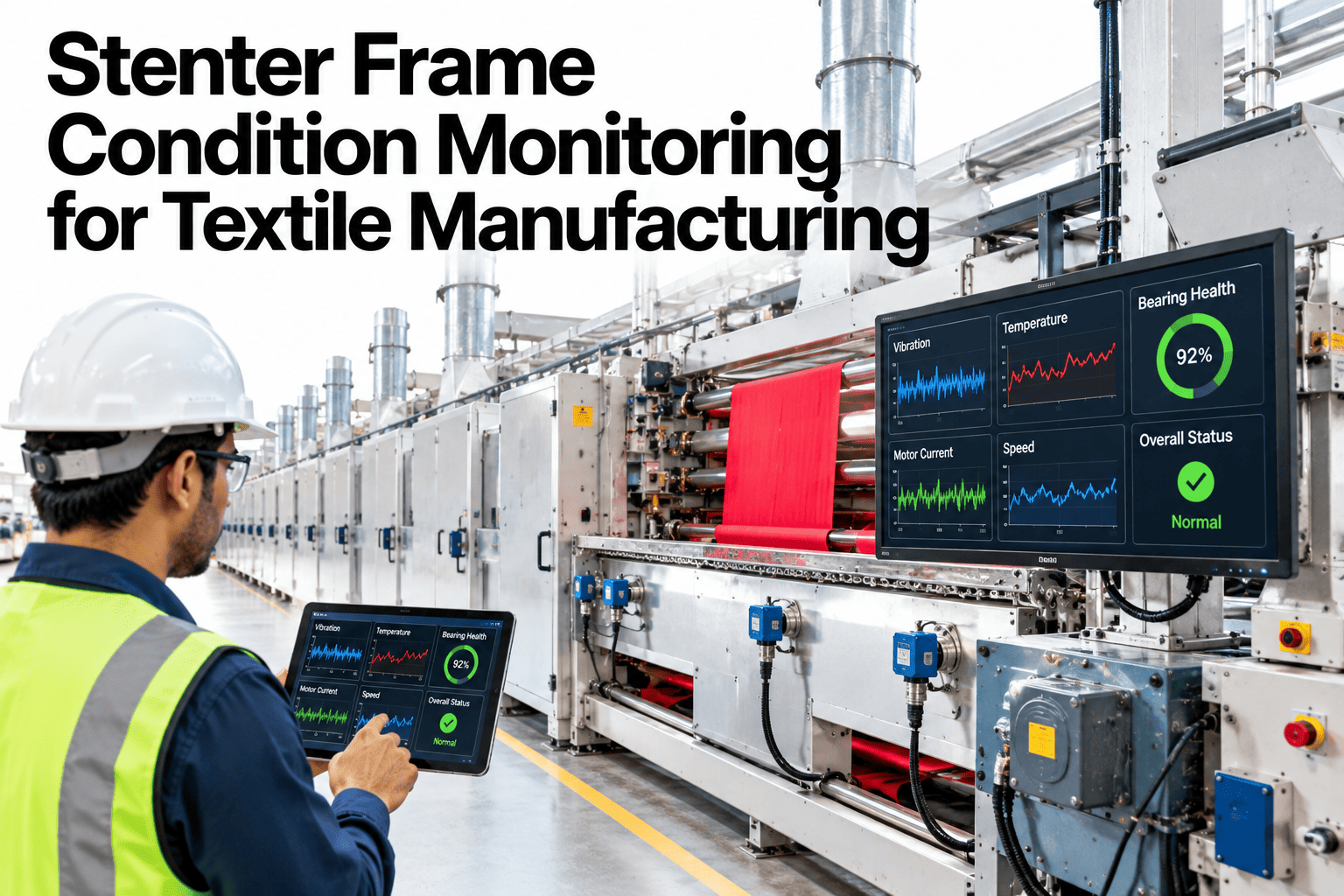
Non-destructive testing for textiles has expanded beyond fabric quality inspection to predictive maintenance of critical production machinery. Stenter frames, the most expensive and energy-intensive machines in textile finishing, account for 30 to 40 percent of unplanned downtime in finishing lines when components such as chains, clips, bearings, and rails fail without warning. Traditional maintenance approaches rely on scheduled replacement intervals or reactive repairs after breakdown, both of which result in lost production time, higher spare parts costs, and inconsistent fabric quality. Modern non-destructive testing methods including ultrasonic thickness measurement, X-ray imaging, infrared thermography, and AI-powered vision analysis enable textile manufacturers to detect stenter frame component wear, corrosion, and misalignment before failure occurs. Facilities using AI-based NDT methods report 40 to 60 percent reductions in unplanned downtime, 30 to 50 percent extensions in chain and clip service life, and 15 to 25 percent reductions in total maintenance expenditure. The industrial textile NDT market reached 480 million dollars in 2024 and is projected to grow at 8.5 percent CAGR as mills shift from calendar-based to condition-based maintenance programs.
Non-Destructive Testing for Textiles AI Methods Compared
Stop replacing stenter frame components on a fixed schedule. iFactory AI-powered NDT detects chain wear, clip fatigue, and rail misalignment before they cause production stoppages.
Traditional versus AI-Based NDT for Textile Machinery
Conventional non-destructive testing methods applied to textile finishing equipment rely on manual inspection rounds, periodic ultrasonic sampling, and visual checks that detect only advanced-stage failures. AI-based NDT methods combine multiple sensing modalities with machine learning analysis to detect early-stage degradation patterns invisible to traditional approaches. The comparison below reflects field data from textile mills using AI-enhanced NDT programs alongside conventional maintenance practices.
NDT Methods Compared for Textile Machinery
Each non-destructive testing method has specific strengths and limitations when applied to stenter frame and finishing line components. The selection of the right method depends on the component material, failure mode, and operating environment. The table below compares the five primary NDT methods used in modern textile maintenance programs.
| NDT Method | What It Detects | Best Application | AI Enhancement | Relative Cost |
|---|---|---|---|---|
| Ultrasonic Testing | Wall thickness loss, internal corrosion, cracks | Chain pins, rail wear, bearing housings | Automated signal classification reduces false positives by 60% | Medium |
| Infrared Thermography | Overheating, friction hotspots, insulation breakdown | Bearing temperature, chain lubrication gaps, motor windings | ML-based thermal pattern recognition predicts failure 2-4 weeks in advance | Low |
| AI Vision Inspection | Surface cracks, clip alignment, chain elongation, corrosion | Clip condition, chain pin visual wear, rail surface defects | Deep learning detects micron-level surface changes invisible to human eye | Medium |
| Vibration Analysis | Bearing wear, shaft misalignment, imbalance, resonance | Fan bearings, motor bearings, gearbox condition | ML models separate fault signatures from background noise with 90%+ accuracy | Low |
| X-Ray / Radiography | Internal cracks, porosity, hidden corrosion | Critical weld inspection, casting defects, chain link integrity | AI-assisted image interpretation reduces inspection time by 70% | High |
Move from calendar-based to condition-based stenter maintenance. iFactory AI-Ndt combines infrared, ultrasonic, and vision sensing with machine learning to predict failures weeks in advance.
How AI-Enhanced NDT Works on the Stenter Frame
AI-powered non-destructive testing transforms raw sensor data into actionable maintenance predictions through a four-stage pipeline. The system continuously monitors stenter frame components, analyzes multi-modal data streams, predicts remaining useful life, and triggers maintenance alerts with specific failure diagnoses.
Multi-Modal Sensor Data Collection
IoT sensors installed on the stenter frame continuously collect data from multiple NDT modalities. Infrared cameras monitor clip and rail temperature profiles. Ultrasonic transducers measure chain pin and rail thickness at critical wear points. High-resolution optical cameras capture surface condition of clips, chains, and rails. Vibration sensors on fan and motor bearings record frequency spectra. All data streams are time-synchronized and tagged with stenter operating parameters including temperature, speed, and fabric tension.
AI Feature Extraction and Fusion
Machine learning models process each sensor stream independently to extract features indicating component health. Ultrasonic signals are analyzed for echo pattern changes indicating wall thinning. Thermal images are segmented and compared against baseline temperature distributions for each stenter zone. Vision images are processed through convolutional neural networks trained to detect micron-level surface cracks, clip deformation, and chain elongation. A fusion model combines features across all modalities into a single health score for each monitored component.
Remaining Useful Life Prediction
Degradation models trained on historical failure data from similar stenter frames predict remaining useful life for each component. The models account for operating conditions, production load, and environmental factors that accelerate wear. Predictions are expressed in production hours or calendar days with confidence intervals. Components approaching end-of-life are flagged with specific failure modes and recommended intervention windows, enabling maintenance teams to plan replacements during scheduled changeovers rather than responding to emergency breakdowns.
Alerting and Maintenance Coordination
When the AI system predicts a component approaching end-of-life, it generates a structured maintenance alert containing the component identifier, predicted failure mode, remaining useful life, recommended spare parts, and estimated replacement labor hours. Alerts are integrated with the mill's CMMS or maintenance scheduling system. The system also generates weekly health summaries for the entire stenter frame showing trends, high-risk components, and recommended maintenance priorities for upcoming production breaks.
Six Stenter Frame Components Monitored by AI NDT
AI-powered non-destructive testing on stenter frames focuses on six high-criticality components where unplanned failure causes the longest production downtime and highest repair costs. Each component requires a specific combination of NDT methods and AI analysis techniques.
Chain Links and Pins
Chain elongation is the most common stenter failure mode. AI vision measures pin-to-pin distance across the full chain length, detecting elongation as low as 0.1 percent. Ultrasonic testing measures pin diameter wear. Thermal imaging identifies links running hot due to friction from misalignment or lubrication failure. Predicted remaining life is typically 4 to 8 weeks before intervention is needed.
Clips and Clip Plates
Clip condition directly affects fabric holding force and edge quality. AI vision detects clip plate deformation, spring fatigue, and fabric residue buildup on gripping surfaces. Infrared thermography identifies clips that are not closing properly by detecting asymmetric heating patterns. Systems tracking individual clip health across 5,000 to 8,000 clips per stenter frame enable targeted replacement of only failed clips rather than full clip rail replacement.
Slide Rails and Tracks
Rail wear causes chain tracking deviation, leading to fabric distortion and uneven clip engagement. Ultrasonic thickness measurement at 50 to 100 points along each rail detects wear patterns before they affect product quality. AI vision scans rail surfaces for scoring, pitting, and galling. Vibration analysis on rail mounting points detects loose fasteners or rail separation from the frame before visual inspection would reveal the issue.
Bearings and Bushings
Bearing failure accounts for 25 to 30 percent of stenter frame unscheduled downtime. AI-enhanced vibration analysis detects bearing wear patterns 4 to 6 weeks before failure using envelope spectrum analysis and machine learning classification of fault signatures. Infrared thermography confirms bearing overheating as a secondary indicator. Ultrasonic inspection of bushing wall thickness on critical pivot points provides additional lead time for procurement of replacement components.
Lubrication System
Automatic lubrication system failures cause accelerated chain and clip wear that may go undetected until visible damage appears. AI NDT monitors lubricant flow rates, application points, and distribution patterns using thermal and vision sensors. Infrared imaging detects dry chain links and clips running above normal temperature ranges. Vision systems verify lubricant presence at each application point. Predictive models alert maintenance teams to pump degradation or nozzle blockages before component damage occurs.
Drive System and Fans
Drive motors, gearboxes, and circulation fans are critical to stenter temperature uniformity and fabric handling. Vibration analysis on drive system components detects bearing wear, gear tooth damage, and shaft misalignment 3 to 5 weeks before failure. Thermal imaging of motor windings identifies insulation degradation. AI models correlate drive system health with fabric quality metrics such as width variation and residual shrinkage, enabling maintenance prioritization based on product quality impact.
ROI Calculation for AI NDT on Stenter Frames
The financial return from AI-powered non-destructive testing on stenter frames is driven by four measurable benefits: unscheduled downtime reduction, spare parts cost optimization, maintenance labor efficiency, and fabric quality improvement from consistent stenter performance. The table below models the annual impact for a mid-size finishing mill operating four stenter frames in three-shift production.
| Cost Category | Before AI (Reactive) | After AI NDT | Annual Savings |
|---|---|---|---|
| Unscheduled downtime (4 stenters, 3 shifts) | $360,000 | $144,000 | $216,000 |
| Emergency spare parts and rush delivery | $120,000 | $48,000 | $72,000 |
| Maintenance labor (emergency call-outs) | $160,000 | $64,000 | $96,000 |
| Fabric quality loss from stenter issues | $200,000 | $80,000 | $120,000 |
| Total annual cost | $840,000 | $336,000 | $504,000 |
Frequently Asked Questions
How does AI NDT differ from traditional predictive maintenance?
Traditional predictive maintenance relies on single-threshold alarms for individual sensor readings. For example, a vibration level exceeding a fixed limit triggers a bearing replacement alert. This approach generates 30 to 50 percent false positive rates in industrial environments because it cannot distinguish between genuine fault signatures and normal operating variations. AI NDT uses multi-variate machine learning models that analyze patterns across multiple sensor types simultaneously, accounting for operating context such as machine speed, temperature, and product type. This reduces false positive rates to 5 to 10 percent and provides 3 to 6 weeks of advance warning compared to the days or hours provided by traditional threshold-based systems.
What is the typical payback period for an AI NDT system on a stenter frame?
Most textile finishing mills achieve full return on investment within 8 to 14 months for AI NDT systems deployed on stenter frames. The primary savings come from unscheduled downtime reduction of 40 to 60 percent, spare parts cost reduction of 30 to 50 percent through planned rather than emergency replacements, maintenance labor efficiency improvement of 25 to 40 percent, and fabric quality loss reduction of 15 to 25 percent. Mills with three-shift operations and multiple stenter frames see the fastest payback, typically within 6 to 10 months. System cost ranges from 30,000 to 80,000 dollars per stenter frame depending on sensor configuration and integration requirements.
Can AI NDT be retrofitted to existing stenter frames?
Yes, AI NDT systems are designed as retrofit solutions that install on existing stenter frames without structural modifications. Sensor mounting brackets attach to existing frame members, camera systems mount on independent supports or existing rail structures, and vibration sensors attach via magnetic bases or threaded studs. The data acquisition unit connects to the stenter control panel for operating parameter data and communicates via standard industrial protocols such as Modbus, OPC-UA, or MQTT to a local edge computer or cloud platform. Typical installation requires 2 to 4 days per stenter frame with no more than 4 to 6 hours of production interruption for sensor mounting and wiring. Some specialized sensor configurations may require minor machining of mounting surfaces for ultrasonic transducers.
How does the AI model handle different stenter brands and configurations?
AI NDT models are trained on data from multiple stenter brands including Brugman, Monforts, Babcock, Brückner, and Santex, as well as various frame widths and configurations. The model architecture uses transfer learning where a base model trained on a large multi-manufacturer dataset is fine-tuned on data from the specific stenter frame during an initial calibration period of 2 to 4 weeks. During calibration, the system learns baseline vibration signatures, thermal profiles, and visual appearance patterns for each component at various operating conditions. This approach achieves accurate predictions from day one with improving accuracy as more site-specific operating data accumulates.
Does AI NDT replace the need for skilled maintenance technicians?
AI NDT does not replace maintenance technicians. It makes them more effective by eliminating guesswork and emergency response. The system tells technicians which component is failing, what failure mode is developing, how much useful life remains, and what spare parts are needed. Technicians shift from reactive troubleshooting to planned preventive interventions. Most mills report that AI NDT reduces emergency call-outs by 60 to 70 percent and enables their maintenance teams to complete the same volume of work with 25 to 40 percent fewer overtime hours. The role of the technician evolves from diagnosing failures to executing precision maintenance on a schedule determined by actual component condition rather than a fixed calendar.
Stop replacing stenter parts on a fixed schedule. Book a demo of iFactory AI NDT and see how predictive maintenance can eliminate unplanned downtime on your finishing lines.