The European Union's Packaging and Packaging Waste Regulation (PPWR) and expanding Extended Producer Responsibility (EPR) frameworks across Europe and Asia are fundamentally reshaping the textile waste landscape. By 2028, EU member states must achieve separate collection of textile waste, and by 2030, textile waste incineration and landfilling will face progressively stricter limits. For textile mills, these regulations create both compliance obligations and commercial opportunity — the ability to process recycled content into new products is becoming a procurement requirement for brands subject to recycled content mandates. Three recycling routes dominate the industrial landscape: mechanical recycling, thermo-mechanical recycling, and chemical recycling. Each route differs fundamentally in the materials it can process, the quality of the output fiber, the cost structure, and the environmental footprint. Understanding these differences is essential for mills evaluating whether to invest in recycling infrastructure or partner with specialized recyclers.
Find the Right Recycling Route for Your Mill's Waste Stream
iFactory Waste Flow Analyzer maps your mill's textile waste by type, volume, and composition — then matches each stream to the optimal mechanical, thermo-mechanical, or chemical recycling route with cost and ROI projections.
Mechanical, Thermo-Mechanical & Chemical — How Each Route Works
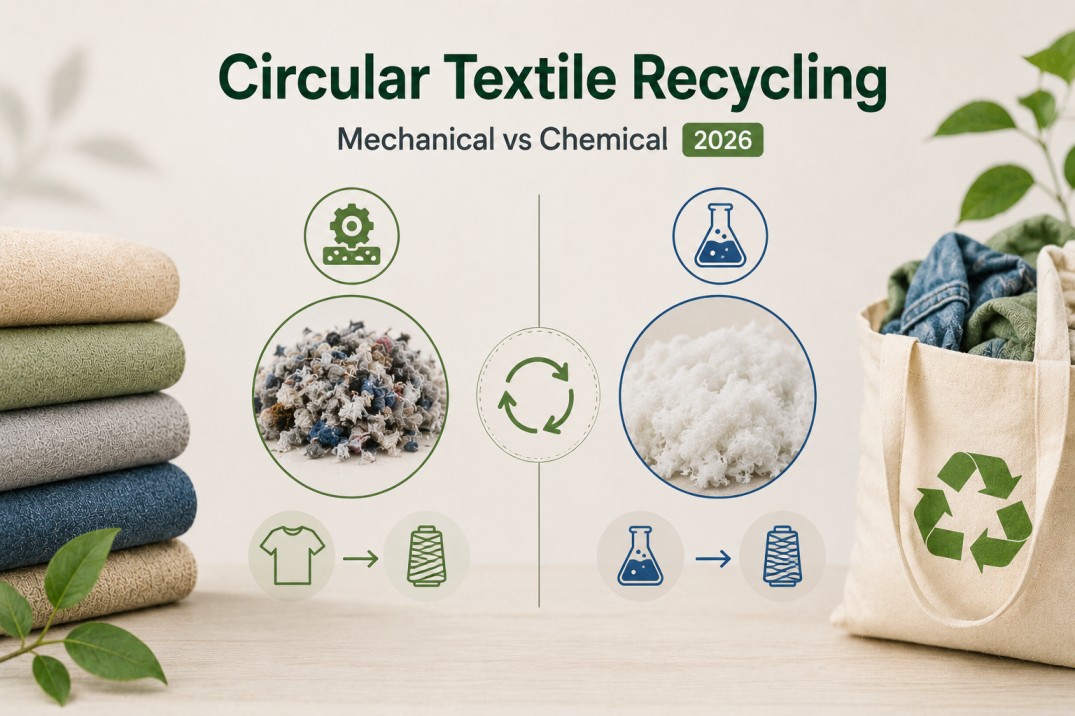
Each recycling route operates on fundamentally different principles — mechanical shreds and re-spins fibers, thermo-mechanical melts and re-extrudes synthetics, and chemical breaks polymers down to their molecular building blocks. The route you choose determines the waste types you can process, the quality of the output fiber, and the capital required.
Mechanical Recycling
CommercialSort → Shred → Open → Card → Spin — fiber length preserved through mechanical processing
Thermo-Mechanical Recycling
Scale-upSort → Shred → Melt → Filter → Extrude — synthetic polymers melted and re-extruded
Chemical Recycling
Pilot / Early CommercialDepolymerize → Purify → Repolymerize — polymers broken to monomers, rebuilt to virgin quality
Which Recycling Route Works for Which Material
Not every recycling route can handle every material. The matrix below shows which routes are viable for common textile fibers — and at what commercial readiness level.
| Material | Mechanical | Thermo-Mechanical | Chemical |
|---|---|---|---|
| 100% Cotton | Best fit — commercial at scale | Not suitable — cotton chars before melting | Viable — hydrolysis route, pilot stage |
| 100% Polyester (PET) | Not suitable — fiber too short | Best fit — commercial, widely deployed | Best fit — glycolysis commercial |
| Cotton/Polyester Blend | Not suitable — separation impossible mechanically | Limited — only if >80% thermoplastic | Best fit — dissolves cotton, recovers both |
| Nylon 6 / 6.6 | Not suitable | Viable — melt reprocessing, some degradation | Best fit — depolymerization to caprolactam |
| Wool | Best fit — commercial mechanical recycling | Not suitable — protein fiber burns | Viable — enzymatic hydrolysis, R&D stage |
| Acrylic | Limited — short fiber, low value | Viable — melt extrusion with stabilizers | Limited — solvent-based, pilot only |
Fiber Quality Retention Across Recycling Routes
The fundamental trade-off in textile recycling is quality retention versus cost and scalability. Mechanical recycling preserves the least fiber quality but operates at the lowest cost and largest scale today. Chemical recycling delivers virgin-quality output but remains expensive and energy-intensive.
Cost Comparison — CAPEX, OPEX & Minimum Scale
The economics of each recycling route dictate the minimum mill size and waste volume required for a viable operation. The table below compares capital requirements, operating costs, and practical scale thresholds for each route.
| Cost Parameter | Mechanical | Thermo-Mechanical | Chemical |
|---|---|---|---|
| CAPEX per ton/yr capacity | $200–$400 | $500–$1,000 | $1,500–$3,000 |
| OPEX per ton processed | $400–$800 | $800–$1,500 | $1,500–$3,500 |
| Energy cost share | 15–20% | 25–35% | 40–55% |
| Minimum viable scale | 5,000 tons/yr | 10,000 tons/yr | 20,000 tons/yr |
| Output value premium | 5–15% over virgin | 10–25% over virgin | 30–60% over virgin |
| Payback period | 2–4 years | 3–6 years | 5–10 years |
Model the Economics of Each Recycling Route for Your Mill
iFactory Cost Analyzer takes your mill's waste composition data and runs CAPEX, OPEX, and ROI projections for all three recycling routes — showing you the break-even point and output value for each option.
EU & EPR Deadlines Driving Textile Recycling Investment
Regulatory pressure is the primary driver of textile recycling adoption. The timeline below shows the key milestones that mills must prepare for — each deadline creates both compliance risk for the unprepared and commercial opportunity for those who invest ahead of the curve.
PPWR Adopted — Recycled Content Targets Set
EU Packaging and Packaging Waste Regulation enters force with mandatory recycled content targets for textile packaging. Brands begin cascading requirements to suppliers.
EPR Schemes Mandatory in EU Member States
Extended Producer Responsibility for textiles becomes mandatory across all EU member states. Producers pay eco-modulated fees based on product durability and recyclability.
Separate Textile Waste Collection Required
EU member states must implement separate collection systems for textile waste. Landfills and incinerators can no longer accept mixed textile waste streams.
Landfill Ban & Minimum Recycled Content
Landfill ban for separately collected textiles takes effect. Minimum recycled content requirements for new textile products begin — 15% for polyester, 10% for cotton.
Frequently Asked Questions
What is the difference between mechanical and chemical recycling?
Mechanical recycling breaks textiles down through physical processes — shredding, opening, carding, and spinning — without changing the chemical structure of the fiber. The output is shorter fiber with lower quality retention, typically blended with virgin material. Chemical recycling uses solvents, heat, or enzymes to break polymers down to their molecular building blocks (monomers), which are then purified and rebuilt into virgin-quality fiber. Chemical recycling can handle blended materials that mechanical recycling cannot separate, but requires significantly more energy and capital investment. The choice between them depends on the waste composition, desired output quality, and available capital.
Which recycling route is most cost-effective today?
Mechanical recycling is the most cost-effective route today with an OPEX of $400 to $800 per ton and the lowest capital requirements. For mills generating clean, single-material waste — particularly cotton waste from spinning and weaving — mechanical recycling at 5,000 to 10,000 tons per year can deliver positive ROI within 2 to 4 years. Thermo-mechanical recycling is cost-effective for polyester-dominant waste streams but requires higher scale (10,000+ tons per year) to achieve comparable unit economics. Chemical recycling remains the most expensive route but produces the highest-value output — the premium over virgin fiber (30 to 60 percent) partially offsets the higher cost, and costs are expected to decline by 30 to 50 percent as the technology scales over the next 5 to 8 years.
Can blended cotton-polyester fabrics be recycled?
Blended fabrics are the most challenging waste stream for recycling and represent 40 to 60 percent of post-consumer textile waste. Mechanical recycling cannot separate the components — shredded blend waste produces a low-quality mixed fiber unsuitable for most applications. Thermo-mechanical recycling works only for blends with more than 80 percent thermoplastic content (polyester or nylon), where the synthetic component acts as the matrix. Chemical recycling is the only route that can fully separate and recover both components from a 50/50 cotton-polyester blend — typically using hydrolysis or solvent-based processes that dissolve one component while leaving the other intact for filtration and recovery. Several chemical recycling facilities are now operating at pilot and early commercial scale specifically targeting blend waste.
How does EU regulation affect textile mills outside Europe?
EU regulation creates extraterritorial obligations through the brand supply chain. Any mill that supplies brands selling into the EU market — regardless of the mill's location — must comply with the brand's recycled content and recyclability requirements, which cascade from EU regulation downstream. Non-EU mills are directly affected in three ways: brands will require certified recycled content documentation for products sold in the EU; mills exporting finished goods to the EU must comply with digital product passport requirements that include recyclability data; and EPR fees paid by brands in the EU are factored into procurement pricing, creating pressure on non-EU mills to improve the recyclability profile of their products. Mills in Asia, the Middle East, and Africa that supply European brands should begin tracking waste composition and recyclability data now, as these requirements will be contractual by 2027 for most major brands.
How does iFactory support textile recycling operations?
iFactory supports textile recycling operations through three integrated capabilities: the Waste Flow Analyzer maps all waste streams by type, volume, and composition to identify the highest-value recycling route for each stream; the Cost Analyzer runs CAPEX, OPEX, and ROI projections comparing mechanical, thermo-mechanical, and chemical options against your mill's specific waste profile and local utility costs; and the Compliance Tracker monitors regulatory deadlines across EU PPWR, EPR frameworks, and national legislation to ensure your recycling investment timing aligns with compliance requirements. For mills that choose to partner with external recyclers rather than invest in their own infrastructure, iFactory's Supply Chain module tracks recycled content certificates from supplier to finished product, providing the documentation brands require for their recycled content claims.
From Waste Composition to Recycling Route — One Platform
iFactory maps your mill's waste streams, matches each to the optimal recycling route, models the economics, and tracks regulatory compliance — all in a single platform purpose-built for textile operations.