Predictive Maintenance for Plastics and Rubber Manufacturing
By Daniel Carter on June 6, 2026
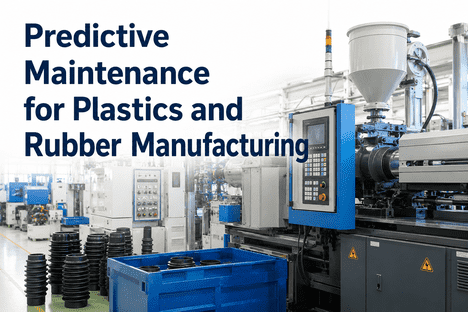
Injection molding machines, extruders, blow molders, and rubber processing equipment form the production backbone of plastics manufacturing — yet unplanned failures in these assets remain the primary cause of production stoppages, scrap waste, and costly emergency repairs across molding, extrusion, and compounding operations. Traditional time-based maintenance schedules cannot account for the variable processing conditions introduced by frequent material changeovers, multi-cavity tooling demands, and just-in-time production schedules that define modern plastics manufacturing. iFactory's predictive maintenance platform ingests barrel zone temperatures, screw torque profiles, hydraulic pressure curves, melt pump vibration, and clamp force telemetry into machine learning models that forecast screw and barrel wear, hydraulic pump degradation, melt pump gearbox fatigue, and heater band failure weeks before breakdown — enabling production engineers to shift from reactive repair to condition-based intervention. Book a Demo to see how iFactory connects your plastics production telemetry to predictive intelligence.
Predictive Maintenance · Plastics & Rubber 2026
Predictive Maintenance for Plastics & Rubber Manufacturing
Injection molding barrel & screw monitoring · Extrusion melt pump & gearbox wear · Blow molding clamp force · Rubber mixer temp & mill gap · All flowing into iFactory CMMS & Shift Logbook.
Why Time-Based Maintenance Falls Short in Modern Plastics Manufacturing
Plastics and rubber production facilities today face processing conditions that change by the batch — material grade changeovers require different barrel temperature profiles, screw speeds, and backpressure settings, while multi-cavity tooling introduces asymmetric wear patterns that fixed-interval maintenance schedules cannot detect. Fixed-interval barrel, screw, and hydraulic maintenance assumes steady-state processing conditions that no longer reflect actual production demands. iFactory replaces calendar-based schedules with continuous condition monitoring — ingesting data from machine controllers, barrel zone thermocouples, screw torque transducers, hydraulic pressure sensors, and melt pump vibration pickups to detect barrel wear, screw degradation, hydraulic pump cavitation, and heater band failure before they escalate into production stoppages.
LIMITATIONS OF SCHEDULED MAINTENANCE IN PLASTICS MANUFACTURING
1
Material-dependent wear ignored — frequent material changeovers create barrel and screw wear patterns that fixed-interval schedules cannot predict
2
No real-time gap detection — screw flight wear, barrel scoring, and hydraulic degradation develop between inspection cycles undetected
3
One-size-fits-all intervals — same PM schedule regardless of actual screw torque, melt temperature, or backpressure levels
4
No fleet-wide trend visibility — cross-machine barrel and screw wear patterns invisible when each press is inspected in isolation
Three Plastics & Rubber Asset Categories iFactory Predicts and Prevents
Injection molding machine failures rank among the highest-cost events in plastics manufacturing — each catastrophic barrel and screw replacement can exceed $85,000 in repair costs plus lost production from extended downtime. iFactory integrates barrel zone temperature uniformity, screw torque profile deviation, hydraulic pump pressure and flow trends, clamp force stability, and heater band current draw into ensemble ML models. The platform classifies injection molding machine health into four states — healthy, moderately stressed, highly stressed, critical — enabling production engineers to prioritise interventions before barrel and screw wear causes scrap parts, hydraulic pump cavitation causes pressure loss, or heater band failure causes temperature deviation. Sites using similar AI-driven injection molding machine monitoring report 28% fewer unplanned stoppages and 22% lower maintenance costs. Book a Demo to see iFactory's injection molding prediction models in production.
Extrusion Melt Pump, Gearbox & Die Wear Forecasting
Extrusion lines in plastics and rubber manufacturing operate under continuous high-torque, high-temperature conditions that accelerate melt pump gearbox and die wear. iFactory monitors extruder screw torque and speed, melt pump discharge pressure fluctuation, gearbox vibration envelope, die pressure uniformity across the melt stream, barrel zone temperature consistency, and motor current draw. The Shift Logbook captures material changeover records, screen pack replacement history, and die maintenance logs alongside sensor data — creating a unified asset health record that feeds remaining useful life (RUL) estimates for each extruder melt pump, gearbox, and die assembly. Predicted failures trigger work order generation in iFactory with recommended intervention windows aligned to scheduled material changeovers.
Blow molding machines, compression presses, and rubber mixers face unique wear modes driven by clamp force cycling, parison control precision, and internal mixer temperature management. iFactory ingests blow molder clamp force profile, parison wall thickness variation, cooling channel temperature trends, and hydraulic system response time alongside rubber internal mixer rotor torque, mixing chamber temperature, mill roll gap uniformity, and curing press platen temperature distribution. The platform identifies assets operating in degraded states — flagging blow molders requiring clamp alignment, internal mixers needing rotor refurbishment, and curing presses requiring platen resurfacing before part quality is affected. Every alert is logged in iFactory with full traceability to the machine controller and sensor data that triggered the prediction.
Clamp force modelMixer torque analysisPart quality protection
How iFactory Transforms Plastics Production Telemetry Into Predictive Intelligence
iFactory is the AI software intelligence layer — not a sensor manufacturer or hardware vendor. The platform integrates with existing plastics machine controllers (Arburg, Engel, KraussMaffei, Husky, Milacron, Nissei, Demag), extruder control systems (Davis-Standard, Leistritz, Coperion, KraussMaffei Berstorff), blow molding controllers (Kautex, SIPA, Sidel), rubber processing automation (HF Mixing Group, Kobelco, Farrel), and ERP (SAP, Oracle). The Shift Logbook captures production operator shift reports, material changeover records, quality inspection results, and maintenance logs alongside the sensor stream — creating a unified data fabric for predictive model training across your entire plastics production asset fleet.
Asset Class
Telemetry Sources
iFactory Prediction Output
Business Impact
Injection Molding
Barrel zone temps · screw torque · hydraulic pressure · clamp force · heater current
Barrel & screw health score · RUL · critical alert
28% fewer unplanned stoppages
Extruders
Screw torque · melt pump pressure · gearbox vibration · die pressure · motor current
Predictive Maintenance Use Cases in Plastics & Rubber Manufacturing
Injection
Injection Molding Barrel Wear, Screw Degradation & Heater Band Monitoring
Continuous
iFactory fuses barrel zone temperature uniformity trends, screw torque profile deviation from baseline, hydraulic pump pressure stability, clamp force consistency across cycles, and heater band current draw into a single injection molding machine health model. The stacked ensemble classifier assigns a health score — healthy, moderately stressed, highly stressed, or critical — based on multi-dimensional feature fusion. Machines flagged as critical trigger automated alerts in the Shift Logbook with recommended actions, RUL estimates, and links to historical production and fault records. Maintenance planners schedule barrel and screw interventions based on actual condition rather than calendar intervals.
Extrusion Melt Pump Gearbox Wear & Die Condition Prediction
Continuous
Extrusion lines face continuous high-torque operation that accelerates melt pump gearbox and die wear beyond calendar-based replacement assumptions. iFactory monitors extruder screw torque and RPM, melt pump discharge pressure and temperature, gearbox housing vibration velocity and acceleration envelopes, die pressure profile uniformity, and motor current draw. The ensemble ML model predicts remaining useful life for each extruder melt pump gearbox, screw and barrel assembly, and die set. Predicted end-of-life triggers work order generation in iFactory with intervention window recommendations aligned to material changeover and scheduled line stops — minimising production disruption.
Blow molding machines and rubber internal mixers require continuous condition monitoring to prevent part quality excursions and unscheduled production stops. iFactory ingests blow molder clamp force profile deviation, parison wall thickness variation trends, cooling channel temperature uniformity, and hydraulic system pressure response time. For rubber processing, the platform tracks internal mixer rotor torque and speed, mixing chamber temperature profile, mill roll gap deviation, and curing press platen temperature distribution. The platform generates per-asset health scores — flagging blow molders approaching clamp alignment requirements, internal mixers needing rotor refurbishment, and curing presses nearing platen maintenance thresholds. Every forecast event is logged in iFactory with full traceability to the machine data that triggered the prediction.
What iFactory Delivers for Plastics & Rubber Manufacturing Reliability
28%
Fewer unplanned injection molding stoppages
AI-driven barrel, screw & hydraulic prediction
22%
Lower plastics maintenance costs
Condition-based vs calendar-based scheduling
4 States
Health classification per production machine
Healthy · stressed · high · critical
RUL
Remaining useful life for barrels, screws & gearboxes
Changeover-aligned replacement scheduling
FAQ
iFactory is the AI software intelligence layer — not a sensor manufacturer or hardware vendor. The platform integrates with existing machine controllers (Arburg, Engel, KraussMaffei, Husky, Milacron, Nissei, Demag), extruder control systems (Davis-Standard, Leistritz, Coperion), blow molding controllers (Kautex, SIPA, Sidel), and rubber processing automation (HF Mixing Group, Kobelco, Farrel) already installed across your production floor. Most modern plastics machines (2018+) are factory-equipped with barrel zone thermocouples, screw torque transducers, hydraulic pressure sensors, and heater band current monitoring. Your production team selects any additional monitoring hardware; iFactory turns the data into predictive intelligence, health scores, RUL estimates, and maintenance work orders.
iFactory integrates with OPC UA (the dominant plastics machine communication standard), Euromap 63/65/77 (injection molding machine data exchange), Modbus TCP (extruder and auxiliary equipment), CANopen (blow molder controllers), PROFINET (rubber processing automation), and REST APIs (modern machine control platforms). The platform normalises data from multi-vendor injection molding machines, extruders, blow molders, and rubber mixers into a unified asset health model — eliminating the integration overhead of managing disparate production monitoring systems.
Yes. iFactory connects to SAP, Oracle, IBM Maximo, and major plastics manufacturing CMMS platforms. The Shift Logbook captures production operator shift reports, material changeover records, quality inspection results, and maintenance logs alongside sensor-generated predictions. Every prediction event, machine reading, and maintenance action is recorded with full traceability for audit, quality compliance, and continuous model improvement across the plastics production asset fleet.
Deploy iFactory for Plastics & Rubber Predictive Maintenance
AI-powered predictive maintenance platform connecting injection molding barrel monitoring, extruder melt pump gearbox wear, blow molder clamp force, and rubber mixer temperature telemetry into one unified intelligence layer — with ML-based failure prediction, Shift Logbook integration, CMMS workflow automation, and fleet-wide plastics production reliability analytics.