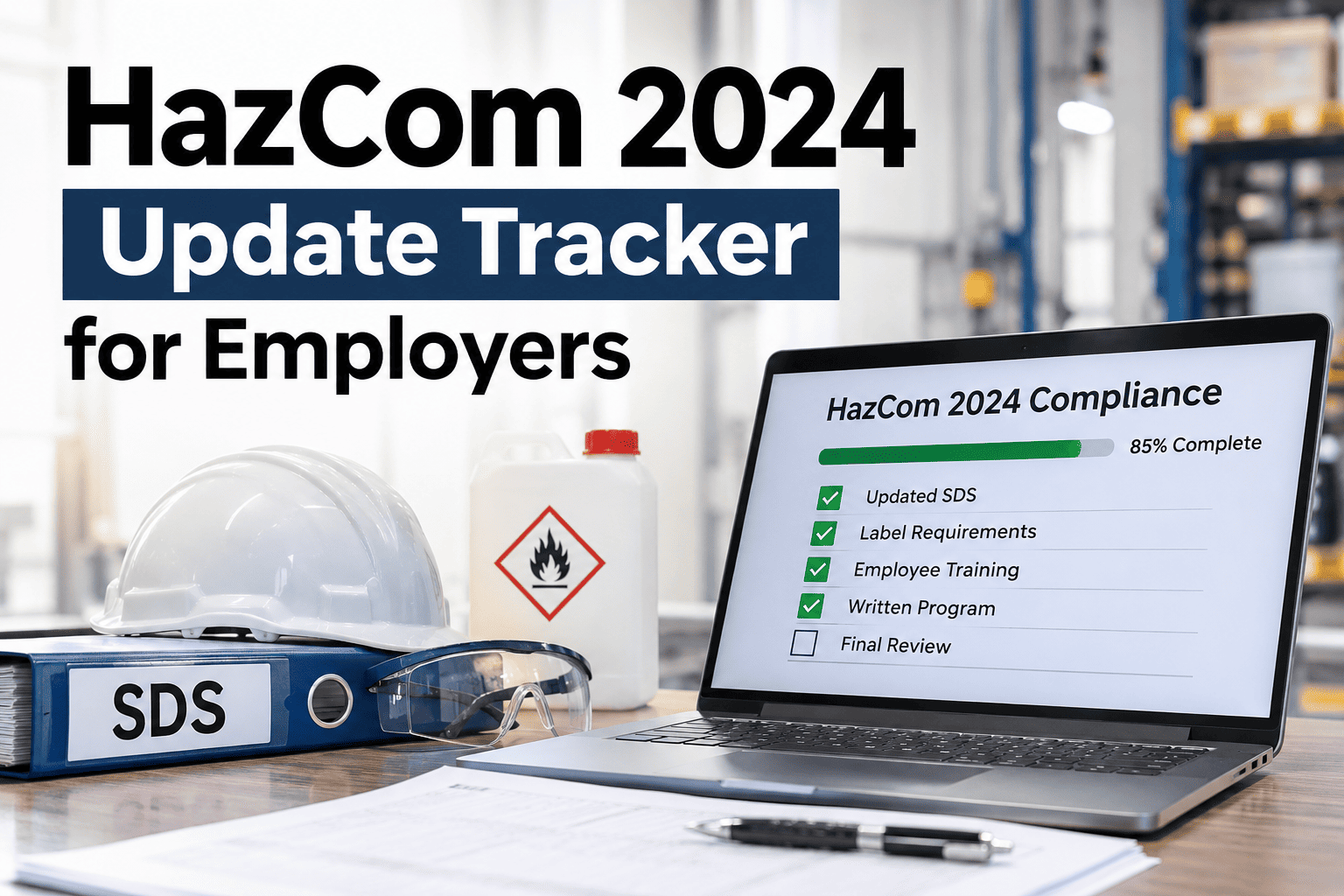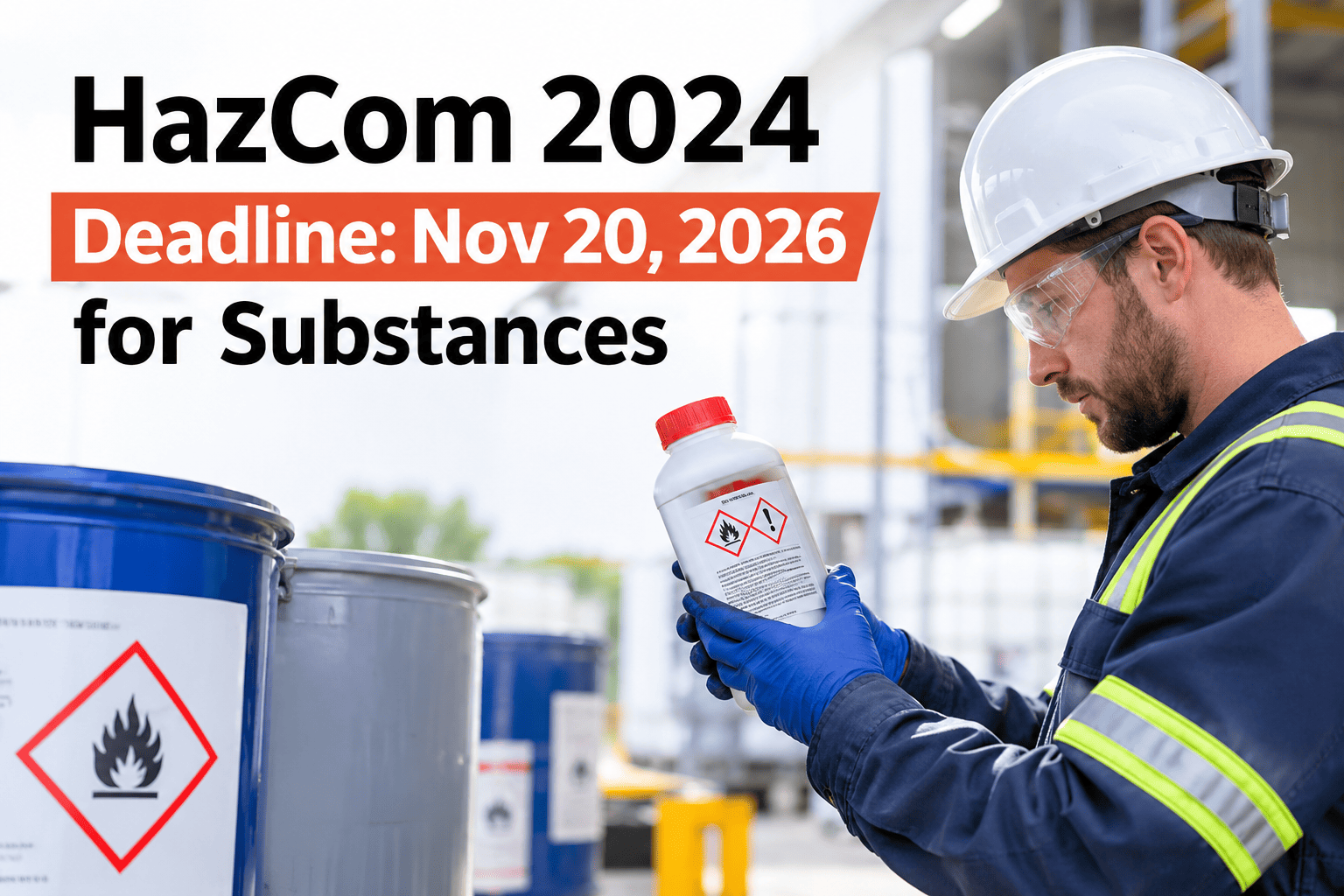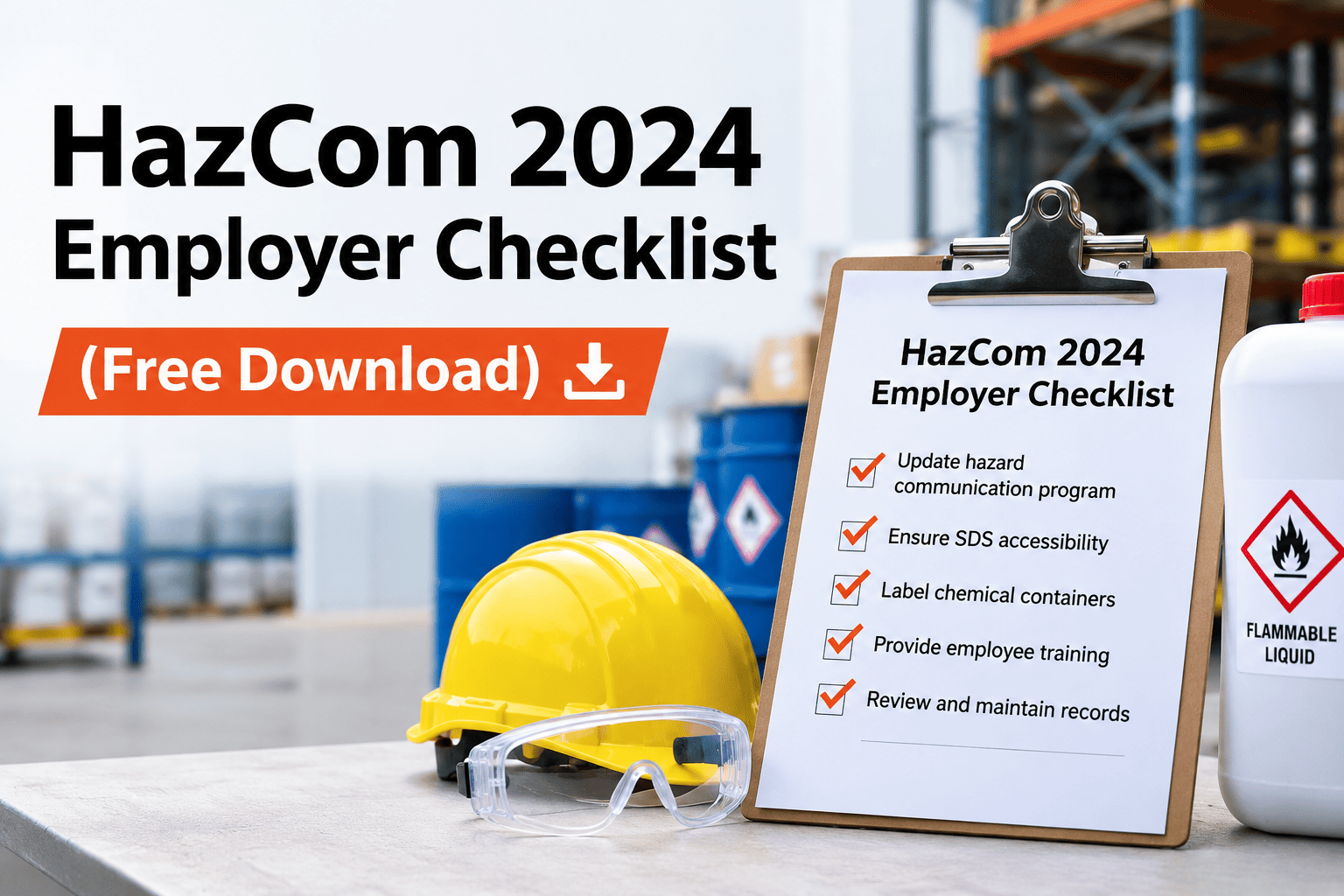
A HazCom 2024 employer checklist has four parts: a chemical and safety data sheet register, revised workplace labels, a revised written program, and training on newly identified hazards. For substances, all four must be finished by November 20, 2026. For mixtures, employers have until May 19, 2028. Most teams track this in spreadsheets, which makes it hard to show who did what and when. A checklist that stores proof beside each task keeps an inspection file ready at all times. Safety coordinators can see these twenty checks turned into a tracked workflow on a real chemical list in a short session.
The HazCom 2024 Employer Checklist: Twenty Checks, Two Deadlines
iFactory AI turns each check into a task with an owner, a due date and stored proof, so nothing is left to memory.
What Does the HazCom 2024 Employer Duty Actually Require?
Employers must, as necessary, revise workplace labeling, the written hazard communication program and employee training to reflect the new classifications (Haynes Boone, 2026). Each duty is a separate line on the checklist.
Workplace Labeling
In-plant and secondary container labels carry the revised hazard information.
Written Program
The program describes your real practice and is dated.
Additional Training
Staff learn newly identified hazards, as necessary.
The phrase "as necessary" matters. Substances whose hazards did not change are unlikely to need rework (National Law Review, 2026), so the first job is finding what changed.
Which Deadline Applies to Substances and Which to Mixtures?
Substances are due November 20, 2026 and mixtures May 19, 2028 for employers, after OSHA's four-month extension at 91 FR 1695 (Jackson Lewis, 2026).
| Employer duty | Paragraph | Substances | Mixtures |
|---|---|---|---|
| Workplace labels | (f)(6) | Nov 20, 2026 | May 19, 2028 |
| Written program | (h)(1) | Nov 20, 2026 | May 19, 2028 |
| Employee training | (h)(3) | Nov 20, 2026 | May 19, 2028 |
Part 1: What Goes Into the Chemical and Safety Data Sheet Register?
The register is the base of every other check. It lists each product on site and the sheet version held for it. Confirm that suppliers delivered revised sheets after their May 19, 2026 substance deadline (National Law Review, 2026).
Part 2: How Do You Check Workplace Labels?
Labels change only where the product changed, so work from the flagged list. The 2024 rule adds desensitized explosives as a new hazard class and widens aerosol categories, which can reach spray adhesives and cleaning foams (Haynes Boone, 2026).
Stop Tracking HazCom in Loose Spreadsheets
Bring your chemical list to a 30-minute session and see iFactory AI hold every check, owner and due date in one place.
Part 3: What Must the Written Program Show?
The written program must be revised too, and it is the line most checklists miss. It has to describe actual practice, because a generic template will not satisfy the duty (Haynes Boone, 2026). Teams can also raise a program question in the customer portal before they finalize it.
Part 4: Who Needs Training on Newly Identified Hazards?
Anyone who handles a flagged product needs training on its new hazards, changed label elements and the revised sheet presentation. Keep dated materials, attendance and comprehension checks.
How Ready Are You After Counting the Boxes?
Count the checks you can prove, not the ones you believe are done. The ladder below is a simple guide for one track.
Where Do Checklists Usually Break Down?
How Does iFactory AI Track the Checklist?
iFactory, an on-premise AI platform for manufacturing, offers Safety and Compliance and EHS Management modules. Its HazCom 2024 checklist tracks tasks and due dates in one place.
Owners and Dates
Each check has a named owner and due date.
Stored Proof
Labels, sheets and training records sit beside each task.
Two Tracks
Substances and mixtures run side by side.
Audit View
One screen shows readiness for inspectors.
Expert Review: Is a Checklist Enough?
Frequently Asked Questions
What should a HazCom 2024 checklist include?
It should cover a chemical and sheet register, revised workplace labels, a revised written program and training on newly identified hazards. Each item needs an owner and dated proof. Review a ready-made twenty-check list in a short walkthrough.
Is there a free HazCom 2024 checklist to download?
Yes, the checklist on this page is free to use, and a print-ready version is available on request. Tracking progress with owners and proof is easier in software. Ask for the print-ready version through the customer portal today.
Do I need separate checklists for substances and mixtures?
Yes. Substances are due November 20, 2026 and mixtures May 19, 2028, so each track needs its own dates and proof. Running both from one tool avoids confusion. See both tracks side by side on your own chemicals.
Does the written program really need revising?
Yes, as necessary. The employer duty includes revising the written program, not only labels and training, and it must describe real practice. Check your program against the revised duty with a specialist.
What proof should I keep after finishing?
Keep the dated program, the register, label records, sign-in sheets and comprehension checks. Store them where an inspector can find them quickly. Ask how proof can be stored with each task in the portal.
Turn Twenty Checks Into a Tracked, Provable Workflow
See iFactory AI run both HazCom tracks with owners, dates and stored proof, then book a short working session on your own chemicals.