Most enterprises didn't choose a hybrid AI strategy — they accumulated one. A fleet of on-prem GPU servers, a growing AWS footprint, and a mounting question: how do you make them work as one? This guide cuts through the complexity of AWS + on-prem hybrid AI deployment — covering reference architectures, networking patterns, IAM unification, and the decision frameworks that actually hold up in production. Whether you're running NVIDIA Blackwell clusters in your data center or evaluating AWS Outposts for the first time, the next 10 minutes will give you the clearest map available for 2026.
Architect Your AWS + On-Prem AI Strategy On-Site
Join the iFactory team at SAP for a live strategy session covering AWS hybrid AI deployment lanes, on-prem GPU architecture, and enterprise AI rollout — backed by 1000+ deployments. Sit down with our architects, model your scenario in real time, and walk away with a concrete plan.
Enterprise apps outside central cloud by 2027 — Gartner
<50ms
Target inference latency for on-prem GPU nodes
1000+
Enterprise AI deployments shipped by iFactory
The Case for Hybrid
Why Neither Pure Cloud Nor Pure On-Prem Is Enough
The argument isn't cloud vs. on-prem anymore. It's about placing each workload where it performs best — and wiring the two sides together without friction. Not sure which model fits your stack? Schedule a free 30-minute architecture review with our hybrid AI engineers and get a clear answer before you commit.
AWS Cloud
Elastic · Managed · Global
On-demand GPU bursting for training peaks
Managed orchestration via SageMaker & Bedrock
Global reach across 30+ Regions
Data egress costs on large model outputs
Sovereignty limits for regulated data
Latency over WAN for plant-floor inference
VS
↓
Hybrid is the answer
On-Premises GPU
Sovereign · Low-latency · Fixed cost
Full data sovereignty — nothing leaves the building
Sub-50ms inference for real-time operations
Predictable CapEx for steady-state workloads
No elastic scaling for training spikes
High upfront hardware investment
Limited access to managed AI services
Workload Placement
The Hybrid Placement Matrix — Where Each Workload Belongs
Not every AI job belongs in the cloud, and not every job belongs on-prem. Here's the decision matrix that enterprise architects use in production.
Low Data Sensitivity
High Data Sensitivity
Bursty / Spiky Compute
AWS Cloud
Model training runs, hyperparameter sweeps, batch inference jobs
Hybrid
Burst training to AWS; keep regulated data on-prem via VPN/Direct Connect
Steady-State / Real-Time
Hybrid
Inference via AWS + edge caching; orchestration from Bedrock
Real-time defect detection, sub-10ms latency, no WAN dependency
Life Sciences
Hybrid
Anonymize on-prem → fine-tune on AWS → inference on-prem
Financial Services
On-Prem + AWS
Transaction scoring on-prem; risk modeling burst to cloud
SaaS / B2B
AWS-First
Low sensitivity, elastic scaling needs, global user base
Reference Architecture
The 3-Layer Hybrid AI Stack — Built for Production
Every successful hybrid deployment shares this structure: a thin control plane in AWS, a thick data plane split across environments, and a secure connectivity layer bridging them. If you want this architecture mapped to your specific ERP and data landscape, contact our support team — we'll send you a reference diagram tailored to your environment within 24 hours.
Layer 1 · Control Plane AWS
AWS SageMaker
Training orchestration & MLOps pipeline
Amazon Bedrock
Foundation model access & agent runtime
AWS Step Functions
Cross-environment workflow orchestration
Amazon CloudWatch
Unified observability across hybrid nodes
AWS Direct Connect · 10Gbps dedicated
Site-to-Site VPN · IPSec fallback
AWS IAM + OIDC federation
Layer 2 · Data Plane On-Premises
GPU Cluster
NVIDIA Blackwell / H100 for inference
Local Model Store
Fine-tuned weights, embeddings, vector DB
EKS Anywhere
Kubernetes workloads with AWS-consistent APIs
AWS Outposts
Native AWS infra in your data center
AWS AI Factories (announced re:Invent 2025) enables AWS-managed workloads to run entirely within your data center — your data never leaves the building while you still get Bedrock-grade tooling.
Networking
Connectivity That Doesn't Become Your Bottleneck
The most common failure in hybrid AI deployments isn't the model — it's the pipe. Here's how to design connectivity that scales with your inference and training volumes.
Option A · Recommended
AWS Direct Connect
Bandwidth 1–100 Gbps
Latency Consistent, sub-ms jitter
Use case High-volume data transfer, training bursts
Best when: Large model artifacts move between on-prem and S3 regularly. Steady training throughput exceeds 1Gbps. SLA requires predictable latency.
Option B · Fallback / Lightweight
Site-to-Site VPN (IPSec)
Bandwidth Up to ~1.25 Gbps
Latency Variable (internet-dependent)
Use case Secure control-plane traffic, low-volume sync
Best when: Direct Connect isn't yet provisioned. Control plane API calls dominate over data plane transfers. Used alongside Direct Connect as an encrypted backup.
Option C · Edge-Specific
AWS Outposts / Local Zones
Bandwidth Native LAN speeds internally
Latency Single-digit ms for local ops
Use case True local inference, air-gap-adjacent
Best when: Regulatory requirements demand data stays on-site. Plant floor or edge inference latency requirements can't tolerate any WAN hop.
Bandwidth Sizing Reference
LLM inference (7B params, 100 req/s)
~200 Mbps
Training data sync (100GB dataset/day)
~9 Mbps avg
Model artifact push (70B checkpoint)
≥1 Gbps recommended
Control plane / API calls only
<10 Mbps
IAM & Security
Unified Identity — One Security Model Across Both Environments
Dual identity systems are a security gap and an ops burden. The pattern below gives your on-prem AI workloads AWS-native IAM roles without storing long-lived credentials anywhere.
1
On-Prem Identity Provider
Your existing IdP (Active Directory, Okta, Ping) issues OIDC tokens to on-prem services and users
→
2
AWS IAM Identity Center
SAML/OIDC federation maps on-prem identities to AWS Permission Sets — no static access keys
→
3
STS AssumeRoleWithWebIdentity
Short-lived credentials (15min–12hr) issued per workload — scoped to minimum required permissions
→
4
AWS Services + On-Prem APIs
Both environments enforce the same policy — S3, Bedrock, SageMaker, and your on-prem model APIs all validate the same identity
The Non-Negotiable Security Rules
Never store long-lived AWS access keys on on-prem servers
Encrypt model artifacts at rest (AES-256) and in transit (TLS 1.3)
Enable AWS CloudTrail across all hybrid API calls — both directions
Apply Zero Trust: no implicit trust between cloud and on-prem networks
Use SCPs (Service Control Policies) to enforce data residency at org level
Rotate credentials automatically — use AWS Secrets Manager for on-prem secrets
Deployment Patterns
Three Proven Hybrid Patterns — Pick the One That Fits
There's no single hybrid blueprint. Here are the three patterns iFactory has deployed across 1000+ enterprise AI rollouts, each with different trade-offs. Want us to walk through which one fits your environment? Book a pattern-selection session — our architects will model the right approach for your industry, data classification, and latency requirements in a single call.
Pattern 01
Cloud-Train, On-Prem-Serve
AWS SageMaker
Training
→
S3
Artifact Store
→
On-Prem GPU
Inference
Train on AWS elastic GPU (Trainium/A100 bursts), push checkpoints to S3, pull to on-prem GPU cluster for low-latency inference. Best for regulated industries where inference must stay on-site but training data can be anonymized and sent to cloud.
✓ Manufacturing · Life Sciences · Defense
Pattern 02
On-Prem-Anonymize, Cloud-Fine-Tune
On-Prem
PII Stripping
→
AWS Bedrock
Fine-Tuning
→
On-Prem
Prod Inference
Sensitive data is stripped/anonymized on-prem before leaving the building. Clean data goes to Bedrock for foundation model fine-tuning. Fine-tuned weights return to on-prem for production serving. This is the Bank CenterCredit pattern validated at AWS re:Invent 2025.
✓ Financial Services · Healthcare · Legal
Pattern 03
Unified Outposts — Fully Sovereign
AWS Outposts
In Your DC
↔
AWS Region
Mgmt Plane
↔
S3 on Outposts
Local Storage
AWS Outposts rack runs native AWS services (EKS, RDS, S3) physically inside your data center. Data never leaves your building. Management plane in AWS Region handles orchestration. Best for enterprises where any data egress — even anonymized — is prohibited.
✓ Government · Defense · Tier-1 Banking
Why iFactory
Why Enterprises Choose iFactory for Hybrid AI — Not Just a Vendor, a Deployment Partner
There's no shortage of consultants who can draw a hybrid AI diagram. There are very few who can ship one. Here's what separates iFactory from everyone else on the Sapphire floor.
1000+
Enterprise AI deployments shipped across manufacturing, finance, healthcare & global services
Not demos. Not pilots. Production systems running today.
50+ Pre-Built AWS & OT Connectors
No custom integration from scratch. Our connector library covers SAP, Siemens, Rockwell, Honeywell, and all major AWS services — cutting your go-live from months to weeks.
4–8 Week Production Cycle
Most vendors quote 6-month timelines. iFactory's pre-built patterns and connector library get regulated industries to production in 4–8 weeks — with a go-live guarantee.
Data Sovereignty by Default
Every iFactory hybrid architecture is designed with data residency first. Your regulated data never leaves your perimeter unless you explicitly authorize it — enforced at the infrastructure layer, not just policy.
99.5% Uptime Across Deployed Infra
Our hybrid architectures are built with Multi-AZ failover, VPN redundancy, and on-prem HA clustering. Downtime is measured in minutes per year, not hours.
iFactory vs. Typical SI / Cloud Consultant
iFactory
Typical SI
Go-live timeline
4–8 weeks
4–6 months
Pre-built connectors
50+ ready-to-deploy
Custom-built per project
Sovereignty by design
Infrastructure-enforced
Policy documentation only
On-prem GPU expertise
Blackwell / H100 certified
Cloud-first, on-prem optional
SAP + AWS integration
Native, 1000+ refs
Varies by team
Uptime SLA
99.5% guaranteed
Best-effort
FAQ
Hybrid AI Deployment — Questions We Get Every Week
From architecture trade-offs to cost models, these are the questions enterprise teams ask us most. If yours isn't here, bring it to our Sapphire session on May 13 — or schedule a call with our team today and we'll answer it directly before the event.
Do I need AWS Direct Connect, or can I start with a VPN?
You can start with Site-to-Site VPN for control-plane traffic and low-volume data sync — it's encrypted and usually ready in days. But if you're moving model artifacts larger than ~10GB regularly, or your inference latency SLA is under 100ms end-to-end, you'll hit VPN bandwidth ceilings quickly. Plan for Direct Connect in your architecture from day one, even if you don't provision it immediately. The provisioning lead time alone (4–12 weeks with your ISP) means you should order it before you need it.
How does AWS Outposts differ from just running EKS on our own hardware?
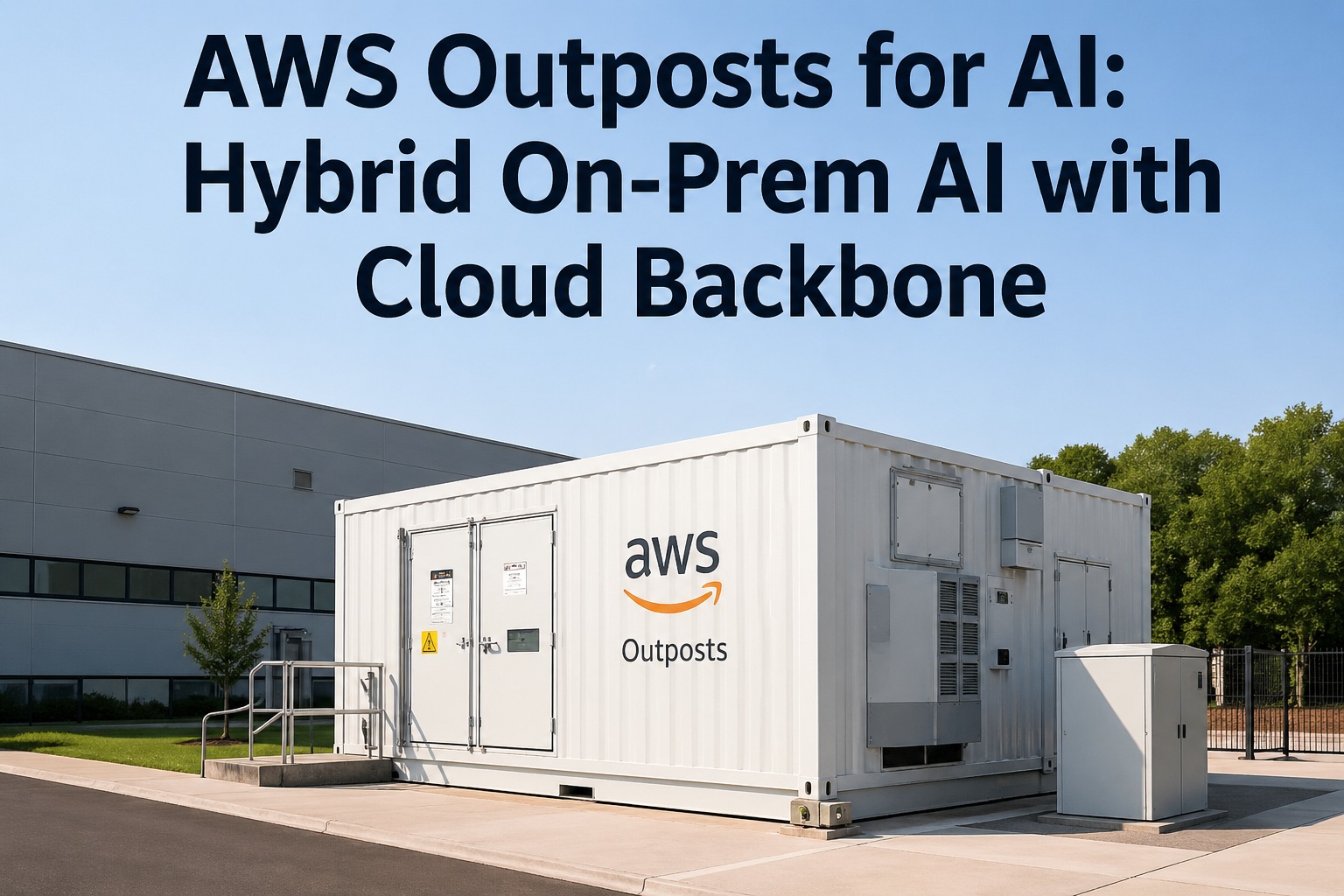
EKS Anywhere runs Kubernetes on your own hardware using AWS-compatible APIs — you manage the underlying infrastructure. AWS Outposts is AWS-managed hardware physically installed in your data center; AWS owns the rack, patches the firmware, and maintains the hardware. Outposts gives you native AWS services (S3 on Outposts, RDS, EKS) with zero data egress to the cloud. EKS Anywhere is lower cost and more flexible; Outposts is the right choice when you need the full AWS management plane locally with full data sovereignty.
What GPU hardware works best for on-prem hybrid inference in 2026?
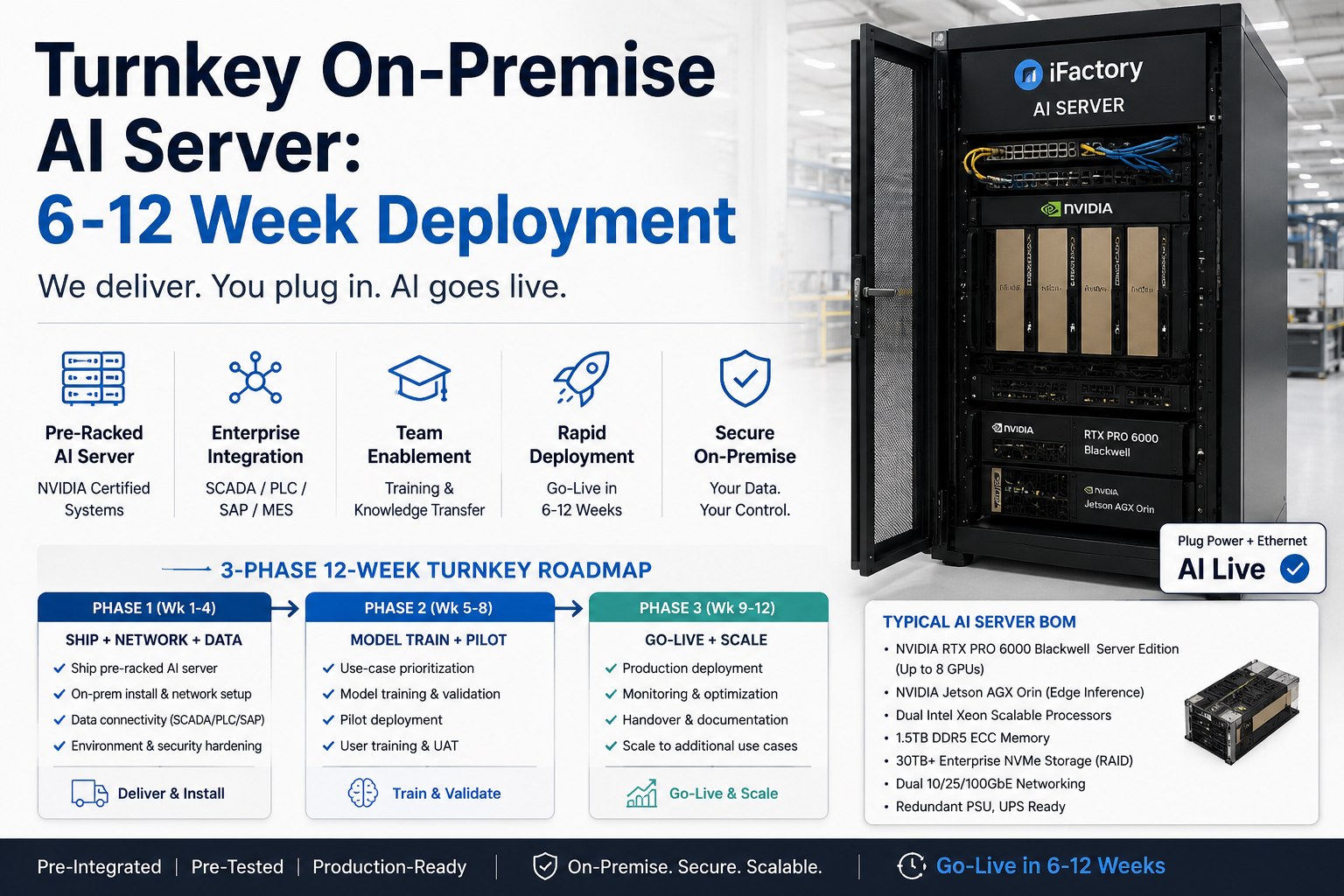
For new deployments, NVIDIA Blackwell (B100/B200) is the current benchmark for sub-50ms inference on 70B+ parameter models. H100 SXM5 remains strong for 7B–34B models at lower cost. For brownfield environments, A100 80GB clusters are still highly capable for most enterprise inference workloads. iFactory's on-prem demo at Sapphire runs a Blackwell cluster serving SAP-context inference — we can show you the benchmark numbers against your specific model and throughput requirements. Hardware selection should always start with your target latency SLA and TCO model, not the GPU spec sheet.
How do we handle model drift when inference runs on-prem but training is in AWS?
Drift detection in hybrid environments requires capturing inference telemetry on-prem (input distributions, confidence scores, output patterns) and shipping that metadata — not the raw data — to AWS CloudWatch or SageMaker Model Monitor. You compare live distributions against your training baseline and trigger retraining alerts when statistical distance (KL divergence or PSI) exceeds your threshold. The key is that you only move metadata, not the regulated data itself, so data residency rules remain intact. iFactory deploys this monitoring pattern as a standard component in our hybrid architectures.
Is hybrid AI significantly more expensive than pure cloud?
For steady-state inference workloads above ~50,000 requests/day, on-prem GPU CapEx typically breaks even with cloud GPU OpEx within 18–24 months. Below that threshold, pure cloud is usually cheaper when you factor in hardware depreciation, power, and data center costs. The hybrid model is most cost-effective when you separate the workloads correctly: burst training to AWS (elastic, pay-per-use) while running production inference on-prem (fixed CapEx, no egress costs). The egress cost alone — typically $0.09/GB out of AWS — makes large-scale inference economics strongly favor on-prem for data-heavy workloads.
Can iFactory integrate our existing SAP landscape with AWS hybrid AI?
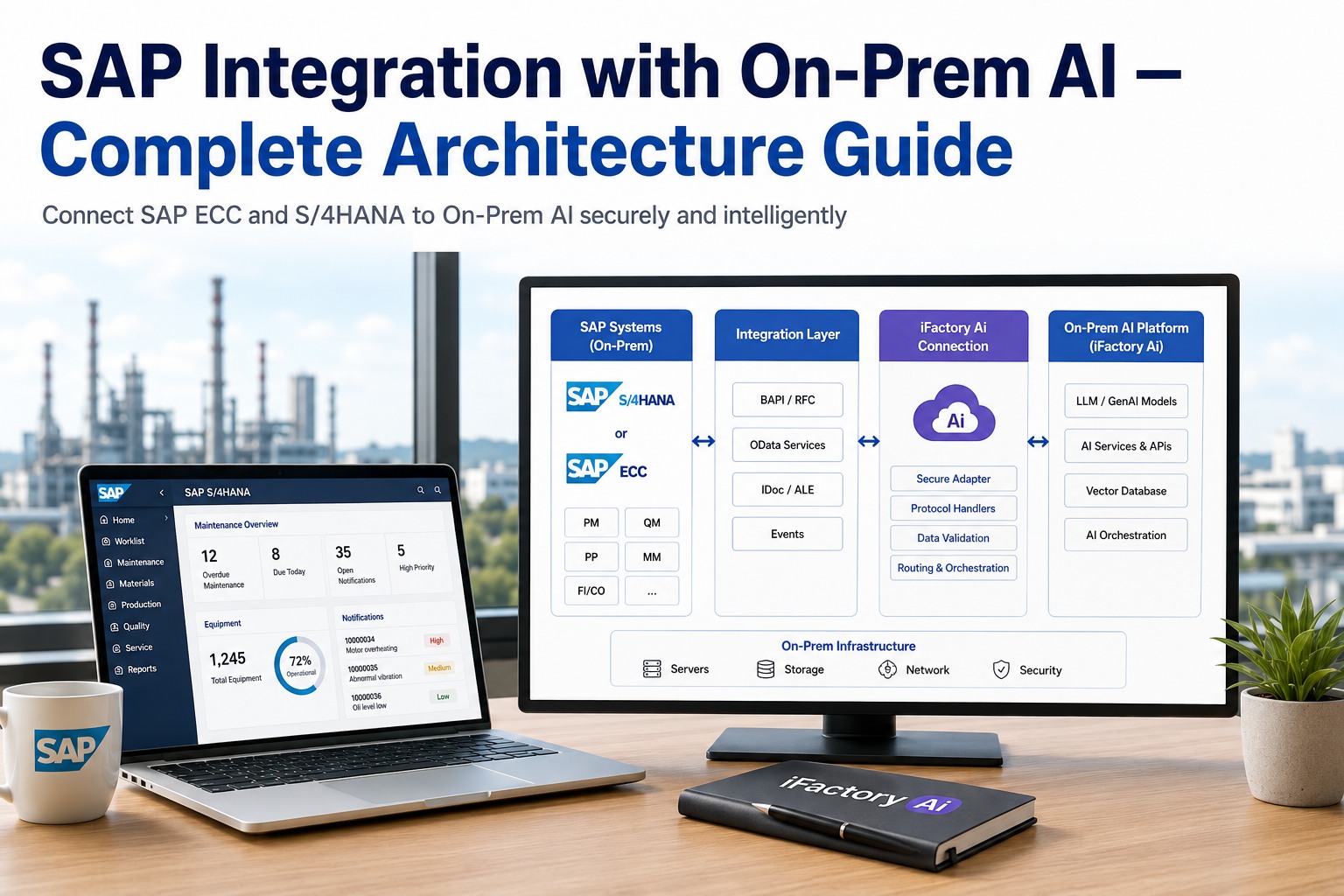
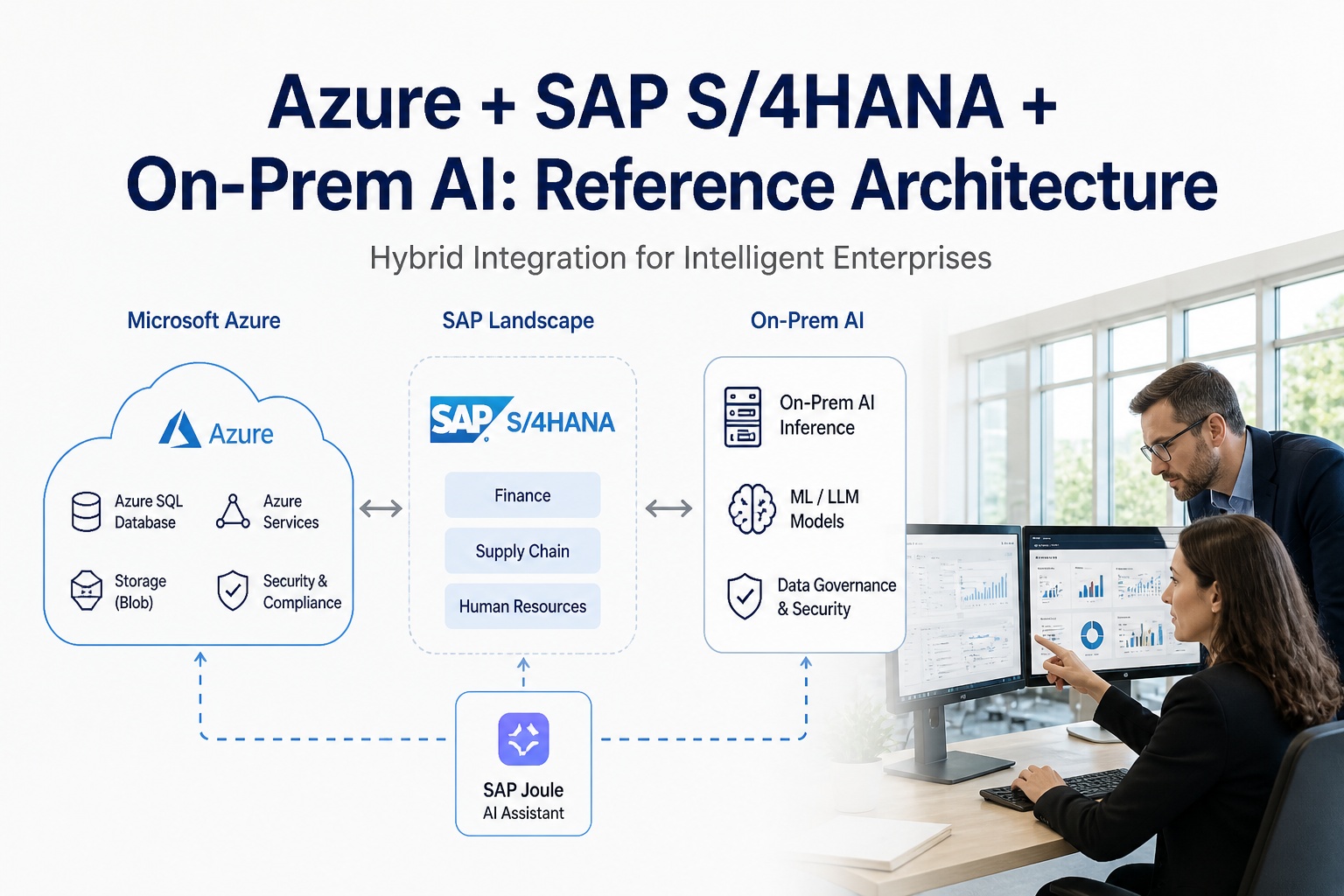
Yes — this is one of our core specializations. iFactory's connector library includes native integrations for SAP S/4HANA (both Public and Private Cloud), ECC, SAP BTP, and Joule. We've deployed hybrid architectures where SAP transactional data stays on-prem, feeds fine-tuned models via secure API, and the inference output writes back to SAP processes in real time. Our Sapphire demo on May 13 shows exactly this pattern running live. If you're evaluating how AI fits into your S/4HANA migration or RISE/GROW decision, that session is built for your situation.
iFactory · Enterprise Hybrid AI
Ready to Deploy? Let's Model Your Architecture.
iFactory has shipped hybrid SAP+AWS AI deployments across 1000+ enterprises — from regulated manufacturing to global financial services. In 30 minutes with our architects, we'll map your workloads to the right pattern, size your connectivity, and give you a go-live roadmap you can act on this quarter.