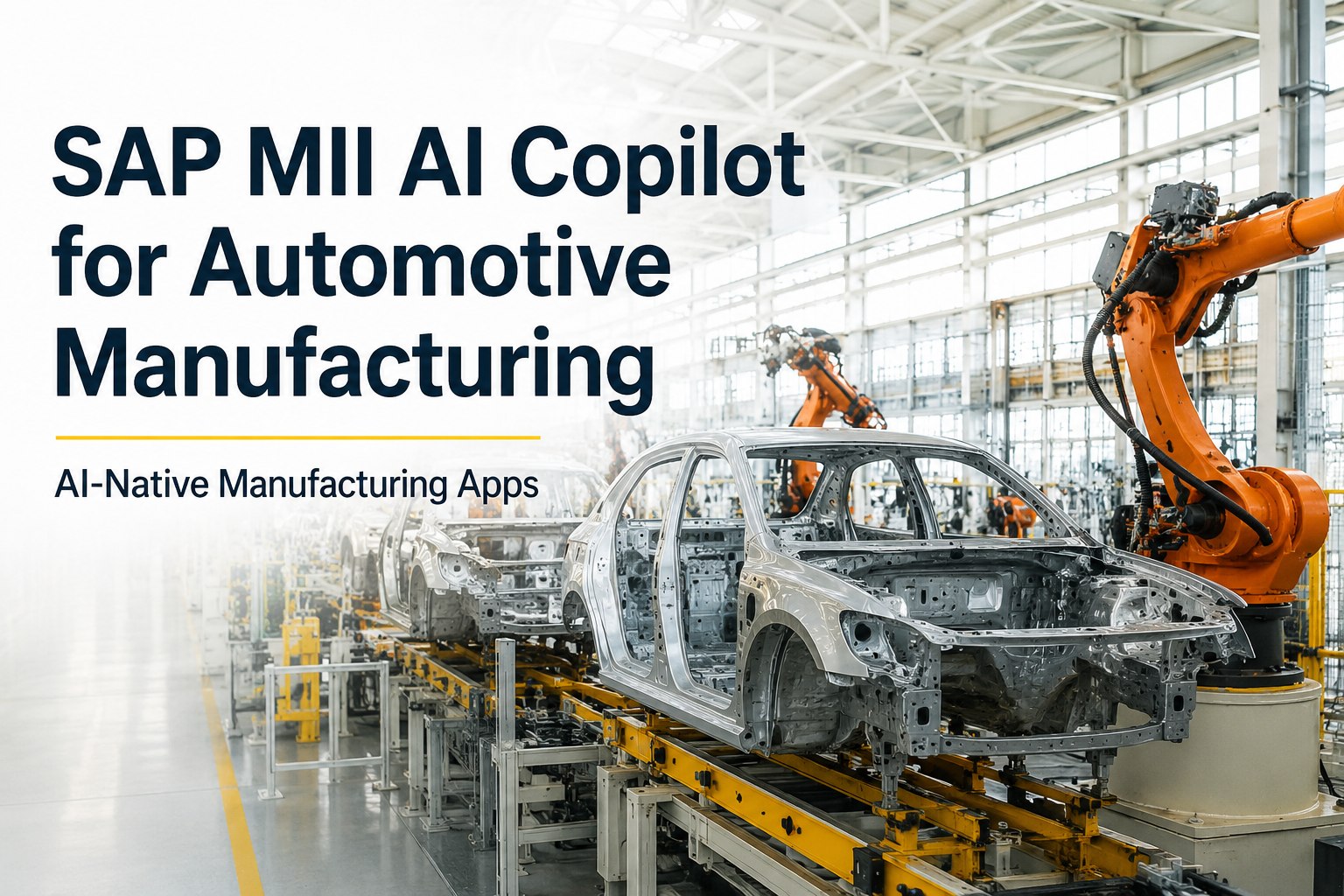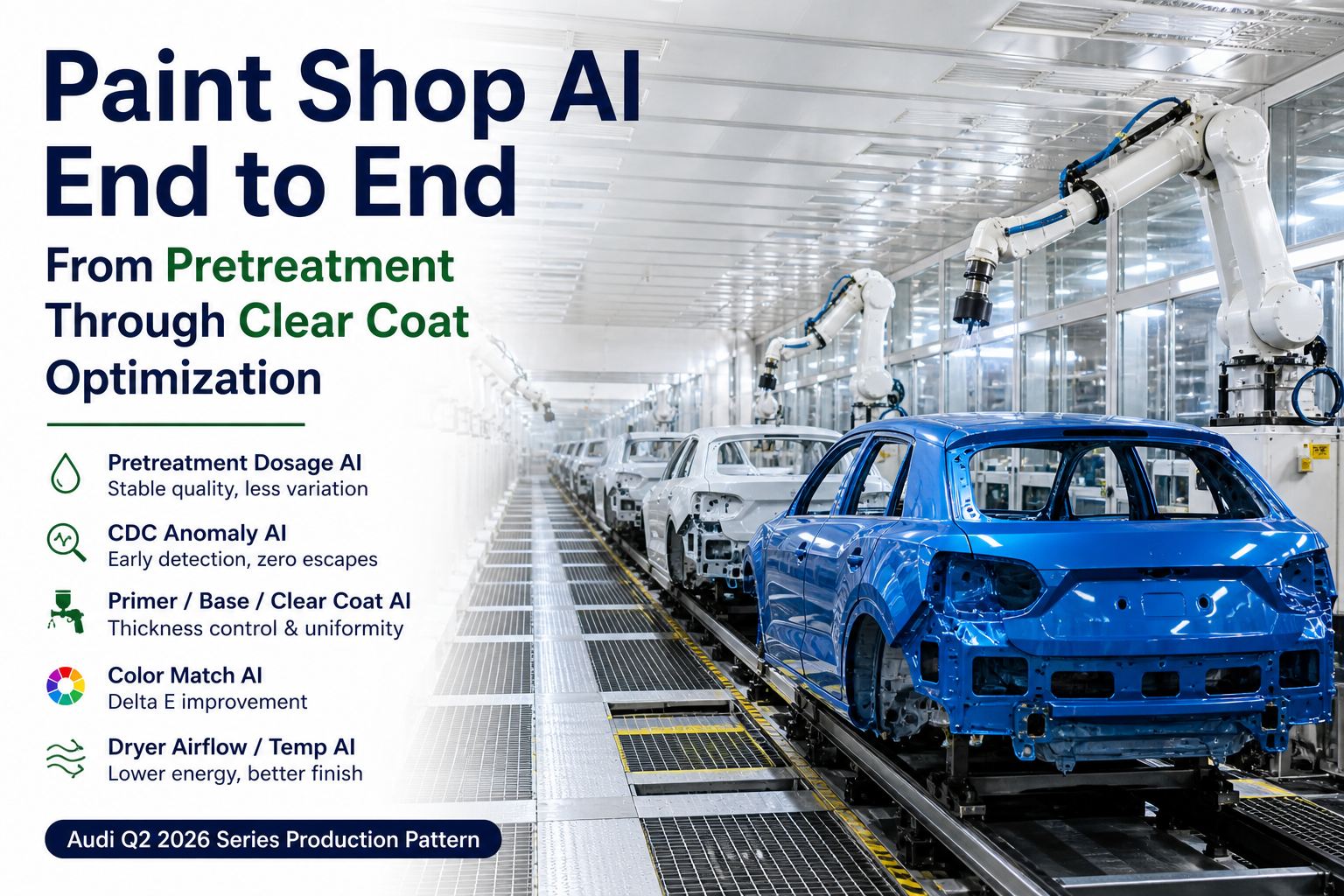
The paint shop is the most expensive room in the plant — and the one where AI has the most ground left to cover. A modern automotive paint shop runs six chemical and thermal stages in series: pretreatment, cathodic dip coating, primer, base coat, clear coat, and dryers. Each stage feeds the next. A pretreatment dosage drift shows up in the CDC three minutes later. A primer thickness wobble shows up in clear coat orange peel two stations down. A dryer airflow excursion shows up in cure quality on the line-end inspection — by which time you've painted ten more bodies wrong. iFactory's paint shop AI follows the body through all six stages with one connected intelligence layer — the pattern Audi began piloting at Neckarsulm with ProcessGuardAIn (Q2 2026 series production), now productized for OEMs deploying end-to-end AI in their own paint shops.
Paint Shop AI End-to-End — Pretreatment Through Clear Coat
Join the iFactory automotive team for a live walk-through of an AI platform that follows the body through all six paint shop stages. Pretreatment dosage · CDC anomaly · primer/base/clear thickness · color match · dryer airflow + temp — the Audi Q2 2026 series production pattern, productized for OEMs.
Audi Neckarsulm — Two Pilots Going Series in Q2 2026
The reference is real and dated. Audi has been piloting two ProcessGuardAIn use cases in the Neckarsulm paint shop — pretreatment dosage optimization and CDC anomaly detection — with series production introduction planned for Q2 2026. A third use case (AI-supported dryer control) is already in series operation, with energy savings being measured through summer 2026. Book a 30-minute review and we'll walk through how this maps to your shop.
ProcessGuardAIn pilot · series production planned Q2 2026 · early fault detection reduces follow-up costs.
Cathodic dip coating monitoring · series production planned Q2 2026 · simplifies manual work steps.
Already in series operation · IPAI partnership · energy savings tested through summer 2026 · joint with appliedAI + CVET.
Six Stages, One AI Layer Following Every Body
Each paint stage has its own physics, its own chemistry, its own sensor signature. Generic AI handles one of them at a time. End-to-end AI follows the body through all six — and catches the upstream cause before the downstream symptom. Below is what's running at each stage.
The Argument Against Stage-by-Stage AI Tools
Most paint-shop AI tools today optimize one stage in isolation. That's better than nothing — but the highest-value insights live in the relationships between stages. A pretreatment drift caught at the pretreatment booth is good. A pretreatment drift caught early because the AI noticed primer adhesion drift starting downstream is what changes your defect rate.
Most paint defects show up two or three stages after their root cause. End-to-end AI traces the symptom back to its origin in seconds — not weeks of QA investigation.
A small pretreatment shift + a small CDC voltage drift + a small primer thickness offset together look fine in isolation but compound to a clear-coat defect. Only end-to-end AI sees the combination.
Dryer energy savings are real — but only if quality holds. End-to-end AI optimizes the dryer with full visibility into upstream film build, so it doesn't compromise cure to save kilowatts.
Every body carries a complete record — pretreatment dosage, CDC voltage curve, primer thickness map, base color delta-E, clear coat defects, dryer cycle. Plant LLM queries that history in seconds.
Three Model Families. One Coordinated Brain.
No single model architecture covers all six stages. Vision Transformers handle perception. Reinforcement learning handles control. Anomaly ML handles process monitoring. The platform composes them — each running where it's best.
Visual inspection across primer, base coat, and clear coat. Detects defects against complex paint backgrounds where CNNs fail — orange peel, sags, fish-eyes, dirt inclusions, color delta-E.
Closed-loop control on application robot bell speed, air shape, primer/base/clear film build, and dryer airflow + temperature. Reward function jointly optimizes quality, energy, and cycle time.
Process monitoring across pretreatment baths, CDC voltage curves, viscosity, conductivity, and 200+ chemical signals. ProcessGuardAIn-class architecture — early fault detection before the defect appears.
When a defect is detected and root-caused upstream, a fine-tuned plant LLM drafts the corrective and preventive action document — including affected body range, root-cause stage, recommended adjustment, and follow-up verification plan. QA reviews and approves. The LLM doesn't control the process — it documents it.
The Defect Library — Mapped to Their Origin Stage
Most paint defects are misattributed. The line-end inspector sees the symptom. The root cause was 90 minutes earlier, four stages back. Below is the map. Talk to our paint-shop specialists for a defect-library walkthrough specific to your color portfolio.
| Defect (Symptom) | Where Inspector Sees It | Actual Root Cause | How AI Catches It Earlier |
|---|---|---|---|
| Orange peel | Clear coat | Base solvent / primer film build | Stage 3-4 thickness ML |
| Crater / fish-eye | Clear coat | Pretreatment contamination | Stage 1 anomaly ML |
| Pin-hole | Clear coat | CDC voltage instability | Stage 2 anomaly ML |
| Color drift (ΔE) | Base coat | Application gun / batch variance | Stage 4 spectro + ViT |
| Sag / run | Clear coat | Bell speed / air-shape mistune | Stage 5 RL controller |
| Dirt inclusion | Clear coat | Booth filtration / robe shedding | Stage 5 ViT + booth env data |
| Solvent pop | Clear coat | Dryer ramp / film build combo | Stage 3-6 cross-stage anomaly |
| Adhesion failure | Post-cure inspection | Pretreatment chemistry | Stage 1 anomaly ML |
Edge + Plant + Enterprise — Right-Sized for Each Job
- ViT inference per camera
- <100ms response on flowing line
- IP65 enclosure for paint atmosphere
- Per-booth deployment
- RL closed-loop controller
- Anomaly ML across 200+ signals
- Cross-stage genealogy & tracing
- One node per paint shop
- Plant LLM (Llama 3.1 70B)
- Multi-shop model registry
- Color formulation knowledge graph
- One rack per OEM enterprise
Stage-by-Stage Tools vs End-to-End AI
| Capability | Manual / Inspector-Driven | Stage-by-Stage AI Tools | iFactory End-to-End |
|---|---|---|---|
| Stage coverage | Inspection at line-end | One stage at a time | All 6 stages connected |
| Pretreatment dosage | Periodic lab samples | Single-stage anomaly | Anomaly ML linked downstream |
| CDC monitoring | Voltage trend chart | CDC-only ML | Linked to primer adhesion |
| Film thickness | Sample measurement | Per-panel measure | RL-controlled bell speed |
| Color match | Spectro at inspection | ΔE flagging | ΔE + flake + gun-source root cause |
| Clear coat defects | Visual inspector | CNN single defect | ViT multi-defect + root cause |
| Dryer control | Fixed setpoints | Schedule-based | RL · line-speed coupled |
| CAPA generation | Manual report | Manual | Plant LLM draft |
| Cross-stage tracing | QA investigation · weeks | Not possible | Native · seconds |
From Site Survey to Closed-Loop in 18 Weeks
Most OEMs deploy stage by stage in priority order — pretreatment + CDC first (Audi's path), then primer/base/clear vision, then RL on dryer and bell controllers. Schedule a deployment review with our paint-shop engineers.
What Paint Shop Engineers Ask First
No. iFactory's end-to-end AI sits above existing per-stage tools and integrates their data into the cross-stage genealogy. You keep what works; we add the connection layer that's typically missing.
ProcessGuardAIn is Audi/VW Group's internal solution. The architecture is similar — modular, edge-aware, anomaly-first. iFactory's platform is the productized version available to non-VW OEMs and Tier-1 paint shops, with the same architectural principles plus end-to-end vision and RL layers.
Yes — but on your timeline. Phase 1 is advisory (RL recommends; operator decides). Phase 2 closes the loop on dryer airflow and temperature once 14+ days of advisory accuracy proves out. The Audi/IPAI/CVET reference is already in series production with this approach.
Stays on-prem. Color match models train on your color data, in your facility, on H200/GB300 you control. No formulation data ever transmits to cloud APIs. Critical for OEMs whose color portfolio is brand identity.
Built for End-to-End — Not Stage Tools Stitched Together
Get the End-to-End Plan for Your Paint Shop
Thirty minutes with our paint-shop engineering team. Bring your shop layout, current per-stage tooling, and your top three recurring defect categories. We'll map exactly which stages to instrument first, model the cross-stage tracing your defect history actually needs, and outline an 18-week deployment path. Talk to support for preliminary scoping if you'd like to start there.