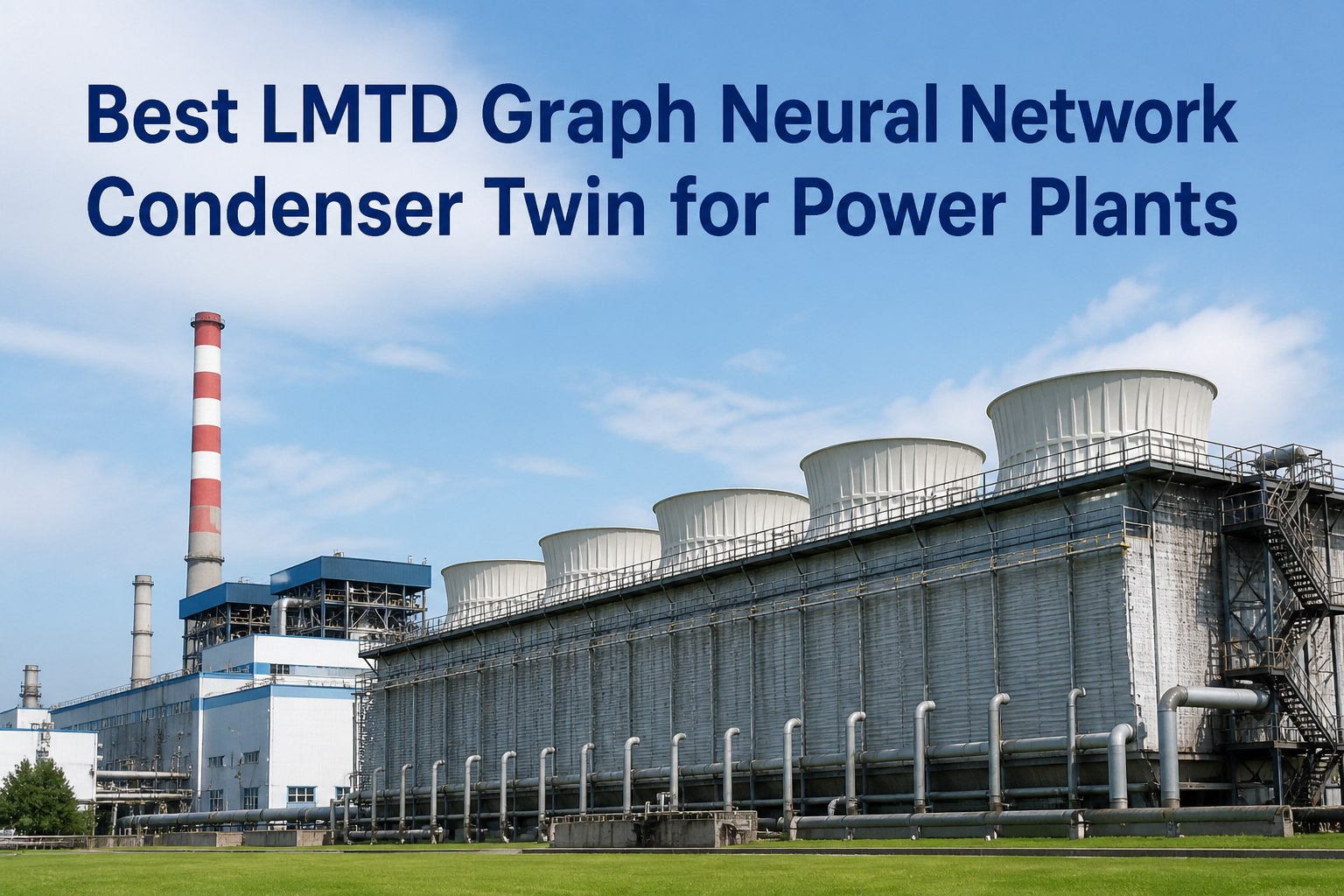
A condenser twin is a live mathematical replica of the 30,000+ tube heat exchanger that determines back-pressure, vacuum, and the bottom 1–2% of plant heat rate. iFactory pairs closed-form LMTD physics with a Graph Neural Network that maps each tube as a node and learns spatial fouling patterns. Live vacuum: 74.9 kPa. 30-min projection: 75.4 kPa. Drift: 0.66%. Last cal: 8 hours ago. Runs on the on-site GB300 + H200 stack. Power and a network drop are the only things you provide. One-time CapEx — you own the twin, the physics, the GNN weights, the data. To scope a unit, get a turnkey quote.
Condenser Twin — LMTD Physics + Graph Neural Network
Live vacuum 74.9 kPa · 30-min projection 75.4 kPa · drift 0.66% · last cal 8 h ago. LMTD captures the physics. A 3-layer GNN maps 30,000+ tubes and learns spatial fouling. Self-calibrates every 6–10 hours. Shipped to your plant, deployed by our engineers, owned by you.
Live Twin Status
Re-projects every 30 seconds. Self-calibrates every 8 hours or on threshold breach. Schedule a session to see this on your unit.
LMTD — The Equation That Defines a Condenser
A condenser rejects ~800 MWth from turbine exhaust to cooling water. LMTD links surface area, heat transfer coefficient, and temperature delta. The twin solves it every 30 seconds.
When LMTD rises but Q stays the same, U has dropped — fouling is increasing. The closed-form physics catches the macro behavior. The GNN catches where in the bundle the fouling is happening.
Why a Graph Neural Network
A condenser has 30,000+ tubes. Adjacent tubes share thermal context — a fouled tube affects its neighbours. That's a graph, not a vector. The GNN treats each tube as a node, the inter-tube coupling as edges, and learns the spatial fingerprint that no single-pass model can capture.
LMTD Physics + GNN Correction
A condenser has more variability than a furnace or turbine because the cooling water side is exposed to ambient — river temperature, seawater chemistry, biofouling. That is why a graph-aware ML correction matters here in a way it doesn't on the boiler twin or turbine cycle twin.
Q = U·A·LMTD with mass and energy balance, IAPWS-97 steam tables. Validated for 100+ years. Sub-5ms evaluation. Generalizes across load and ambient.
3-layer GNN (~500K params) runs message-passing across the bundle. Captures spatial fouling, dead zones, biofilm clustering. Trained on 12+ months historian + half-pass logs. Bounded — never overrides physics.
30-Minute Vacuum Projection
Reactive operation is "vacuum hit 80 kPa, derate now." Proactive is a 30-minute heads-up that vacuum is rising 0.5 kPa per 30 min — enough lead time to dose chlorine, swap a CW pump, or schedule cleaning before back-pressure forces a derate.
A 1 kPa rise on a 660 MW unit costs ~1–2 MW of gross output. Catching it 30 minutes early is usually enough to act before the derate.
Why 0.66% Drift Is Excellent for a Condenser
If you've seen our boiler thermal twin (0.11% drift) or turbine cycle twin (0.02% drift), you might wonder why this twin runs at 0.66%. Here's why higher drift is the right design choice for a condenser.
| Twin | Typical Drift | Why | Ambient Exposure |
|---|---|---|---|
| Boiler thermal twin | 0.10 – 0.30% | CFD surrogate captures most physics | Low — boiler shell isolated |
| Turbine cycle twin | 0.02 – 0.05% | Closed-form Rankine; very little for ML to learn | None — sealed steam loop |
| Condenser twin | 0.40 – 0.90% | 30,000+ tubes, biofouling, CW chemistry, debris | High — exposed to river / sea water |
Cooling Water Linkage
The condenser is the only major plant component dominated by something outside your fence — river temperature, seawater intake, cooling tower approach. The twin ingests these as live PI tags so projections account for ambient drift in real time.
Live PI: CW-IN-T (28.4 °C). Ambient sensitivity ±5 °C seasonally. Biofouling load varies with chemistry.
Steam side: turbine LPT exhaust. CW side: 4 passes. Heat duty ~800 MWth. Vacuum 73–76 kPa target band.
Live PI: CW-OUT-T (36.1 °C). ΔT typical 7–9 °C across condenser. Cooling tower approach 3–5 °C.
Why iFactory
Most "condenser monitoring" pitches end at a vacuum trend chart. iFactory ships LMTD physics, GNN correction, spatial fouling map, calibration loop, operator dashboard, and the on-site GPU stack — all integrated. Schedule a working session.
Real fouling spreads from neighbour to neighbour. The GNN captures that. Single-vector models flatten the bundle and lose the fingerprint.
Reliability sees a heat-map of which passes are fouling fastest. Tells you which half-pass to clean first — saving hours during outages.
Boiler thermal + turbine cycle + condenser = three pieces explaining heat rate end-to-end. The trio together explains gaps no single twin can.
Every PI tag, every twin output, every operator action stays inside your fence. No cloud sync. NERC CIP / IEC 62443 audit-ready.
Existing DCS, CMMS, dashboards keep working as before. Twin lives alongside, not on top of. No rip-and-replace.
One-time CapEx. You own the GB300, H200, LMTD parameterization, GNN weights, data. Talk to support.
Power + Network. We Handle the Rest.
Power — 3-phase circuit at the plant DC for the GB300 + H200 rack. Network drop — Gigabit uplink with read-only path to historian + DCS zone.
GB300 + H200 build, ship, install. Tube bundle topology mapped from drawings. LMTD parameterized. GNN trained on historian + half-pass logs. Self-calibration loop. OPC UA bridge. Dashboard. Plant copilot LLM.
6–10 Week Deployment
Condenser twins take longer than turbine cycle twins because the GNN trains on your bundle topology and historian backfill. Typical 6–10 weeks. After commissioning, calibration is fully automated.
Drawings, tube count, pass layout received. Half-pass cleaning history pulled. Fixed BOM in 5 days.
Bundle graph constructed. 12+ months historian backfill. GNN trained. Hardware racked.
Engineers fly in. Network bridged to historian, twin goes live in shadow mode.
Dashboard live in control room. Calibration active. Year-one support active.
FAQ
No. The GNN learns spatial fouling from bulk vacuum + CW inlet/outlet + half-pass cleaning logs. Graph topology comes from drawings.
Because a condenser is dominated by external ambient — river temperature, biofouling, debris ingestion. There is genuinely more variability. 0.66% is excellent given that real-world unpredictability.
Yes. Standalone — needs vacuum, CW inlet/outlet, and load tags. But many customers deploy the trio because together they explain heat-rate gaps no single twin can.
Fixed price per unit, scoped to condenser size and tube count. No per-projection billing. Get a quote — proposal in 5 days.
Get a Quote on Your Unit.
Watch the condenser twin run on a live 660 MW unit or send your condenser drawings and historian backfill — fixed-price BOM in 5 business days. Hardware, LMTD parameterization, GNN training, deployment, dashboard, training, and year-one support all included. You own the platform outright the day it goes live.