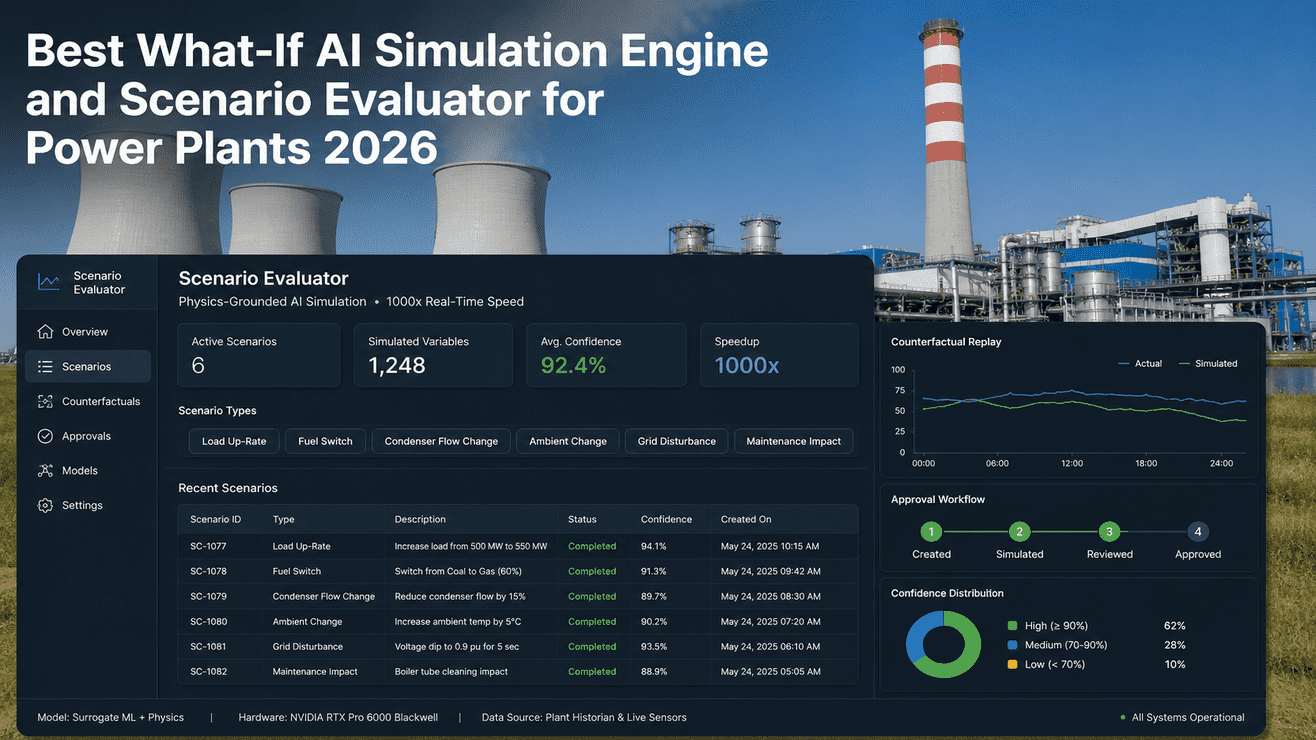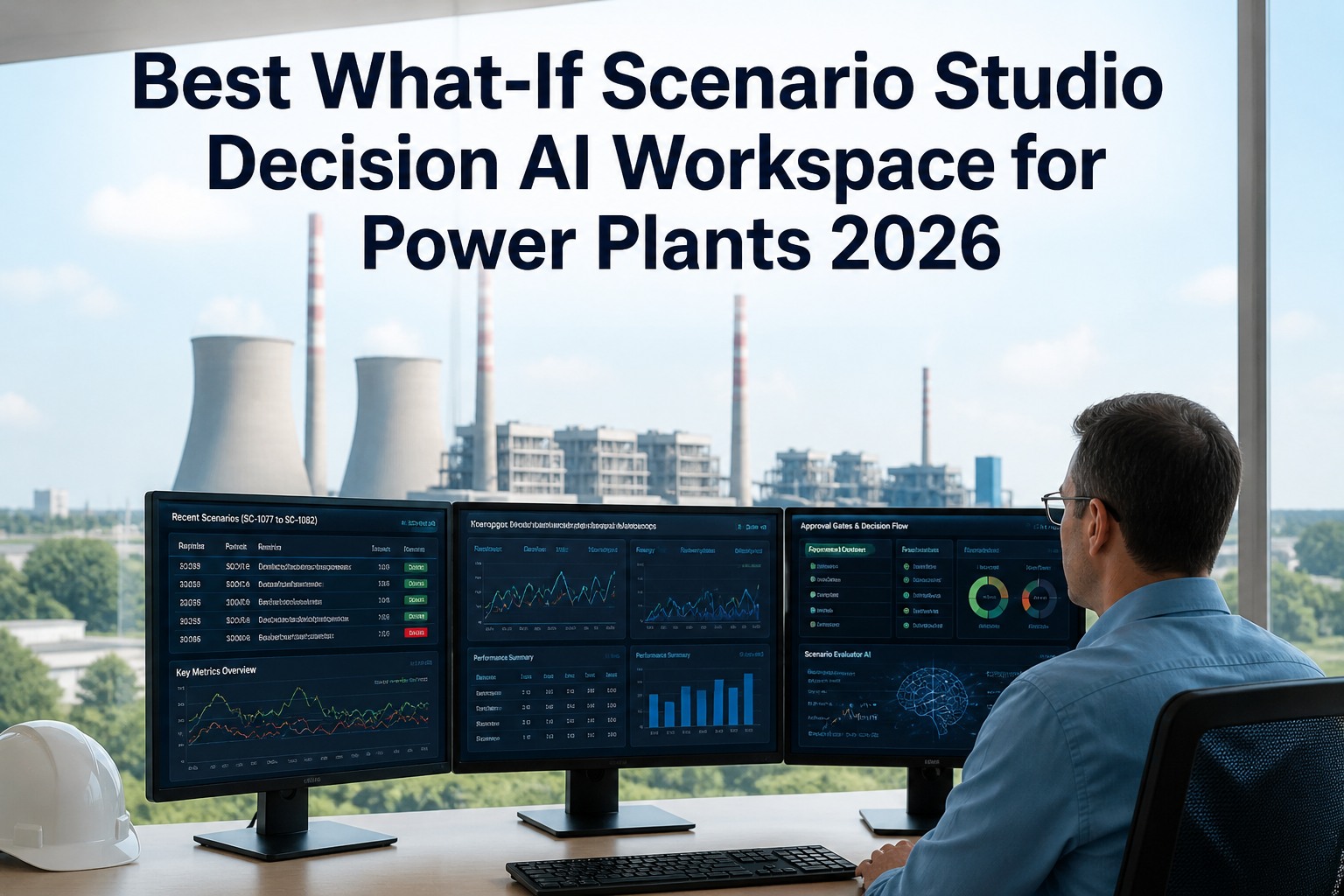
A what-if scenario studio is the safe sandbox above your digital twins — the workspace where shift engineers, day-ahead schedulers, and reliability teams test changes before running them on real equipment. Want to load up by 10 MW? Open a scenario, pick the load profile, run it against the boiler-cycle-condenser twin trio, see projected heat rate / vacuum / drift, route to the approver, execute. Recent live examples: SC-1082 load up to 460 MW (+10 MW, 96% confidence, approved) · SC-1078 soot blowing optimize (+0.4% efficiency, approved) · SC-1077 HP turbine 105% (rejected, overspeed risk). Runs as a batch GPU workload on the on-site NVIDIA GB300 — every scenario uses the same twins your operators trust live, no separate model. One-time CapEx — you own the studio, the scenarios, the approval log, the data. To scope a unit, get a turnkey quote.
What-If Scenario Studio — Test Decisions Before You Make Them
A safe sandbox built on top of your twin trio. Shift engineers run scenarios in seconds. SC-1082 load up to 460 MW · approved at 96% confidence. SC-1078 soot blowing · +0.4% efficiency, approved. SC-1077 HP turbine 105% · rejected on overspeed risk. Five scenario categories. Two-stage approval gates. Full audit log. Runs as batch GPU on the on-site GB300 — same twins, different mode.
The Anatomy of a Live Scenario
This is what an operator actually sees when SC-1082 (load up to 460 MW) opens on the studio dashboard. Inputs, twin projections, confidence band, recommended approver, and status — all on one card. Schedule a session to see this on your unit.
- Target: 460 MW (+10 MW)
- Window: 15:00 to 19:00 IST
- Fuel: blend held constant
- Requested by: Shift A operator
- Heat rate: +18 kJ/kWh
- Main steam temp: 539.4 °C (within band)
- Vacuum: 75.6 kPa (within band)
- Tube wall hot spots: 2, both within design
- Confidence: 96%
- Approver: Plant manager
- Approved at: 14:18 IST
- Execute window opens: 14:45 IST
Recent Scenarios — SC-1077 to SC-1082
The studio keeps every scenario in a versioned log — what was requested, what the twin projected, who approved or rejected, and what actually happened after execution. Here is a snapshot of the last 6 entries from a real-world deployment.
Every scenario is logged with timestamp, requestor, twin version, projection, approver, and post-execution actuals. This becomes the audit trail for NERC CIP, IEC 62443, ISO 27019, and reliability committee reviews. Rejected scenarios are kept too — the studio learns from refusals.
Five Scenario Categories. Same Workflow.
Every plant decision falls into one of five buckets. Each has its own twin focus, but the studio uses one unified workflow — describe change, run sim, get verdict, route to approver, log outcome.
Load up / load down, ramp rate, peaking blocks, day-ahead bid scenarios. Twin focus: cycle + condenser.
Coal A vs blend B vs imported, fuel switch trials, NOx / SOx sensitivity. Twin focus: boiler thermal.
De-rate windows, frequency response, black-start drills, RPP coordination. Twin focus: trio + LLM copilot.
Half-pass cleaning windows, soot blower scheduling, planned outage staging. Twin focus: condenser + boiler.
Valve trims, desuperheater set-points, O2 bias, soot blowing optimization. Twin focus: full trio.
The Approval Gate Flow
Not every scenario can auto-execute. The studio routes by twin confidence and change risk — auto-approve for low-risk + high-confidence, manual review for medium, escalation or reject for the rest.
Shift engineer describes the change in plain English or by template. Studio fills in the rest from live PI.
Studio runs the trio twins in batch on GB300 GPU. Output: projected metrics + confidence band. Sub-2 minute typical.
Above 90%: auto-approve. 70–90%: manual review. Below 70%: rejected with twin-explained reason.
Operator executes the approved change. Studio reconciles actual vs projection. Discrepancy > 1% flags retraining.
SC-1077 vs SC-1078 vs SC-1082 — The Three Outcomes
Three real scenarios, three different outcomes. The studio is not just a "yes machine" — refusing a bad idea is as important as approving a good one.
Operator wanted to push HP turbine speed to 105% briefly. Twin projected overspeed-trip risk and irreversible blade stress. Confidence to safely execute: 38%. Rejected with twin-generated reason; logged for OEM review.
Reliability proposed a new soot-blowing sequence on the boiler-side. Twin projected +0.4% efficiency gain at no incremental wear. Confidence 94%. Approved by reliability lead. Post-execution: actual gain 0.37% — within tolerance.
Day-ahead scheduler asked to push to 460 MW for 4 hours. Twin projected +18 kJ/kWh, all envelopes within band. Confidence 96%. Approved by plant manager; execute window 14:45 IST. Post-load: heat rate +16 kJ/kWh actual.
This is the whole point of a scenario studio. Refusing SC-1077 saved the unit from a possible overspeed event. Approving SC-1078 picked up a real efficiency gain. Approving SC-1082 gave the day-ahead bid the heat-rate envelope it needed. Talk to us about deployment on your unit.
Where the Studio Runs
The studio is a batch workload, not a real-time loop — that means it can run at higher GPU utilization on the same GB300 that already hosts your plant copilot LLM. Same hardware, different mode. No second box.
Studio queues scenarios as batch GPU jobs. Each scenario runs the trio twins (boiler + cycle + condenser) plus the plant copilot LLM for human-readable verdict. Sub-2 minute typical, 30 sec for simple ones.
The studio uses your live boiler thermal twin, turbine cycle twin, and condenser twin — the same models your operators see in real time. No "second-tier scenario model" that drifts from production. What the operator trusts live is what the scenario uses.
Why iFactory
Most "scenario tools" are spreadsheets or Excel macros. iFactory ships a batch GPU studio, the trio twins it runs against, the approval gate workflow, the audit log, and the LLM that explains verdicts in plain English — all integrated, all on your floor. Schedule a working session.
Studio uses your live boiler-cycle-condenser twins. Not a separate offline model that hasn't been calibrated in 6 months.
Confidence-routed approval workflow. Auto-approve, manual review, escalation, reject. Tied to NERC CIP / ISO 27019 audit log out of the box.
The studio rejects unsafe scenarios with a twin-generated reason. SC-1077-style overspeed asks get blocked — not silently approved.
Every scenario, every projection, every approval stays inside your fence. No cloud sync. No vendor data lake. Audit-ready.
Existing DCS, CMMS, dashboards keep working as before. Studio lives alongside, not on top of. No rip-and-replace.
One-time CapEx. You own the GB300, the studio, the scenario library, the approval log, the data. Talk to support.
Power + Network. We Handle the Rest.
Power — 3-phase circuit at the plant DC for the GB300 rack. Network drop — Gigabit uplink with read-only path to historian + DCS zone (already needed for the trio twins).
GB300 batch scheduler. Studio dashboard. Scenario template library (Throughput, Fuel, Energy, Maintenance, Efficiency). Approval gate routing. Audit log integration. Plant copilot LLM grounded for verdicts. Operator + reliability + scheduler training.
4–6 Week Studio Deployment
Studio deploys faster than a fresh twin because the trio twins are already running. Typical 4–6 weeks once your boiler / cycle / condenser twins are live.
Discovery on existing approval workflows. Scenario template seed list (50 most common decisions on your unit).
Studio dashboard provisioned on the existing GB300. Templates loaded. Approval routes mapped to your roles.
Studio runs scenarios in shadow alongside real operator decisions. Confidence thresholds tuned to your tolerance.
Studio live in control room. Operator + reliability + scheduler trained. Year-one support active.
FAQ
No. It runs the simulation, projects metrics, routes by confidence. The operator and approver still own the decision. The studio's job is to make refusal cheap and approval fast.
Yes. The studio runs against live, calibrated twins. If you have the boiler thermal twin only, you can still run boiler-side scenarios; trio is recommended for end-to-end heat-rate scenarios.
30 seconds for simple single-twin scenarios. 1–2 minutes for trio scenarios with LLM copilot verdict. Operators see a "running" status with progress and can queue several in parallel.
Fixed price per unit, scoped to twin coverage and approval workflow complexity. No per-scenario billing. Includes studio, templates, training, year-one support. Get a quote — proposal in 5 days.
Get a Quote on Your Unit.
Watch SC-1082, SC-1078, and SC-1077 run live Or send your asset list, current decision workflows, and twin coverage status — we come back with a fixed-price BOM in 5 business days. Studio, templates, GB300 batch scheduling, approval workflow, audit log, training, and year-one support all included. You own the studio outright the day it goes live.