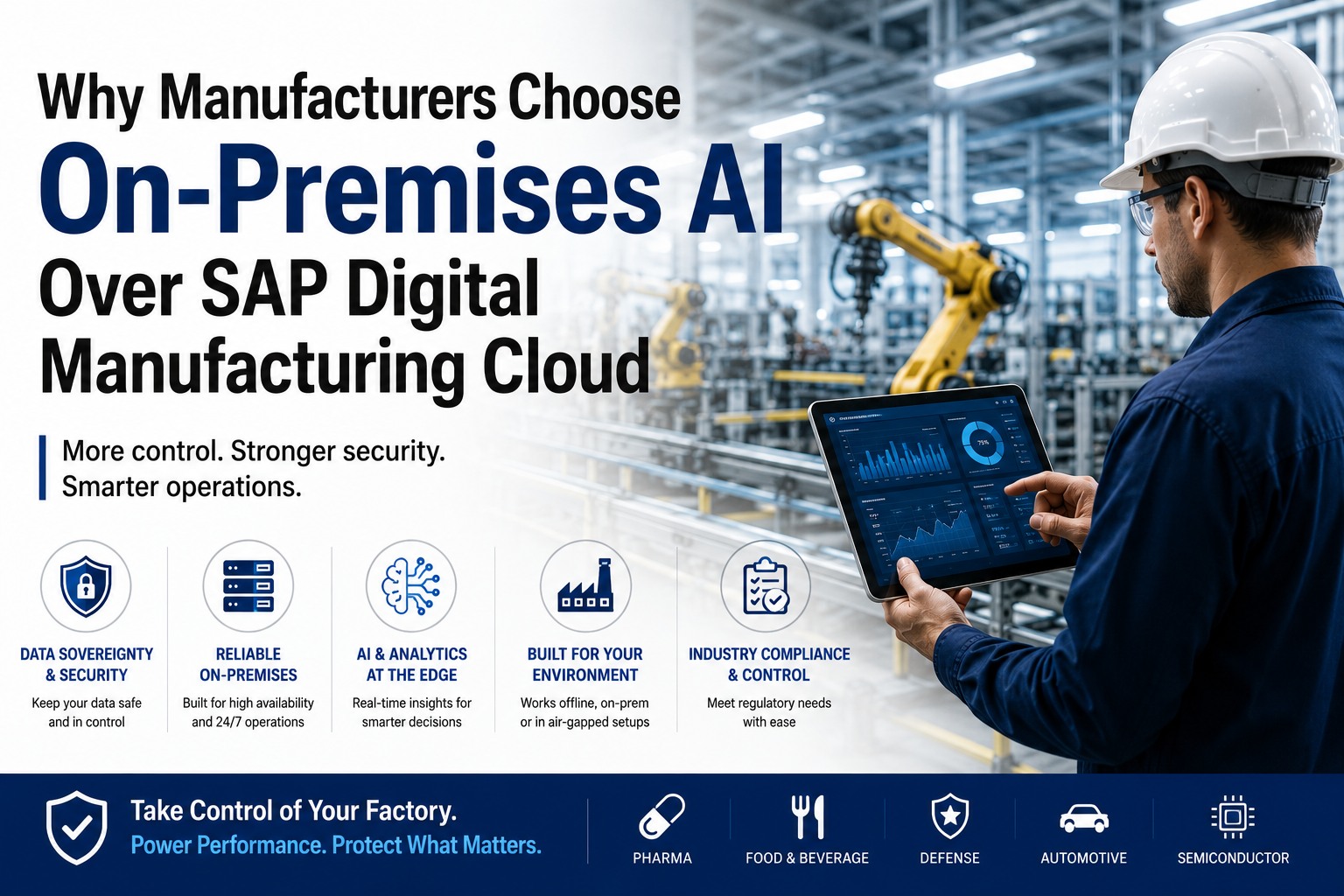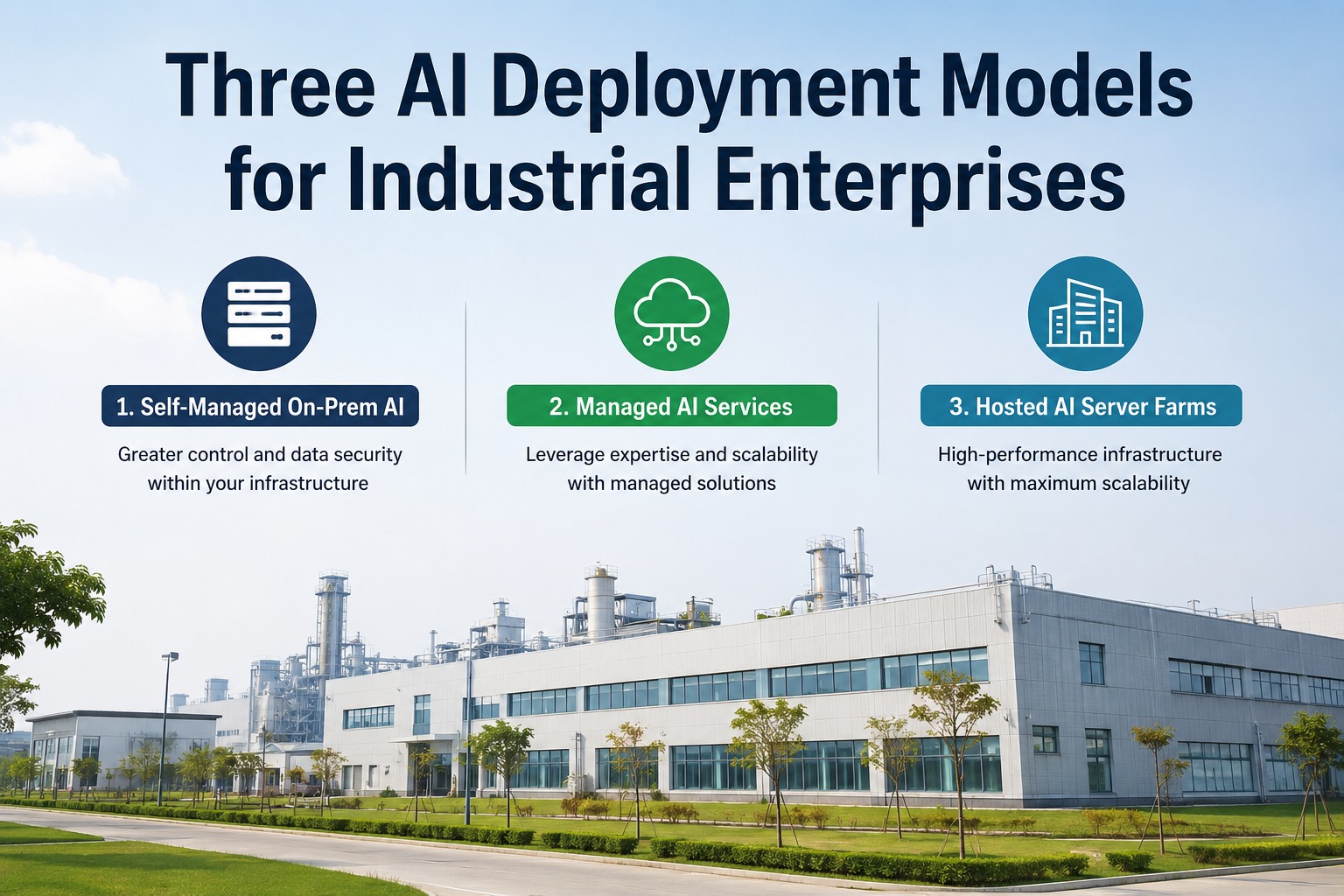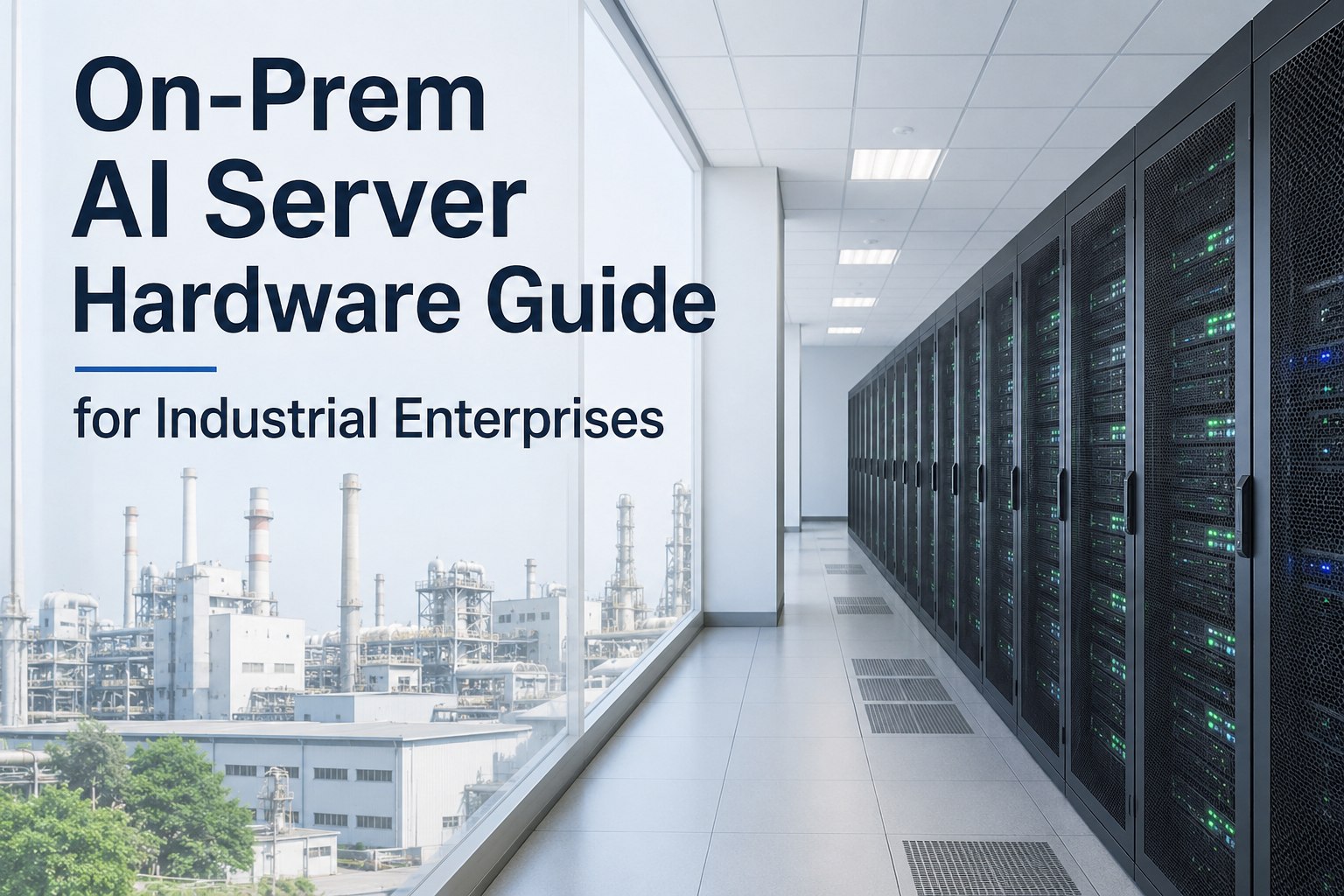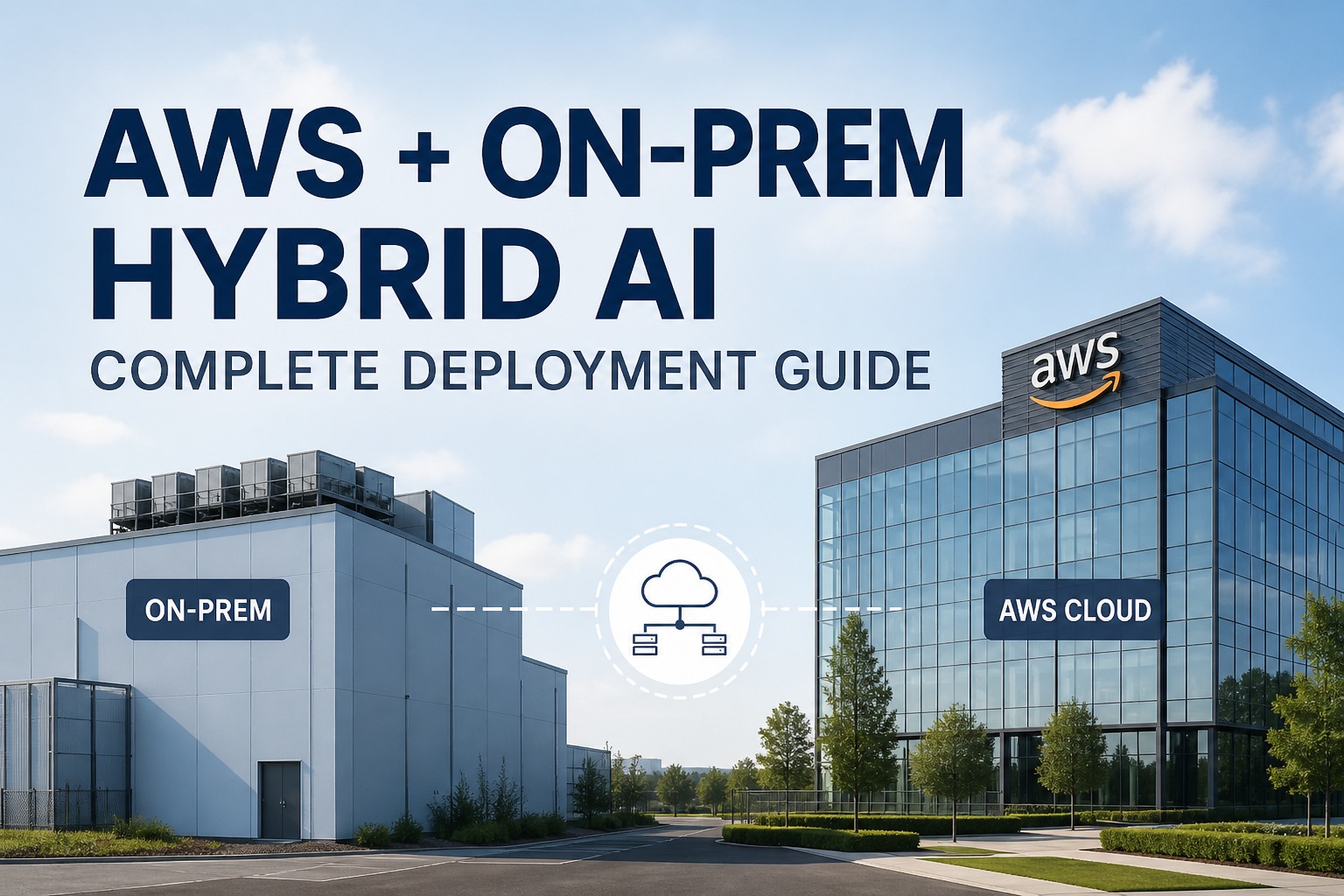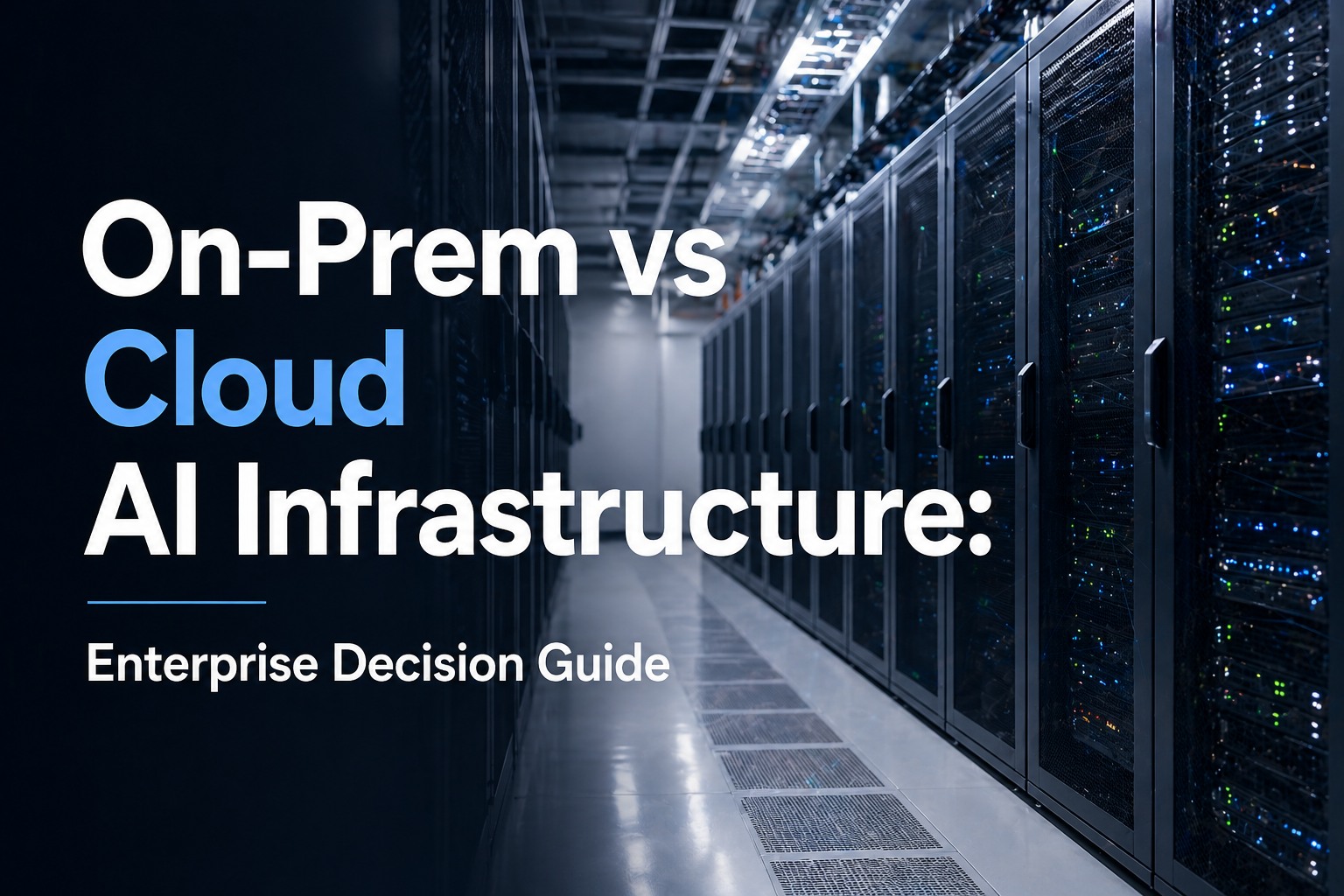
Enterprise AI in 2026 isn't a question of whether — it's a question of where it runs, what it costs per token, and who controls the data. The inference inversion has rewritten the math: token volumes have crossed the threshold where on-premise hardware breaks even in months, not years, while frontier APIs remain irreplaceable for bursty experimentation. The right answer is no longer cloud-only or on-prem-only — it's a deliberately architected hybrid that routes each workload to the environment built for it. This pillar gives infrastructure leaders the numbers, frameworks, and architectural patterns to make that call with confidence — covering on-prem vs cloud TCO, DGX vs RTX PRO platform selection, AWS Bedrock vs Azure AI Foundry vs Google Vertex AI, token economics, and a defensible 90-day decision roadmap. Every recommendation here is grounded in current 2026 benchmarks and TCO models drawn from over 1,000 enterprise deployments.
Architect Your Enterprise AI Strategy On-Site
Join the iFactory team at SAP for a live strategy session covering on-prem vs cloud TCO, Blackwell platform selection, and hybrid AI deployment — backed by 1,000+ enterprise factory rollouts. Sit down with our architects, model your scenario in real time, and walk away with a concrete plan.
Why 2026 Is the Year Enterprise AI Strategy Got Hard
For the first time, the volume of tokens generated by inference has officially exceeded those used in training. That single shift has rewritten the cost model — turning AI infrastructure from an experiment into a sustained operational expense that finance teams now scrutinize line-by-line.
GenAI Moved From Pilots to Production
AI now drafts customer communications, summarizes regulated documents, generates code, and triggers actions across core systems. These aren't experiments — they're operational dependencies with uptime SLAs.
Costs Became Visible — and Volatile
Usage-based AI services are easy to start and hard to predict without strong controls. Finance teams now expect unit economics — cost per million tokens, cost per query, cost per outcome — not excitement.
Data Sovereignty Pressure Increased
Stricter expectations around where data is processed and which third parties can touch it have made cloud-only strategies untenable for regulated industries — even when cloud compliance is technically possible.
GPU Capacity Planning Got Strategic
Whether you rent or own, GPU access and utilization now shape product timelines and margins. Cloud capacity constraints during peak demand have made dedicated infrastructure a strategic moat.
On-Premise vs Cloud — The TCO Math, Honestly
The cheapest unit price is rarely the cheapest system. Below is the side-by-side comparison every enterprise AI strategy must reconcile — built from 5-year amortization data and current cloud pricing.
| Factor | On-Premise | Cloud / Managed API | Verdict |
|---|---|---|---|
| Year 1 Cash Outlay | High CapEx — $250K+ for 8× H100 server | Low — pay only for what you use | Cloud wins |
| Cost at Sustained Volume | Drops 80%+ after Year 1 amortization | Linear — same monthly cost forever | On-prem wins |
| Cost Per Million Tokens | 10–18× cheaper at >60% utilization | $15–60 per million tokens average | On-prem at scale |
| Time to First Inference | 4–12 weeks (procurement + setup) | Minutes (API key + SDK) | Cloud wins |
| Data Sovereignty | Full control — data never leaves perimeter | Vendor-managed; depends on region/SLA | On-prem wins |
| Model Refresh Cycle | Manual — driven by hardware lifecycle | Automatic — newest models on day one | Cloud wins |
| Burst / Spike Handling | Constrained by owned capacity | Effectively unlimited (subject to quota) | Cloud wins |
| Break-Even Point | 4–6 months at >20% utilization (2026 data) | Never — costs are linear | Depends on utilization |
| Hidden Costs | Power, cooling, IT staff, HW refresh | Egress fees, reserved capacity, vendor lock-in | Both have them |
| Best For | Sustained production inference, regulated data | Experimentation, bursty training, rapid prototyping | Hybrid is the answer |
The strategic threshold most often cited: on-premise becomes the mathematically superior choice when GPU utilization consistently exceeds 60% over the hardware's lifespan. Below that, cloud flexibility justifies the premium — above it, the savings compound every month.
DGX vs HGX vs RTX PRO — Picking the Right Blackwell Platform
NVIDIA's 2026 lineup is no longer a single product family. Each platform targets a distinct workload profile. Choose the wrong one and you'll either overpay by 3× or hit a memory wall on day one.
NVIDIA DGX B200 / B300
Eight Blackwell GPUs interconnected via 5th-gen NVLink. The reference platform for SuperPOD-scale training and high-throughput inference clusters.
HGX H200 / L40S Servers
The TCO champion for the 7B–70B parameter range. Lenovo ThinkSystem SR650a V4 with L40S has emerged as the price-performance leader for batch inference.
RTX PRO 6000 Blackwell
96GB ECC GDDR7 at 1.8 TB/s bandwidth. Designed for production-grade local AI inference and fine-tuning on a single workstation chassis.
DGX Spark (GB10)
Compact Grace-Blackwell Superchip with 128GB unified memory. Built for AI developers running 70B-class models locally — not for production serving.
AWS Bedrock vs Azure AI Foundry vs Google Vertex AI
If you're going cloud, you're really choosing between three distinct strategies — model marketplace breadth (Bedrock), exclusive OpenAI access (Azure), or native Google stack integration (Vertex). Below is the operator-level comparison.
| Dimension | AWS Bedrock | Azure AI Foundry | Google Vertex AI |
|---|---|---|---|
| Strategic Position | Aggregator — multi-vendor marketplace | Exclusive — only home for GPT-4o / GPT-5 | Native — owns chips (TPU) through model (Gemini) |
| Model Catalog | Claude, Llama, Titan, Mistral, Cohere, Jamba, Stability AI | OpenAI suite + 1,800+ models in Foundry | Gemini family + Model Garden |
| Pricing Model | Per-token on-demand or Provisioned Throughput | Token-based + PTU (Provisioned Throughput Units) | Compute-hour + per-character prediction |
| Reserved Discount | Up to ~30% with provisioned throughput | Up to 40% with regional PTUs | 50% discount on batch prediction |
| Compliance Breadth | ISO, SOC, GDPR, HIPAA, FedRAMP High | Most comprehensive — all major + regulated industry | SOC 2, HIPAA, ISO 27001, PCI DSS, FedRAMP Moderate |
| Agent Platform | AgentCore (GA October 2025) | Microsoft Agent Framework (Dec 2025) | Vertex Agent Builder + A2A protocol |
| Best Fit Org | Multi-cloud, multi-model architectures | Microsoft 365 / Azure-first enterprises | Data-heavy orgs with BigQuery / GCP |
| Cost at 10–50M tokens/mo | 15–25% lower than peers (typical) | Most competitive at scale with reserved capacity | Best price-performance for compute |
| FinOps Attribution | Application Inference Profiles — clean attribution | Subscription / RG scopes + tag inheritance | Project-per-team + labels-everywhere |
The Cost-Per-Million-Tokens Framework
The most important metric for AI inference TCO is the cost per million tokens — the price-performance actually delivered. Below is how the four deployment models stack up at sustained enterprise volume (10B tokens/month).
GPT-4o, Claude 4.x, Gemini Ultra direct API or via hyperscaler. Highest capability, highest unit cost. No volume threshold makes this cheap at scale.
Llama 3.3 70B, Mistral, Gemma on AWS/Azure/GCP. Capability gap with frontier has closed for many production tasks. Mid-range cost, full cloud flexibility.
Self-hosted on Lenovo ThinkSystem or equivalent. Once CapEx is amortized (~12 months at high utilization), ongoing cost is electricity and maintenance only.
GB200 NVL72 delivered $0.012/M tokens on GPT-OSS-120B per Q1 2026 SemiAnalysis benchmarks — the lowest cost per token verified among major platforms.
For any sustained workload, on-prem hardware pays for itself when monthly cloud spend exceeds (CapEx + 3-year OpEx) ÷ 36. For a $250K 8× H100 server with $4K/month operating cost, that's roughly $11K/month in equivalent cloud spend — a threshold most enterprise AI applications cross within their first production year.
See the TCO Math Run Against Your Workload — In Real Time
Bring your token volumes, current cloud spend, and compliance constraints. In a 30-minute call, our enterprise AI architects model your specific scenario across on-prem Blackwell, hyperscaler APIs, and hybrid deployment — showing you the exact break-even point, infrastructure mix, and 3-year TCO projection. No deck. No pitch. Just your numbers.
-
01Custom 3-year TCO model built on your actual token volumes and workload mix
-
02Hardware sizing recommendation across DGX, HGX, and RTX PRO Blackwell options
-
03Hybrid routing architecture showing where each workload should live and why
-
0490-day pilot roadmap with milestone gates, success criteria, and budget envelope
Hybrid AI — Why 89% of Enterprises Land Here
The choice between cloud and on-premise is no longer binary. Mature enterprises now run intentional hybrid architectures — using on-prem for high-volume predictable workloads and cloud for flexibility, experimentation, and frontier capability.
- Production inference at sustained volume
- Sensitive customer / IP data
- Regulated workloads (HIPAA, PCI, FedRAMP)
- Plant-floor and edge AI (sub-50ms latency)
- Fine-tuned domain models
- RAG over proprietary data
- Frontier model access (GPT-4o, Claude, Gemini)
- Bursty training and fine-tuning runs
- Experimentation and rapid prototyping
- Customer-facing scalable applications
- Multi-region availability
- Zero procurement lead time
Route 80% of predictable inference to amortized hardware, keep cloud for the long tail of bursty workloads — typical 40–60% reduction in blended AI infrastructure cost.
Sensitive workloads stay on-prem within your perimeter; non-sensitive ones leverage cloud agility. Single architecture serves both regulated and unregulated business units.
Avoid hard lock-in to any single cloud or model provider. Migration paths stay open as the model leaderboard reshuffles every quarter.
Use frontier APIs for capabilities your local models don't yet match — without committing capital before the open-weight gap closes (it usually does).
90-Day Enterprise AI Strategy Roadmap
A defensible decision framework — gating questions, weighted scorecard, 3-year TCO model, production readiness checklist. This is the sequence that survives board scrutiny.
- Token volume audit by use case
- Data classification: public / internal / regulated
- GPU utilization baseline (existing infra)
- Current cloud AI spend & trajectory
- Compliance gating questions answered
- 3-year TCO model: 4 deployment scenarios
- Workload-to-environment mapping matrix
- Reference architecture sign-off
- Vendor RFP: hardware + cloud + integrator
- Hybrid control plane tooling selection
- One on-prem use case pilot live
- One cloud use case pilot live
- FinOps attribution proven end-to-end
- Production readiness checklist signed
- Year-2 scaling plan board-approved
Five Strategy Errors That Derail Enterprise AI
Patterns we see repeatedly across enterprise AI deployments. Each is correctable — but only if surfaced before the architecture is locked in.
Buying hardware before measuring utilization
A $300K GPU server running at 12% utilization costs more per token than on-demand cloud. Always baseline existing GPU utilization for 60+ days before signing a hardware PO.
Comparing cloud invoice to hardware quote
That's a vendor comparison, not TCO. Real TCO includes power, cooling, IT staffing, hardware refresh, security patching, and the engineer hours to keep it all running. Loaded properly, the on-prem premium is real but smaller than vendors suggest.
Letting model choice drive cloud choice
Models commoditize on a quarterly cycle. Infrastructure integration — IAM, VPC, audit, data connectors — does not. Pick the cloud that fits your existing data gravity, not the one with this quarter's leaderboard winner.
Treating AI as one workload
Your customer chatbot, your code-gen tool, your document summarizer, and your defect-detection model have different latency, accuracy, and compliance profiles. They almost certainly belong in different environments.
Accidentally arriving at hybrid
Most enterprises are running hybrid AI today — but they got there through accumulated migration decisions, not architectural intent. The strategic advantage goes to those who designed it deliberately. Re-architecting a sprawl is 5–10× more expensive than designing it right the first time.
The Operator's Edge — How iFactory Delivers Enterprise AI Strategy
Most consultancies hand you a deck. Most hyperscalers hand you a bill. iFactory hands you a fully operational AI infrastructure inside your facility — hardware, integration, dedicated AI team, and ongoing optimization — designed and run as one system. Below is how that translates into measurable wins our customers don't get from anyone else.
Complete On-Premise AI Infrastructure
We deploy the full stack inside your facility — GPU AI servers, secure high-performance networks, production-ready LLM models, and enterprise data pipelines. No cloud dependency, no third-party data risk, full sovereignty over your IP and operational data from day one.
End-to-End Smart Factory Integration
SCADA, ERP, MES, PLC systems, IoT sensors, advanced robotics and humanoids (ROS2), and factory machines connected into a unified AI intelligence layer. Pre-built connectors for SAP S/4HANA, NetWeaver, PM, MM, SRM — live in a 4–8 week cycle, not 4 quarters.
Dedicated AI Engineering Team
We establish a dedicated AI team for your factory — trained, deployed, and running your AI operations. ML engineers, MLOps specialists, and security operators embedded on-site. The staffing burden every TCO model quietly omits is solved before you sign.
Greenfield-to-Production in One Engagement
From empty land to AI-powered factory in a few months. We design the digital backbone before the first brick is laid — server placement, network cabling, IT/OT separation, sensor architecture. Built right the first time costs 10× less than retrofitting.
Production-Ready in a 4–8 Week Cycle
Pre-built integrations, validated reference architectures, and proven deployment runbooks compress what consultancies bill as a 12-month engagement into a 4–8 week go-live cycle. Live data flowing from shop floor to AI to dashboards within the first deployment cycle.
Hybrid Architecture, Not Vendor Lock-In
Our control plane routes inference between your owned hardware and AWS Bedrock, Azure AI Foundry, or Google Vertex AI based on workload, cost, and compliance. You stay independent of any single cloud or model provider — and your TCO compounds in your favor.
TCO modeling, workload mapping, vendor selection
Reference architecture, hardware sizing, network & security
Hardware install, integration, model deployment, training
Embedded AI team, 24/7 monitoring, continuous optimization
Frequently Asked Questions
Get Your Custom Enterprise AI Strategy & TCO Model
Our team has deployed AI infrastructure across 1000+ enterprises — from greenfield factories to Fortune 500 hybrid architectures. Bring your token volumes, compliance requirements, and timeline. We'll deliver a defensible 3-year TCO model and reference architecture you can take to the board.