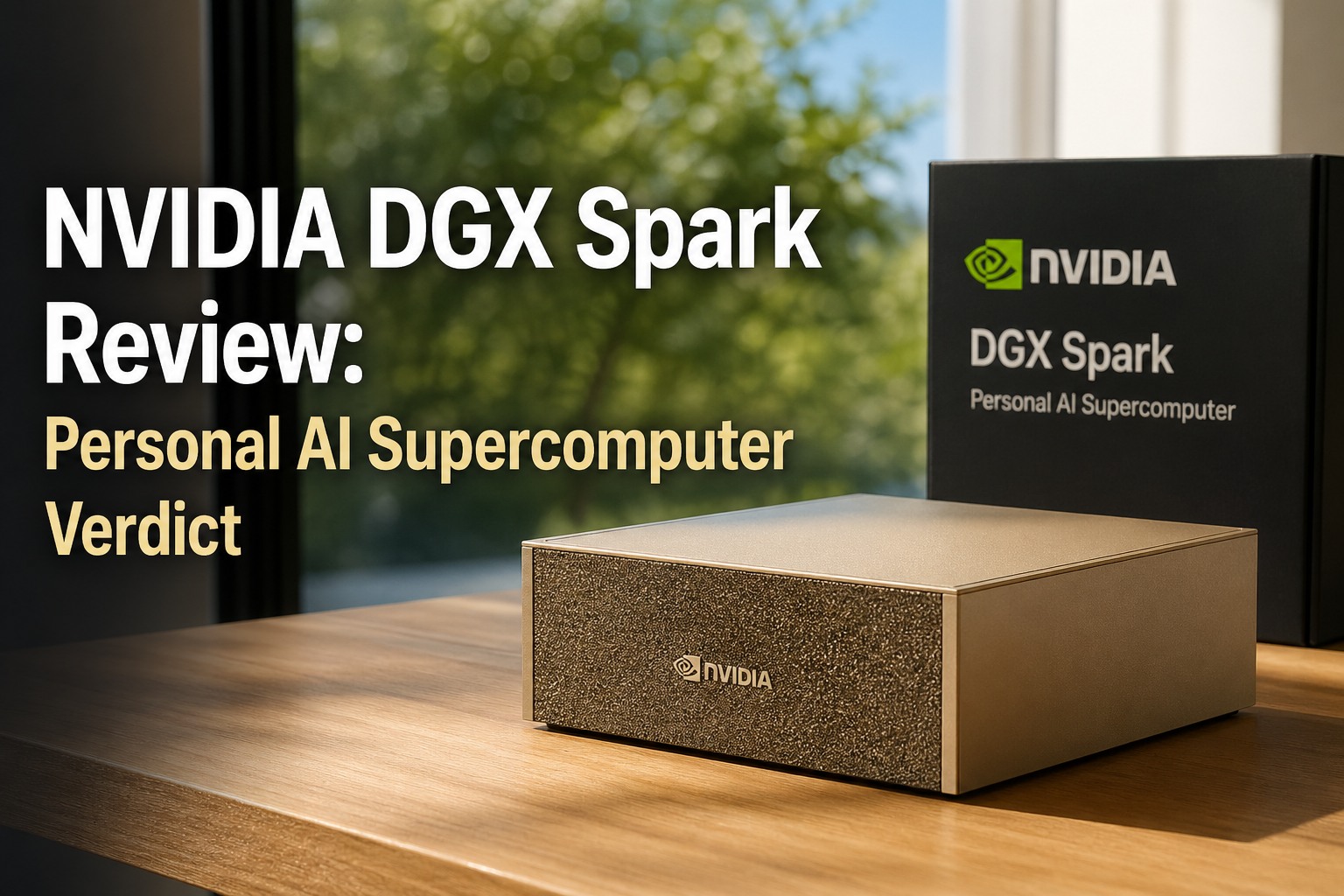
The NVIDIA DGX Spark is the most over-promised, over-priced, and yet quietly indispensable piece of AI hardware on enterprise desks today. Built around the GB10 Grace Blackwell Superchip with 128GB unified memory, 1 petaFLOP FP4 compute, and a $3,999–$4,699 price tag, it isn't trying to replace your data center — it's trying to put a CUDA-native, 200B-parameter-capable AI workstation on the desk of every developer who currently waits 40 minutes for a cloud GPU instance to spin up. After three months of independent benchmarks from LMSYS, StorageReview, and direct enterprise pilots, the verdict is clear: DGX Spark is brilliant for the right job and brutally wrong for the wrong one. This review tells you exactly which is which — backed by token-per-second numbers, the unflinching memory-bandwidth math, and a head-to-head against the RTX PRO 6000 Blackwell.
Meet Us at SAP Sapphire Week 2026 — See DGX Spark and On-Prem AI Live bring AI closer to the action with edge computing
Join the iFactory team at SAP Sapphire Orlando to see DGX Spark and RTX PRO 6000 architectures running enterprise SAP workloads on-prem — live. Walk in with your S/4HANA edition; walk out with a costed 2026–2028 on-prem AI plan.
DGX Spark, Distilled — Where It Wins, Where It Loses
If your situation maps to any pattern below, spend 30 minutes with our enterprise AI team to confirm DGX Spark fits your workload. We've deployed across 1000+ environments and can tell you in one call whether the math works.
Where It Wins
- Local prototyping of 70B–200B models — fits in 128GB at FP4, no quantization gymnastics
- CUDA-native development — entire NVIDIA stack runs day one, no porting drama
- Sensitive data that can't leave the building — regulated industries, defense, IP
- Single-developer fine-tuning — LoRA/QLoRA on 70B models works smoothly
- Carry-on portability — 1.2 kg, brings full-stack AI on the road
Where It Loses
- Production inference serving — RTX PRO 6000 is 6–7× faster for the same workload
- High-concurrency batch workloads — 273 GB/s memory bandwidth is the bottleneck
- Throughput-per-dollar at scale — multi-user serving math doesn't favor Spark
- Gaming or graphics-heavy creative work — not designed for it, and it shows
- "Replace the cloud" pitches — only works if cloud spend is small and bounded
The GB10 Grace Blackwell Superchip — A Desktop Petaflop
The GB10 marries a 20-core Arm CPU complex to a Blackwell GPU via NVLink-C2C, delivering up to 5× the bandwidth of PCIe Gen 5. The unified memory architecture is a real, coherent address space shared between CPU and GPU.
Benchmarks — What DGX Spark Actually Delivers
Three independent benchmark sources paint the same picture: Spark is excellent for small-to-mid models at low concurrency, and gets bandwidth-pinned at higher batch sizes or larger models. Want these benchmarks mapped to your model and concurrency profile? Custom workload modeling delivered in 24–48 hours.
| Model / Workload | Quantization | Throughput (tps) | Notes |
|---|---|---|---|
| Llama 3.1 8B (batch 1) | SGLang FP8 | 20.5 decode / 7,991 prefill | Strong single-user latency |
| Llama 3.1 8B (batch 32) | SGLang FP8 | 368 decode / 7,949 prefill | Excellent batching efficiency |
| Llama 3.1 8B (batch 128) | FP4 | ~924 decode | StorageReview-measured peak |
| GPT-OSS 20B (Ollama) | MXFP4 | 49.7 decode / 2,053 prefill | Memory-bandwidth pinned |
| Qwen3 Coder 30B-A3B | FP8 (batch 64) | ~483 decode | MoE benefits from unified memory |
| Llama 70B (single-sample) | FP8 | Roughly H100-class | Per Sebastian Raschka analysis |
| Qwen3-235B (2× Spark cluster) | FP4 | Production-viable | 200 Gb/s ConnectX-7 fabric |
DGX Spark vs RTX PRO 6000 — The Memory Bandwidth Story
For production inference, RTX PRO 6000 is 6–7× faster, costs 1.8× more, and obliterates Spark on throughput-per-dollar. The reason is one number: memory bandwidth.
DGX Spark
RTX PRO 6000
Who Should Actually Buy DGX Spark — Four Profiles That Pay Off
Spark earns its $4,699 price tag in specific scenarios — and burns money in others. Match your use case in a 30-minute call before committing to a fleet purchase.
Developers Prototyping 70B+ Models
Iterating on agents, RAG pipelines, or fine-tuning runs against models that don't fit a 32–48 GB consumer card. Spark's 128 GB lets you load Llama 70B at FP16 without quantization tricks.
Regulated Teams With Data-Sovereignty Locks
Healthcare PHI, defense IL5, EU GDPR-locked data, financial trade secrets. Full CUDA stack on-prem at a fraction of an air-gapped data-center build.
Field Engineers and Plant-Floor AI
You need a GPU that comes with you to a customer site, remote plant, or field hospital. 1.2 kg carry-on form factor delivers full-stack AI where rack hardware can't go.
Research Labs Running Single-Sample Experiments
Sebastian Raschka measured Spark on par with H100 for single-sample inference on small models — at one-sixth the price. For experimentation, math swings hard in Spark's favor.
Why iFactory Is the Right Partner for Your Rollout
DGX Spark is a tool — not a solution. Turning a $4,699 desktop into measurable enterprise outcomes requires model selection, fine-tuning pipelines, MLOps, and integration with your SAP/MES/ERP. Talk to our solution architects to walk through how this maps to your stack.
Hardware-Agnostic Architecture Modeling
We model DGX Spark, RTX PRO 6000, Apple M4 Ultra, and Strix Halo against your token volume, model mix, and concurrency. You get the right answer — not the answer that closes our quota.
Sovereign-Grade Deployment Patterns
We've shipped DGX-class hardware behind air-gaps, in regulated cleanrooms, and across multi-jurisdiction data residency. Reference architecture handles the legal and audit trail.
SAP, MES, and ERP-Native Integration
50+ pre-built connectors for industrial OT, ERP, and PLM systems. The DGX Spark model talks to your real plant-floor data on day one — not after a six-month integration project.
Production-Grade MLOps from Day One
Model versioning, drift monitoring, A/B routing, observability — pre-configured against DGX OS and CUDA. We ship the operational layer alongside the inference layer.
Fine-Tuning & Custom Model Engineering
LoRA, QLoRA, and full fine-tunes against your domain — manufacturing defect taxonomies, pharmaceutical formulation, financial document understanding. Tuned on Spark against proprietary corpora.
Lifecycle Support & Roadmap Continuity
Hardware refresh cycles, model upgrades, GPU generation transitions (Blackwell to Rubin). We don't ship and disappear — engineers stay engaged through the full deployment lifecycle.
Should You Buy DGX Spark? — A 90-Second Framework
Walk these three questions before you sign a PO. They mirror the framework we use in customer architecture sessions.
DGX Spark FAQ
Get a Costed On-Prem AI Recommendation in 30 Minutes
DGX Spark, RTX PRO 6000, or hybrid? The right answer depends on your workload mix, concurrency, and integration constraints — not hype. Bring us your scenario; we'll model TCO, sketch architecture, and give you a buy/don't-buy answer backed by real benchmarks.