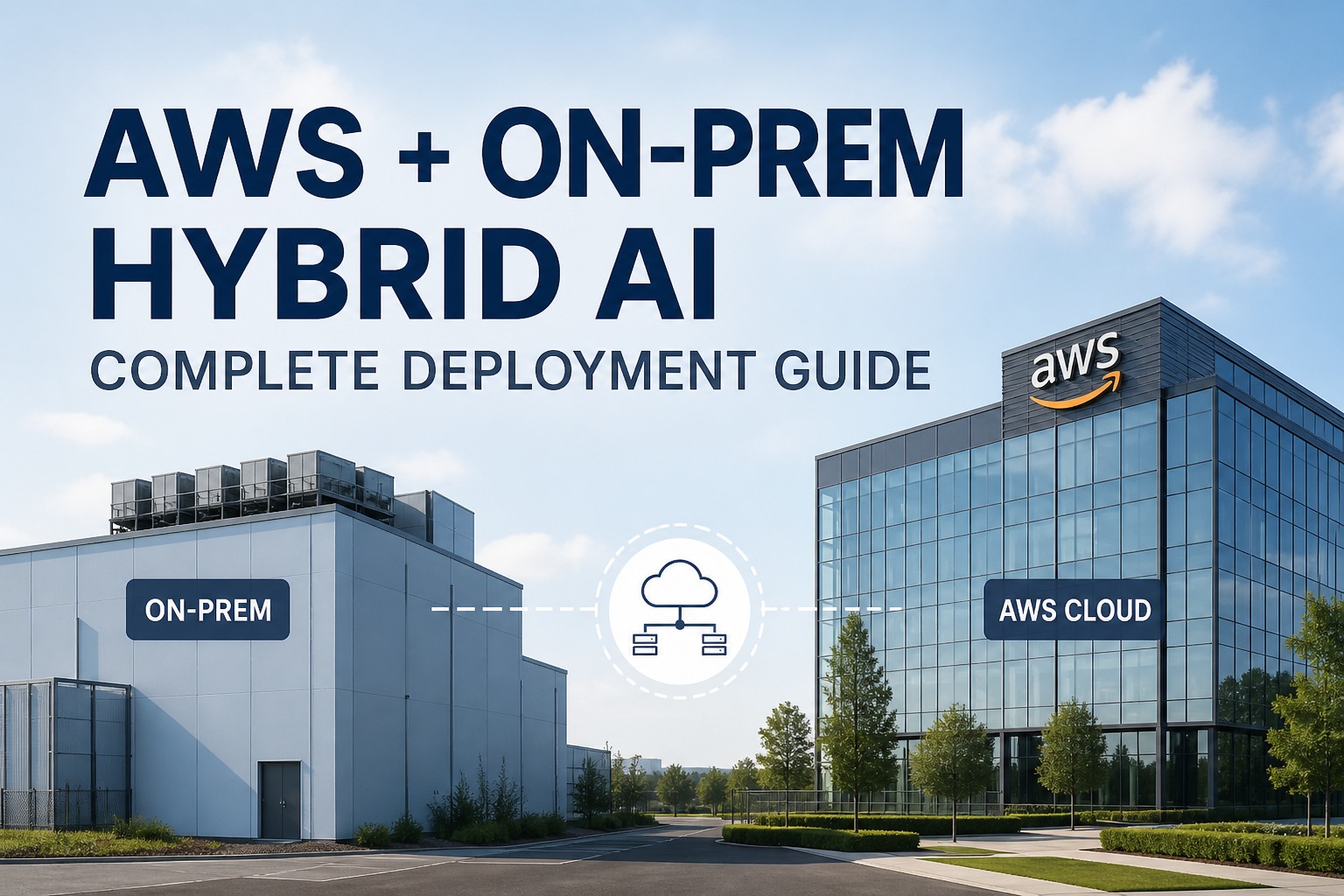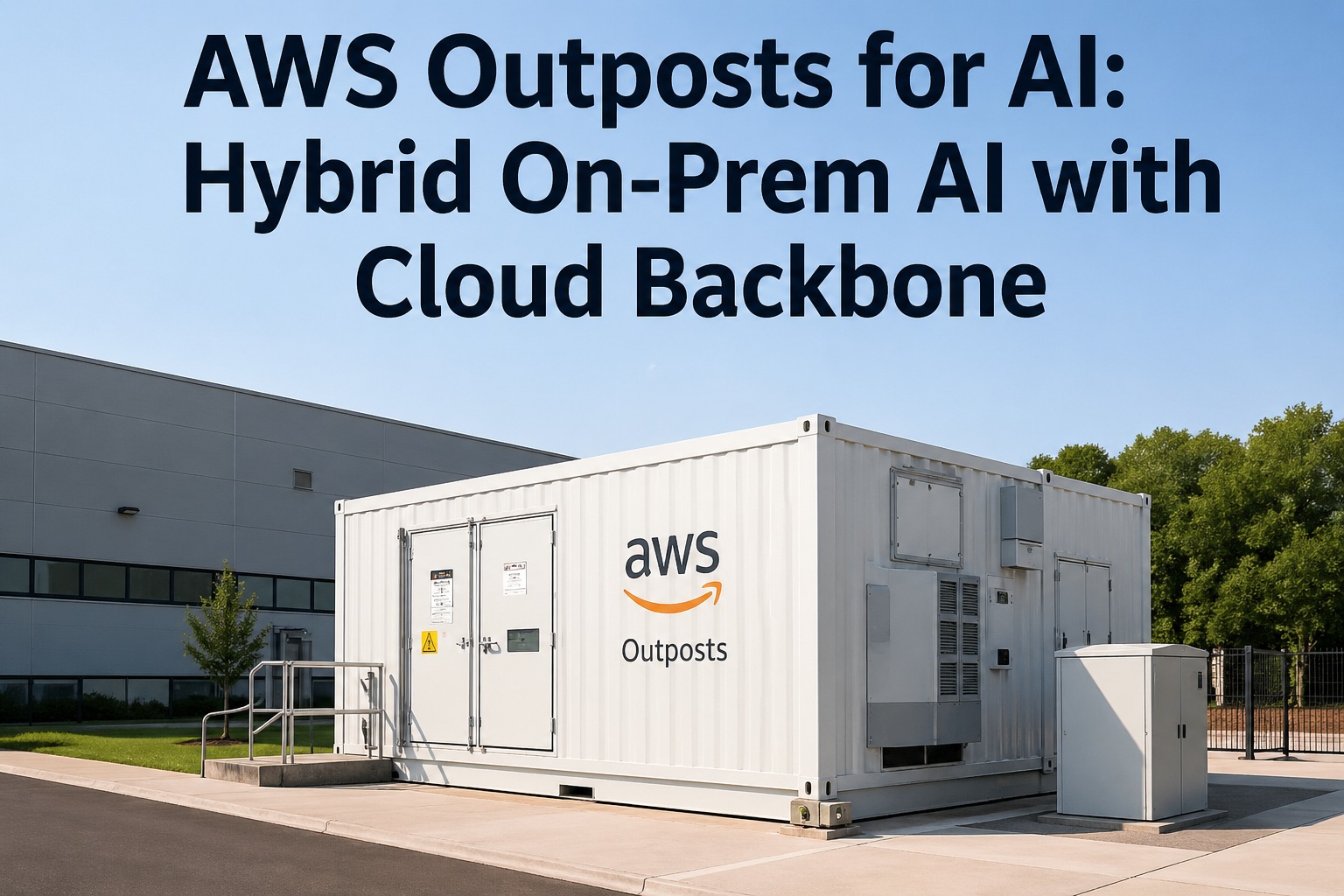
AWS Outposts is the hybrid bet for enterprises that can't put all their AI in the public cloud — and don't want to build a Kubernetes platform from scratch on a stack of GPU servers. It's literal AWS hardware: same Nitro System, same EC2 APIs, same CloudFormation templates, same console — physically installed in your data center, factory floor, or co-location facility. For regulated industries facing data sovereignty pressure, manufacturing operations needing sub-50ms inference latency, and government workloads with residency rules, Outposts has quietly become the architectural answer that lets you keep AWS-native AI services like SageMaker, Bedrock-adjacent inference, and EKS while keeping sensitive data inside your perimeter. As of Q1 2026, AWS is deploying its second-generation Outposts racks with C8i/M8i/R8i Intel Xeon 6 instances, GPU-enabled instances are arriving via EKS Hybrid Nodes, and customer deployments span from athenahealth to FanDuel to India's National Informatics Centre. This page is the operator-grade guide — what Outposts AI actually delivers, where it fits, what it costs, and when DGX or vanilla on-prem is a better fit.
Plan Your AWS Outposts AI Hybrid Architecture Live
The iFactory team will be on-site at SAP running 1-on-1 working sessions on AWS Outposts hybrid AI architectures for regulated enterprises. Fill out the form below to reserve a meeting slot, and walk away with a costed 3-year deployment plan tailored to your stack.
How AWS Outposts Bridges Your Data Center to AWS — Visualized
Outposts isn't a separate cloud, isn't a private cloud emulation, and isn't an appliance. It's an extension of an AWS Region — same APIs, same identity, same management plane — running on AWS-owned hardware physically installed inside your perimeter. The diagram below traces how a single inference request flows through the architecture. If you want to walk through this diagram with your specific workloads in mind, schedule a 30-minute architecture review with our AWS-certified team — bring your latency targets and data residency requirements and we'll sketch the exact data flow for your environment.
1U vs 2U vs 42U — Picking the Right Outposts Footprint
Outposts comes in three form factors with sharply different scope. Choose the wrong one and you'll either run out of capacity in 6 months or pay for 80% empty rack space for three years. The matrix below maps each form to its actual sweet spot. Not sure whether server or rack is right for your environment? Our AWS specialist team can run a capacity-planning workshop based on your projected workload, growth headroom, and which AWS services are non-negotiable for your roadmap.
- Compute: C6gd Arm-based Graviton2
- Storage: Up to 4× 1.9 TB NVMe
- AI fit: CPU-based edge inference, light ML
- EKS support: No (rack form only)
- Sweet spot: Retail stores, branch offices
- Compute: C6id Intel Xeon Scalable (3rd Gen)
- Storage: Up to 7.6 TB NVMe
- AI fit: Larger ML models, more memory
- EKS support: No (rack form only)
- Sweet spot: Plant floors, healthcare clinics
- Compute: 2nd-gen Outposts · Xeon 6 · 20% perf gain
- Storage: EBS + S3 on Outposts · 11TB to 1PB
- AI fit: Production EKS GPU clusters · SageMaker on-prem
- EKS support: Yes · Hybrid Nodes · GPU edge AI
- Sweet spot: Regulated enterprise data centers
Outposts servers (1U/2U) cannot run EKS, ElastiCache, EMR, RDS, ALB, EBS volumes, or S3 buckets — those services are rack-only. If your AI architecture depends on EKS for GPU orchestration, you must commit to the 42U rack form factor. That's a fundamentally different procurement conversation. Don't pick a server because the price looks better unless you've confirmed the services it doesn't run.
Which AWS AI/ML Services Actually Run On-Prem
Not every AWS AI service has an Outposts-resident equivalent. The list below reflects what actually executes locally versus what calls back to the parent Region. Knowing the difference is the most common architecture mistake we correct in customer reviews.
- EC2 — full instance set on second-gen rack
- EKS — GPU node groups via Hybrid Nodes (rack only)
- ECS — container workloads, both forms
- S3 on Outposts — local object storage
- EBS gp2 — block storage, rack only
- RDS — managed databases for RAG, rack only
- SageMaker Edge Manager — on-device inference
- IoT Greengrass — edge inference orchestration
- App Load Balancer — traffic routing, rack only
- Bedrock — foundation models always cloud
- SageMaker training — large-scale jobs in Region
- Bedrock Knowledge Bases — vector store in Region
- Comprehend / Rekognition — managed AI services
- Translate / Transcribe — managed AI APIs
- Bedrock Agents — agentic AI control plane
- SageMaker Studio — IDE in Region
- CloudWatch — metrics flow to Region
- IAM / KMS — identity always Region-anchored
Train in the Region, serve from Outposts. Foundation model training and fine-tuning happen on EC2 P6e-GB200 UltraServers in us-east-1 or eu-west-1. The trained model artifact is pushed to Outposts where SageMaker Edge Manager or vLLM on EKS Hybrid Nodes serves inference locally — sub-50ms latency, sensitive data never leaves your building, predictable per-hour cost.
Where Outposts AI Actually Wins — Five Production Patterns
Outposts is not the right answer for general-purpose AI. It's the right answer when one of five specific constraints is in play. The customer profiles below come from announced production deployments and reflect where the architecture earns its premium. If your use case sits at the edge of one of these profiles, book a strategy call to validate the fit before you commit to a 3-year hardware term — we've seen too many enterprises buy Outposts for the wrong reasons.
India's National Informatics Centre Meghraj 2.0 deploys Outposts inside Yotta data centers — government departments access full AWS services and generative AI while data residency is guaranteed. The reference deployment for any sovereign cloud requirement.
athenahealth runs Outposts where patient records, imaging data, and AI-assisted diagnostics must stay inside the hospital perimeter. Bedrock-style summarization runs on local SageMaker endpoints, preserving compliance posture without sacrificing AWS-native tooling.
Plant-floor defect detection, predictive maintenance, and real-time process control need single-digit millisecond inference latency. Outposts runs the EKS GPU cluster locally — model training stays in the Region, inference happens at the line.
First Abu Dhabi Bank uses Outposts where customer transaction data and fraud-detection models must run inside the bank's perimeter. The SageMaker model gets the latest training run from the Region, but inference stays local for jurisdictional compliance.
FanDuel and Riot Games use Outposts where multiplayer game-state, sportsbook risk models, or low-latency ML scoring need to run within milliseconds of player input. The control plane is in the Region, the inference is in the building.
Map Your Outposts AI Architecture in a 30-Minute Working Session
Bring your latency target, data residency constraints, current cloud spend, and AI workload mix. Our enterprise architects model the Outposts deployment that fits — server vs rack form factor, EKS Hybrid Nodes vs SageMaker on-prem, 3-year TCO against equivalent DGX or vanilla GPU buildout. You leave with a costed, defensible reference architecture.
What Outposts Actually Costs — Pricing Without the Marketing
Outposts pricing is structurally different from regional EC2. You commit to a 3-year term, you pay for the full hardware whether you use 10% or 100% of it, and there's a non-trivial Enterprise Support requirement. Below is the breakdown finance teams need before signing. For a custom 3-year TCO model with your projected workloads modeled across All Upfront, Partial Upfront, and No Upfront options, our AWS pricing specialists can build a side-by-side cost model against equivalent Region capacity and DGX hardware buildouts.
The 3-year commitment is non-negotiable. End-of-term: renew or return. If you forget, AWS auto-renews on the No-Upfront monthly rate corresponding to your config.
All Upfront yields the deepest discount. No Upfront keeps cash flow flat across 36 months. Partial Upfront splits the difference. CFOs negotiate this — the rate spread is meaningful.
The cheapest legitimate Outposts entry point. Graviton2 only — for CPU-bound edge inference, not GPU AI. Branch offices and retail are the right fit.
The maximally-spec'd 2U server — Intel Xeon Scalable, useful for larger ML models. Still no EKS, still no full AWS service set. Plant-floor and clinic deployments.
Outposts vs DGX vs Vanilla On-Prem GPU — Which Wins?
Outposts is one of three legitimate hybrid AI architectures. Each has a different center of gravity. The matrix below is how to think about which one fits your organization — and why most enterprises pick wrong on first instinct.
| Dimension | AWS Outposts | NVIDIA DGX | Vanilla On-Prem GPU |
|---|---|---|---|
| Hardware ownership | AWS-owned, AWS-managed | You own, you manage | You own, you manage |
| Management plane | AWS console / APIs | Base Command / NVIDIA | Roll your own (k8s, etc.) |
| GPU options | g4dn / g5 (EKS Hybrid Nodes) | H100 / B200 / B300 native | Any — H100, L40S, RTX PRO |
| AI services included | EC2/EKS/S3/RDS/SageMaker Edge | None — bring your own | None — bring your own |
| Setup time | Weeks (AWS install team) | Months (procurement + config) | Months (procurement + build) |
| Term commitment | 3-year mandatory | None (capital purchase) | None (capital purchase) |
| Best fit | Regulated AWS-native shops | Foundation model training | Custom stacks, max control |
| Worst fit | Pure cost optimization | Mixed AWS workloads | Teams without platform staff |
Should You Even Be Looking at Outposts? — The 5-Question Filter
Outposts is a niche product. It's the right answer when very specific conditions are present, and an expensive mistake when they aren't. Run through these five questions in order — if you fail any one of them, Outposts probably isn't your architecture. If you pass all five, the next step is to schedule a deployment-planning session with our AWS architects to lock in your form factor, capacity sizing, and 90-day rollout sequence before you raise the procurement request.
No Outposts is overkill — you'd be paying for AWS integration value you can't use.
No Use AWS Region directly. Outposts has no advantage.
No Region-based inference is cheaper and easier.
No Outposts isn't structured for short commitments — look at vanilla on-prem.
No Get the facility upgraded first — installations have hard prerequisites.
AWS Outposts AI — The Practical Questions, Answered
Get a Costed AWS Outposts AI Architecture in 30 Minutes
iFactory has deployed AWS-native AI architectures across 1000+ customers — including hybrid Outposts deployments for regulated manufacturing, healthcare, and government. Bring your data residency constraints, latency targets, and current AWS spend. We deliver a deployment-ready reference architecture and 3-year TCO model — Outposts vs Region vs DGX — that you can take to your CIO and your AWS account team.