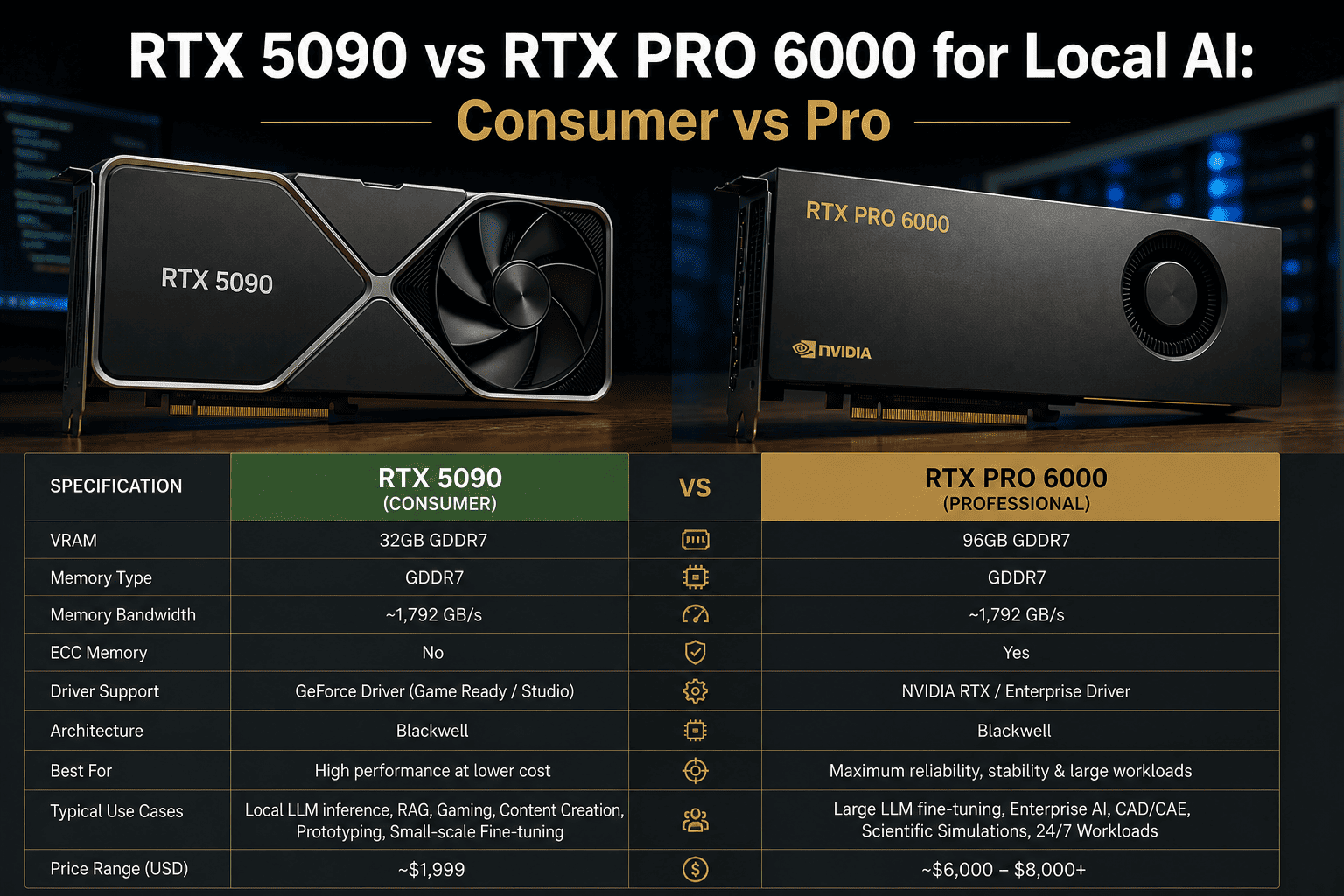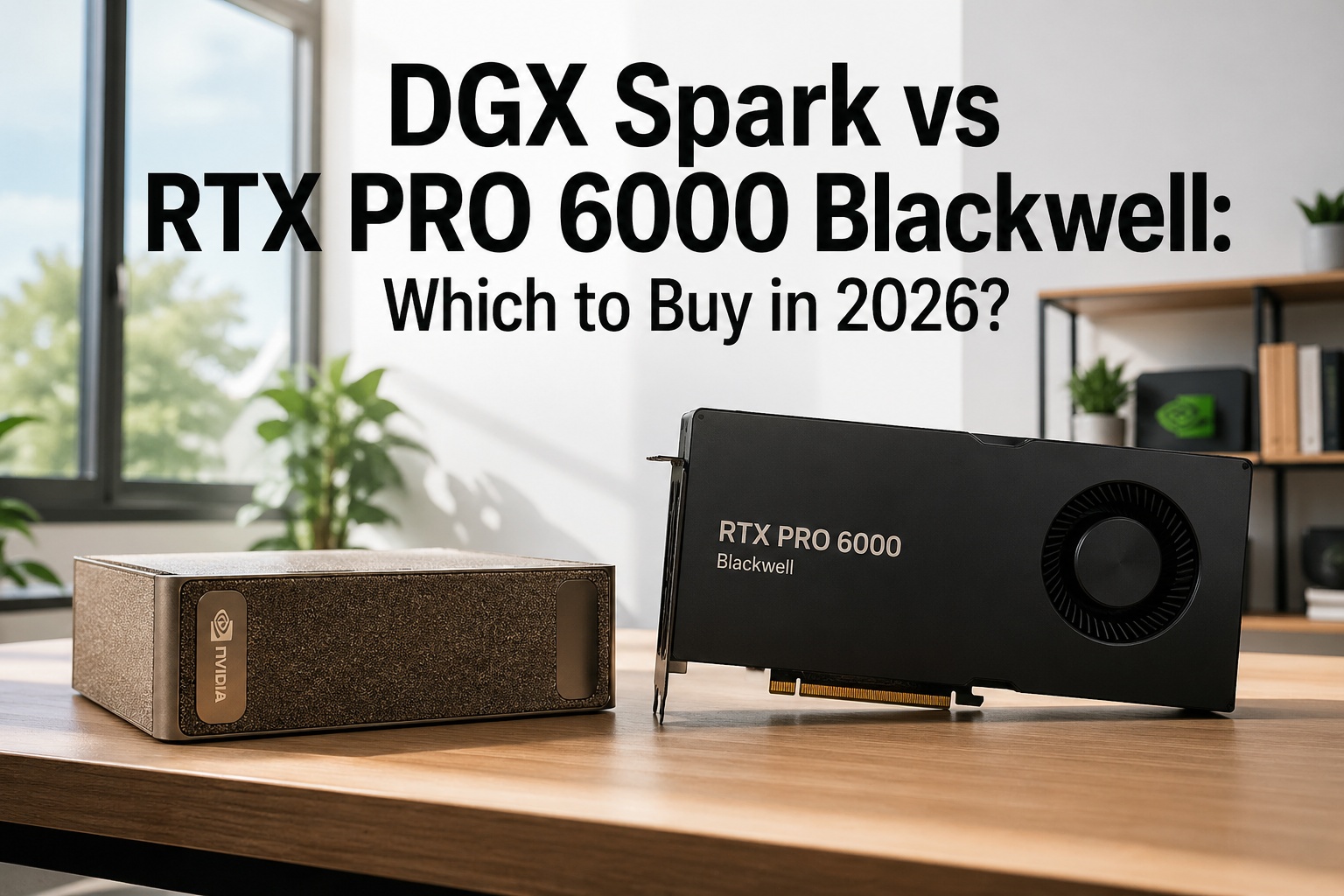
If you're choosing between NVIDIA's DGX Spark and the RTX PRO 6000 Blackwell Workstation Edition, the headline number you need on a slide is this: in head-to-head LLM inference benchmarks across batch sizes 1 through 32, the RTX PRO 6000 delivers approximately 6–7× faster token generation than DGX Spark — for roughly 2× the price. That gap isn't a CUDA-core difference or a Tensor-core advantage — both are Blackwell-generation, both ship with 5th-gen Tensor Cores, both support FP4 / FP8 quantization. The gap comes from one number: memory bandwidth (273 GB/s on Spark vs 1,792 GB/s on the RTX PRO 6000, a 6.57× ratio that maps almost exactly to the inference speed delta). This page is the operator-grade comparison — what each box actually does, where each one wins, and the decision rule that separates "I'm prototyping locally" (Spark) from "I'm serving inference to real users" (RTX PRO 6000). Both are excellent at what they're built for. The mistake is buying the wrong one.
The Self-Healing Factory — Pick the Right Blackwell GPU for Your AI Workload
The iFactory team will be on-site at SAP running 1-on-1 GPU sizing sessions on DGX Spark vs RTX PRO 6000 Blackwell for enterprise AI buyers. Fill out the form below to reserve a meeting slot, and walk away with a workload-specific buy recommendation backed by measured benchmarks.
TL;DR — The Honest 30-Second Answer
If you only read one section, read this. Below is the decision tree most enterprise GPU buyers should run before opening either NVIDIA spec sheet. Everything else on this page is the evidence that supports it. If you'd rather just talk it through with someone who has deployed both platforms, schedule a 30-minute GPU sizing call — bring your model sizes and concurrency targets and we'll tell you which box wins for your specific workload.
- You're a developer / researcher building locally
- You need to fit large models (70B+) more than serve them fast
- You want a portable, plug-in-anywhere AI dev box
- Budget cap around $3K–$4K
- You'll cluster two units via 200GbE for larger experiments
- You're serving AI to real users in production
- You need fast tokens/sec for chat, agents, RAG endpoints
- You're doing GPU-intensive creative or scientific work too
- Budget allows $8K–$9K for the GPU alone (workstation $15K+)
- You'll fine-tune frequently and need real throughput
Side-by-Side Specifications — What Each Box Actually Is
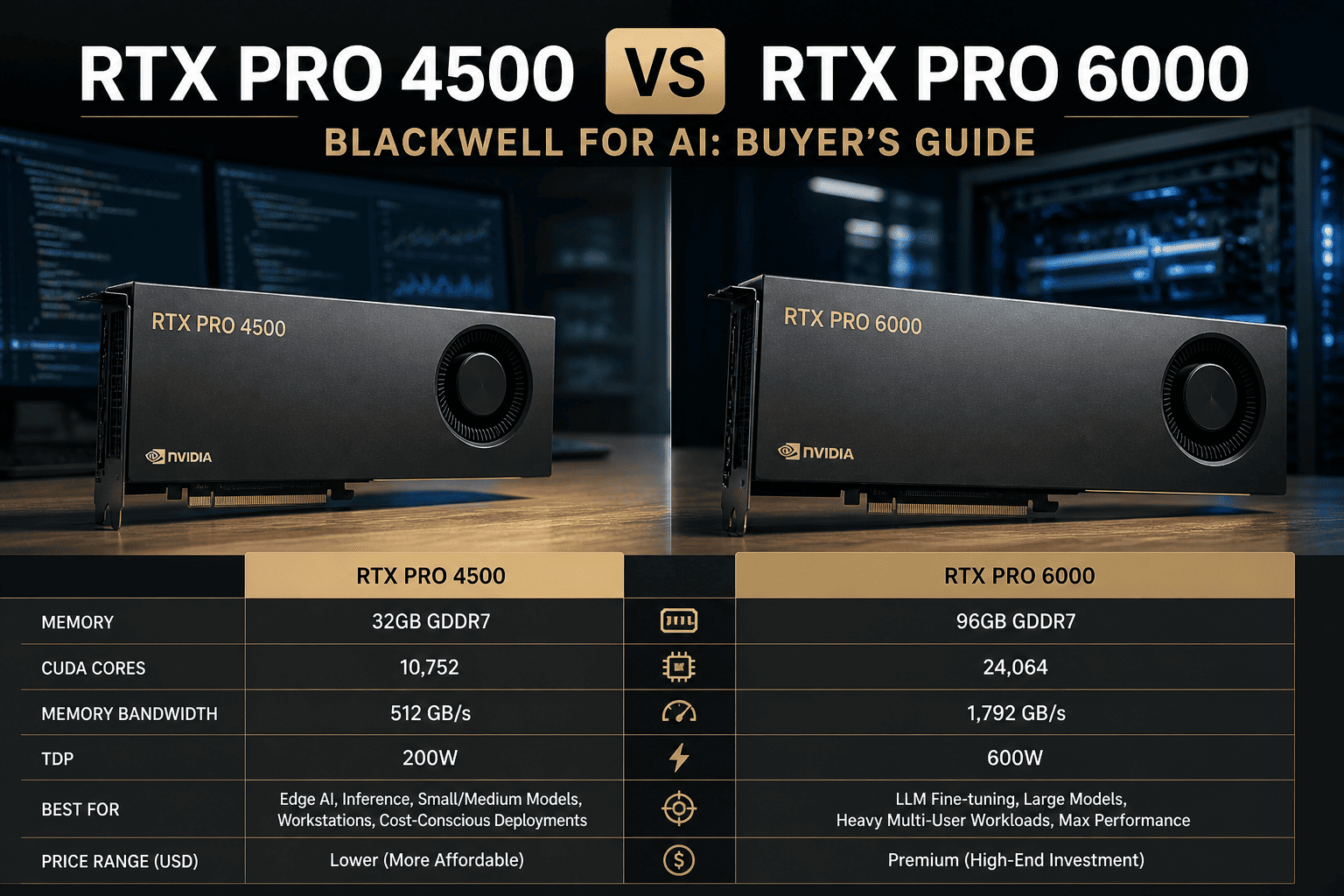
Both systems use NVIDIA Blackwell, both have 5th-gen Tensor Cores, both support FP4. Where they diverge is in memory architecture, bandwidth, form factor, and intended deployment model. The matrix below is the unvarnished spec comparison. For deeper specs, driver compatibility checks, or workstation BOM advice for an RTX PRO 6000 build, our GPU support team has reference build configurations for Threadripper PRO and Xeon W host platforms tuned to AI workloads.
Developers, researchers, AI students. Carry-on-friendly. Two units cluster for 256GB unified memory.
Production inference, fine-tuning, creative + scientific workflows that touch a GPU all day.
Memory Bandwidth — Why the Spec That Matters Isn't What You Think
LLM token generation is memory-bound, not compute-bound. The model weights have to be read from memory for every single output token. The faster that read happens, the faster the tokens come out. Both Blackwell GPUs have plenty of compute headroom — they wait on memory. Below is the chart that explains the entire performance gap. To model what this bandwidth gap means for your specific model and quantization, book a working session with our GPU benchmarking team — we can run your exact model on both platforms and share the measured token-per-second numbers within 48 hours.
Divide 1,792 by 273 and you get 6.57. That number maps almost exactly to the 6–7× inference speedup the RTX PRO 6000 shows in independent benchmarks. Memory bandwidth is the bottleneck — everything downstream is just confirmation.
You might think batching helps. It doesn't change the ratio. The RTX PRO 6000 maintains its ~6× lead at batch 1, batch 8, and batch 32 — because the bandwidth advantage applies equally at every concurrency level. Spark closes the gap slightly with prefill, but not enough to matter.
Spark's LPDDR5X is slower per byte but bigger overall (128 GB). For models that don't fit in 96 GB at FP16, Spark wins by default — the RTX PRO 6000 either won't run them or has to quantize down to FP8.
Benchmarks Across Models — What the Token-Per-Second Gap Actually Looks Like
Independent benchmarks across Llama 3.1 8B, GPT-OSS 20B, and Llama 3.1 70B show a remarkably consistent picture. The RTX PRO 6000 generates roughly 4–7× more tokens per second across model sizes, batch configurations, and quantization levels. Below are the numbers that have been measured and published.
| Model · Config | DGX Spark | RTX PRO 6000 | Ratio |
|---|---|---|---|
| Llama 3.1 8B · single request E2E | ~100 sec | ~14 sec | ~7× |
| Llama 3.1 70B · single request E2E | ~13 min | ~100 sec | ~7.8× |
| GPT-OSS 20B (MXFP4) · prefill | 2,053 tps | 10,108 tps | ~4.9× |
| GPT-OSS 20B (MXFP4) · decode | 49.7 tps | 215 tps | ~4.3× |
| Llama 3.1 8B · SGLang batch 1 prefill | 7,991 tps | ~50,000 tps | ~6× |
| Llama 3.1 8B · SGLang batch 32 decode | 368 tps | ~2,200 tps | ~6× |
| Daily request capacity (Llama 8B) | ~12,500 req/day | ~85,000 req/day | ~6.8× |
Cost-Per-Throughput — Where the Real Economics Live
Sticker price is misleading. What matters is dollars-per-throughput — how much you spend per unit of work the box does. Below is the analysis that explains why "DGX Spark is cheaper" is technically true and operationally wrong. For a custom 3-year amortized cost-per-token model with your actual workload mix, our GPU economics team can build a side-by-side TCO spreadsheet covering Spark, RTX PRO 6000, RTX 5090, and H100 across your projected daily request volumes.
(GPU only)
(full workstation)
Get a Personalized DGX Spark vs RTX PRO 6000 Recommendation
Bring your model size, expected concurrency, latency target, and budget. In 30 minutes our GPU specialists model your specific workload on both platforms — token throughput, daily request capacity, 3-year amortized cost-per-inference. You leave with a concrete buy recommendation tied to your actual numbers, plus an alternative architecture (multi-Spark cluster, RTX PRO 6000 + Threadripper workstation, or hybrid) where the math actually works.
5 Real-World Scenarios — Which Box Actually Wins
Specs and benchmarks tell you what each box does. Scenarios tell you which one is the right buy. Below are the five most common situations we see — and the answer for each. If your situation doesn't fit cleanly into any of these, book a 30-minute call to map your specific scenario against both platforms — we'll model the workload, score the trade-offs, and give you a buy recommendation backed by measured numbers, not guesses.
Perfect fit. 128 GB unified memory fits 70B at FP16, you don't need fast tokens for prototyping, and you can take it on a flight. Cluster two via 200GbE if you need 256 GB for even larger experiments. The RTX PRO 6000 doesn't add anything for this use case unless you also do production serving.
Production serving needs throughput. The 6–7× token-per-second advantage means you can serve more concurrent users without buying more boxes — which means RTX PRO 6000 wins on cost-per-inference at any meaningful scale. Spark can't deliver real-time UX on 70B models.
Spark isn't designed for graphics — its display output and rendering capabilities are minimal. RTX PRO 6000 is a full workstation GPU with 4× DisplayPort 2.1, 4th-gen RT Cores, DLSS 4, and the full creative software stack. If your day involves Maya, Blender, Unreal, AVEVA, or scientific visualization alongside AI, this isn't even close.
QLoRA fine-tuning of 70B models needs 48–80 GB. Both qualify. Spark fits at FP16 in 128 GB unified — but training will be slow due to bandwidth. RTX PRO 6000 needs FP8 quantization to fit but trains much faster. If your budget is hard-capped at $4K and you can wait, Spark wins. If you'll fine-tune frequently, RTX PRO 6000 pays for itself in time saved within months.
Genuinely. Give each developer a Spark for prototyping ($3.5K each is bearable). Stand up RTX PRO 6000 workstations for the production serving and fine-tuning loops. The Spark fleet handles model exploration, the RTX PRO 6000 handles throughput. Total cost is lower than either-or strategies and developer velocity is higher. This is the most common iFactory recommendation for serious AI teams of 5+ people.
DGX Spark vs RTX PRO 6000 — The Practical Questions
Get a Workload-Specific GPU Recommendation in 30 Minutes
iFactory has deployed enterprise AI infrastructure on DGX Spark, RTX PRO 6000, H100/H200, and DGX B200 across 1000+ customers. Bring your model sizes, expected concurrency, and latency targets. We deliver an honest buy recommendation with throughput forecasts, 3-year cost-per-inference math, and procurement timeline — even if the answer is "don't buy either, here's a better path."