A power plant control engineer needs to test a setpoint change. Move boiler outlet pressure up by 5 bar to chase efficiency. The simulation that lives in their head is good, but it's not testable. The simulation that lives in a static spreadsheet is testable, but it's not coupled to the real-time PI tag stream. The simulation that exists as a CFD model takes overnight to run a single what-if and isn't synced to today's plant state. The thing that doesn't exist for most power plants is a physics-accurate digital twin of the whole BTG island that runs in real time, ingests live PI tags and OPC-UA, mirrors the as-built CAD geometry, and lets the engineer test the setpoint at 11:42 AM and have a numerically grounded answer at 11:43 AM. iFactory builds that twin on NVIDIA Omniverse with OpenUSD as the scene graph. CAD geometry from your engineering archives, physics from PhysicsNeMo and PhysX, time-series from PI Asset Framework, real-time tag bridge from OPC-UA. The same RTX PRO 6000 Blackwell appliance Omniverse ships pre-loaded on, racked in your plant control building. iFactory's published references on PI-integrated twins describe what the prize looks like — BP cut analysis time from over a day to 20 minutes after deploying digital twin technology across production systems globally, and SCG Chemicals reached 100% plant reliability with a 9× ROI on the unified PI-twin platform. Those numbers are the ceiling. Whether your plant gets near it depends on the fidelity of the geometry, the cleanliness of the historian data, and how quickly your engineering team adopts the simulate-before-changing-production discipline. The hardware ships in 6–12 weeks. The fidelity grows over the first year.
Physics-Accurate Digital Twin For Power Plants —
Built On NVIDIA Omniverse With OpenUSD
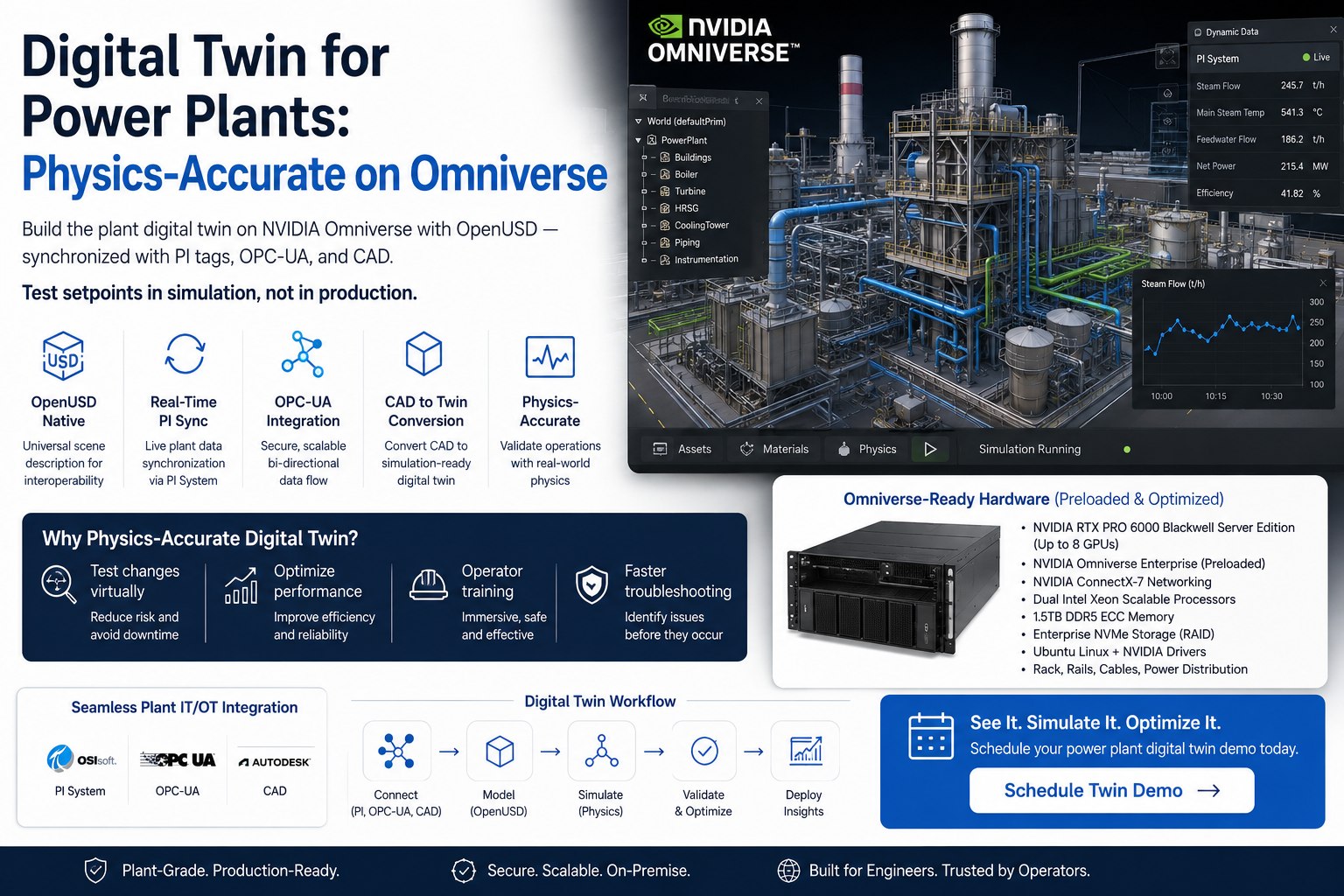
Plant geometry from your CAD archives, physics from PhysicsNeMo and PhysX, real-time tags from PI Asset Framework and OPC-UA, dashboards rendered on RTX PRO 6000 Blackwell. Test setpoint changes, fuel mix swaps, load ramps, and trip recoveries in simulation — not in production. The twin is the safe place to ask "what if". The plant remains the single place where decisions get committed, by humans, on the DCS.
The Setpoint Change That Should Have Been Tested First
Most catastrophic excursions on a BTG unit trace back to a perfectly reasonable setpoint move that turned out to be wrong in a way nobody had pre-tested because there was nowhere to pre-test it. A static heat-balance spreadsheet doesn't see the interaction between drum level, superheater temperature, and downstream condenser pressure during a load ramp. A CFD model that runs overnight is too slow to inform a 30-minute decision. Operations engineers are good at this judgement, but their judgement isn't testable evidence. The twin is. Talk to our digital-twin lead about your unit's typical decision points.
Engineer recommends a tweak. Ops accepts. Trip happens at 03:14 because of an interaction nobody saw. Investigation runs three weeks. Root cause: the second-order effect that wasn't visible in any single instrument trend at the time of the decision.
Engineer proposes the setpoint move. Twin runs the next 90 minutes of plant behaviour at 100× real-time speed. Drum level, superheater excursion, condenser back-pressure, NOx — all visible. Engineer commits or revises. Ops sees the simulation result before the move. Audit trail captures both.
A twin that writes setpoints to the DCS based on its own simulation is not a digital twin — it's an unvalidated autonomous controller. The iFactory twin has no write path to the DCS. Recommendations only. Operators commit on the panel. Always.
Four Layers Make A Twin Physics-Accurate — Drawn End-To-End
A digital twin built without physics is a 3D dashboard. A digital twin built without real-time data is a CAD model. A digital twin built without an OpenUSD scene graph is a stack of point integrations that breaks the moment one tool changes. Omniverse is the layer that makes geometry, physics, time-series, and AI inference share a single representation. The four layers below show how the iFactory twin assembles them — every stage labelled, every input traceable.
Boiler, turbine, generator, BoP equipment, piping, structural steel — pulled from your existing engineering CAD (Aveva E3D, Bentley OpenPlant, AutoCAD Plant 3D, SolidWorks, Inventor) and converted to OpenUSD as SimReady assets. Reduced LOD where appropriate, full fidelity where simulation needs it. The USD scene graph becomes the single source of truth — every downstream layer points at the same geometry rather than each holding a copy.
PhysicsNeMo runs the physics-informed ML models — heat balance, steam-water cycle, combustion, turbine performance. PhysX runs the rigid-body and structural dynamics. The fast-running surrogate models are trained on the slower CFD or process-simulator outputs you already have, then coupled with live tag data so the twin behaves like the unit it's twinning. The physics models are the reason a what-if returns a numerically grounded answer instead of a guess.
PI tags structured by PI Asset Framework feed the twin at the same cadence the historian receives them. OPC-UA pulls directly from the DCS for tags that aren't in the historian or where lower latency matters. CAD asset hierarchy is mapped to PI AF templates one-to-one — every USD prim has a PI AF reference. The twin doesn't drift from reality because the synchronisation is structural, not periodic.
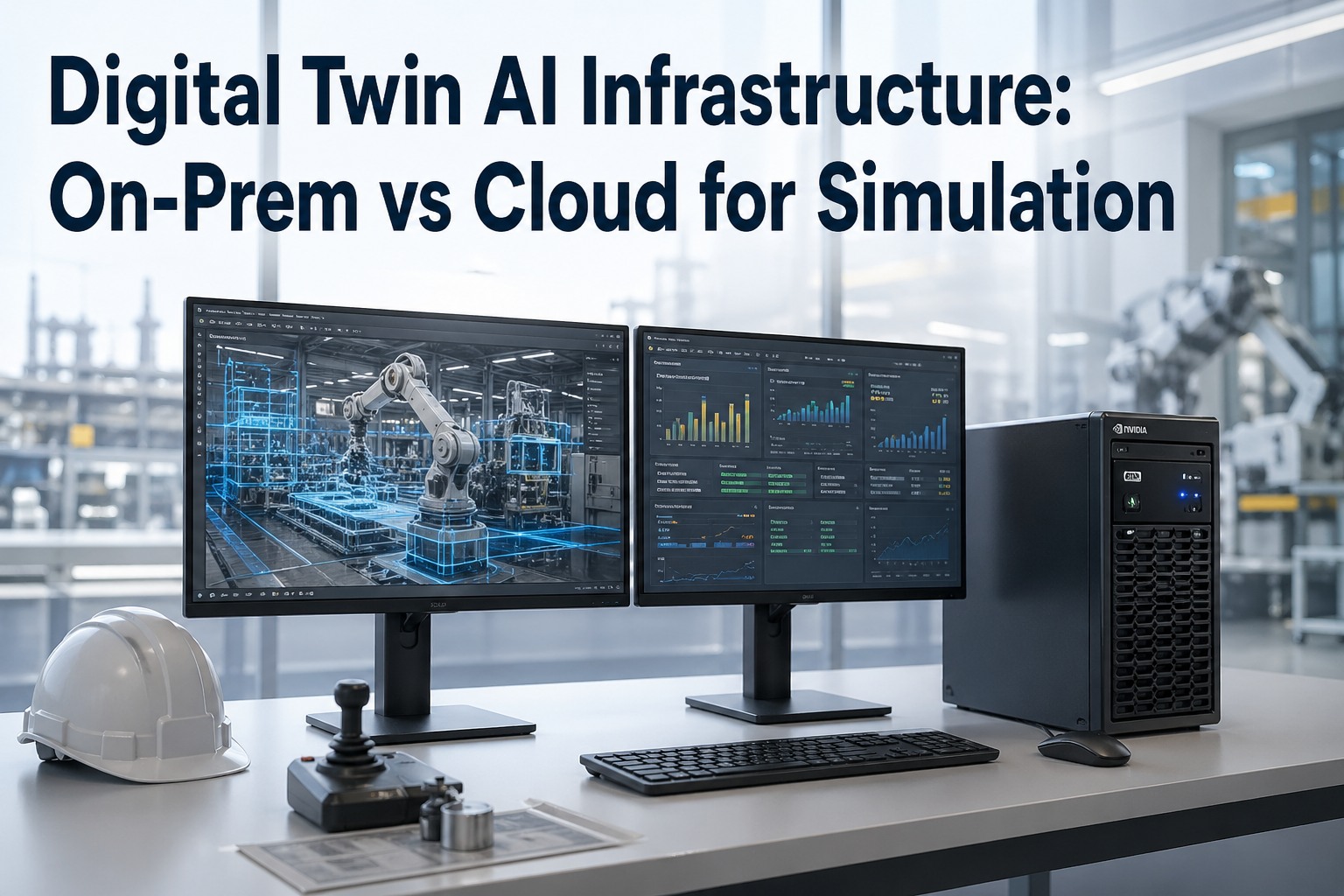
Omniverse ships pre-loaded on the iFactory turnkey appliance. RTX PRO 6000 Blackwell with 96 GB GDDR7 memory is the baseline because plant-grade twins consume GPU memory rapidly once full geometry, physics surrogates, and ML inference run together. AGX Orin edge nodes handle PLC and CCTV ingest separately so the twin's GPU memory is never starved by camera decode. The hardware was specified for the twin, not retrofitted to it.
The OpenUSD point: the reason this stack works is that OpenUSD lets every layer reference the same scene graph rather than maintaining four parallel copies. Engineers update geometry once, and physics, data sync, and render all see the change immediately. NVIDIA's published industrial digital-twin partners — Siemens, Schaeffler, Sight Machine, Rockwell — all converged on this pattern for the same reason.
What Plant CTOs & Engineering Heads Ask About Twin Fidelity
Honest answer: at Level 1 fidelity, the twin matches plant behaviour to roughly engineering-judgement accuracy on aggregate variables (load, heat rate, MS pressure, condenser pressure). At Level 2, it matches per-equipment behaviour to the accuracy of the underlying CFD or process-simulator surrogates, which is typically within a few percent of acceptance test data. Level 3 predictive accuracy depends on operating regimes the twin has seen during its life. We share specific accuracy numbers from comparable units under NDA — these vary too much by plant to put on a marketing page.
No, but cleaner CAD makes Phase 1 faster. The CAD-to-USD pipeline handles AVEVA E3D, Bentley OpenPlant, AutoCAD Plant 3D, SolidWorks, Inventor, and STEP imports. Where geometry is missing or the CAD is older than the plant's last retrofit, our team does laser-scan capture or photogrammetry to fill the gaps. Most plants discover their CAD is 80% accurate to as-built; the twin deployment is often the first time anyone reconciles the gap.
Through PI Asset Framework. We map your PI AF hierarchy one-to-one to the USD scene graph during Phase 1. Each USD prim — a feedwater pump, a superheater tube section, an attemperator — carries a PI AF reference. Tags update on the historian's normal cadence and the twin sees them at that cadence. For tags that need lower latency than PI provides, OPC-UA pulls directly from the DCS via the AGX Orin edge node.
Stays inside your perimeter. The Omniverse twin runs on the on-prem RTX PRO 6000 appliance you own. PI tags, CAD geometry, simulation results, audit trail — none of it leaves your zone. Air-gapped from public internet by default. The model trains on your operating data only; we don't share weights between customers.
No, by architecture. The twin reads PI and OPC-UA. It has no write path to the DCS or BMS. Recommendations are surfaced to engineers, who decide whether to route them to operations. Operators commit moves on the DCS panel under their own authority. This isn't a policy that could be flipped — the write capability doesn't exist in the tool surface.
6 to 12 weeks from PO to a Level 1 operational twin. Phase 1 (weeks 1–4) is hardware ship, network, CAD ingestion, and PI mapping. Phase 2 (weeks 5–8) is physics surrogate training, twin assembly, validation against historical operating data. Phase 3 (weeks 9–12) is engineer training, what-if workflow rollout, and go-live. Level 2 fidelity grows over the following year; Level 3 is multi-year. We Gantt the schedule at PO and walk it weekly.
Twin keeps running. You own the appliance, the OpenUSD scene, the trained surrogates, the PI mappings, and the audit logs. Renew support and quarterly model refresh annually, run it in-house with our handover docs, or mix both. Omniverse is licensed via NVIDIA Enterprise — that license stays with the appliance you own.
Yes. The first deployment establishes the CAD-to-USD pipeline, PI AF mapping, physics surrogate library, and engineering workflow. Subsequent units reuse the same pipeline and run faster — typically 4 to 8 weeks per unit on the same site. Multi-site rollouts use the same pattern; Year-2 onwards we Gantt the fleet expansion against your maintenance and capital cycles.
Schedule A Twin Demo Or Walk The Live Plant Twin
Two ways to see this running. First: a 30-minute working session with our digital-twin lead — bring a CAD sample and a PI tag list from one unit; we'll walk through what the twin would render and what physics surrogates would suit your equipment. Second: walk the iFactory booth, where the full twin is rendering on the actual RTX PRO 6000 Blackwell appliance with live PI sync, against a representative BTG plant model. Bring questions about your environment.