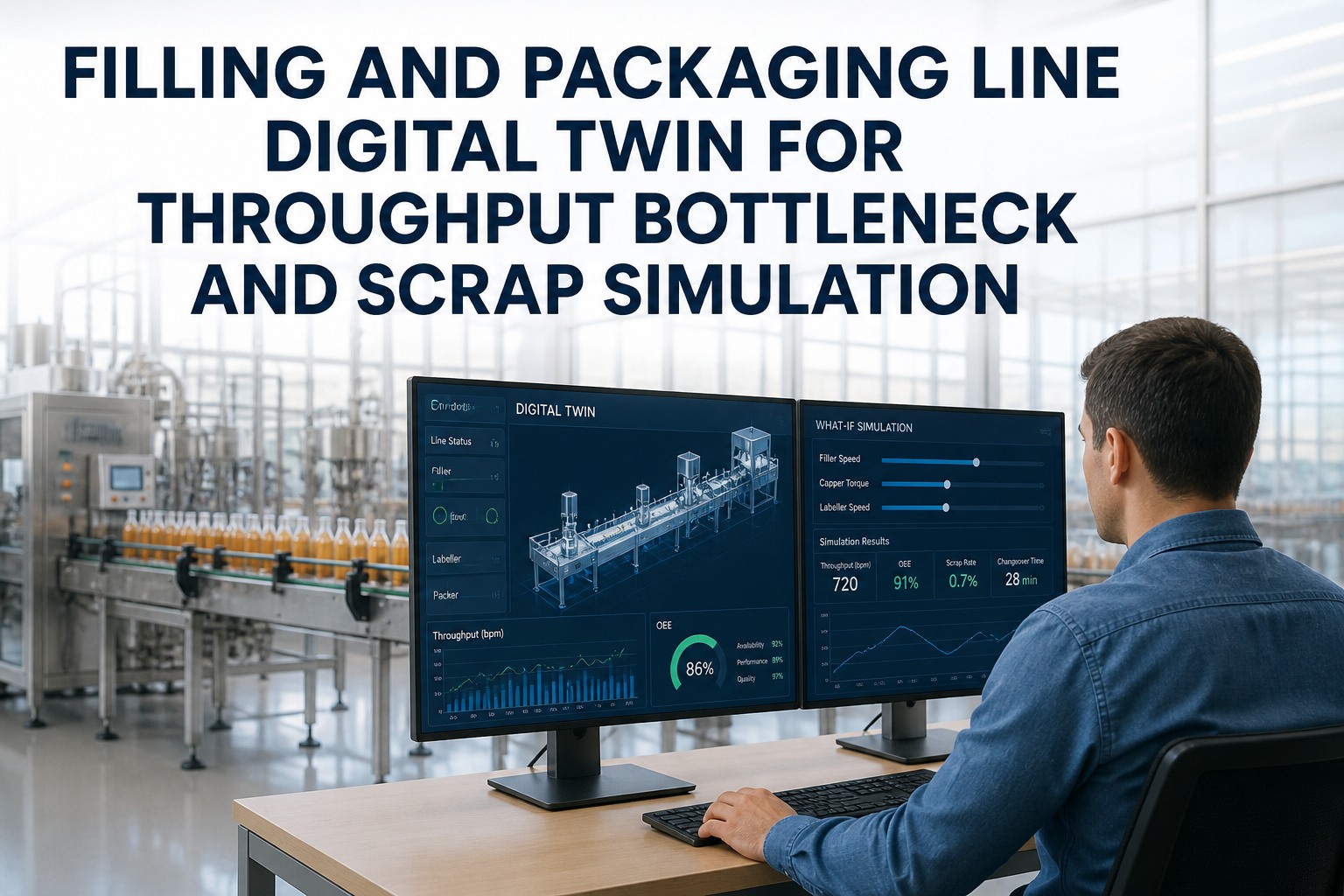
A packaging line digital twin is a discrete-event simulation of every station — filler, capper, labeller, packer, palletizer — running lock-step with the live PLCs and encoders on your floor. It tells the line manager which station is the real bottleneck, where OEE is bleeding, why scrap is rising, and how the next changeover will hit throughput — all before committing a physical change. iFactory pairs a deterministic discrete-event sim with an ML residual fitted on shift-level history. Real-world benchmarks: 52% downtime drop and 14% OEE rise on a canned-beverage line (Rockwell / Kalypso case), +3.3 points availability from one accumulator placement decision (Haskell beverage case), 10× faster troubleshooting versus stopping the line. Runs as batch GPU on the on-site GB300 + H200 stack — deterministic DES + ML, no LLM in the loop. Power and a network drop are the only things you provide. One-time CapEx — you own the line model, the ML weights, the OEE archive, the data. To scope a unit, get a turnkey quote.
Packaging Line Digital Twin — Filler, Capper, Labeller, Packer
A live discrete-event simulation of your filling and packaging line. Discrete-event sim + ML residual. What-if on filler speed, capper torque, labeller dwell, conveyor speed, accumulator size — all run on the GPU before any physical change. 52% downtime drop, 14% OEE rise on a canned-beverage line (Rockwell case). Sovereign on-site compute on the GB300 + H200 rack. No cloud sync.
Live Line Status · OEE Right Now
Anonymized status panel from a beverage filling line. The twin recomputes OEE every 60 seconds, identifies the current bottleneck station, projects scrap rate for the next hour, and flags the upcoming changeover impact. Schedule a session to see this on your line.
The Line Layout · Bottleneck Heat Map
The twin renders your line as a flow graph and colours each station by utilization. Red is saturated — the bottleneck. Yellow is starved or blocked. Green is healthy. The current bottleneck is the capper at 99.4%, with downstream stations starved waiting for capped bottles. Half a second delay at the capper ripples all the way to palletizing (PepsiCo + Siemens + NVIDIA case).
OEE = Availability × Performance × Quality
OEE is the single number every line manager watches. The twin computes it live by station and by line, decomposes it into the three contributing factors, and tells you which factor is dragging today's number down. The example below is real — from the live status panel above.
Scrap Modelling · Why Units Get Rejected
Scrap is the silent OEE killer. The twin tracks every reject reason, ties it to upstream conditions (fill volume, cap torque, conveyor speed, label alignment), and projects scrap rate for the next hour based on current trajectory. ML residual learns the patterns no PLC alarm ever fires for.
Fill weight outside spec. Twin correlates with carbonation level, filler valve dwell, product temperature.
Cap under-torque (leakers) or over-torque (cracks). Currently rising — torque drift on capper head 4 suspected. Maintenance flag raised.
Label out of register or wrinkled. Correlates with conveyor speed at labeller and bottle-arrival cadence from capper.
Vision-system rejects. Twin shows correlation with sanitation cycle interval — CIP frequency tuning recommended.
Changeover Impact · Before You Run It
Every SKU change is a planned OEE hit. The twin runs the next changeover virtually first — bottle size change, label change, fill recipe change — and tells you exactly how many minutes you'll lose, where the slowest sub-step is, and whether parallel work could shave time off.
Total projected: 37 min with twin-recommended parallelization, vs 45 min using the historical playbook. The 8-minute saving is one filler-valve change run in parallel with the capper head change — a sequencing tweak the twin spotted by simulating both options.
What-If Scenarios · Run Hundreds Before Touching the Line
Want to test a 5% filler-speed increase? A new label adhesive recipe? A bigger accumulator between capper and labeller? Run hundreds of virtual configurations on the GPU first. One Haskell beverage case decided accumulator placement (between filler and capper) using exactly this approach — +3.3 points availability, OEE targets hit 6 weeks ahead of schedule.
Test 95% / 100% / 105% of design rate. Twin projects scrap rate, downstream starvation, and OEE impact for each.
Sweep cap torque setpoint. Twin projects leak rate vs crack rate, and the torque sweet spot for each closure type.
Where to place buffer, how big? Haskell case: 500-bottle buffer between filler and over-capper gave +3.3 pt availability vs alternative placements.
Sweep label-application dwell time. Twin projects misalignment rate vs throughput tradeoff.
The Two-Layer Model · DES + ML
Discrete-event simulation handles the deterministic mechanics — bottle by bottle, station by station, exactly when each event fires. ML residual handles what the discrete model can't predict: micro-stops nobody alarmed on, cap torque drift, label adhesion variability with humidity, the patterns shift-level history reveals.
Every bottle, every station, every conveyor. PLC logic mirrored to the millisecond. Encoder synchronization preserved within 0.1 sec to match real conveyor behavior. Validated against 30+ years of DES practice in CPG packaging.
Bounded ML residual fitted to shift-level history. Captures cap-torque drift, label-adhesion variability with humidity, micro-stops below the PLC alarm threshold, scrap correlation across stations. Bounded — never overrides the deterministic line model.
The Hardware — GB300 + H200
Two NVIDIA platforms, two jobs, one rack. GB300 handles the heavy compute — full-line DES batch jobs, ML residual training, scenario engine running hundreds of virtual configurations in parallel. H200 handles the live inference — OEE recompute every 60 seconds, scrap projection, bottleneck identification, changeover preview.
Full-line discrete-event simulation, ML residual training, scenario engine batch. Hundreds of virtual configurations in parallel. Sub-2-minute runtime per virtual shift.
Live OEE recompute every 60 sec. Scrap projection per hour. Bottleneck station identification. Changeover preview. Streams to operator dashboard. Holds full shift trace in HBM3e memory.
Industry-Validated Outcomes
Real F&B packaging deployments, real metrics, public sources.
Why iFactory
Most "OEE dashboards" are post-hoc reporting tools. iFactory ships a working line model, the ML residual, the scenario engine, and the on-site GPU stack — all integrated. Schedule a working session.
Twin recomputes bottleneck station every 60 seconds. The line manager knows where to act now — not from yesterday's MES report.
Every changeover gets simulated first. Operators see exact projected duration and where parallelization can shave minutes — before the line stops.
Filler speed, capper torque, accumulator size, labeller dwell — sweep parameters on the GPU. Hundreds of virtual configurations before any physical change.
Line model, ML weights, OEE archive all stay on-prem. No cloud sync. No vendor data lake. HACCP / FSMA audit-ready.
Existing PLC, MES, SCADA keep working as before. Twin lives alongside, not on top of. No rip-and-replace.
One-time CapEx. You own the GB300, H200, line model, ML weights, every byte of shift data. Talk to support.
Power + Network. We Handle the Rest.
Power — 3-phase circuit at the plant DC for the GB300 + H200 rack. Network drop — Gigabit uplink with read-only access to PLC OPC UA, MES batch system, and historian.
GB300 + H200 build, ship, install. Line model parameterized per station. ML residual trained on shift history. PLC encoder sync. Operator dashboard. Scenario engine. Training across line manager / maintenance / engineering.
4–6 Week Deployment
Faster than process twins because discrete-event simulation is well-understood and the input data (PLC OPC UA + MES shifts) is already structured. Typical 4–6 weeks. Subsequent lines deploy in 2–3 weeks once the station library is built.
Stations enumerated, PLC OPC UA tags mapped, MES shift history pulled. BOM in 5 days.
Line discrete-event model built per station. ML residual trained on 6–12 months shift history. Hardware racked.
Twin runs alongside live shifts. OEE projections compared to actuals. Confidence thresholds tuned.
Dashboard live in line office. Scenario engine active. Year-one support active.
FAQ
Yes. The twin computes OEE itself from PLC OPC UA data and MES shift records. If you already have an OEE platform (Sight Machine, OSI PI Vision, etc.), the twin reads from it — doesn't replace it.
The architecture is station-agnostic. Same DES + ML pattern applies to canning lines (canner / seamer / pasteurizer / labeller), aseptic carton lines, pouch fillers, and end-of-line case packers. Station library expands per line type.
OEE projection within 1–2 percentage points typical, validated in shadow mode against actuals before going live. The deterministic DES handles 80% of the prediction; ML residual closes the remaining gap on micro-stops and shift-level patterns.
Fixed price per line, scoped to station count, PLC complexity, and historical data volume. No per-shift billing. Includes hardware, line model, ML training, dashboard, training, year-one support. Get a quote — proposal in 5 days.
Get a Quote on Your Line.
Watch the packaging twin diagnose a live bottleneck Or send your line layout, station list, and PLC OPC UA scope — we come back with a fixed-price BOM in 5 business days. GB300 + H200, line model, ML residual training, scenario engine, dashboard, training, and year-one support all included. You own the platform outright the day it goes live.