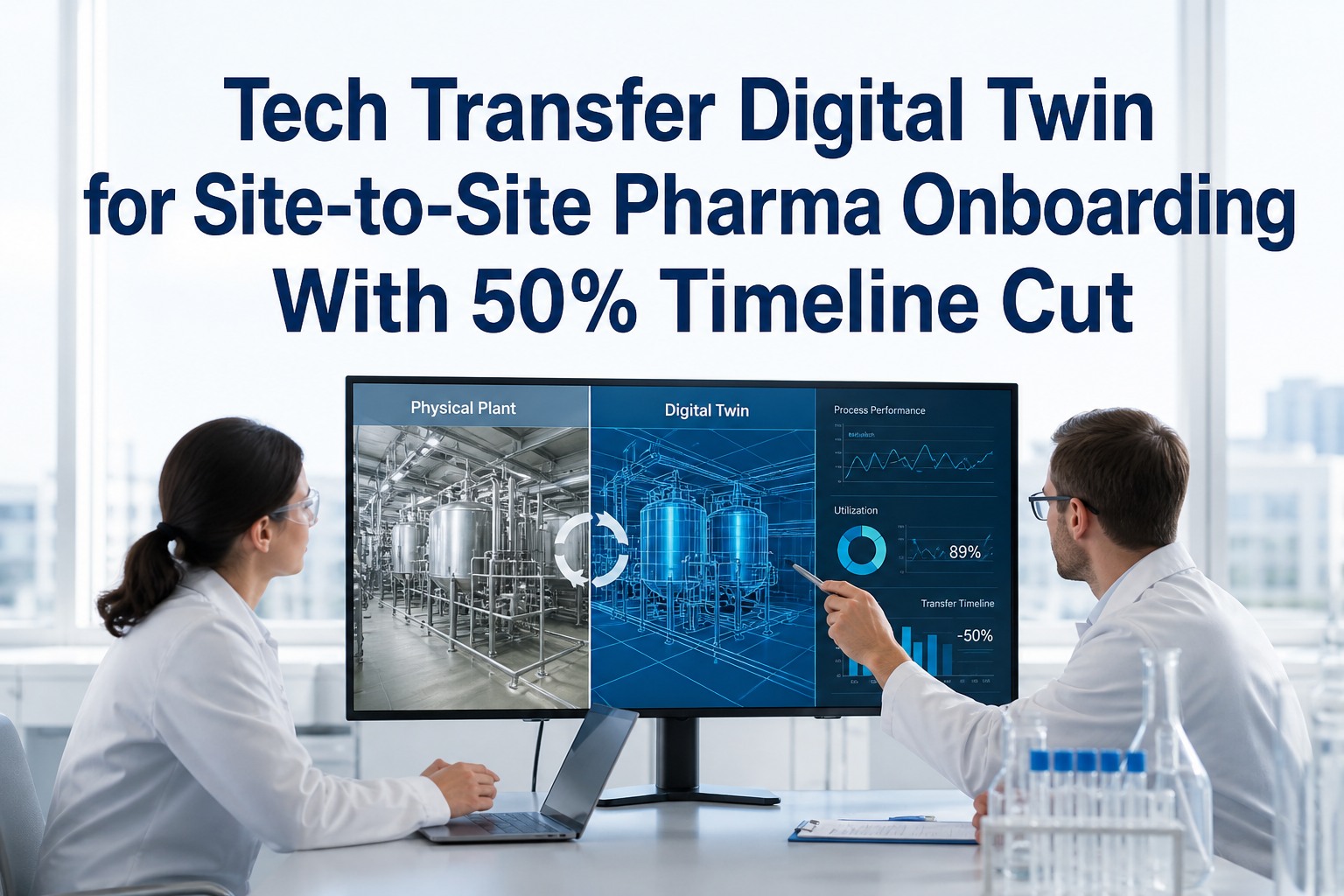
A pharma tech transfer digital twin is the virtual onboarding layer that runs before a single vial is filled at the receiving site. It pulls multi-thousand-page SOP and electronic batch record (eBR) packages from the sending site, runs an agentic LLM gap analysis in days instead of months, and qualifies the receiving line in a digital sandbox using a hybrid first-principles + ML model of the actual equipment. PharmTech 2026 reports approximately 50% reduction in tech transfer timelines — collapsing the traditional 18–24 month window down to 9–12 months on average, and dramatically de-risking process complexity for CMOs, CDMOs, and site-to-site moves. iFactory's tech transfer twin runs as a batch GPU workload on the on-site NVIDIA GB300, sovereign by architecture. The AI drafts and routes — every regulated decision still requires human sign-off. No GxP compromise, no shortcut on validation, no closed-loop automation of QA. Power and a network drop into your historian and document repository are the only things you provide. One-time CapEx — you own the twin, the gap-analysis logs, the qualification artifacts, the data. To scope a unit, get a turnkey quote.
Tech Transfer Digital Twin — Site-to-Site Pharma Onboarding in Half the Time
Virtual onboarding before physical runs. ~50% tech transfer timeline cut (PharmTech 2026). Agentic LLM runs multi-thousand-page SOP / eBR gap analysis in days. Hybrid model + scenario engine qualifies the receiving line in a digital sandbox. AI drafts, humans sign — full GxP / 21 CFR Part 11 compliance preserved. Runs on the on-site GB300 batch.
The 18–24 Month Problem
Traditional human-driven tech transfer takes 18–24 months from sending-site freeze to receiving-site PPQ. That window has become a critical business liability under patent cliffs, personalized modalities, and the BIOSECURE Act's "China+1" diversification mandate. The cost of every extra month is missed revenue, contract penalties, and stalled supply-chain resilience.
How the Twin Compresses the Timeline
The savings come from three places: an agentic LLM that reads SOPs and eBRs at machine scale, a hybrid first-principles + ML model that virtually qualifies the receiving line, and a scenario engine that runs hundreds of what-ifs in parallel before anyone touches physical equipment. Together they replace months of manual gap analysis and pilot runs.
LLM ingests 5,000–20,000 pages of sending-site SOPs, batch records, deviation logs, and CAPA history. Maps every parameter, every operating range, every step against the receiving site's existing master batch records. Produces a versioned gap report in days, not months.
First-principles physics (heat & mass transfer, mixing, residence time) combined with ML residual fitted to sending-site batch data. Scenario engine runs hundreds of parallel what-ifs on receiving-site equipment geometry — bioreactor scale-up, granulator load, fill-finish line speed.
Receiving line modelled to ICH Q8–Q13 design space. Operators "run" virtual batches on the digital twin before physical PPQ. Out-of-spec excursions caught and resolved on the GPU, not on commercial-scale material.
The Agentic SOP / eBR Gap Engine
This is the layer that earns the headline timeline cut. Manual review of 8,000–15,000 pages of regulated documents typically takes 8–12 weeks across an SME team. The agentic LLM runs the same review in 2–5 days, with deterministic output: every parameter mismatch flagged, every range delta computed, every standardization gap surfaced for human review.
The LLM never closes a gap. It surfaces every mismatch, drafts the resolution language, and routes to the right SME — Process, QA, Regulatory, Validation. The human signs. The audit trail captures every prompt, every model version, every reviewer, every decision. Full 21 CFR Part 11 / EU Annex 11 compliance preserved.
Virtual Qualification Sandbox
Once gaps are resolved on paper, the twin runs the receiving line through a virtual qualification protocol. Operators run virtual batches on the GPU sandbox using the same eBR templates that will be used at the physical site — same parameters, same setpoints, same SOPs. The twin produces a virtual qualification artifact for each batch that becomes part of the regulatory submission package.
Equipment specs vs design. Material grade, instrumentation, room utilities cross-checked from drawings + DCS tags.
Equipment operating ranges verified empty: speed, temp, pressure, flow profiles. Twin confirms hardware envelope.
Twin runs hundreds of virtual batches at production load. Out-of-spec excursions caught on GPU, not on commercial material.
Three live GMP runs at the receiving site, informed by the twin's virtual results. Massively reduced surprise rate.
Physical PPQ is never skipped or replaced. The twin's role is to catch what would otherwise be caught on the third or fourth physical run — the costly ones. By the time material hits the line, the design space is well-characterized and the SOPs are battle-tested in simulation.
What the AI Does, What Humans Do
This is the architectural line that keeps the twin GxP-compliant. The AI never signs, never closes, never auto-executes a regulated action. Every approval, every batch release, every CAPA closure is human-signed with full audit trail.
- Read 10,000+ pages of SOPs & eBRs in days
- Map parameter deltas across two sites
- Flag deviations, CAPAs, OOS for review
- Run virtual batches on the digital twin
- Draft resolution language for SME review
- Generate audit-ready qualification artifacts
- Every SOP / eBR sign-off
- Every deviation closure
- Every CAPA approval
- Every batch release
- Every qualification protocol approval
- Every regulatory submission
Where It Fits — CMO, CDMO, Site-to-Site
The twin works across the three transfer scenarios that dominate Pharma 5.0 — CMO onboarding, CDMO scale-up, and internal site-to-site moves driven by capacity rebalancing, BIOSECURE Act diversification, or facility lifecycle.
Sponsor brings master recipe + sending-site SOPs. CMO runs gap analysis vs its existing equipment. Virtual qualification before any commercial material is committed.
50L lab data feeds the hybrid model. Twin projects 200L pilot & 1,000L commercial outcomes. Each scale-up step treated as a mini tech transfer with its own virtual qualification.
Capacity rebalancing, facility lifecycle, BIOSECURE-driven diversification. Twin captures the sending-site tribal knowledge before SMEs retire or move on.
Where the Twin Runs
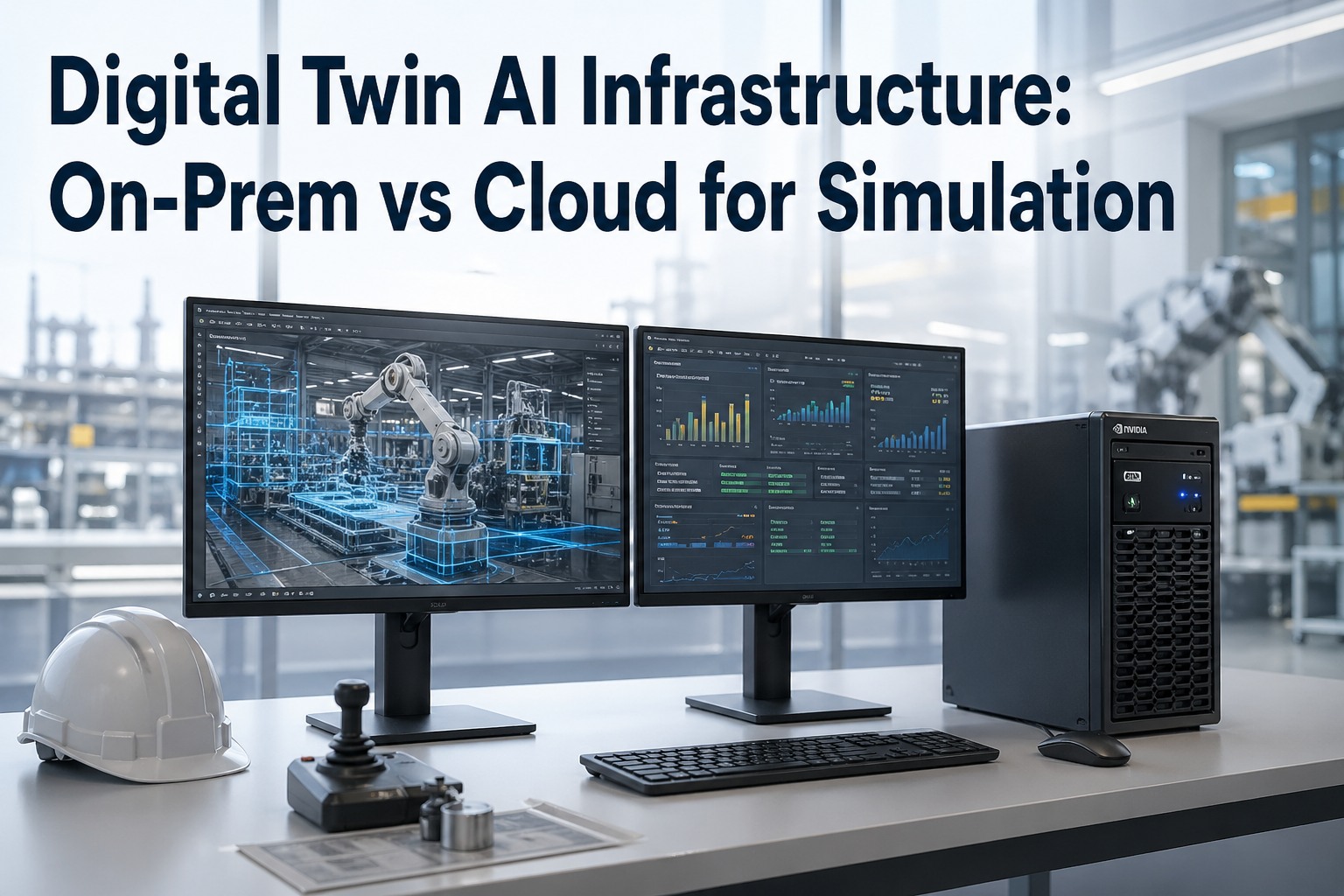
The tech transfer twin is a batch GPU workload — heavy when a transfer is active, idle between transfers. That fits the on-site NVIDIA GB300 well: the same node hosts your plant copilot LLM, the scenario studio, and any live process twins, all sovereign by architecture.
Hybrid model + LLM + scenario engine all run on the same on-site GB300. No cloud sync, no document egress. SOPs, eBRs, deviation logs, batch data — all stay inside your fence.
Every prompt logged, every model version pinned, every reviewer captured. Audit trail integrates with your existing eQMS & doc-control systems. AI never signs — humans always do.
Why iFactory
Most "tech transfer software" is a SharePoint of templates with a search bar. iFactory ships the agentic LLM, the hybrid first-principles model, the scenario engine, the qualification sandbox, and the audit infrastructure — all on-prem, all GxP-architected, all integrated. Schedule a working session.
PharmTech 2026 references 25–50% reductions across analyzed CMO / CDMO case studies. Aligned with our deployment data on small-molecule and biologic transfers.
Architectural separation between draft and sign-off. The AI never closes a regulated action. Full GxP, 21 CFR Part 11, EU Annex 11 compliance preserved.
SOPs, eBRs, deviation logs never leave your fence. Runs on your on-site GB300. No model registry sync, no API call to vendor cloud.
First-principles physics + ML residual, not a black-box LLM pretending to understand mass transfer. Auditable by validation engineers, defensible to regulators.
Same engine as our scenario studio. Hundreds of what-ifs run in parallel — scale, blend, hold time, line speed — before any physical batch.
One-time CapEx. You own the GB300, the trained models, the gap-analysis logs, the qualification artifacts. Talk to support.
Power + Network. We Handle the Rest.
Power — 3-phase circuit at the plant DC for the GB300 rack. Network drop — Gigabit uplink with read-only access to historian, eQMS / doc-control system, and DCS / MES.
GB300 build, ship, install. Hybrid model parameterized for your equipment. Agentic LLM tuned for SOP / eBR vocabulary. Scenario engine. Virtual qualification sandbox. Audit log integration with your eQMS. SME training across Process / QA / Regulatory / Validation.
8–14 Week Initial Deployment
The first transfer takes longer because hybrid model training is bespoke to your equipment. After the first transfer, subsequent ones run faster because the LLM has learned your SOP / eBR vocabulary and the equipment library has accumulated.
Equipment list, SOP / eBR access, audit-trail integration scoped. Fixed-price BOM in 5 business days.
First-principles physics parameterized. ML residual trained on historical batch data. LLM tuned to your SOP / eBR vocabulary.
GB300 racked, eQMS bridge live, twin runs first transfer in shadow mode alongside SME team for validation.
First gap analysis approved by QA. Virtual qualification artifacts in regulatory submission. Year-one support active.
FAQ
Virtual qualification supplements physical PPQ — it does not replace it. Three live GMP runs are still required. The twin's role is to ensure those three runs succeed first time. ICH Q8–Q13 design-space methodology supports this approach. Final regulatory submission is signed by your QA / RA team, not the AI.
The AI drafts and routes — humans sign every regulated action. Every prompt, every model version, every reviewer is logged. Audit trail integrates with your existing eQMS. The architectural rule is non-negotiable: no closed-loop automation of QA decisions.
No. The agentic LLM, hybrid model, and scenario engine all run on the on-site GB300. Documents are read locally, embeddings stay locally, gap reports are generated locally. No vendor cloud, no API call out, no document registry sync.
Fixed price per first transfer, scoped to molecule complexity, equipment count, and document volume. No per-page billing, no per-batch fee. Includes hardware, hybrid model, LLM tuning, scenario engine, training, and year-one support. Get a quote — proposal in 5 days.
Get a Quote on Your First Transfer.
Watch the agentic SOP gap engine run on a real CMO transfer scenario Or send your sending-site equipment list and document scope — we come back with a fixed-price BOM in 5 business days. GB300, hybrid model, agentic LLM, scenario engine, virtual qualification sandbox, eQMS integration, training, and year-one support all included. You own the platform outright the day it goes live.