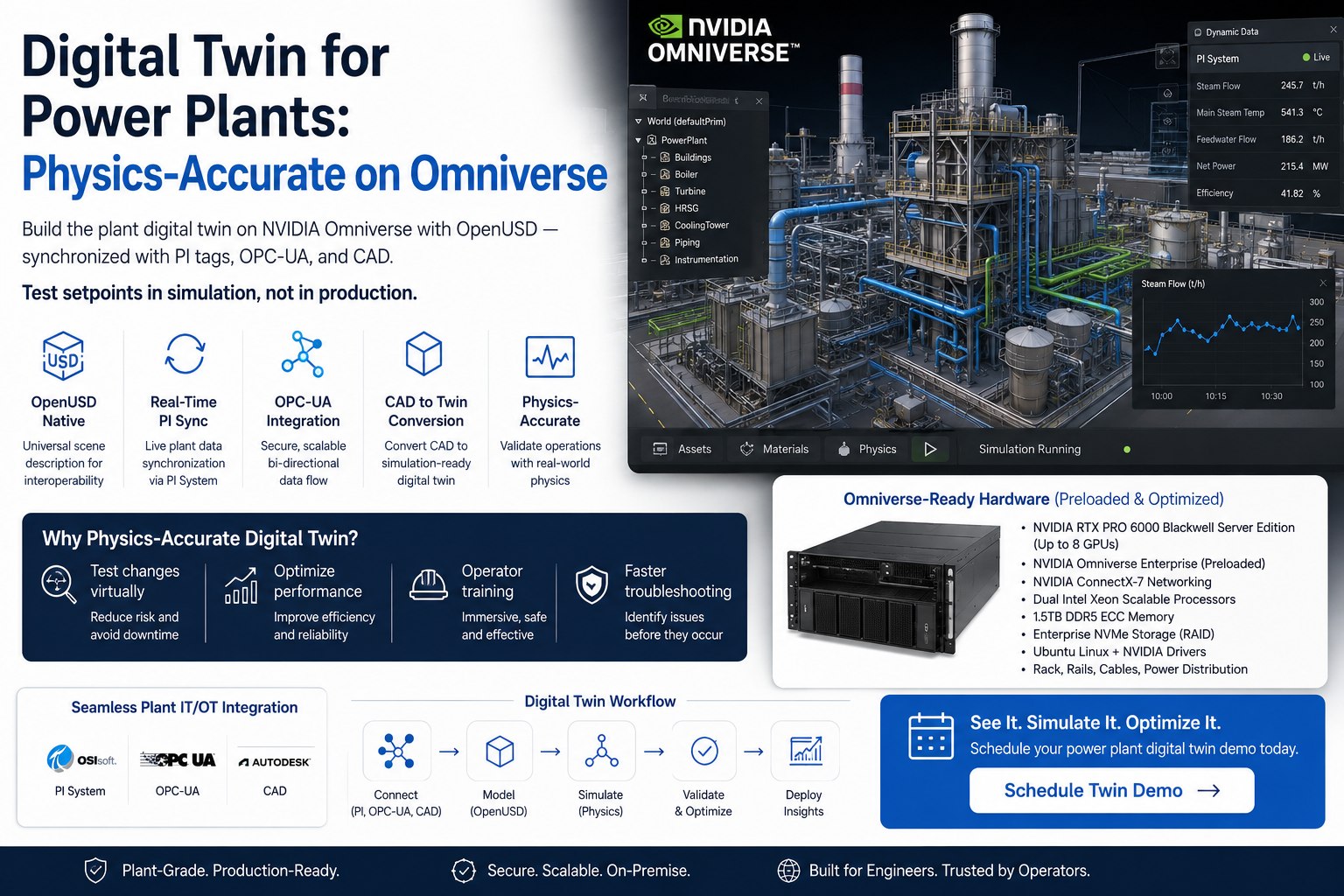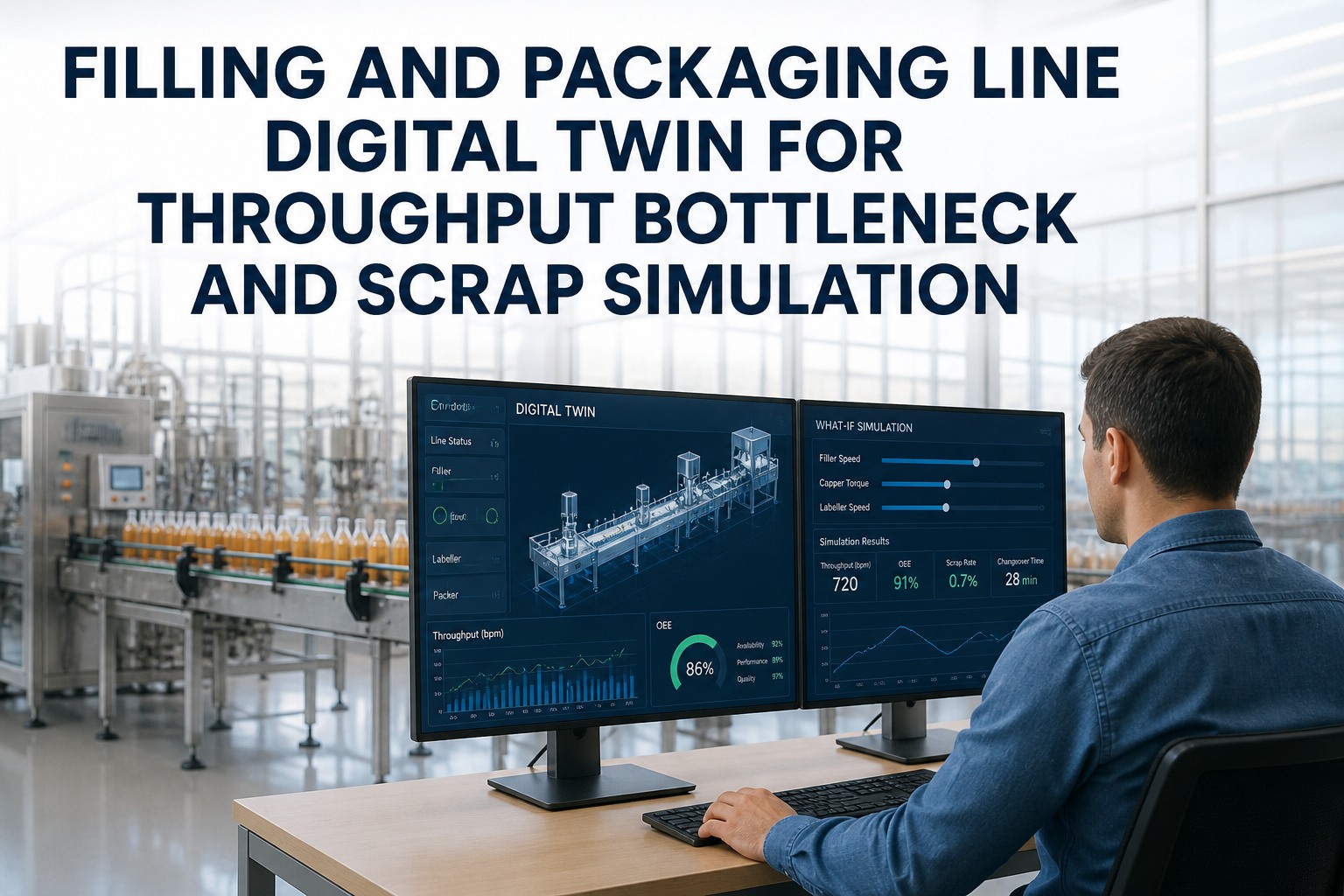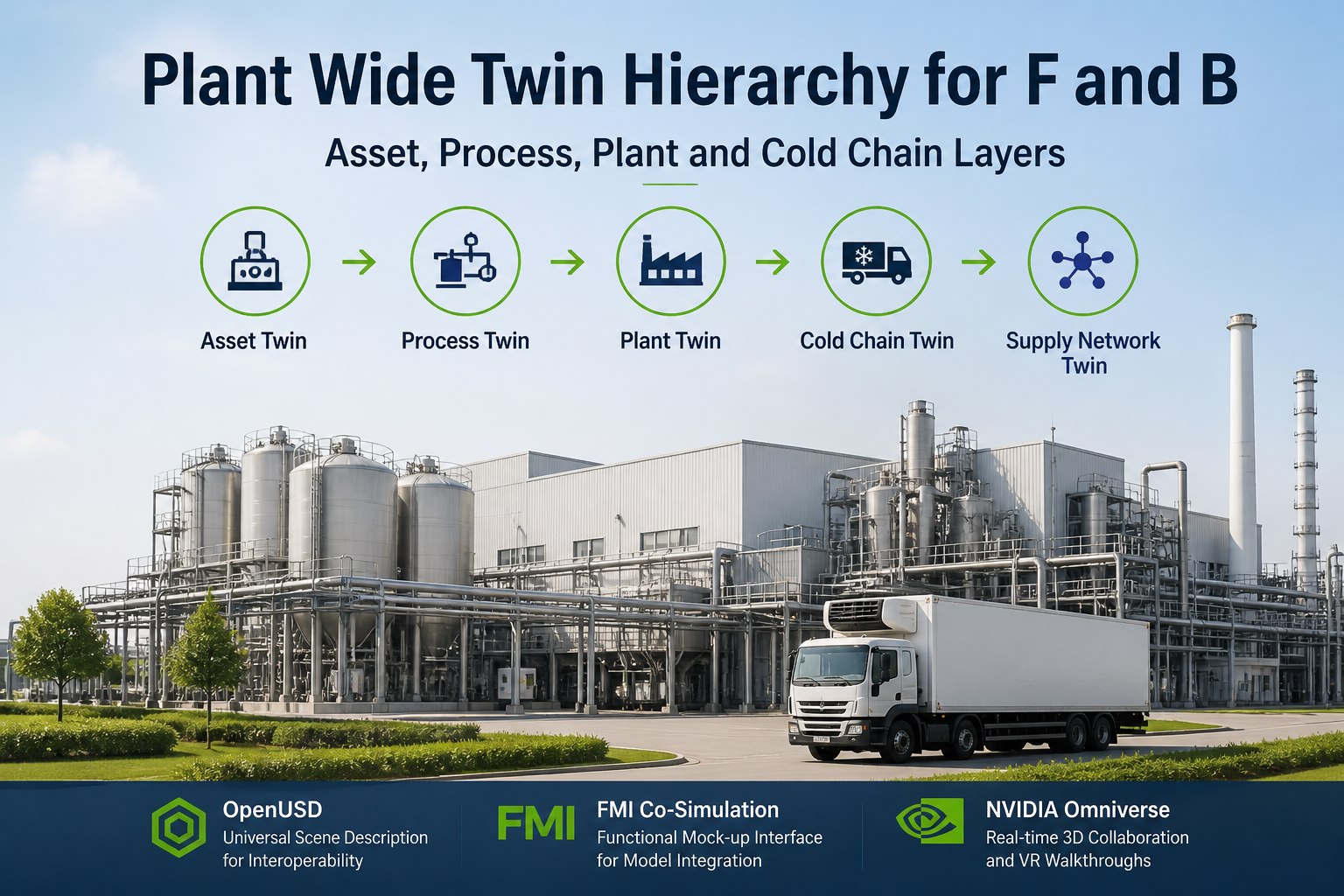
An F&B plant-wide twin is not one model — it is a hierarchy of five layers stacked together: asset twins for individual equipment, process twins for unit operations, the plant twin that ties the lines and utilities together, the cold-chain twin that follows temperature-sensitive product through freezing / chilling / shipping, and the supply twin that spans inbound raw materials and outbound distribution. iFactory composes these layers using the open industry stack — OpenUSD for geometry and scene composition, FMI for physics co-simulation across solvers (CFD, hydraulics, thermal, controls), and ML residuals for what the equations miss. The whole hierarchy lives on NVIDIA Omniverse, runs on the on-site GB300 + OVX, and stays HACCP / FSMA audit-ready end to end. Power and a network drop are the only things you provide. One-time CapEx — you own the geometry, the FMI bundles, the ML weights, the Omniverse scene, the audit trail. To scope a unit, get a turnkey quote.
Plant-Wide F&B Twin — Asset to Cold Chain to Supply
A layered F&B twin stack — asset, process, plant, cold-chain, and supply twins — composed via OpenUSD + FMI + ML on NVIDIA Omniverse. Sovereign on-site compute on the GB300 + OVX rack. Full HACCP / FSMA audit trail. Open standards, not vendor lock. No cloud sync. Industry proof: PepsiCo + Siemens + NVIDIA reports up to 90% of issues caught before physical changes; Krones cut simulation times from 3–4 hours to under 5 minutes; Unilever reports 55% cost / 65% time savings on product twins.
The Five-Layer F&B Twin Hierarchy
An F&B plant is too complex for one model. A filling line is not the same kind of system as a blast freezer, which is not the same kind as a multi-DC supply network. The hierarchy lets each layer use the right model fidelity, the right physics, and the right data sources — while staying composable through OpenUSD references. Schedule a session to see this on your facility.
Raw material inflow, finished-goods outflow, distribution centers, third-party logistics. Material flow, capacity, lead time across plants and DCs.
Blast freezers, chillers, refrigerated storage, refrigerated trucks. Temperature excursions, dwell time, predicted shelf-life impact tracked end to end.
Assembles all process twins on a site — material flow, utilities (water, steam, CO2), CIP loops, room airflow, personnel paths, batch & line scheduling.
One unit operation — pasteurizer, homogenizer, filler, blast freezer, oven. Hybrid first-principles + ML, validated against batch records.
One filler, one freezer, one CIP skid, one mixer. CAD geometry, instrumentation, control logic, live PI tag stream. The atomic unit of the hierarchy.
Each higher layer composes lower layers via OpenUSD references — the plant twin doesn't duplicate equipment models, it points at them. Change one asset twin, the change propagates up the stack automatically.
Why Cold Chain Is Its Own Layer
Pharma plant twins use Network and Product layers. F&B uses Cold Chain because most of the regulatory and quality risk in food & beverage lives in the temperature-controlled path between filling and the end customer. The cold-chain twin tracks every temperature excursion against HACCP critical limits and projects shelf-life impact in real time.
Twin projects core temperature curves, predicts whether the load will hit -18 °C target inside the cycle window, flags cycles likely to fail.
3D thermal map of the chamber, tracks hot spots from door openings, packing density, refrigeration cycle. Logs HACCP-flag deviations automatically.
Telematics + door open events fed to the twin. Predicted shelf-life loss per pallet calculated continuously, before delivery.
Arrhenius-based shelf-life model integrates every temperature minute across the chain. Each lot has a predicted remaining shelf life on arrival.
The Open Standards Underneath
Three open standards do the work. OpenUSD handles geometry and scene composition. FMI handles physics co-simulation across solvers. ML handles what the physics misses. None of them is iFactory-proprietary — you can take the artifacts to any compatible vendor.
Pixar-derived Universal Scene Description, now the industry standard for industrial digital twins. Native format on NVIDIA Omniverse. Used by Krones, Unilever, Continental, PepsiCo. Alliance for OpenUSD (AOUSD) governs the spec.
Open standard for model exchange and co-simulation across solvers. Lets a CFD model from Ansys, a hydraulic model from another vendor, and a control logic model from a third all compose into one process twin without rewriting any of them.
Bounded ML residuals fitted on batch / shift / lot data. Capture conveyor wear, freezer fan degradation, fouling on heat exchangers, equipment age. Never overrides physics — sits as a correction term on top.
How OpenUSD Composes the Hierarchy
The Pixar-derived USD format treats the plant as a hierarchical scene graph. Each prim is an asset or process. References let you reuse models without duplicating them. Layering lets different teams modify the same scene without conflict. PepsiCo, Krones, and Unilever build their plant twins this way — same approach, applied to your facility.
/FB_Network                                       <-- LAYER 05 supply
├── /Plant_Chicago                              <-- site reference
│   ├── /Building_A
│   │   ├── /FillingLine_1                   <-- LAYER 03 plant twin
│   │   │   ├── /Pasteurizer_PZ-001        <-- LAYER 02 process twin
│   │   │   ├── /Homogenizer_HG-002        <-- LAYER 02 process twin
│   │   │   ├── /Filler_FL-003             <-- LAYER 01 asset twin
│   │   │   └── /Capper_CP-004             <-- LAYER 01 asset twin
│   │   └── /BlastFreezer_BF-101              <-- LAYER 04 cold chain
│   └── /CIP_Loop_Utilities
├── /Plant_Atlanta                              <-- site reference
├── /DC_Memphis                                 <-- LAYER 05 distribution centre
└── /ColdChainPath_Lot_2026-04-127              <-- LAYER 04 (cuts across)
Where FMI Comes In
OpenUSD describes the geometry. FMI describes the physics. A single process twin like a pasteurizer might combine a CFD solver from one vendor, a heat-transfer model from another, and a PLC control logic model from a third. FMI lets all three run together inside the same composite twin — without rewriting any of them.
Heat-exchanger flow patterns, dwell time. From CFD vendor.
Log-reduction model, lethality F-value. From process vendor.
Sequence, alarms, interlocks, divert valve logic. From control vendor.
What the three FMUs miss — fouling, plate degradation, batch variability.
NVIDIA Omniverse VR Walkthrough
Once the OpenUSD hierarchy is composed and the FMI co-sim is running, the whole twin is queryable through NVIDIA Omniverse — on a workstation, on a tablet at the line, or in VR for design reviews and operator training. Same scene, four use cases, no reauthoring.
Walk through the new line before equipment ships. Identify clash, utility runs, ergonomics. PepsiCo + Siemens reports up to 90% of issues caught before physical modifications.
FAT in the twin before SAT on the floor. Catch control logic errors, sequence issues without test material. Krones cuts sim time from 3–4 hours to under 5 minutes.
Live PI tag overlay on the 3D scene. Operators see filler status, freezer pull-down, cold-chain alerts in spatial context, not buried in HMI lists.
CIP procedure, allergen changeover, SOP rehearsal in VR. Faster onboarding, fewer real-world errors during training.
The Hardware — GB300 + OVX
Two NVIDIA platforms, two jobs, one rack. GB300 hosts the FMI co-simulation, the ML residual training, and any scenario engine batch jobs. OVX hosts the Omniverse scene, the OpenUSD compose, and the real-time visualization. Both stay sovereign — no cloud sync, no model registry egress.
Hosts FMI co-simulation across coupled solvers, ML residual training, scenario engine. Same node serves your existing process twins (pasteurizer, freezer) and any plant copilot above.
Purpose-built rack for Omniverse workloads. RTX-accelerated rendering, OpenUSD scene compose, multi-user collaboration. Streams to workstation, tablet, VR headset.
HACCP & FSMA Audit Trail Across All Five Layers
The hierarchy doesn't dilute compliance — it strengthens it. Every layer change, every FMI version pin, every ML retrain, every cold-chain excursion is logged with timestamp, user, and intent. Audit trail integrates with your existing QMS / batch system.
HACCP, FSMA, FDA QbD, ICH-style design space all map cleanly onto this layered model. The auditor's question "show me the version of equipment X that ran lot Y" is one OpenUSD reference traversal away.
Why iFactory
Most "plant twin" pitches give you one monolithic model that breaks the moment you need to swap a vendor or a solver. iFactory uses open standards end to end — OpenUSD, FMI, HACCP, FSMA — so the twin survives vendor changes, equipment upgrades, and audits. Schedule a working session.
OpenUSD, FMI, HACCP, FSMA, FDA QbD. No proprietary geometry format, no proprietary physics solver lock-in. Take the twin to any compatible vendor.
Most plant-twin tools treat cold chain as an afterthought. We make it Layer 04 — on equal footing with the plant itself, because it's where most F&B quality risk lives.
OpenUSD scene, FMI bundles, ML weights all on-prem. No cloud render, no model registry sync. Your geometry doesn't leave your fence.
CFD from one vendor, process model from another, control logic from a third — all coupled through FMI. No re-authoring, no IP exposure.
Same OpenUSD scene serves engineering review, virtual commissioning, live ops, and VR onboarding. One artifact, four use cases.
One-time CapEx. You own the GB300, OVX, OpenUSD scene, FMI bundles, ML weights. Talk to support.
Power + Network. We Handle the Rest.
Power — 3-phase circuit at the plant DC for the GB300 + OVX rack. Network drop — Gigabit uplink with read-only access to historian, batch system, MES, WMS, and DCS.
GB300 + OVX rack build, ship, install. CAD-to-OpenUSD ingest. FMI bundles parameterized per asset class. ML residual training on historical batch / shift data. Cold-chain telematics integration. Omniverse scene compose. VR streaming setup. HACCP audit-trail integration. Training across Engineering / QA / Ops.
10–14 Week Initial Deployment
The first plant twin takes longer because the OpenUSD hierarchy is bespoke and the FMI bundles are vendor-specific. Subsequent sites in the network deploy faster — 5–7 weeks — because templates and FMI libraries carry over.
3D scan / CAD ingest. Asset list mapped to OpenUSD prims. PI tag mapping audited. BOM in 5 days.
FMI bundles parameterized per asset class. ML residuals trained on historical batches / shifts. Hardware racked.
Layers composed. SME walkthroughs. Omniverse VR review by Engineering / QA / Ops.
Live PI sync, cold-chain telematics live, audit trail integrated, VR access for ops & training. Year-one support active.
FAQ
Different workloads. GB300 is sized for AI/ML/co-sim compute (FMI, residual training, scenario engine). OVX is sized for real-time Omniverse rendering and OpenUSD scene compose. They share the rack, the network, and the audit trail, but the chips are tuned for different jobs.
Recommended, not mandatory. OpenUSD is the open standard. Omniverse is the deepest-integrated platform that uses it natively, but the OpenUSD scene is portable to any compatible viewer / engine. You're not locked in to NVIDIA infrastructure.
No — it complements both. MES holds the master batch record; the process twin references MBR versions. WMS holds inventory; the supply twin references WMS lots. The plant-wide twin is a derived view, not a replacement system.
Fixed price per site, scoped to asset count, CAD readiness, and FMI bundle count. No per-prim billing. Includes hardware, OpenUSD compose, FMI bundles, ML training, audit-trail integration, training, year-one support. Get a quote — proposal in 5 days.
Get a Quote on Your Plant.
Watch the five-layer F&B twin compose live OpenUSD scene, FMI co-sim, ML residual, Omniverse VR walkthrough — on a real beverage filling line. Or send your CAD scope, asset inventory, and FMI vendor list — we come back with a fixed-price BOM in 5 business days. GB300 + OVX, OpenUSD compose, FMI bundles, ML training, cold-chain telematics, audit-trail integration, training, and year-one support all included. You own the platform outright the day it goes live.