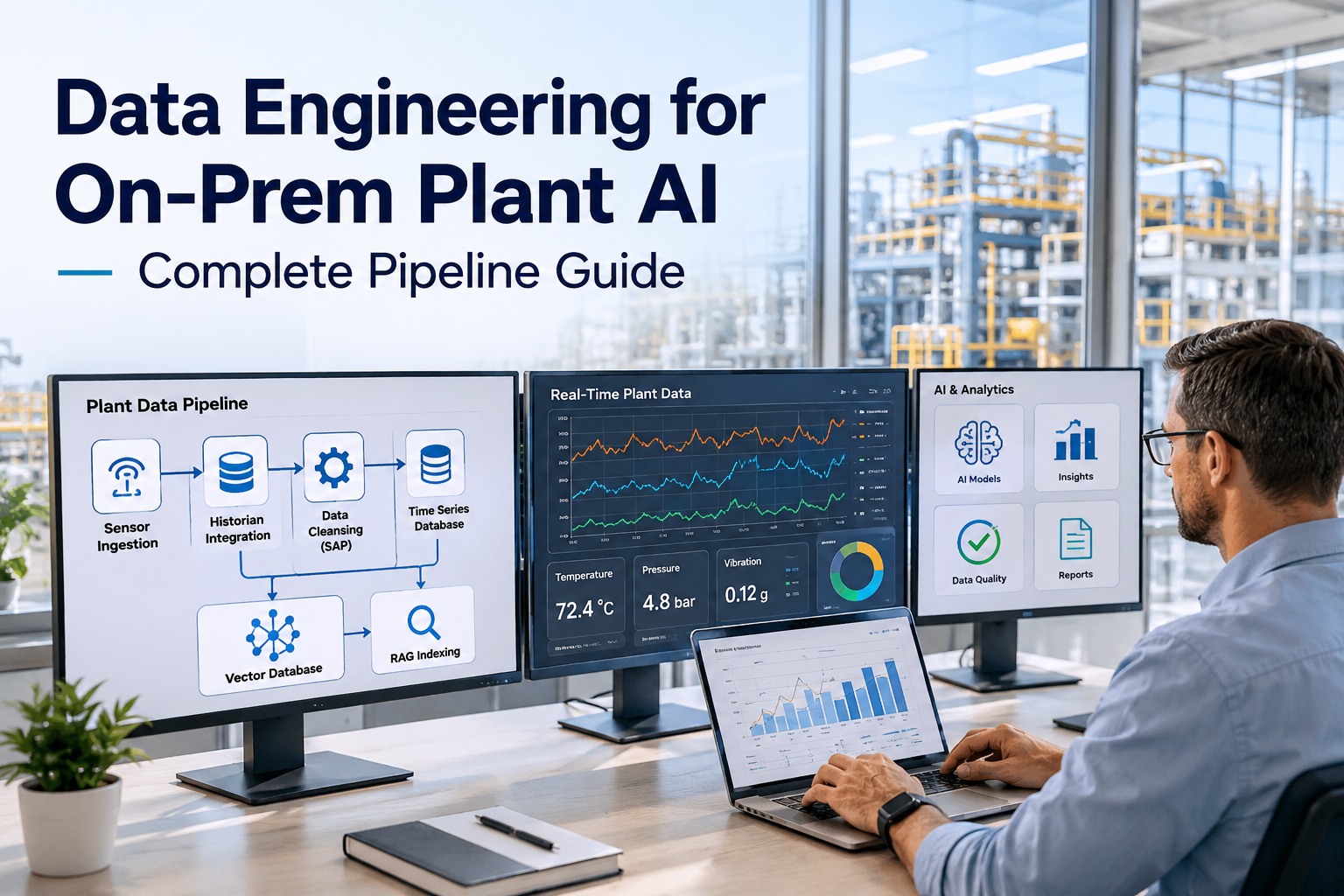
This page is part of iFactory's Industrial AI knowledge hub — built for engineers and operations leaders connecting real factory floors to on-prem AI inference. An IoT Data + On-Prem AI Pipeline enables factories to process machine data in real time without relying on cloud latency. Industrial sensors stream operational data through protocols such as MQTT and Kafka into local time-series databases, where on-prem GPU-powered AI models analyze patterns, detect anomalies, and predict failures instantly. This architecture allows manufacturing plants to perform sub-second inference, automate responses, and send optimized commands back to PLCs and control systems. By keeping data processing inside the facility, organizations gain higher security, faster decision-making, and reliable AI-driven automation, making it a critical foundation for modern Industrial AI and smart factory operations.
IoT Data + On-Prem AI: Building the Real-Time Factory Pipeline
Connect IoT sensor streams to on-prem AI inference without cloud round-trips. MQTT ingestion, Kafka streaming, time-series storage, GPU inference, and closed-loop feedback to PLCs — the reference architecture factories actually deploy in 2026.
✔ Discuss your factory IoT architecture and AI deployment strategy
✔ See live demonstrations of industrial AI pipelines
✔ Understand MQTT, Kafka, and time-series data architectures for factories
✔ Explore on-prem GPU inference vs cloud AI deployment
✔ Get a custom Industrial AI roadmap for your facilit
80 ZB
IoT data generated globally by 2025
70.65%
of AIoT implementations run on-prem in 2026
<20ms
latency mandate for OT-coupled AI inference
50%
unplanned downtime reduction with AI predictive maintenance
The Real Problem
Why Cloud Alone Breaks the Factory AI Promise
Most industrial AI pilots work fine in a demo environment. They fail in production because nobody did the latency math. A factory floor running PLC feedback loops, SCADA telemetry, and anomaly detection across 10,000 to 50,000 sensor points cannot absorb the 80 to 200ms round-trip variance of a cloud inference call — not when a conveyor jam costs $50,000 per hour and a control response needs to land in under 20ms. The architecture answer isn't philosophical; it's physics.
Cloud-Only Approach
- ✕ 80–200ms round-trip latency on cloud inference
- ✕ 800 Mbps sustained bandwidth cost at plant scale
- ✕ OT data leaves the facility — sovereignty risk
- ✕ Single connectivity failure halts AI decisions
- ✕ Cloud egress costs compound at petabyte data volumes
On-Prem AI Pipeline
- ✓ Sub-5ms inference latency at the edge
- ✓ Zero raw OT data leaves facility boundaries
- ✓ Inference runs through connectivity failures
- ✓ Amortized GPU cost beats cloud at sustained loads
- ✓ Direct PLC feedback loop — no network hop
Reference Architecture
The 5-Layer IoT-to-AI Pipeline
Every production-grade factory AI pipeline is built from five distinct layers. Each has a different latency profile, compute requirement, and failure mode. Understanding where each layer runs — and why — is the difference between a working deployment and a six-month integration project that never goes live.
L1
Sensor & Device Ingestion
PLCs, SCADA, vibration sensors, cameras, temperature probes. Protocols: OPC UA, MQTT, Modbus, HART, 4–20mA. A typical plant has 10,000–50,000 measurement points generating up to 4.3 billion readings per day at 1-second polling intervals.
MQTT 5.0OPC UAModbusHART
▼
L2
OT/IT Bridge & Protocol Translation
Ruggedized gateways terminate field protocols and translate to IT-friendly formats. This is where most legacy architectures stall — proprietary historians trap data in OT silos that AI platforms cannot reach without custom connector development. iFactory ships 50+ pre-built connectors.
OT GatewayProtocol BridgeData Normalization
▼
L3
Stream Processing — Kafka Backbone
Apache Kafka is the central nervous system of a production IIoT pipeline — handling millions of sensor events per second with sub-10ms latency, guaranteed delivery, and persistent event replay. Topics partition by asset type, enabling parallel downstream consumers simultaneously. Kafka Streams and ksqlDB handle real-time threshold alerting and windowed aggregations.
Apache KafkaKafka StreamsksqlDBEvent Replay
▼
L4
Time-Series Storage & Feature Engineering
Raw telemetry lands in a time-series database optimized for high-cardinality sensor data. Feature engineering extracts rolling windows, FFT frequency components, and statistical summaries before feeding the inference layer. A vibration sensor at 10,000 Hz sends only frequency-domain features — not raw waveforms — unless an anomaly triggers full capture.
InfluxDB / TimescaleDBFeature StoreFFT Processing
▼
L5
On-Prem GPU Inference & PLC Feedback
NVIDIA RTX PRO 6000 or L40S clusters run inference at sub-5ms latency. LSTM anomaly detection achieves 94.3% accuracy on manufacturing equipment. AI outputs route back to PLC/SCADA as control signals or to MES as structured work orders — in seconds, with no manual handoff and full audit trail.
RTX PRO 6000ONNX RuntimePLC FeedbackSCADA Integration
Latency Reality
The Latency Budget That Decides Your Architecture
Cloud pitches skip past this table. We won't. Every factory use case has a hard latency ceiling — and your infrastructure choice must live below it. Below 50ms, cloud round-trips become physically unreliable even with private peering. Below 20ms, on-prem is the only architecture that works.
| Use Case |
Latency Budget |
Data Volume |
Architecture Decision |
Cloud Viable? |
| PLC closed-loop feedback |
<5ms |
Low |
On-Prem mandatory |
No |
| Real-time anomaly detection |
<20ms |
High |
On-Prem mandatory |
No |
| OT-coupled SCADA twin |
<20ms |
~800 Mbps sustained |
On-Prem mandatory |
No |
| Operator dashboard alerts |
<50ms |
~250 Mbps |
On-Prem preferred |
Marginal |
| Single-operator monitoring |
<80ms |
~50 Mbps |
Hybrid acceptable |
Yes |
| Model training / synthetic data |
100ms+ |
~2 Gbps burst |
Cloud preferred |
Yes |
Protocol Decision Guide
MQTT vs Kafka vs OPC UA: Which Layer Uses Which
These three protocols are not competitors. They operate at different layers of the pipeline and serve fundamentally different purposes. Mismatching them is one of the most common architecture mistakes in industrial AI projects — and it always shows up as data loss or latency spikes at scale.
Device Layer
MQTT 5.0
Sensor-to-broker messaging
Lightweight publish/subscribe protocol built for resource-constrained devices on unreliable networks. Handles millions of concurrent connections with minimal overhead. Ideal for PLCs, sensors, and edge controllers pushing telemetry at high frequency. MQTT is the ingestion endpoint — it is not a streaming backbone or a data store.
Payload size256 MB max, typically <1KB per message
LatencySub-millisecond broker delivery
Best forSensor telemetry, device command/control
Streaming Layer
Apache Kafka
Stream processing backbone
Distributed event streaming with guaranteed delivery, persistent event replay, and millions of events per second at sub-10ms latency. Kafka receives data from the MQTT broker, partitions it by asset or plant zone, and fans it out to parallel consumers — inference engines, time-series databases, and historian systems simultaneously. No other technology matches Kafka's combination of throughput, durability, and ecosystem maturity for industrial IIoT pipelines.
ThroughputMillions of events/sec per cluster
Latency<10ms end-to-end
Best forStream routing, replay, feature engineering
OT Integration Layer
OPC UA
OT/IT interoperability standard
The IEC 62541 standard for secure, reliable data exchange between industrial controllers and enterprise systems. OPC UA carries machine semantics — not just raw values, but structured data models that describe what a reading means in context. It is the translation layer between PLC logic and the IT data world, and it is the only protocol that speaks the language of every major SCADA and DCS vendor.
SecurityX.509 certificates, encrypted transport
Latency1–50ms depending on server config
Best forPLC/SCADA integration, semantic data models
On-Prem Inference Hardware
GPU Sizing for Real-Time Factory AI Inference
Inference latency is a direct function of GPU memory bandwidth and tensor core density — not just VRAM. Running LSTM anomaly detection, computer vision quality inspection, and time-series forecasting simultaneously requires careful sizing against your sensor count and inference frequency. Below is the practical guidance iFactory uses across 1,000+ industrial deployments.
| Hardware Tier |
VRAM |
Inference Latency |
Sensor Scale |
Best Use Case |
Est. Cost |
| RTX 6000 Ada |
48 GB |
~8ms |
Up to 5,000 points |
Single-line anomaly detection, pilot deployment |
~$6,800–$8,000 |
| RTX PRO 6000 Blackwell Recommended |
96 GB |
~3ms |
5,000–25,000 points |
Multi-line inference, predictive maintenance, vision QC |
~$8,500–$9,000+ |
| L40S Cluster (4×) |
4×48 GB |
<2ms |
25,000–100,000 points |
Plant-wide AI, multi-model concurrent inference |
~$45K–$90K |
| DGX H200 |
288 GB HBM3E |
<1ms |
100,000+ points |
Facility-wide fleet, training + inference combined |
$200K+ per node |
Expert Perspective
What Industrial AI Engineers Say About On-Prem Pipelines
"The hardest part of an industrial IoT AI pipeline is not the model — it's getting OPC UA, MQTT, MES, and historian data into a unified streaming layer reliably. Most projects underestimate the OT/IT bridge by 4 to 6 months. Having pre-built connectors for 50+ industrial systems changes the deployment math entirely."
"Fewer than 20% of industrial organisations have a production-grade data pipeline capable of turning sensor data into real-time AI insights. The gap is not in AI models — it's in the ingestion, streaming, and inference infrastructure connecting the OT layer to the intelligence layer."
"On-premises deployments account for 70.65% of AIoT implementations in 2026, reflecting regulatory, security, and operational resilience requirements in industrial and critical infrastructure environments. Edge AI chipsets reduce latency and energy consumption by up to 88% versus cloud-routed inference."
Pre-Deployment Checklist
Is Your Factory Ready for On-Prem AI Inference?
Run through this checklist before scoping hardware or engaging a vendor. Gaps in any of the five areas below will extend your deployment timeline and inflate integration costs. iFactory's solution architects can assess your readiness in a 30-minute call.
01 — OT Connectivity
□ All sensor protocols identified (OPC UA, MQTT, Modbus, HART)
□ OT/IT network segmentation documented
□ PLC and SCADA vendor list confirmed
□ Data historian type and access rights confirmed
02 — Data Quality
□ Sensor polling frequency and data volume estimated
□ Historical labeled failure data available for model training
□ Missing data and sensor dropout rate below 5%
□ Timestamp synchronization confirmed across assets
03 — Inference Requirements
□ Maximum acceptable inference latency defined per use case
□ AI use cases ranked by latency criticality
□ Number of concurrent inference streams estimated
□ PLC feedback loop requirements documented
04 — Infrastructure & Sovereignty
□ Facility network bandwidth and uptime measured
□ Data sovereignty and regulatory constraints documented
□ Available rack space and power budget confirmed
□ Cybersecurity requirements for OT/IT bridge reviewed
05 — Integration & ERP
□ SAP S/4HANA or MES integration scope defined
□ Work order and maintenance system API access confirmed
□ AI output format agreed with operations team
□ Pilot asset scope and success metrics defined
ROI Benchmarks
What On-Prem IoT AI Actually Delivers in 12–18 Months
50%
Reduction in unplanned downtime
For a plant with 100 hours of unplanned downtime per year at $50K/hr, that is $2.5M in annual savings from a single metric.
25–30%
Reduction in maintenance costs
Eliminating unnecessary preventive maintenance, optimizing parts inventory, and reducing emergency repair premiums.
94.3%
LSTM anomaly detection accuracy
Validated on manufacturing equipment across industry studies. Conventional scheduled maintenance achieves 60–70% fault detection rates.
10:1–30:1
ROI ratio within 12–18 months
Consistent across multiple industry studies. Infrastructure cost is recovered in year one on facilities with high-frequency equipment failures.
FAQ
IoT On-Prem AI Pipeline — Common Questions
Why can't we just send all IoT data to the cloud and run inference there?
The latency math rules it out for real-time control applications. A PLC feedback loop requires a response in under 5ms — a cloud round-trip adds 80 to 200ms of latency even on private peering, and that variance is unpredictable. Beyond latency, a plant-wide twin with OT coupling sustains roughly 800 Mbps of data transfer continuously, making cloud egress costs prohibitive at scale. The architecture that works is on-prem inference for real-time decisions and cloud for batch workloads like model training and synthetic data generation. iFactory's
solution architects can model your specific facility's data volumes and latency profile.
How long does it take to connect MQTT and Kafka to existing factory PLCs?
The OT/IT bridge is consistently the longest phase of an industrial AI pipeline deployment. Connecting PLCs, SCADA systems, and historians to a Kafka streaming backbone typically takes 6 to 12 weeks for a focused pilot covering a single production line. The complexity depends on PLC vendor diversity, historian type, and whether OT network segmentation allows an integration gateway. iFactory ships 50+ pre-built connectors for common industrial systems — SAP, Siemens, Rockwell, Honeywell, OSIsoft — which compresses this phase significantly compared to custom connector development. See our
30-minute architecture call for a timeline specific to your OT stack.
What GPU do we need for real-time inference across 20,000 sensor points?
At 20,000 sensor points with sub-20ms inference latency requirements and concurrent anomaly detection, predictive maintenance scoring, and quality inspection workloads, the RTX PRO 6000 Blackwell at 96 GB VRAM is the reference tier iFactory deploys most often. It delivers approximately 3ms inference latency on LSTM and transformer-based models at this sensor scale while running multiple models simultaneously. Below 5,000 points, a single RTX 6000 Ada at 48 GB is sufficient for a pilot. Above 50,000 points, an L40S cluster is the right architecture. iFactory will size this precisely against your sensor inventory and model mix within 24 to 48 hours —
send your facility specs here.
Can this pipeline integrate with SAP S/4HANA or our existing MES?
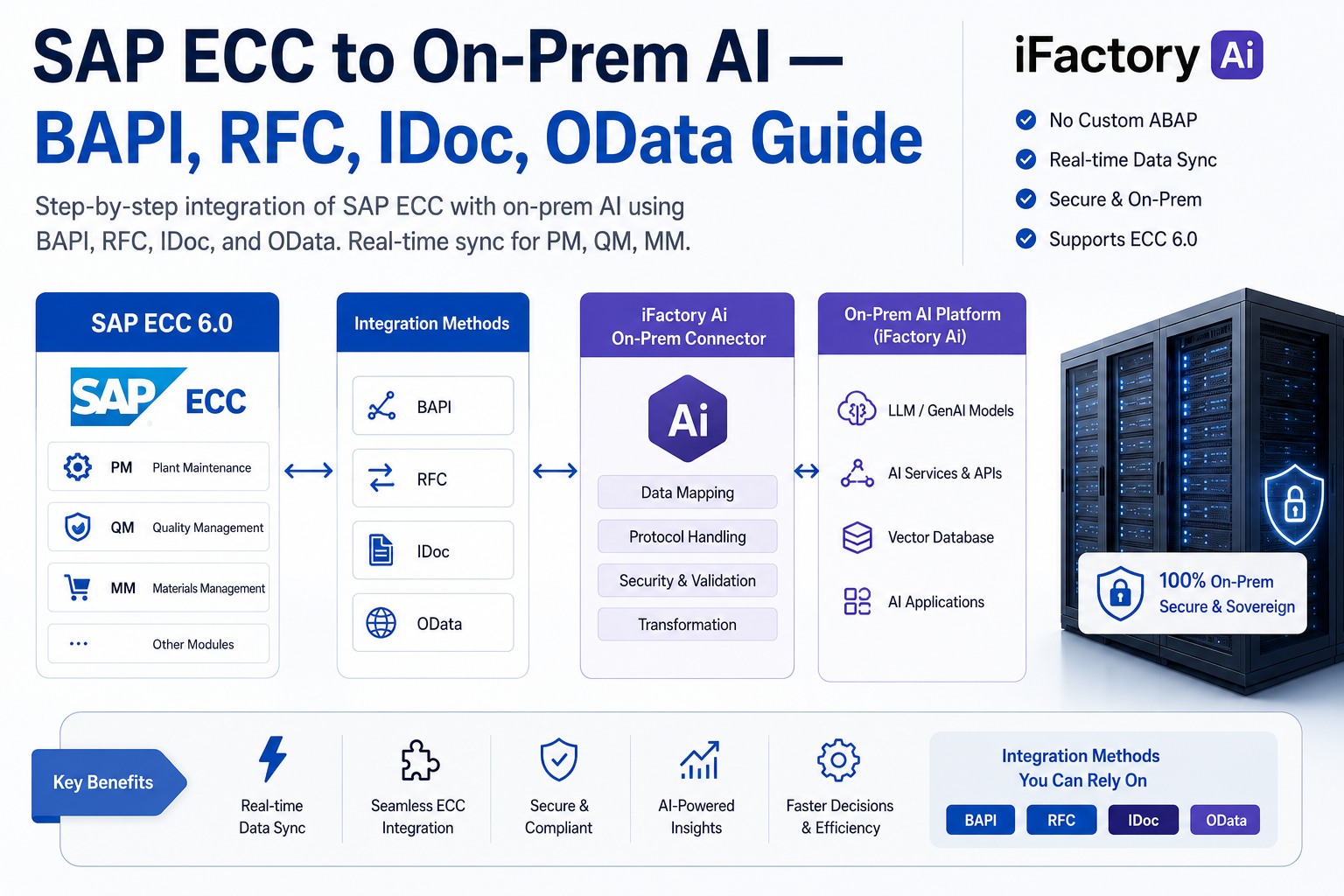
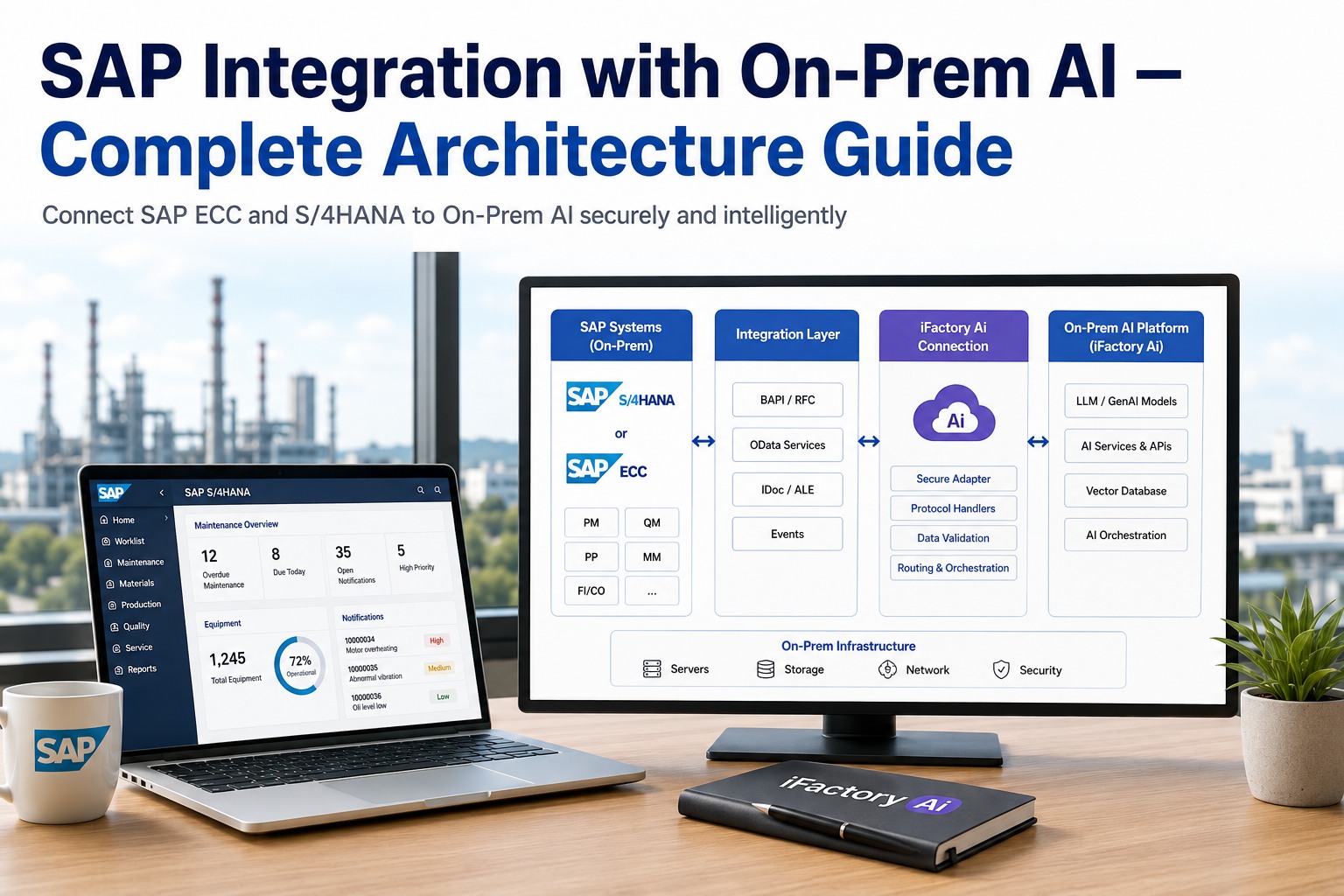
Yes, and this is where most IoT AI projects break down — the AI inference layer produces good predictions, but those predictions never reach the maintenance team or production scheduler because the ERP integration was not scoped. iFactory's pipeline architecture routes AI outputs directly into SAP S/4HANA work order management, MES production scheduling, and historian systems through 50+ pre-built enterprise connectors. Every anomaly detection becomes a structured, tracked, compliant work order in seconds with no manual handoff. The goal is AI that feeds your existing operational workflows — not a new silo that operators have to check separately.
Book a demo to see the SAP integration live.
What does a full on-prem IoT AI pipeline deployment cost and how long does it take?
Hardware costs range from approximately $8,500 for a single RTX PRO 6000 workstation handling a pilot deployment, to $45,000–$90,000 for an L40S cluster supporting plant-wide inference across multiple production lines. Software, integration, and deployment services scale with OT complexity and sensor count. A production pilot covering one line — MQTT ingestion, Kafka streaming, time-series storage, and on-prem inference — typically takes 8 to 14 weeks. A full plant deployment with SAP integration, multi-line coverage, and continuous model retraining runs 16 to 26 weeks. iFactory delivers a costed architecture plan with hardware sizing, integration scope, and timeline in 24 to 48 hours.
Contact our team with your facility details.
Build the Right Pipeline
Get a Costed IoT-to-AI Architecture Plan in 30 Minutes
Bring your sensor inventory, OT protocol stack, and latency requirements. iFactory engineers will model your MQTT ingestion, Kafka streaming, GPU sizing, and PLC feedback architecture — backed by 1,000+ enterprise deployments and 50+ pre-built industrial connectors. No guesswork, no boilerplate pitches.
1,000+
Enterprise AI deployments
50+
OT, MES, ERP connectors
24–48 hr
Architecture sizing turnaround
99.5%
Uptime SLA on deployed AI infra