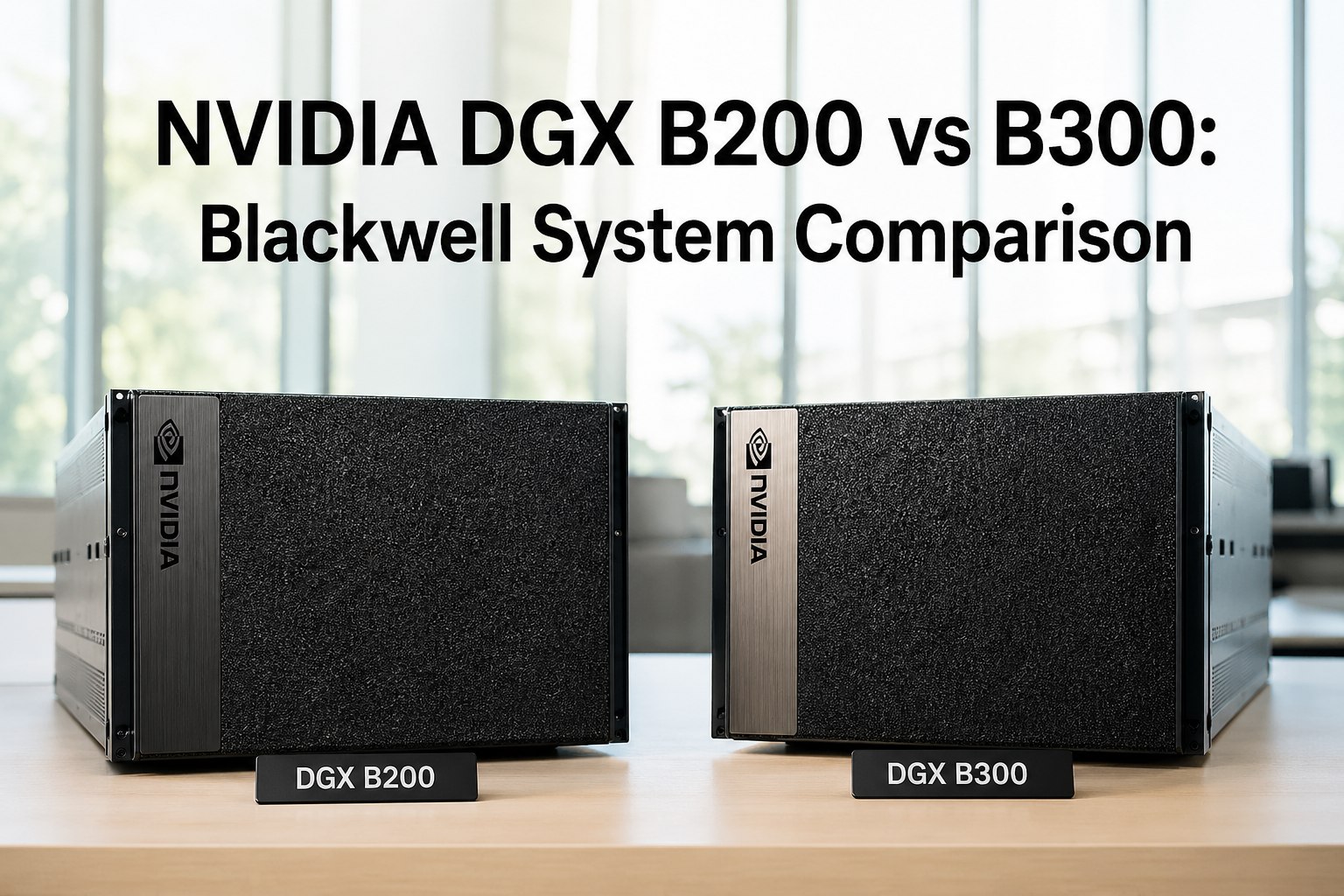
NVIDIA's Blackwell architecture introduced two DGX-class systems — the DGX B200 and the DGX B300 (Blackwell Ultra) — that together define the 2025–2026 on-premise AI infrastructure decision for enterprises, research labs, and regulated industries. With the DGX B300 shipping since January 2026 and B200 orders now in the 8–16 week lead-time window, the question isn't whether to go Blackwell — it's which Blackwell system fits your workload, facility, and budget. This page cuts through the spec sheets and gives you a direct, workload-by-workload comparison so you can walk into a procurement conversation with a clear answer. Not sure where to start? Schedule a free 30-minute architecture call with the iFactory team and we'll map the right system to your stack before you commit.
NVIDIA DGX B200 vs B300 — Architect Your Blackwell AI Infrastructure Strategy
Join the iFactory team to explore NVIDIA DGX B200 and DGX B300 Blackwell systems in depth — from FP4 performance gains and HBM3E memory scaling to NVLink-powered cluster design. Work through real-world AI training and inference scenarios, compare deployment architectures, and walk away with a clear, actionable roadmap for building your enterprise AI infrastructure.
Two Blackwell Systems. One Architecture. Very Different Use Cases.
Both the DGX B200 and DGX B300 are built on NVIDIA's Blackwell architecture — the first with 9 petaFLOPS FP4 and 192 GB HBM3e per GPU, the second (Blackwell Ultra) with 15 petaFLOPS FP4 and 288 GB HBM3e. Understanding where they diverge is the entire decision.
- Ideal for inference at scale + FP64 HPC
- Supports 70B model without quantization
- 3× training vs Hopper H200
- 15× inference vs Hopper H200
- $35K–$40K per GPU (April 2026)
- Designed for 400B+ parameter models in GPU mem
- FP4 as first-class inference citizen
- 50% more memory than B200 per GPU
- Requires mandatory direct liquid cooling
- $300K–$350K full 8-GPU system (2026)
Side-by-Side: Every Number That Matters
The tables below cover the specifications that actually drive workload fit decisions — not every row in the datasheet, but the ones that determine whether your model fits in memory, how fast inference runs, and whether your data center can physically host the system. If a specific row raises a question about your environment, reach out to our support team — we'll give you a plain-language answer based on your facility specs, not a sales deck.
| Specification | DGX B200 | DGX B300 | Edge |
|---|---|---|---|
| Architecture | Blackwell (SM100) | Blackwell Ultra (SM103) | B300 |
| GPUs per system | 8× B200 | 8× B300 | Equal |
| HBM3e per GPU | 192 GB | 288 GB | B300 +50% |
| Total system memory | 1.5 TB | 2.3 TB | B300 |
| Memory bandwidth/GPU | ~8 TB/s | ~8 TB/s | Equal |
| FP4 dense compute | 9 PFLOPS | 15 PFLOPS | B300 +67% |
| FP8 compute | 9 PFLOPS | ~13.5 PFLOPS | B300 |
| FP64 compute | 37 TFLOPS | 1.25 TFLOPS | B200 |
| TDP per GPU | 1,000W | 1,400W | B200 lower |
| System peak power | ~10 kW | ~14 kW | B200 lower |
| NVLink generation | NVLink 5 | NVLink 5 | Equal |
| Liquid cooling | Recommended | Mandatory (DLC) | B200 flexible |
| System price (2026) | ~$280K–$320K | $300K–$350K | B200 lower |
| Availability (Apr 2026) | 8–16 wk lead time | 12–20 wk lead time | B200 faster |
The Memory Gap: Why 288 GB Changes Everything for LLMs
Memory capacity isn't a vanity metric — it determines whether your model fits in GPU VRAM or gets sliced across nodes, whether KV cache stays hot or gets evicted, and whether you need model parallelism tricks at all.
B200 handles 70B in FP16 with ~100 GB headroom for KV cache. B300 offers 200+ GB of headroom, enabling higher batch sizes and longer context without quantization pressure.
DGX B300's 2.3 TB system total makes it the only single-node solution capable of running frontier 400B+ models entirely in GPU memory — no model parallelism required.
Long-context inference (128K+ tokens) lives or dies by KV cache residency. B300's extra 96 GB per GPU keeps more context hot, directly reducing latency on attention-heavy workloads.
FP4 Throughput: Where the B300 Pulls Ahead
The B300's 67% FP4 uplift isn't uniform across all workloads. Here's where it matters — and where B200 holds its own.
Which DGX System Fits Your Workload?
The fastest way to choose: match your primary use case to the decision matrix below. Each row is a real workload scenario with a clear system recommendation.
Facility Requirements: The Hidden Decision Maker
On paper, the B300 is the obvious upgrade. In the physical world, the 1,400W TDP per GPU changes the facility conversation completely. Both systems require significant infrastructure, but the B300 raises the bar on every dimension. Before ordering either system, schedule a facility readiness review with our architects — we'll tell you exactly what needs to change in your data center before hardware arrives.
Power Requirements
B300 draws ~2× what an equivalent H100 DGX system draws. Verify rack PDU capacity before ordering.
Cooling Architecture
B300 DLC captures up to 98% of heat via Supermicro DLC-2. Air cooling cannot dissipate the thermal output.
Networking
Both require 800 Gbps interconnect. Existing 400 Gbps infrastructure requires upgrade before deployment.
Lead Times (Apr 2026)
B200 backlog estimated at 3.6M units through mid-2026. B300 shipping since January 2026 with faster cloud ramp.
The Three Questions That Make the Decision
If yes: DGX B200 is your only Blackwell option. The B300 sacrifices nearly all FP64 capability — from 37 TFLOPS to just 1.25 TFLOPS — to achieve its FP4 headroom. Scientific computing, molecular dynamics, and climate modeling can't tolerate this trade-off.
If yes: DGX B300. Running 400B+ parameter models, maintaining large KV caches for long-context inference, or avoiding aggressive quantization for 70B+ models all hit the B200's memory ceiling. The B300's 288 GB per GPU resolves this without model parallelism overhead.
If no: DGX B200 is the deployable system today. The B300's 1,400W TDP and mandatory direct liquid cooling makes it a facility upgrade project, not just a hardware order. For teams in air-cooled data centers, the B200 delivers 3× training and 15× inference vs Hopper with far less infrastructure burden. Still unsure which path fits your timeline? Book a 30-minute decision call — our team will model both scenarios against your 2026 deployment window at no cost.
Running SAP Joule on Blackwell? iFactory Has Deployed It.
iFactory's on-prem AI platform runs open-weight models fine-tuned for SAP transactional context on Blackwell GPU clusters — delivering sub-50ms latency on plant-floor inference with full data sovereignty. If your data residency requirements rule out hyperscaler-only Joule deployments, this is the architecture that solves it.
Why Enterprise Teams Choose iFactory for Blackwell On-Prem AI
Deploying a DGX B200 or B300 cluster is only half the equation. The other half is making that hardware actually work with your SAP landscape, OT systems, and data sovereignty requirements — and doing it in weeks, not quarters. Talk to our support team to see how iFactory's pre-built SAP connector library and Blackwell cluster architecture can compress your integration timeline from months to weeks.
SAP-Native from the Start
iFactory's platform ships with 50+ pre-built SAP and OT connectors — S/4HANA, ECC, SAP BTP, and plant-floor OT systems. No custom integration work before you see your first inference result.
Sovereign by Design
For regulated industries and organizations with EU data residency requirements, iFactory's on-prem Blackwell architecture keeps all inference, training data, and model weights inside your facility — never touching a hyperscaler endpoint.
4–8 Week Production Cycles
Most enterprise AI deployments stall in integration. iFactory's pre-built connector library and Blackwell cluster architecture compress the typical 12-month integration project to a 4–8 week production rollout.
<50ms Plant-Floor Inference
iFactory runs open-weight models fine-tuned for SAP transactional context on Blackwell GPU clusters, delivering sub-50ms inference latency on plant-floor workloads — the benchmark for real-time OT+AI integration.
Frequently Asked Questions
NVIDIA Blackwell Roadmap: What Comes After B300
Blackwell is a two-year generation. Understanding where NVIDIA is heading helps you size your B200/B300 investment correctly — particularly if you're building for a 3–5 year horizon.
Deploy Blackwell On-Prem with Full SAP Context
iFactory architects have deployed Blackwell GPU clusters running SAP-context AI for regulated manufacturing, healthcare, and global services — with data sovereignty built in from day one. Whether you're sizing a DGX B200 cluster for inference or planning a DGX B300 deployment for 400B+ model serving, we'll model your architecture and tell you exactly what your facility needs before you commit to hardware.