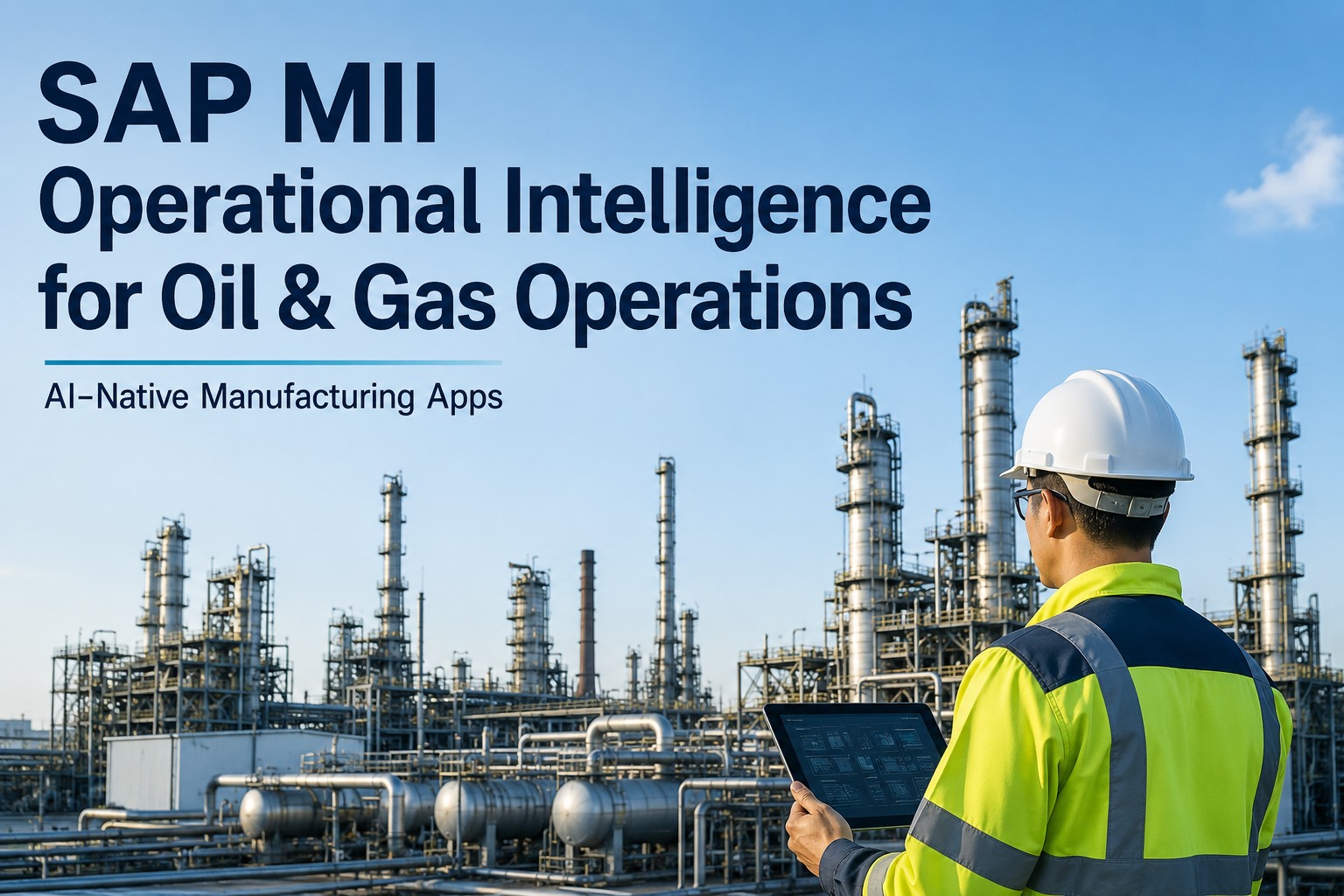
An oil and gas operation runs on three things working together: assets that do not fail, schedules that match reality, and decisions made with enough lead time to matter. Legacy SAP MII gave the industry a generation of dashboards that did one of those jobs adequately, the second one slowly, and the third one rarely. In 2026, that is no longer enough. Approximately 35% of refinery downtime is unplanned — and roughly 70% of those incidents were preventable with better analytics. Maintenance costs eat up to 20% of operational budgets when run reactively. Shell, BP, ExxonMobil, PETRONAS, and ADNOC have already proven that AI-driven operational intelligence delivers 20% maintenance cost reduction and 90–95% predictive accuracy on real upstream and downstream assets. This page walks through exactly how oil and gas operations are migrating from SAP MII operational intelligence to AI-native manufacturing apps — covering scheduling, predictive maintenance, asset monitoring, and refinery efficiency. Book a 30-minute working session to map your specific O&G operational intelligence estate against AI-native equivalents.
35%
Of refinery downtime is unplanned; ~70% of those incidents were preventable with better analytics
20%
Reduction in total maintenance cost per asset reported in major IOC AI deployments
90–95%
Predictive accuracy achieved by AI maintenance systems on rotating equipment
7+
Days of failure forewarning vs. 1–2 days for reactive detection methods
What Oil & Gas Operational Intelligence Actually Has to Cover
"Operational intelligence" sounds like a single capability. In oil and gas, it is at least six different jobs across upstream, midstream, and downstream operations — each with its own data sources, decision cycles, and stakeholders. SAP MII tried to handle them all with the same toolkit; AI-native platforms now handle each with purpose-built models layered on top of a common data spine.
UPSTREAM
Production Optimization
Wellhead performance, artificial lift optimization, ESP failure prediction, choke management, and gas-lift allocation. Decisions cycle hourly to daily.
UPSTREAM
Offshore Asset Monitoring
Compressor and turbine health on platforms and FPSOs. Drilling pump performance. Subsea control system monitoring. High-cost-of-downtime environments.
MIDSTREAM
Pipeline & Terminal Operations
Leak detection, batch tracking through multi-product pipelines, pump-station efficiency, terminal blending and movement scheduling.
DOWNSTREAM
Refinery Production Scheduling
Crude selection, unit utilization optimization, blend recipe execution, turnaround sequencing, product yield optimization across CDU, FCC, hydrocracker, reformer.
DOWNSTREAM
Predictive Maintenance & Reliability
Rotating equipment (pumps, compressors, turbines), fired heaters, heat exchangers, control valves, instrumentation. The single largest AI use case across the industry.
CROSS-CUTTING
HSE & Process Safety Monitoring
Leak detection, hazardous-condition recognition, near-miss pattern analysis, alarm management, and process safety performance indicators. Non-negotiable in a regulated industry.
Why SAP MII Operational Intelligence Hits Its Limits in O&G
SAP MII was a strong fit for oil and gas in the 2010s — a flexible integration layer above PI, OSIsoft, plant historians, and SAP ERP. But in 2026, four specific limitations are pushing IOCs and NOCs toward AI-native replacements.
01
Schedules built on yesterday's reality
MII can display production schedules. It cannot dynamically re-optimize them when crude slate changes, when an unplanned shutdown reroutes feed, or when a fired heater throws an alarm. Schedulers spend their day patching what should be an automated optimization.
02
Asset health logic frozen in time
MII reads vibration, temperature, pressure tags from the historian. It compares them to static thresholds. It cannot fuse those signals with maintenance history, OEM characteristics, and operational context to predict remaining useful life on a specific pump in a specific service.
03
No native scenario simulation
"What happens to the schedule if Unit 220 trips at 03:00?" is a question schedulers answer with experience and spreadsheets. AI-native platforms run the scenario, propagate effects, and surface the best response in seconds — including blend impact, product availability, and customer commitment risk.
04
End-of-life timeline closes the window
SAP MII mainstream maintenance ends December 31, 2027; extended ends December 31, 2030. For a refinery on a 5–7 year turnaround cycle, the migration must align with planned outages, not be forced into emergency cutover during a production crisis.
Schedules That Self-Correct. Assets That Tell You Before They Break. Decisions With Real Lead Time.
AI-native operational intelligence is not a dashboard upgrade. It is a fundamentally different decision-making cycle for refinery and field operations. iFactory's oil and gas migration playbook brings SAP MII estates forward with both lift-and-shift preservation and AI-native modernization, scheduled around your turnaround cycle.
The Manufacturing Scheduling AI Layer: How It Actually Works
Scheduling AI in oil and gas is not "AI does the schedule." It is a hybrid system where deterministic optimization handles hard constraints, machine learning models predict probabilities and conditions, and human schedulers retain final authority. Below is what the layer actually contains and how it connects to the rest of operations.
Layer 4
Decision Support & Recommendation Surface
Schedulers and operations leads see ranked recommendations with explanations — "Pull Unit 220 turnaround forward by 3 days; expected $1.4M reduction in unplanned cost; impact on product slate: +2% diesel, −1% jet." Every recommendation is explainable, traceable, and reversible.
Layer 3
Scenario Simulation & Optimization Engine
Mixed-integer programming, reinforcement learning, and scenario-based simulation evaluate dozens of alternative schedules in seconds. Constraints (tank capacity, customer commitments, regulatory limits) handled deterministically; uncertainty handled probabilistically.
Layer 2
Predictive Models on Live Asset State
Asset health models, remaining-useful-life predictions, anomaly detection, yield forecasts, and energy-consumption models feed live probabilities into the scheduling engine. The schedule reflects what the plant actually looks like right now, not last week's snapshot.
Layer 1
Unified Data Spine
Historian (PI, OSIsoft, IP21), DCS, SCADA, lab LIMS, CMMS, ERP, MES, and SAP MII transactional context all flow through a unified data layer with ALCOA-aligned data integrity. The scheduling AI never operates on a partial view.
The Six Operational Intelligence Use Cases Driving Migrations
Across the IOCs and NOCs we work with, six specific AI use cases dominate the operational intelligence migration agenda. Each one has a documented ROI pattern from public Shell, BP, ExxonMobil, Chevron, PETRONAS, or ADNOC deployments.
USE CASE 01
Predictive Maintenance on Rotating Equipment
The single highest-value AI use case in oil and gas. Centrifugal pumps, compressors, gas turbines, drilling pumps, and fired-heater fans monitored continuously with vibration, temperature, pressure, and flow signatures. Failures predicted 7–14 days ahead.
Asset focus: Compressors, turbines, centrifugal pumps, ESPs, drilling pumps
Public ROI proof: Shell deployment across 24 refineries + 1,200 offshore platforms; 20% reduction in maintenance cost per asset
KPI: MTBF >8,760 hrs target; 85%+ planned maintenance percentage; 90–95% predictive accuracy
USE CASE 02
Refinery Scheduling Optimization
Crude selection, unit utilization, blend recipe execution, and turnaround sequencing optimized as a unified problem instead of separate spreadsheets. Schedules update when reality changes — feedstock shifts, unit trips, demand variations — without losing the underlying optimization logic.
Asset focus: CDU, FCC, hydrocracker, reformer, hydrotreaters, blenders
Public ROI proof: Margin improvements of $0.50–$1.50 per barrel reported across major refiners adopting AI scheduling
KPI: Unit utilization rate, blend giveaway reduction, schedule adherence percentage
USE CASE 03
Pipeline Leak Detection & Integrity
AI-driven leak detection layered over SCADA pressure and flow data identifies anomalies faster than conventional methods. Reduces false alarms that lead to alert fatigue while catching small leaks earlier. Pipeline integrity models predict corrosion progression on monitored sections.
Asset focus: Crude pipelines, product pipelines, gas gathering systems, terminal manifolds
Public ROI proof: Leak detection latency reductions of 40–70% reported in industry case studies vs. traditional methods
KPI: Mean time to detection, false-alarm rate, miles of pipeline under predictive monitoring
USE CASE 04
Energy & Emissions Optimization
Furnace efficiency, steam network balancing, power demand management, and flare gas recovery optimized with AI recommendations. Methane emissions detection and quantification using sensor and video fusion supports regulatory reporting and ESG commitments.
Asset focus: Fired heaters, boilers, steam turbines, flare systems, utilities complex
Public ROI proof: 3–8% energy intensity reduction reported across multi-site IOC programs
KPI: Energy intensity index, CO2/methane intensity per barrel, flare gas recovery rate
USE CASE 05
Turnaround & STO Planning
Shutdown, Turnaround, and Outage (STO) planning is the most expensive scheduling problem in a refinery. AI models work in inspection findings, crew availability, parts lead times, and weather constraints to optimize the path between scope creep and schedule slip.
Asset focus: Major units on 4–7 year turnaround cycles; catalyst changes; vessel inspections
Public ROI proof: Turnaround cost reductions of 5–15% reported across industry leaders applying AI
KPI: Turnaround duration vs. plan, scope-growth percentage, critical-path adherence
USE CASE 06
HSE & Process Safety Pattern Recognition
Alarm flood analysis, near-miss pattern recognition, hazardous-condition detection through sensor + video fusion, and process safety leading indicators. Catches the precursors to incidents before they reach severity thresholds.
Asset focus: DCS alarm systems, operator workstations, perimeter cameras, gas detection networks
Public ROI proof: Alarm-flood reductions of 30–60% reported; process safety event reductions in published case studies
KPI: Tier 1/2 PSE rate, alarm rate per console, near-miss precursor detection
What Each Role Actually Experiences
Operational intelligence only matters when it changes how people work. Here is the practical view from each oil and gas role when SAP MII operational intelligence is replaced with AI-native equivalents.
CONTROL ROOM OPERATOR
Fewer alarms, better-prioritized.
Alarm flooding drops 30–60% as AI suppresses correlated nuisance alarms. Remaining alarms come with context: similar past events, suggested actions, expected progression if no action taken.
RELIABILITY ENGINEER
Forecasts failure 7–14 days ahead, with reasons.
Asset health dashboards show RUL estimates with contributing-factor breakdowns. Engineers schedule interventions during planned downtime instead of fighting emergency repairs at 3 AM.
PRODUCTION SCHEDULER
Schedule self-corrects when reality changes.
Crude shifts, unit trips, demand changes — the scheduling AI re-optimizes in seconds with constraint-aware recommendations. Schedulers move from data entry to strategic decisions.
TURNAROUND MANAGER
Scope creep visible before it becomes a budget event.
Inspection findings, parts lead times, and crew availability feed a live critical-path model. Decisions about scope additions get made with full impact visibility on duration and cost.
HSE LEAD
Process safety precursors surface as leading indicators.
Near-miss patterns, alarm anomalies, and hazardous-condition signals flagged before they become Tier 1 or Tier 2 PSEs. ESG and methane intensity reports generate from real data.
SITE / OPERATIONS LEADER
Unit utilization, margin, energy, safety — live.
One dashboard, every unit, real-time. Compare facilities. Identify best practices. Walk into corporate reviews with answers grounded in today's operating reality, not last week's slide deck.
Shell, BP, ExxonMobil, PETRONAS, and ADNOC Are Already Running This Playbook.
The IOCs and NOCs leading the industry have proven the value of AI-native operational intelligence at scale. The question is no longer whether the architecture works — it is which platform fits your existing SAP MII estate, your turnaround cycle, and your data sovereignty constraints.
The Migration Pattern: Aligned With Your Turnaround Cycle
Oil and gas operations cannot accept big-bang cutovers, and cannot easily reschedule turnarounds. Migrations have to align with the natural rhythm of refinery operations. Below is the pattern that works in real plants.
MONTHS 1–2
Estate Discovery & Turnaround Alignment
Catalog every MII operational intelligence artifact — dashboards, BLS transactions, KPI calculations, alert rules, historian connections. Tag each for preserve, transform, or retire. Align migration phases with your existing STO schedule so cutovers land in planned outage windows.
MONTHS 2–4
Data Spine Build & Asset Onboarding
Connect PI, OSIsoft, IP21, AspenTech IP, and other historians to the unified data layer. Onboard high-criticality assets first — major compressors, fired heaters, key process units. Validate data integrity against your existing systems.
MONTHS 4–8
Quick-Win Use Cases on Pilot Unit
Deploy predictive maintenance on rotating equipment in a pilot area. Run alongside existing SAP MII analytics for at least one full operating cycle. Compare predictions, refine models, gain operator confidence. Document the first measurable ROI.
MONTHS 8–14
Scheduling AI & Cross-Unit Optimization
Activate scheduling AI on the units the operator most wants to optimize — typically downstream-most CDU/FCC complex first. Layer scenario simulation. Train scheduling team on the recommendation surface. Roll out to additional units in waves.
MONTHS 14–24
Site-by-Site Rollout & MII Retirement
Roll out to remaining sites in waves coordinated with each site's turnaround cycle. Each site runs MII and new platform in parallel through at least one full operating quarter before MII components are retired. Update audit and cyber insurance posture.
SAP MII vs. AI-Native Operational Intelligence: O&G Comparison
The side-by-side, framed for oil and gas operations specifically. Both have legitimate strengths; the gap on AI scheduling, multivariate analytics, and asset prediction is real and widening every quarter.
Frequently Asked Questions
Will AI-native operational intelligence work with our existing PI/OSIsoft/IP21 historians?
Yes. The standard historians used in oil and gas — PI, OSIsoft, IP21, AspenTech IP, Honeywell PHD, Yokogawa Exaquantum — all connect via the new platform's native connector framework. Tag mappings, compression settings, and sample rates migrate from existing MII configurations.
Book a Demo for your specific historian patterns.
How does scheduling AI handle hard constraints like tank limits or product specifications?
Scheduling AI is a hybrid system. Mixed-integer programming handles hard constraints — tank capacities, product specifications, customer commitments, regulatory limits — deterministically. Machine learning handles probabilistic elements — equipment availability, demand fluctuation, weather risk. The combination respects constraints while optimizing within them.
Talk to Support for constraint modeling examples.
Do AI predictions work on offshore platforms with intermittent connectivity?
Yes. Edge computing handles AI inference locally on the platform or FPSO, with bidirectional sync to onshore systems when connectivity is available. Failure predictions, alarm management, and operator-facing recommendations all work offline. Aggregate analytics happen onshore when data is synced.
Book a Demo for offshore architecture patterns.
How is this aligned with our turnaround cycle?
Migration phases are scheduled around your existing STO calendar. Pilot deployments use planned outages for safe cutover. Site-by-site rollout aligns each site's transition with its own turnaround window. The migration never forces unscheduled downtime — the operating cycle is the master schedule, the IT migration adapts.
Talk to Support about turnaround-aligned planning.
What about cybersecurity for OT environments and IEC 62443 compliance?
The platform is designed for OT-grade segmentation, IEC 62443 zones-and-conduits architecture, read-only historian access, and edge-deployable inference that does not require continuous cloud connectivity. On-prem and air-gapped deployments are supported. Cyber posture aligns with TSA pipeline security directives and NERC CIP where applicable.
Book a Demo for security architecture details.
What is the smallest first step we can take this quarter?
A 4–6 week pre-migration assessment of one high-value asset group — typically rotating equipment in a critical unit. Output: inventoried MII artifacts, identified quick-win predictive maintenance use case, ROI estimate based on Shell/BP/PETRONAS benchmark patterns, and a phased migration plan aligned with your turnaround calendar.
Talk to Support to scope it.
Refinery Schedules That Self-Correct. Assets That Predict Their Own Failures. Operations Intelligence Decades Ahead of MII.
Upstream, midstream, and downstream operations all benefit from the same architectural shift — from static dashboards to AI-native operational intelligence. iFactory delivers the platform, the migration playbook, and the integration tooling engineered for oil and gas-scale operations, with deployment phases aligned to your turnaround cycle.
7–14 days of failure forewarning on rotating equipment
Dynamic scheduling AI re-optimizing in seconds
Alarm flood reductions of 30–60%
IEC 62443-aligned OT cybersecurity posture
Turnaround-aligned migration phasing