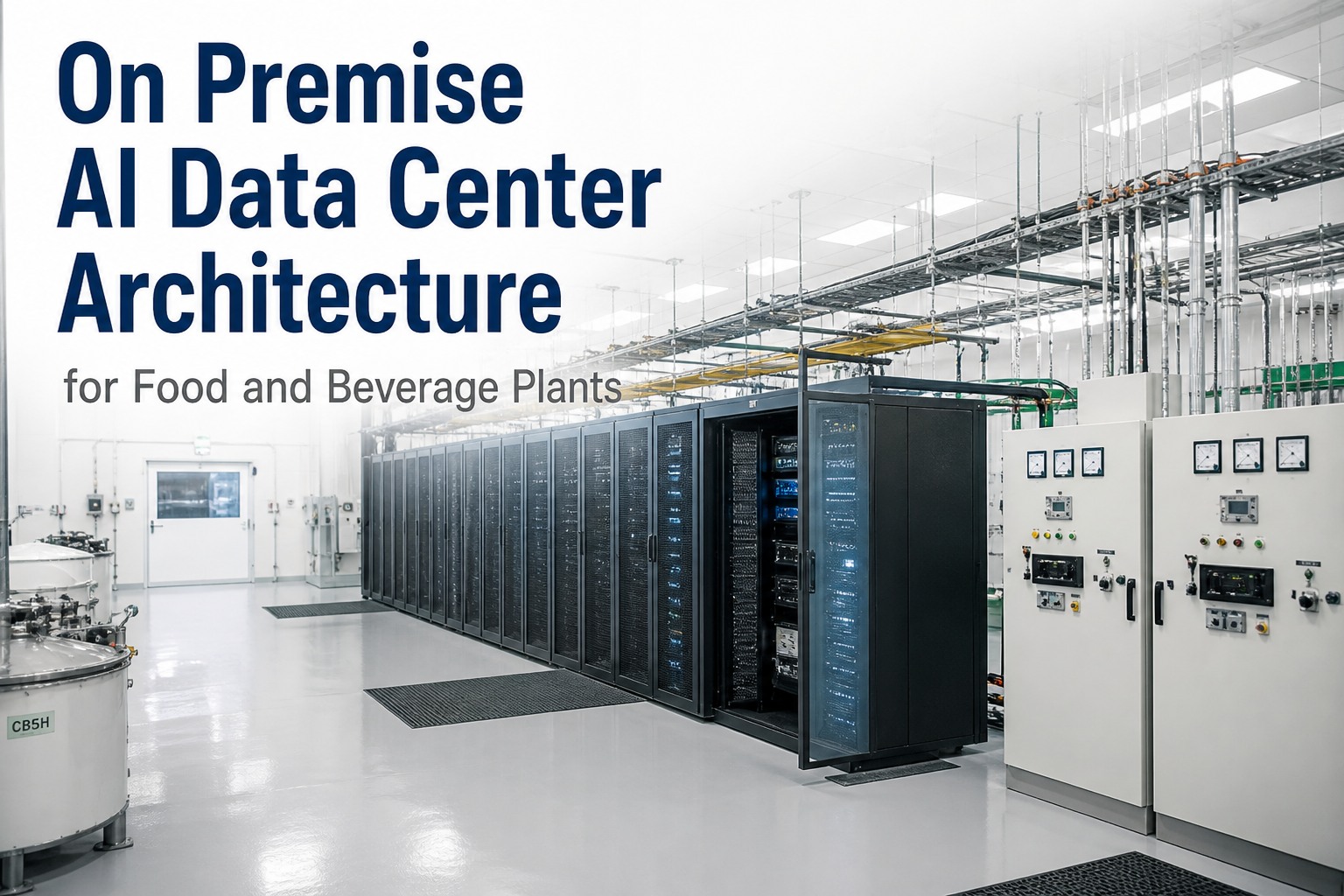
Coca-Cola's formula. Heinz's tomato process curve. KFC's 11 herbs. The most valuable IP in food and beverage isn't a patent — it's a recipe. And it's stored as numbers, parameters, and sequences that flow through your plant's PLCs every shift. Sending that to a public cloud AI service was always uncomfortable; with FSMA 204 traceability requirements taking effect July 2028 and EU sovereignty rules already enforced, it's now a compliance liability. iFactory ships an on-premise AI data center built specifically for food and beverage plants — washdown-rated where it has to be, cold-chain-aware, FSMA 204 ready, with a sovereign LLM hosting your recipe context inside your own fence. Power and internet from you. Everything else from us.
On-Premise AI Data Center for
Food & Beverage Plants
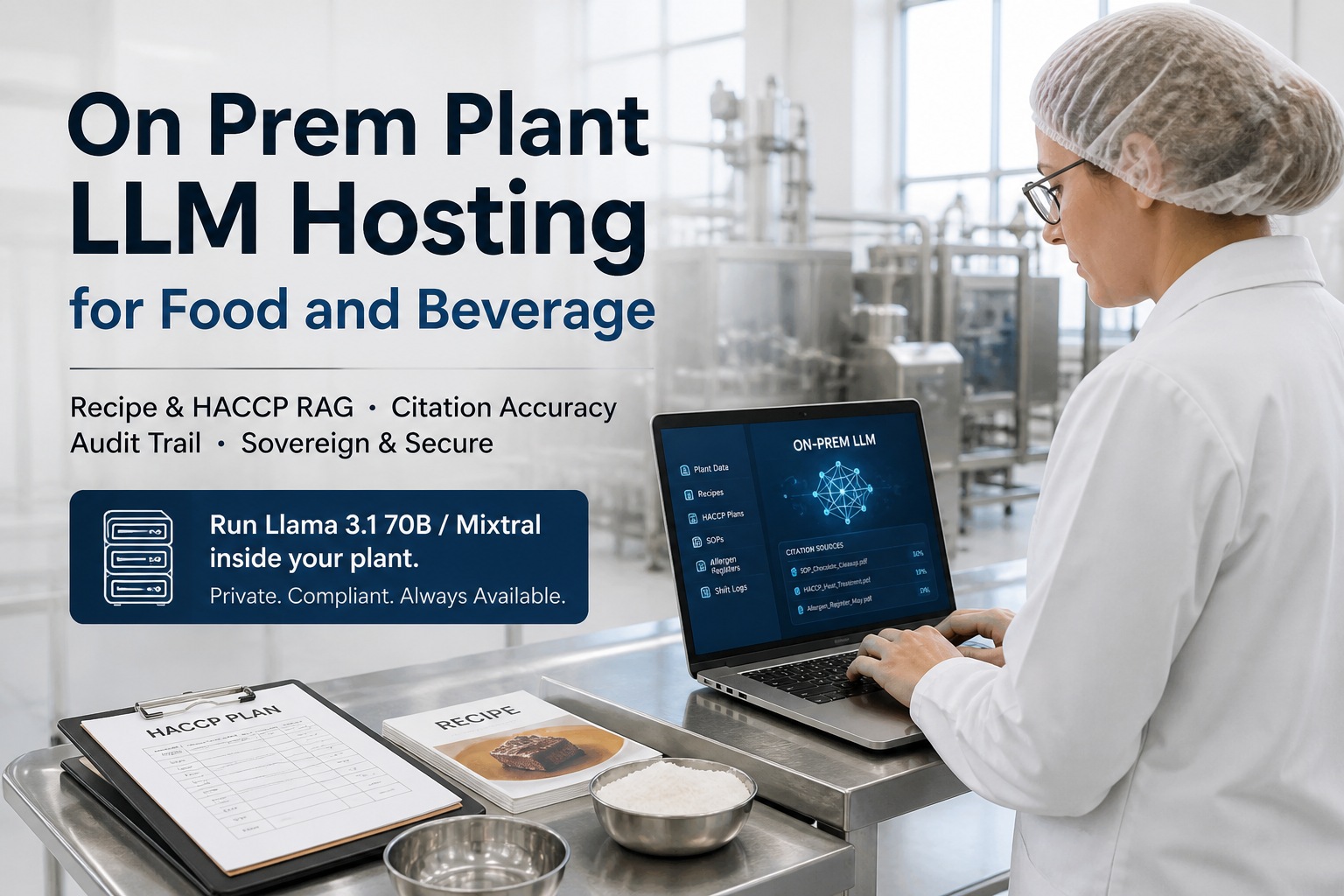
A pre-built, pre-configured AI server engineered for F&B plant realities — IP69K washdown-rated edge enclosures, food-safe cabling, hygienic-zone segmentation, and a central LLM node that holds your recipes, batch genealogy, and FSMA 204 traceability data. No cloud. No subscription. No recipe ever leaves your plant.
Four Things That Don't Exist in a Discrete Plant
F&B plants share most of the AI use cases of discrete manufacturing — vision QC, predictive maintenance, scheduling — but the operational and regulatory environment is fundamentally different. Generic on-prem AI architectures break against these realities. Book a 30-min briefing to walk through your specific plant.
Caustic detergents, 80°C water, high-pressure spray — every shift, sometimes every product changeover. Equipment in food zones must survive what would destroy discrete-grade enclosures within a year.
The formula, the process curve, the ingredient blend ratio — your most valuable IP is stored as PLC parameters and HMI setpoints. Cloud AI APIs that "anonymize" data still process it. That's not a tradeoff F&B can make.
FSMA 204 mandates 24-hour traceability response. Lot-coded Critical Tracking Events. 24-month retention. The plant DC has to hold that data, query it fast, and never lose a record. Compliance date: July 20, 2028.
CIP sequencing between allergen-containing and allergen-free runs. Refrigeration that can't drift two degrees without losing a batch. AI must reason across both — with audit trails to match.
What's Actually Inside Your Recipes
"Recipe" sounds like a single ingredient list. In reality, it's five layers of operational IP — each one accumulated over years, each one capable of recreating your competitive edge if it leaks. The on-prem DC keeps every layer encrypted, audit-logged, and inside your fence.
Ingredient list, ratios, source specifications. The headline secret. Often the only layer competitors think exists.
Cook times, temperature ramps, mix shears, ferment durations, hold times. The "how" that turns ingredients into product.
Filler RPM, heat-exchanger pressure, homogenizer settings, packaging tension. The PLC parameters that operators tune over years.
Clean-out cycles, sequencing rules, sanitization chemistry, allergen segregation programs. Operational hygiene IP.
Spec windows, micro test thresholds, sensory panels, release rules. What separates a great brand from a recalled one.
Why a public-cloud AI vendor can't hold this: their terms allow them to derive value from inputs, even when "anonymized." Your formula curve becomes statistical signal in their next model. The on-prem DC is the only architecture where that vector simply doesn't exist. Talk to our F&B team about recipe-vault hardening.
A Plant Cross-Section · Where the AI Lives
An F&B plant has zones a discrete plant doesn't — and each zone has its own IP rating, materials, and cabling rules. The on-prem DC reaches into all four through certified cabling and gland kits. Here's the layout from the wettest zone to the driest.
Fillers, ovens, mixers, conveyors with direct food contact. Daily caustic + 80°C washdown. AI hardware: stainless steel cabinets, sealed cable glands, food-safe IP69K Jetson edge boxes.
Case packers, labelers, palletizers — adjacent to food contact, splashed but not direct. AI hardware: IP66 rated edge boxes, stainless wall mounts, vision cameras with food-grade housings.
Refrigeration plant, compressors, boilers, CIP skids. Indoor industrial, no direct washdown. AI hardware: standard IP54 industrial enclosures with PdM sensors on every motor.
Climate-controlled server room. The GB300 + H200 racks live here. Rear-door cooling, redundant UPS, fire suppression, biometric access. Connects out to all three production zones via certified conduits.
Where the AI Sits in an F&B Network
F&B layers a hygienic-zone overlay on top of standard Purdue. The plant DC sits at L3, but its conduits down to L1 must respect both cyber boundaries (IEC 62443) and physical food-safety boundaries. We design both into the architecture from rack 1.
Built In, Not Bolted On
FSMA 204 doesn't just want records. It wants queryable, lot-coded, electronic records that hit the FDA inbox within 24 hours of request. That's an architectural problem more than a paperwork one. The plant DC handles it natively.
Receiving · Transformation · Creation · Shipping events captured at the line, automatically tagged with lot codes, timestamps, locations.
Each CTE auto-bound to Key Data Elements: TLC, GTIN, quantities, source, destination — pulled from PLCs, MES, scales, and OCR.
24-month retention in the plant DC's traceability ledger. Encrypted, immutable, indexed for sub-second lot-genealogy queries.
One operator request: "trace lot X." Plant LLM queries the ledger, returns full genealogy in FDA's required format. Sub-24-hr SLA — usually sub-2-min.
Three Tiers · One Sovereign F&B Stack
No single tier runs a food plant. Vision at the line needs sub-10 ms in a washdown environment. Multi-line inference needs efficiency. Recipe-aware LLM and retraining need horsepower. iFactory composes all three.
- Vision QC: fill levels, label OCR, foreign objects
- Sub-10 ms inference at line speed
- Stainless steel housings · sealed glands
- Survives daily caustic + 80°C washdown
- Multi-line inference + cold-chain monitoring
- FSMA 204 traceability ledger
- Time-series + vector DB plant memory
- Redundant power · UPS · A/B feed
- Plant copilot with recipe context
- Full vision & PdM model retraining
- RAG over historian + MES + ERP + lab
- Confidential compute for formula data
Cloud · Hybrid · Sovereign On-Prem (F&B Lens)
F&B raises the bar on every dimension — recipe protection, FSMA 204 response, washdown reach, allergen sequencing. Most cloud-first AI architectures weren't built for any of it.
| Capability | Public Cloud AI | Hybrid | iFactory Sovereign On-Prem |
|---|---|---|---|
| Recipe data location | Vendor cloud | Mixed / unclear | Inside plant fence |
| Vendor model training on your data | Often allowed | Possibly | Never |
| Edge enclosures rated for washdown | N/A | You source | IP69K shipped |
| FSMA 204 traceability ledger | External SaaS | Manual integration | Built into plant DC |
| 24-hr FDA query response | Vendor SLA | Mixed | Sub-2-min typical |
| Cold-chain inference latency | 50–250 ms | 20–80 ms | < 10 ms |
| Works during WAN outage | No | Partial | Yes — fully autonomous |
| Commercial model | Per-call subscription | Mixed | One-time CapEx |
| Allergen sequencing AI | Generic logic | Add-on | Native to recipe scheduler |
Built for the Wet Side and the Server Room
IP69K Jetson edge cabinets, food-safe cabling, 304/316 stainless wall mounts, sealed gland kits. We ship the wet-side AI hardware most vendors leave you to source.
Five-layer recipe IP isolated, encrypted, audit-logged. The LLM hosts recipe context locally — never uploads to a vendor cloud, never trains a third-party model.
Traceability ledger pre-installed. Lot codes, CTEs, KDEs auto-captured. 24-hour FDA query SLA built into the platform — not bolted on as a separate SaaS.
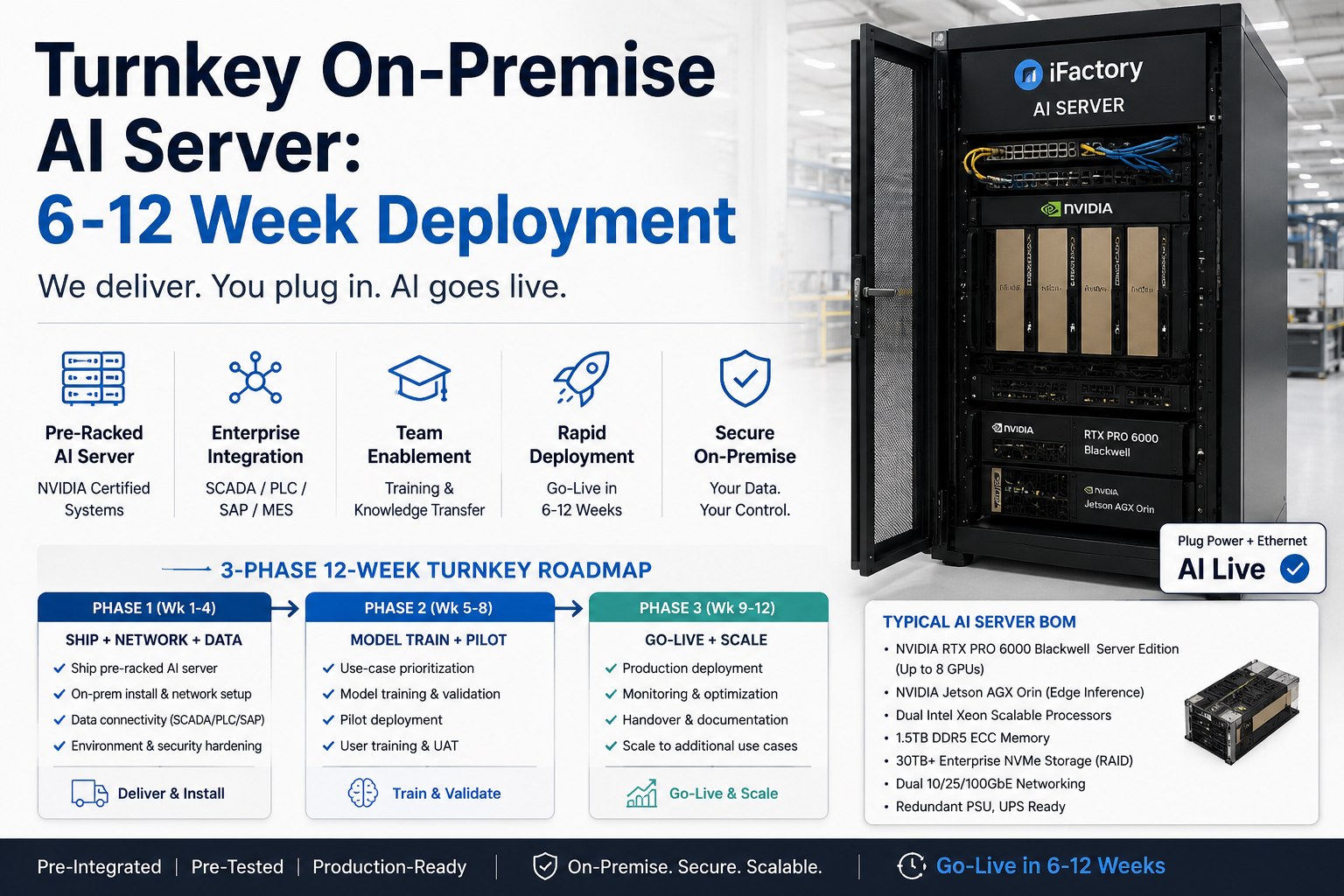
Server hardware, cabling, switching, PLC/SCADA integration, vision camera mounting in food zones, plant copilot tuning to your recipes — our engineers globally, in 6–12 weeks.
What F&B Plant Heads Ask Before Issuing a PO
Yes — provided it's IP69K rated with sealed glands and stainless housings. We ship Jetson edge boxes purpose-built for food zones, certified for high-pressure caustic spray at 80°C. Standard IP65/IP66 industrial gear typically fails within 12 months in F&B; IP69K is the right spec.
Recipe layers (formula, process curves, setpoints, CIP, release criteria) are stored in an encrypted compartment inside the plant DC. The LLM accesses them via retrieval-augmented generation locally — the recipes never leave the GB300 node, never cross a network boundary, and access is audit-logged per query.
Yes. The deadline moved; the requirements didn't. Implementation is a 12–18 month effort for most plants because of supply-chain coordination — starting in 2026 is the realistic path. The plant DC's traceability ledger gives you the data backbone now; supplier coordination and KDE alignment runs in parallel. Get a quote and we'll include FSMA 204 in the proposal.
Yes. We integrate with Wonderware, Rockwell PlantPAx, Siemens Braumat, ProLeit, and most batch managers via OPC-UA, ISA-88-aligned interfaces, and direct connectors. The plant DC reads recipes from your existing system; we don't replace it. Talk to support with your batch stack list and we'll confirm coverage.
Get a Quote. Or Join the Webinar.
Send your line list, batch manager, and zones requiring washdown coverage. We come back with a fixed-price proposal — server, IP69K edge gear, FSMA 204 ledger, deployment, training — within 5 business days.