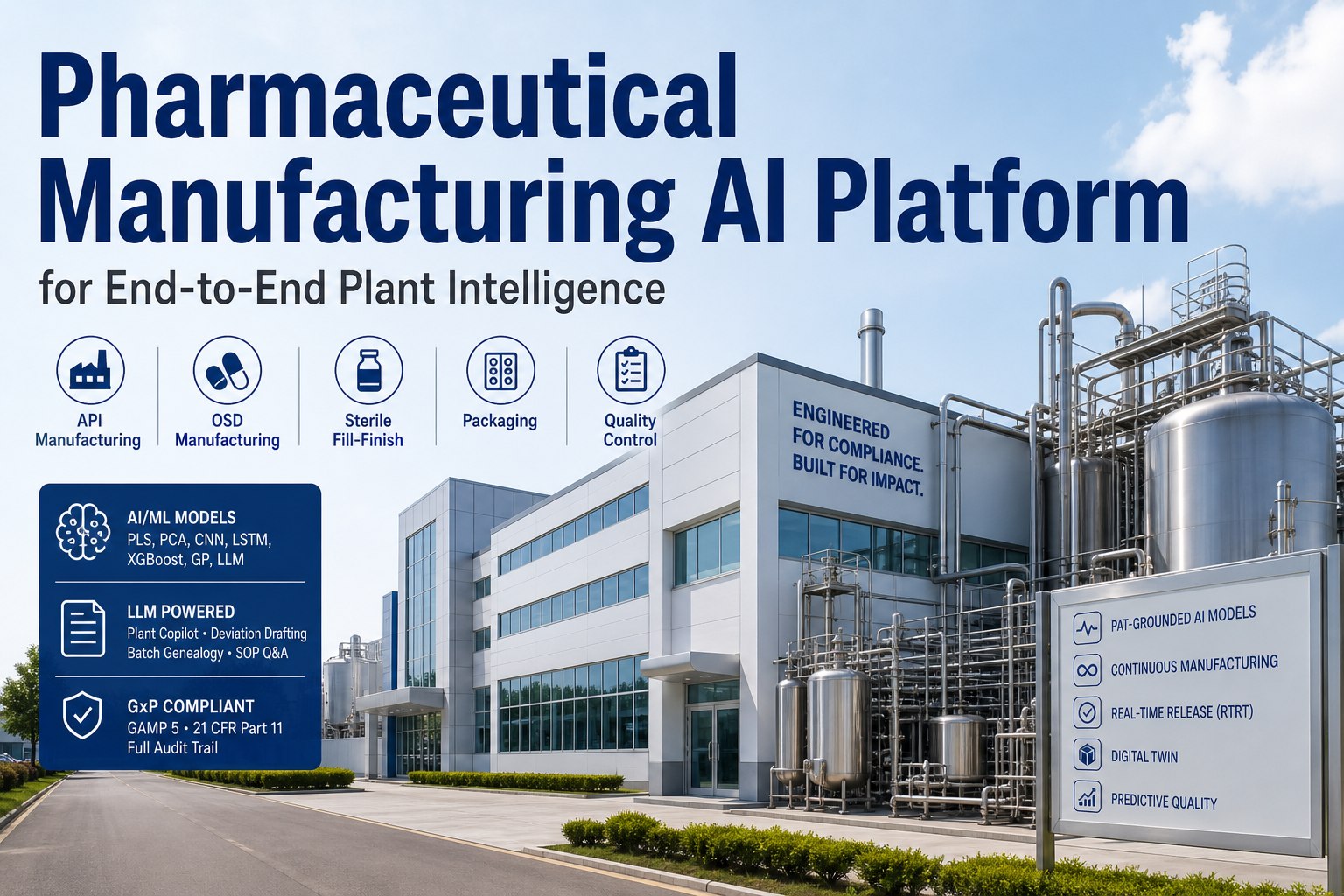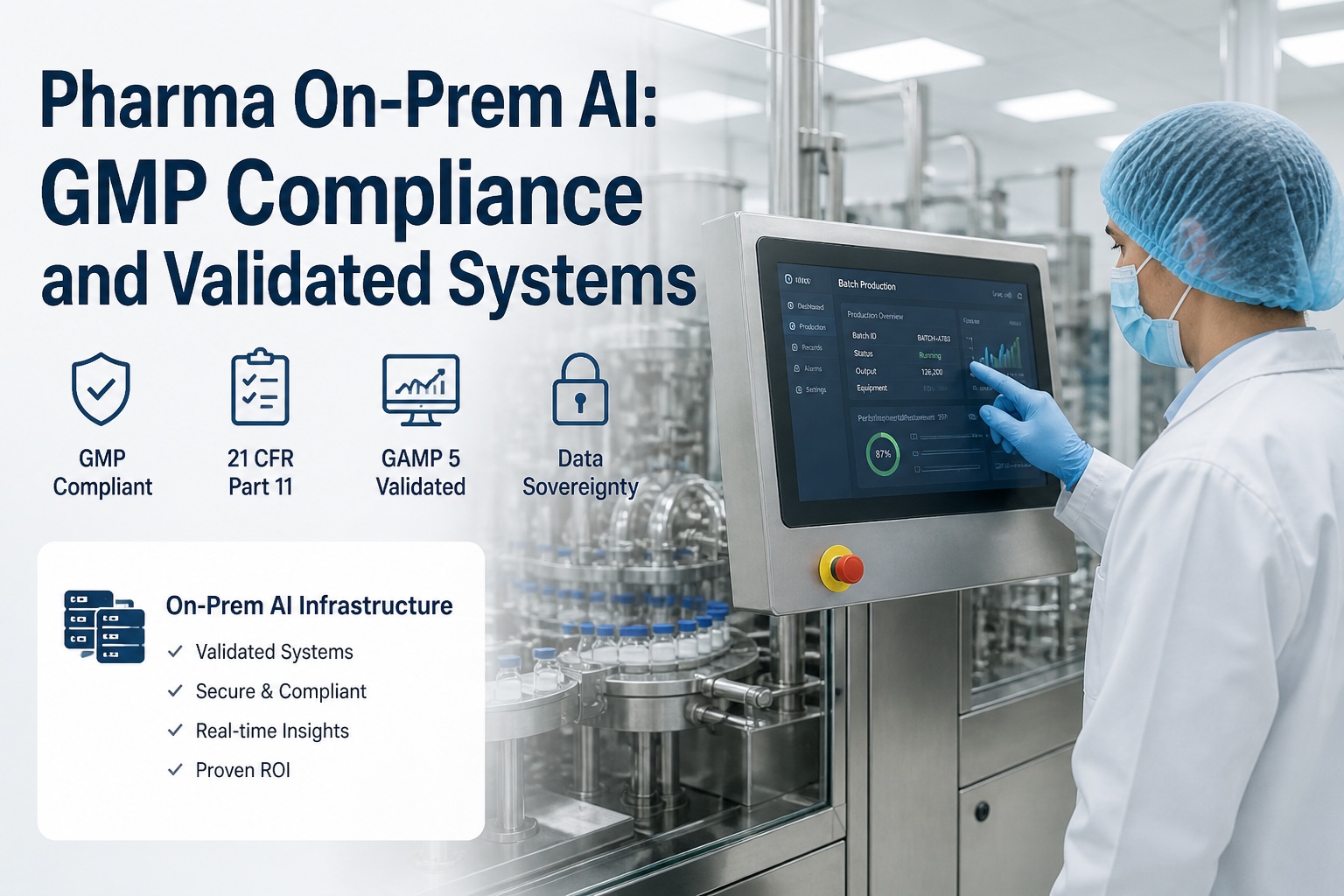
Pharmaceutical manufacturers are under more regulatory pressure than ever — and cloud-first AI architectures simply weren't built to survive an FDA 483 or an EMA Annex 11 audit. For pharma IT leaders, quality heads, and digital transformation directors, on-premises AI is not a legacy choice — it's the only architecture that satisfies 21 CFR Part 11, GAMP 5, and the incoming EU Annex 22 framework simultaneously, while keeping batch records, process data, and model weights inside your validated environment. This guide maps the exact compliance requirements, deployment patterns, and real-world ROI numbers that make on-prem AI the defensible path for GMP-regulated manufacturing in 2026.
Validate Your Pharma AI Strategy On-Site
Join the iFactory GMP-validated on-prem AI, Joule deployment for regulated manufacturing, and hybrid SAP+AI rollout — backed by 1000+ enterprise deployments. Sit down with our architects, model your pharma scenario in real time, and walk away with a concrete compliance plan.
Why Cloud AI Fails the GMP Audit — Every Time
Cloud AI platforms promise speed. But the moment your auditor asks "where is the model weights stored?" or "show me the audit trail for this inference," the cloud architecture breaks down. On-prem AI doesn't just solve a compliance checkbox — it changes the entire risk posture of your AI deployment.
- Data leaves the facility — violates data residency mandates
- Model versioning outside your quality system
- Vendor-controlled audit trails — not 21 CFR Part 11 compliant
- Third-party training on your batch data by default
- Unpredictable latency on time-critical line decisions
- Difficult to validate under GAMP 5 Category 5
- All data, models & inferences stay inside your validated environment
- Model versioning inside your QMS with IQ/OQ/PQ documentation
- Full audit trail under your 21 CFR Part 11 controls
- No third-party model training on proprietary batch data
- <50ms inference latency — plant floor ready
- GAMP 5 lifecycle documentation included out of the box
The Three Frameworks That Govern Your AI Deployment
Three overlapping regulatory frameworks now govern AI in pharma manufacturing. Understanding how they interact — and where they demand on-prem control — is the first step to a defensible deployment. Talk to our compliance support team to map these frameworks against your current stack.
21 CFR Part 11
FDA · USAThe FDA's electronic records and signatures regulation requires that any AI inference generating a GMP record must produce a tamper-evident, time-stamped audit trail — managed under your own controlled system. On-prem AI keeps all inference logs, model weights, and electronic signatures within your validated infrastructure and under your SOPs.
GAMP 5 (2nd Edition)
ISPE · GlobalThe GAMP 5 Second Edition (2022) introduced AI/ML appendices requiring a full validation lifecycle — including training data governance, algorithm version control, and operational qualification. The upcoming Appendix D11 formalizes this into an AI-specific validation plan that maps directly to on-prem deployment patterns.
EMA Annex 11 + Annex 22
EMA · EU · Final 2026The EU's July 2025 draft expanded Annex 11 from 5 to 19 pages and introduced brand-new Annex 22 specifically for AI/ML in GMP environments — mandating AI model selection, training, validation, and continuous monitoring procedures. Final versions are expected in 2026. Annex 22 requires explainability and an AI oversight committee, both achievable only with an on-prem deployment you fully control.
Where On-Prem AI Runs on the Plant Floor Today
These aren't pilot programs. These are production-grade AI applications running inside validated GMP environments — generating ROI that finance teams can measure and quality heads can defend to regulators.
Visual Quality Control
Computer vision models detect particulates, coating defects, and fill-level deviations in real time on tablet and capsule lines — replacing manual AQL sampling that misses <2mm defects.
Predictive Maintenance
ML models trained on vibration, temperature, and pressure sensor data predict equipment failure 48–72 hours in advance — eliminating unplanned downtime on critical filling and packaging lines.
Process Analytical Technology
AI-connected PAT instruments analyze NIR, Raman, and particle size data in-line — enabling real-time release decisions without off-line lab sampling delays.
Batch Record Automation
LLMs running entirely on-prem auto-populate eBMR fields from SCADA/DCS event logs, flag critical deviations, and route for e-signature — reducing batch review time by up to 60%.
Digital Twin Process Simulation
Virtual models of fermentation, granulation, and lyophilization processes run in real time on local GPU clusters — identifying golden batches before production commits resources.
Deviation & CAPA Intelligence
On-prem NLP models classify incoming deviations, suggest root-cause categories from historical records, and pre-populate CAPA workflows — cutting investigation cycle time in half.
What the Numbers Look Like on a Real Line
Pharma AI ROI is no longer theoretical. The data below comes from real industry deployments. Schedule a 30-minute session and we'll model these numbers against your specific line and production volume.
Installation & IQ
GPU cluster deployed in your data center or server room. Installation Qualification (IQ) documentation completed. Network segmentation from QMS and SCADA established.
OQ + Model Training
Operational Qualification on sensor integrations. Model trained on your historical batch data — entirely on-prem. No proprietary data leaves the facility at any point.
PQ + Go-Live
Performance Qualification with live production data. QA sign-off. System live on line — predictive maintenance alerts active, vision QC replacing sampling.
Scale + Second Use Case
Extend to second production line or second use case (e.g., batch record automation). Roche-style ROI curve begins: ~180% ROI by month 24 documented in comparable deployments.
Continuous Improvement Loop
Model retraining on new batch data within QMS change-control. Annex 22 AI oversight committee reviews quarterly. Audit-ready at any point — every inference logged, every model version traceable.
The On-Prem AI Stack for GMP — Layer by Layer
iFactory's validated on-prem AI architecture is purpose-built for regulated manufacturing environments. Every layer is designed for a 21 CFR Part 11 audit, not bolted on after the fact. Want to see how it maps to your current infrastructure? Review our full on-prem AI architecture page or speak with our team.
Data Ingestion & Segregation
OPC-UA / OPC-DA connections from SCADA, DCS, and MES. Air-gapped from internet. Raw sensor data stored locally with ALCOA+ data integrity controls — attributable, legible, contemporaneous, original, accurate.
On-Prem GPU Compute
NVIDIA Blackwell or A-series GPU clusters hosted in your server room or on-site data center. Sub-50ms inference latency for real-time line decisions. No hyperscaler. No egress.
Validated Model Registry
All model versions stored in a GxP-compliant model registry with change-control integration. Every model training run logged with training data provenance — auditable back to source batch records.
21 CFR Part 11 Audit Trail Engine
Every inference, every model decision, every override — written to a tamper-evident audit log with timestamp, user identity, and e-signature linkage. Designed for FDA inspector review on day one.
QMS Integration & GAMP 5 Documentation
Bi-directional integration with your eQMS for deviation triggers, CAPA workflows, and batch record population. GAMP 5 IQ/OQ/PQ documentation delivered as part of every deployment — not an add-on.
Unless we open the box of specific AI implementation within an organization, it's in superposition of either transformative success or failure. The difference in 2026 is whether your AI architecture can survive regulatory scrutiny — not just a pilot review.
Is Your AI Architecture Audit-Ready? A 6-Point Check
Before your next regulatory inspection, run this checklist against your current AI deployment. If you can't answer "yes" to all six, contact our pharma compliance support team — we'll identify the gaps and map a remediation path.
Data Residency
Can you confirm that no GMP batch data, process parameters, or patient-identifiable data ever leaves your validated environment — not even for model training?
Audit Trail Completeness
Does every AI inference that influences a GMP record produce a 21 CFR Part 11-compliant audit trail with timestamp, user ID, and e-signature linkage?
Model Version Control
Is every model version stored in a GxP-compliant registry with change-control documentation, and can you reconstruct the exact model state at any historical batch?
GAMP 5 Lifecycle Documentation
Do you have IQ, OQ, and PQ documentation for your AI system, including training data specifications and algorithm validation test cases?
Annex 22 Explainability
For any AI decision that influences a batch disposition or critical process parameter, can you produce a model-level explanation that satisfies a QP's review?
Continuous Monitoring SOP
Do you have a documented SOP for monitoring model drift, performance degradation, and triggering revalidation — with an assigned AI oversight committee?
Why Pharma Teams Choose iFactory Over Generic AI Vendors
Most AI vendors ask you to adapt your validated environment to their platform. iFactory works the other way around — our on-prem AI is built to fit inside your existing GMP infrastructure, your QMS, and your audit obligations from day one.
GMP Validation Package Included
IQ, OQ, and PQ documentation delivered as part of every deployment — not sold as an add-on. Our validation engineers write protocol documentation aligned to your QMS structure, GAMP 5 Category 5, and 21 CFR Part 11 from the very first sprint.
Zero Data Egress — Guaranteed
Your batch data, process parameters, and model weights never leave your facility. Not for training. Not for monitoring. Not for updates. iFactory manages everything remotely through a secured tunnel — data stays behind your firewall, always.
50+ SAP & OT Connectors Pre-Built
Integration with SAP S/4HANA, ECC, MES, and OT systems (SCADA, DCS, OPC-UA) ships pre-built — not custom-developed. Your AI is live on the line in weeks, not months of integration work. No middleware rebuild required.
<50ms Inference on Plant Floor
On-prem GPU clusters deliver sub-50ms inference latency — fast enough for real-time line decisions on filling, inspection, and packaging without introducing process deviation risk from delayed AI responses.
Pharma-Dedicated Deployment Team
Your iFactory deployment team includes engineers with pharma manufacturing backgrounds — not generalist AI consultants. They understand GMP deviations, batch release, and QP sign-off requirements because they've sat in validation meetings before.
Annex 22 Ready — Now, Not 2027
iFactory's architecture already satisfies draft EMA Annex 22 requirements — AI oversight committee support, model explainability outputs, and continuous monitoring SOPs — before the regulation finalizes. No scramble when it becomes law.
Questions Pharma IT & Quality Teams Ask Us First
Your Next FDA Inspection Should Be the Last Time You Worry About AI Compliance
iFactory deploys on-prem AI that is audit-ready from day one — fully validated, fully documented, and fully inside your four walls. Bring your line configuration, your compliance requirements, and your production schedule. We'll model the deployment in real time.