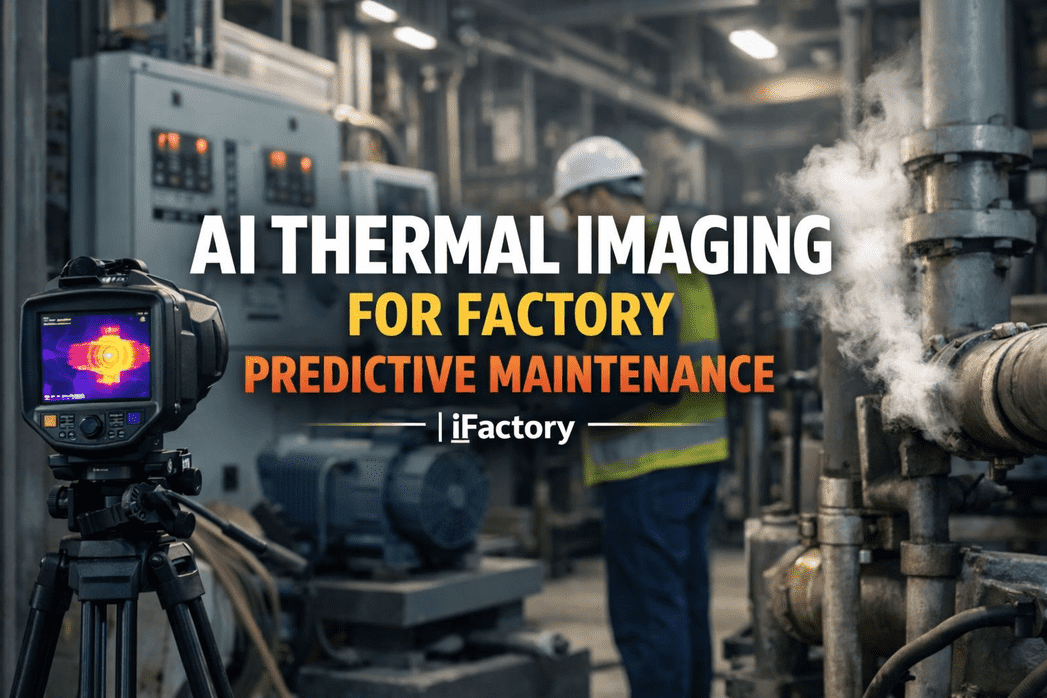
The average industrial facility experiences electrical failures causing 25-30% of all unplanned downtime — costing 4-6 times more than planned maintenance — yet most factories still rely on quarterly manual IR gun surveys that capture a single thermal snapshot of equipment that operates 8,760 hours per year. That quarterly survey inspects your critical assets for roughly 2 hours out of every 2,190 operating hours — a coverage rate of 0.09%. It's no surprise that periodic IR surveys catch only 10-15% of developing thermal faults, while the other 85-90% develop and fail between survey intervals. Continuous AI-powered thermal monitoring changes this equation completely: 24/7 surveillance detects 70% more failures in advance compared to periodic inspections, reduces electrical-related downtime by 45-65%, and identifies 85-90% of electrical faults and 70-80% of mechanical issues before failure occurs. Predictive maintenance with thermal imaging reduces overall downtime by 30-50% and maintenance costs by 20-40%, with ROI typically exceeding 300% in the first year. iFactory deploys AI-powered thermal cameras on your most critical assets — motors, bearings, electrical panels, switchgear, steam systems, and refractory linings — providing always-on thermal intelligence that predicts failures 30-90 days before breakdown.
Why Thermal Imaging Is the Fastest ROI Path to Predictive Maintenance
Thermal imaging provides the most intuitive, immediate, and cost-effective entry point into predictive maintenance. Unlike vibration analysis or oil sampling that require specialized training to interpret, thermal anomalies are visually obvious — a hot bearing, an overheating connection, a steam leak are instantly recognizable in a thermal image. This visual clarity accelerates adoption and compresses time-to-value.
Downtime Reduction
Facilities implementing thermal monitoring reduce unplanned downtime by 30-50% — the single largest operational savings driver in manufacturing
Maintenance Cost Cut
Targeted interventions replace blanket time-based maintenance — fixing only what's failing, when it's failing, with planned labor rates
First-Year ROI
Preventing a single catastrophic failure ($50K-$500K) from a $5K-$20K thermal sensor investment delivers immediate payback
Advance Warning
Thermal signatures appear 30-90 days before catastrophic failure — ample time for planned repair during scheduled downtime
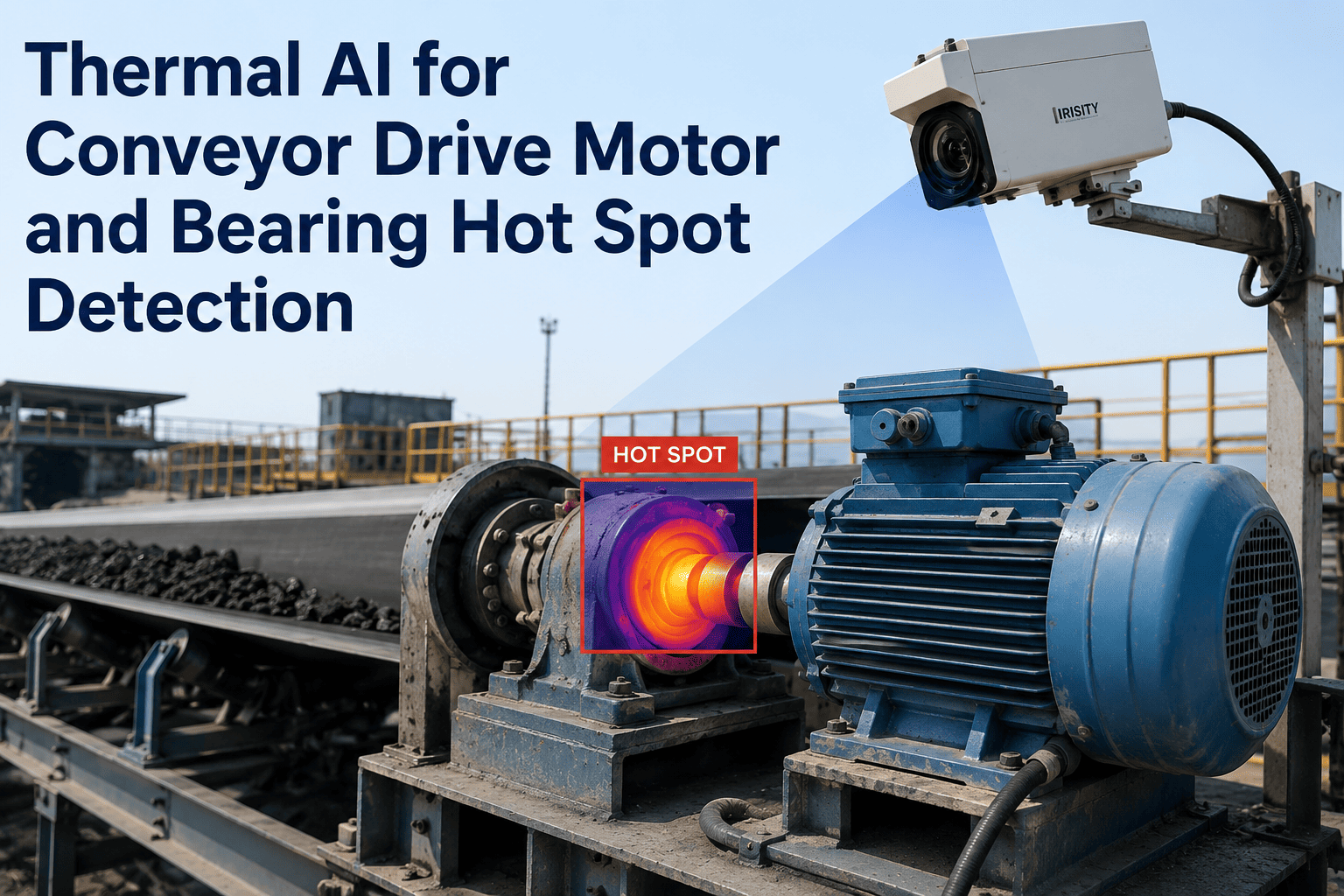
Motor & Bearing Overheating Detection
Bearing failure is one of the most common causes of unplanned downtime in manufacturing. As bearings wear, friction increases, generating additional heat that is detectable by thermal cameras 30-60 days before traditional vibration symptoms appear. A main drive motor replacement might cost $5,000, but the unplanned downtime — emergency service call, waiting for parts, lost production — can push total cost above $50,000.
Early Bearing Wear
Increased friction from lubrication degradation or initial spalling produces moderate temperature rise. AI flags for increased monitoring frequency and planned lubrication or replacement at next scheduled window.
Lead time: 30-60 days before failureWinding Insulation Stress
Motor winding temperature rise indicates insulation degradation, overloading, or cooling system failure. Every 10 C above rated temperature halves insulation life — AI tracks cumulative thermal stress exposure.
Lead time: 2-8 weeks before failureCoupling Misalignment
Asymmetric thermal patterns on couplings and bearing housings indicate misalignment loading. AI detects thermal imbalance patterns that correlate with specific misalignment types (angular, parallel, combined).
Lead time: 4-12 weeks before damageCooling Degradation
Fan blockage, filter clogging, and coolant flow reduction detected through rising motor casing temperatures. AI correlates ambient temperature, load, and cooling system effectiveness to distinguish cooling failure from overloading.
Lead time: 2-6 weeks before thermal damageElectrical Panel, Switchgear & Transformer Thermal Scanning
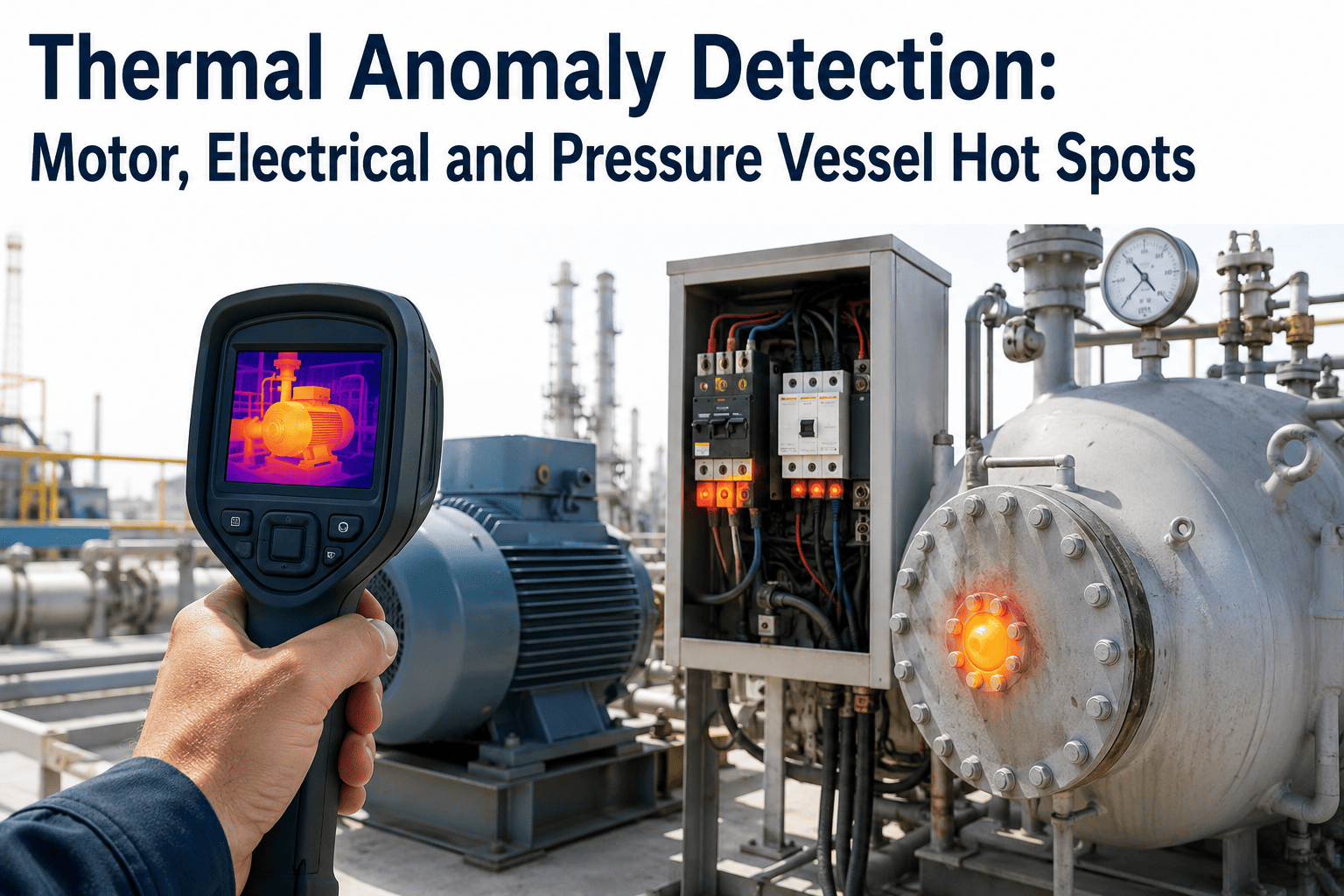
Loose or corroded electrical connections generate excess heat due to increased resistance. A connection running at 85 C instead of its normal 40 C is a fire and arc flash hazard. Thermal monitoring of electrical panels, motor control centers, switchgear, and junction boxes is one of the highest-ROI predictive maintenance applications — detecting 85-90% of electrical faults before failure.
MCC & Distribution Panels
Loose connections, overloaded circuits, and phase imbalances create localized hot spots. AI monitors every breaker, contactor, and bus bar connection — flagging thermal anomalies that indicate imminent failure or fire risk.
Medium & High Voltage
Internal arcing, insulation degradation, and contact erosion produce thermal signatures invisible from the outside. Fixed thermal sensors inside switchgear cabinets provide continuous monitoring without opening doors — eliminating arc flash exposure risk.
Dry & Oil-Filled Units
Winding hot spots, tap changer degradation, and cooling system failures detected through surface thermal profiling. AI correlates load, ambient temperature, and thermal response to distinguish normal heating from abnormal degradation.
Connection Points
Bolted busbar connections loosen over time from thermal cycling. A connection with 0.1 ohm increased resistance generates significant heat under load — AI detects the temperature rise long before the connection fails catastrophically.
Steam Trap, Valve & Pipe Insulation Leak Detection
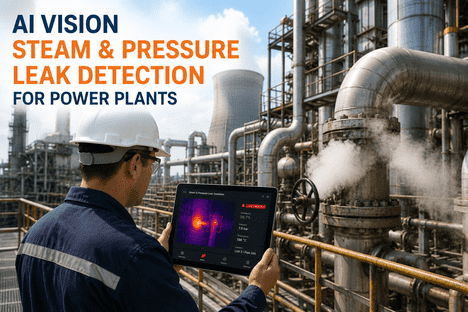
Failed steam traps waste 15-30% of steam system energy. A single failed-open steam trap can waste $5,000-$15,000 per year in energy alone. Thermal cameras detect failed traps, leaking valves, and damaged insulation instantly by identifying temperature anomalies that are invisible to visual inspection.
Failed Steam Traps
Failed-open traps pass live steam through to condensate return — AI detects the characteristic temperature differential between upstream and downstream piping that indicates trap failure.
Valve Leakage
Internal valve leakage creates downstream temperature anomalies — hot spots on isolation valves that should show ambient temperature indicate through-leakage wasting energy and creating safety concerns.
Insulation Damage
Missing, wet, or damaged pipe insulation creates visible hot spots on thermal cameras — each gap radiating heat energy that translates directly to wasted fuel cost and personnel burn hazards.
Refractory Lining & Kiln Shell Hot Spot Mapping
For cement, steel, and glass manufacturers, refractory lining failure is a catastrophic event. A kiln shell hot spot indicates refractory erosion that, left unchecked, can burn through the steel shell and force a multi-week shutdown for rebricking. iFactory thermal cameras continuously map kiln shell temperatures, detecting refractory thinning months before breach.
Full 360-degree kiln shell thermal profile updated continuously. AI identifies hot spots by zone, tracks temperature progression over time, and predicts when refractory thickness will reach minimum safe limits.
Refractory wear is progressive — AI tracks hot spot temperature over weeks and months, projecting when the zone will require repair. Maintenance scheduled during planned kiln stop, not forced by shell breach.
In cement kilns, protective coating loss accelerates refractory wear. AI detects coating loss events (sudden temperature spikes) and adjusts wear rate projections accordingly.
AI Thermal Baseline Learning & Adaptive Thresholds
Static temperature thresholds generate excessive false alarms because they don't account for load, ambient conditions, or seasonal variation. iFactory AI learns what "normal" looks like for each asset under every operating condition — then alerts only when temperatures deviate from the learned baseline in ways that indicate genuine degradation.
Load-Adjusted Baselines
A motor running at 100% load legitimately runs hotter than at 50% load. AI establishes temperature baselines at every load level — alerting only when temperature exceeds what's expected for the current operating condition.
Ambient Compensation
Summer heat raises all equipment temperatures. AI subtracts ambient influence to reveal genuine equipment degradation — eliminating the summer false alarm flood that plagues static threshold systems.
Rate-of-Change Detection
A bearing that goes from 60 C to 75 C over 4 weeks is degrading gradually. A bearing that jumps from 60 C to 75 C overnight has an acute problem. AI distinguishes gradual wear trends from sudden failure events — prioritizing response accordingly.
Auto-Generated Work Orders from Thermal Anomaly Detection
If a thermal alert sits in a dashboard and doesn't trigger action, it's expensive data collection — not predictive maintenance. iFactory converts every confirmed thermal anomaly into a prioritized work order with annotated thermal image, asset identification, severity classification, and AI-suggested corrective action.
Thermal Anomaly Detected
AI identifies temperature exceeding adaptive baseline for current load and ambient conditions
Severity Classification
Alert (increased monitoring), Alarm (plan repair within 2 weeks), or Critical (immediate investigation)
Work Order Created
Annotated thermal image, asset ID, failure mode, and AI-recommended action pushed to SAP PM, Maximo, or iFactory CMMS
Technician Dispatched
Assigned by skills and availability. Push/SMS notification with thermal evidence — technician arrives knowing exactly what and where the problem is
Frequently Asked Questions
Your Equipment Is Telling You It's About to Fail. Are You Listening?
iFactory deploys AI-powered thermal cameras on your critical assets — motors, bearings, electrical panels, steam systems, and kilns — providing 24/7 thermal intelligence that predicts failures 30-90 days before breakdown and auto-generates maintenance work orders.