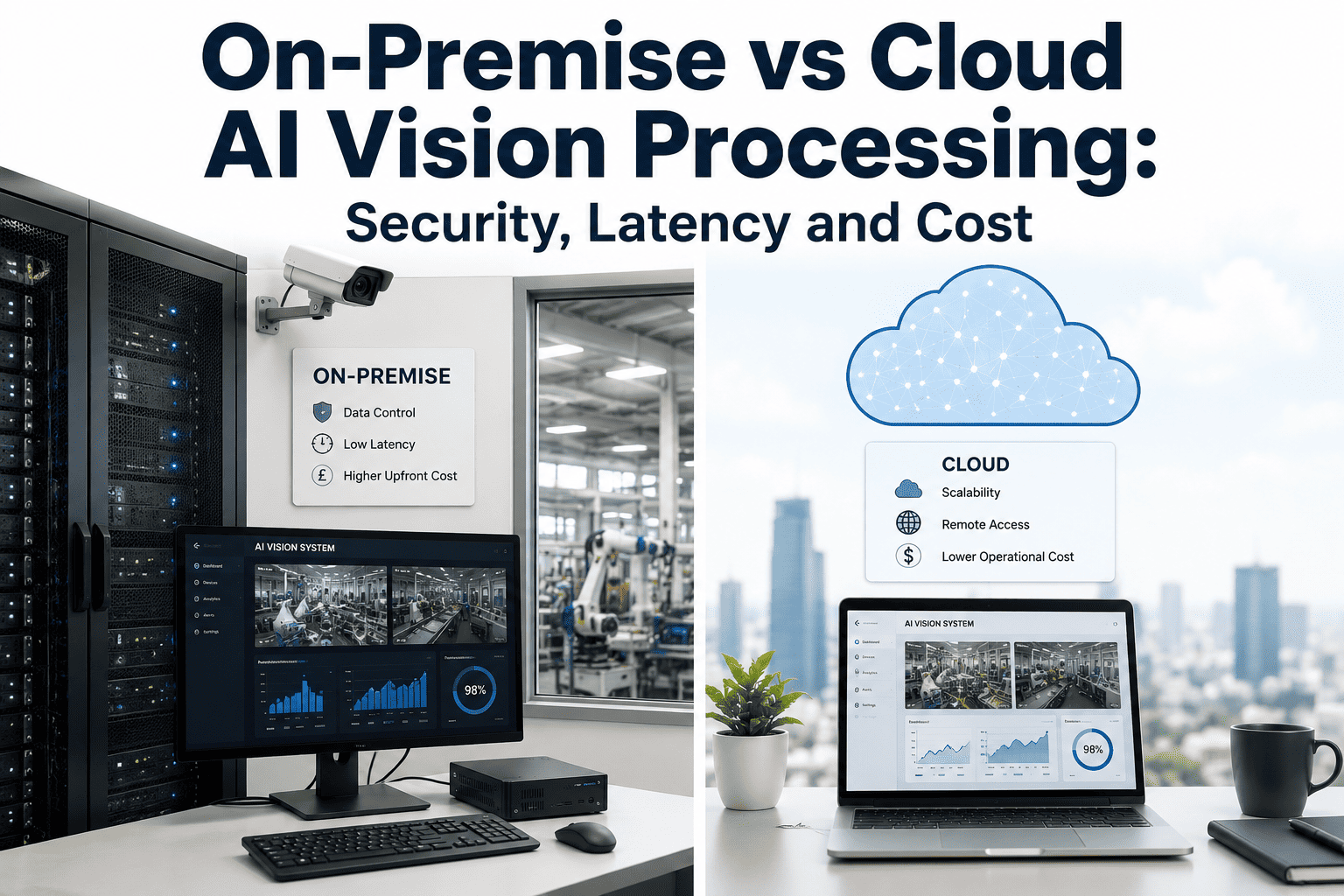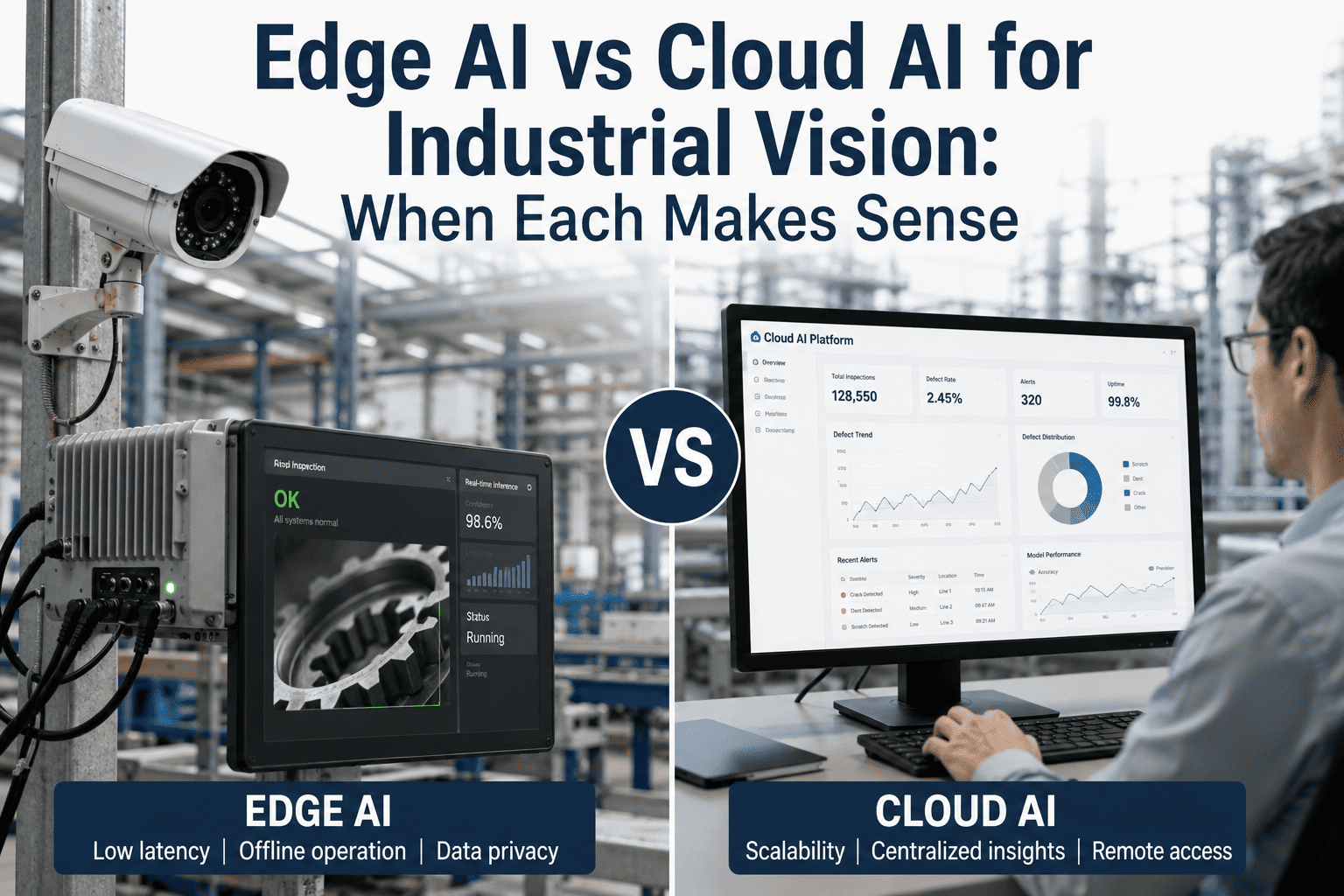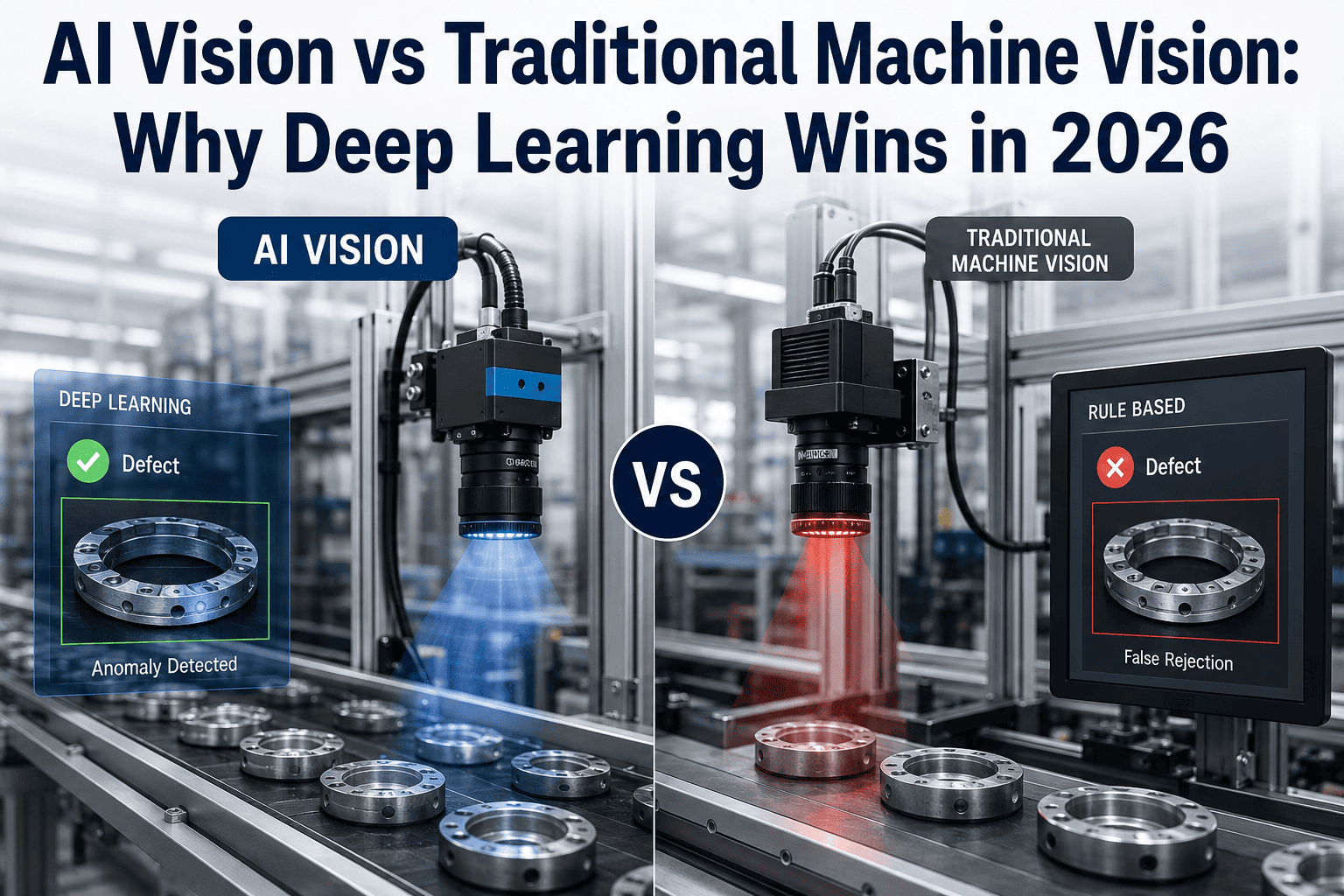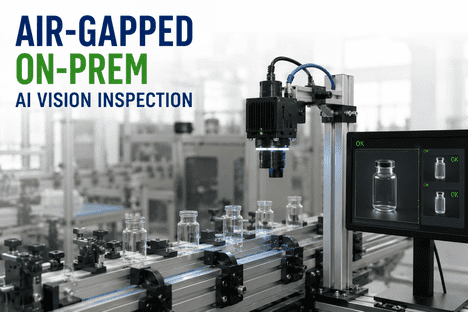
Air-gapped on-premise AI vision inspection is the deployment architecture that runs deep learning defect detection, quality classification, and process monitoring models entirely within a facility's physical perimeter — with no internet connection, no cloud dependency, and no outbound data transmission of any kind. For defense manufacturers, regulated pharmaceutical plants, semiconductor fabs handling proprietary process IP, and critical infrastructure operators bound by network isolation mandates, this is not a preference — it is an operational and compliance requirement that cloud-dependent vision AI vendors cannot satisfy by design. iFactory's Edge AI Vision Platform is built specifically for this deployment model: all inference, model management, inspection data storage, SPC monitoring, and CMMS integration run on a pre-configured NVIDIA edge server located on the production floor, fully isolated from external networks, delivering sub-100ms real-time inspection performance without a single frame leaving the facility. Organizations that cannot compromise on data sovereignty no longer have to choose between advanced AI vision capability and the security posture their operating environment demands.
Why Air-Gapped AI Vision Is a Hard Requirement — Not a Preference
The assumption that cloud connectivity is negotiable in manufacturing AI vision deployment collapses immediately when examined against the actual operating environments of defense contractors, semiconductor fabricators, pharmaceutical manufacturers, and critical infrastructure operators. These facilities do not evaluate cloud AI platforms and conclude the risk is acceptable with the right encryption — they operate under network architecture mandates, regulatory frameworks, and contractual security requirements that prohibit outbound data transmission from production equipment regardless of the destination or the encryption in transit. A defense contractor producing components under ITAR jurisdiction cannot route assembly inspection images through any cloud infrastructure. A semiconductor fab inspecting wafer surfaces carries process recipe IP in every captured image that represents billions in R&D investment. A pharmaceutical manufacturer subject to FDA 21 CFR Part 11 cannot maintain the electronic record integrity audit trail that the regulation requires when inspection data flows through cloud infrastructure outside the validated system boundary. Cloud-based AI vision vendors respond to these requirements with assurances about data handling policies — which are legally meaningless in most regulated contexts because the architecture itself violates the requirement, regardless of what happens to the data after transmission. iFactory's AI vision camera platform resolves this by design: the architecture never transmits inspection data outside the facility. There is no cloud component to audit, no data handling policy to evaluate, and no architectural exception to justify to a regulator or auditor.
Industries That Require Air-Gapped Vision AI Deployment
The industries that require fully isolated AI vision deployment share a common characteristic: the data captured during manufacturing inspection is either classified, regulated, proprietary at a level that makes external transmission unacceptable, or subject to contractual security requirements that carry legal liability for violations. Understanding which regulatory frameworks and security mandates drive air-gapped deployment requirements clarifies why the architecture is non-negotiable rather than simply preferred.
iFactory Edge AI Vision Platform: Air-Gapped Architecture
iFactory's Edge AI Vision Platform is architected from the ground up for isolated on-premise operation. Every component of the inspection workflow — camera image acquisition, deep learning inference, defect classification, SPC threshold monitoring, alert generation, CMMS work order creation, and inspection data archival — runs on a pre-configured NVIDIA edge server located within the production facility. The system requires no internet connection at any point in the operational lifecycle: initial deployment, ongoing inspection operation, model performance monitoring, and inspection data reporting all function identically whether the facility's external network connection exists or not. Model deployment to the edge server uses validated offline transfer processes — cryptographically signed model packages delivered via secured USB media or isolated internal network segments — that satisfy change control documentation requirements under GAMP 5, FDA CSA guidance, and AS9100 software configuration management standards. Inspection images, defect classifications, SPC data, and audit trail records are stored on local encrypted storage within the edge server enclosure. Dashboard access for quality engineers, maintenance teams, and operations leadership is served from the local edge server to facility intranet endpoints — providing full visibility into inspection performance without any data leaving the plant boundary. Book a Demo to see the complete air-gapped inspection architecture demonstrated on your facility's network topology requirements.
| System Component | Cloud-Dependent Architecture | iFactory Air-Gapped Architecture | Compliance Impact |
|---|---|---|---|
| Inference Engine | Cloud GPU — external data transmission required | NVIDIA edge GPU — all inference on-premise | ITAR, CMMC, 21 CFR Part 11 compliant |
| Inspection Image Storage | Cloud object storage — data leaves facility | Local encrypted storage — never leaves facility | Data residency and sovereignty satisfied |
| Model Updates | Cloud model registry — internet required | Signed offline transfer via validated process | Change control documentation maintained |
| SPC Monitoring | Cloud analytics — data transmission required | Local SPC engine — no external dependency | Audit trail remains within validated boundary |
| CMMS Integration | Cloud API — external connectivity required | Local OPC-UA / REST — intranet only | Work order data stays within facility network |
| Dashboard Access | Cloud-hosted web application | Local server — facility intranet only | Access control fully within facility perimeter |
Offline Model Management and Change Control
The operational challenge that air-gapped AI vision deployment introduces — and that most vision AI vendors have not solved — is model lifecycle management without cloud connectivity. AI vision models require ongoing maintenance: retraining on new defect types as product specifications change, threshold adjustments as process drift affects defect rate baselines, and version updates as the underlying deep learning architecture improves. Cloud-dependent platforms handle this transparently through internet-connected update pipelines that are architecturally impossible in air-gapped environments. iFactory's offline model management system addresses this directly. Model updates are packaged as cryptographically signed deployment bundles that include the updated model weights, configuration parameters, validation test results, and change documentation required by regulated industry change control procedures. These bundles are transferred to the edge server via validated USB transfer stations or isolated internal network segments — with every transfer logged in the system's change control record. The edge server validates the cryptographic signature before installing any model update, preventing unauthorized model modifications that could compromise inspection integrity. Model rollback capability is built into the deployment architecture: if a newly deployed model performs below acceptance criteria during the post-update validation period, the previous model version is restored automatically without requiring external connectivity or vendor support access. For facilities operating under FDA Computer Software Assurance guidance, iFactory provides installation qualification and operational qualification documentation templates for each model update — reducing the validation documentation burden that has historically made AI model updates in regulated environments impractically slow.
Data Sovereignty: What It Means in Practice for AI Vision
Data sovereignty in manufacturing AI vision is more operationally complex than a policy statement about data ownership. It requires that the physical location of every piece of inspection data — raw images, inference results, defect classifications, model training data, performance metrics — is within the manufacturer's physical and jurisdictional control at all times. This requirement eliminates multi-tenant cloud infrastructure, shared model training pipelines, and any architecture where inspection data passes through systems not owned and operated by the manufacturer. iFactory's air-gapped deployment satisfies data sovereignty at the architectural level, not through contractual assurance.
Physical sovereignty means inspection images and defect data are stored on hardware located within the facility — hardware the manufacturer owns, controls, and can physically secure. Jurisdictional sovereignty means the data never traverses network infrastructure subject to the legal jurisdiction of a cloud provider's data center location — eliminating the cross-border data transfer compliance issues that affect multinational manufacturers using US-headquartered cloud platforms in EU or Asian facilities. Operational sovereignty means the manufacturer controls who has access to inspection data, when model updates are applied, and when the inspection system itself is operational — without dependence on a cloud vendor's availability, pricing decisions, or policy changes. iFactory's edge AI platform delivers all three layers. Book a Demo to review the data architecture documentation for your specific sovereignty requirements.
Regulatory Compliance Documentation for Air-Gapped AI Vision
Deploying AI vision inspection in regulated manufacturing environments requires documentation that demonstrates the system meets the applicable quality and security standards — not just that it operates correctly. The documentation burden varies by regulatory framework, but the common requirement across FDA, EU GMP, ISO 13485, AS9100, and CMMC is evidence that the computerized inspection system is validated, access-controlled, audit-trailed, and operating within a defined and controlled system boundary. iFactory's air-gapped deployment package includes the validation documentation framework that supports compliance evidence generation for the most demanding regulatory environments.
Installation and Operational Qualification Records
iFactory provides IQ and OQ documentation templates aligned to GAMP 5 principles and FDA Computer Software Assurance guidance for each edge AI vision deployment. IQ documentation covers hardware specification verification, software version confirmation, network isolation verification, and security configuration baseline. OQ documentation covers inspection accuracy validation against reference defect sets, latency performance qualification, alarm and alert function testing, and CMMS integration verification. These documents form the validation record that FDA inspectors and ISO 13485 auditors request as evidence of controlled computerized system deployment.
Electronic Record Integrity and Access Control Logs
The edge AI platform maintains a tamper-evident audit trail of all inspection events, model changes, configuration modifications, and user access actions — stored locally on the edge server with cryptographic integrity verification. Audit trail records include the timestamp, user identity, action type, and before/after values for all configuration changes. User access is managed through role-based access control with individual credentials, satisfying the 21 CFR Part 11 requirement for individual accountability in electronic record systems. Audit trail export capability supports both scheduled compliance reporting and on-demand audit evidence retrieval within the timeframes that regulatory inspections and customer audits require.
Model Update and Configuration Change Records
Every model update, threshold adjustment, and configuration change applied to the air-gapped edge system generates a change control record that includes the change description, approval workflow, pre-change and post-change performance validation results, and implementation confirmation. For facilities operating formal change control procedures under ISO 9001, AS9100, or GMP quality management systems, iFactory's change documentation integrates into existing change request workflows — providing the inspection system change records that quality auditors require as evidence of controlled system management throughout the operational lifecycle.
Network Isolation Verification and Security Architecture Records
CMMC, ITAR, and NERC CIP compliance assessments require documentation demonstrating that the AI vision system is deployed within the correct network security zone and that no unauthorized data paths connect the inspection system to external networks. iFactory's deployment documentation includes network architecture diagrams, port and protocol specifications, firewall rule documentation, and network isolation test records that support cybersecurity assessment evidence requirements. For facilities undergoing CMMC assessments, this documentation supports the evidence package that demonstrates controlled unclassified information handling controls are implemented at the OT system level.
Air-Gapped Deployment vs. Hybrid and Cloud Vision: A Direct Comparison
Understanding which deployment architecture fits a manufacturing environment requires honest comparison of what each model delivers across the dimensions that matter: inspection performance, data security posture, regulatory compliance compatibility, operational resilience, and total cost of ownership. The following comparison reflects real deployment conditions rather than vendor marketing positions.
Frequently Asked Questions: Air-Gapped AI Vision Inspection
Yes. iFactory's Edge AI Vision Platform is designed for complete operation without any internet connectivity. All inference, defect classification, SPC monitoring, alert generation, CMMS work order creation, dashboard serving, and inspection data archival run on the local NVIDIA edge server with no external network dependency at any point in normal operation. Model updates are delivered via validated offline transfer processes that do not require internet connectivity. The system's operational status is unaffected by internet outages, WAN disruptions, or deliberate network isolation mandated by security architecture requirements.
Model updates are packaged as cryptographically signed deployment bundles containing updated model weights, configuration parameters, validation test results, and change control documentation. These bundles are transferred to the facility via USB media or isolated network segments using validated transfer procedures that satisfy change control requirements under GAMP 5, FDA CSA guidance, and AS9100. The edge server validates the cryptographic signature before installing any update, preventing unauthorized modifications. Each update generates a change control record that supports regulatory audit evidence requirements. Rollback to the previous model version is available automatically if post-update validation does not meet acceptance criteria.
iFactory's air-gapped edge architecture is compatible with ITAR and CMMC Level 2 and Level 3 deployment requirements at the architectural level — meaning the system design itself satisfies the no-external-data-transmission requirement rather than relying on contractual assurances about data handling. Inspection images, defect data, and process information never traverse external networks. Network isolation verification documentation, port and protocol specifications, and security configuration records are provided as part of the deployment package to support CMMC assessment evidence requirements. Customers should engage their CMMC Registered Practitioner Organization to confirm specific control implementation requirements for their enclave configuration.
iFactory's air-gapped edge platform delivers superior inspection performance compared to cloud alternatives on the metrics that matter most to production environments: inference latency and operational reliability. Local NVIDIA GPU inference achieves sub-100ms frame-to-classification latency — compared to 200–800ms for cloud round-trip architectures — enabling real-time reject actuation at line speeds where cloud latency would allow defective product to exit the inspection station before a result arrives. Operational reliability is higher because the system has no external dependency: cloud outages, WAN disruptions, and internet connectivity issues have zero effect on inspection continuity. Inspection accuracy is equivalent because the same deep learning model architectures and TensorRT optimization that cloud platforms use are deployed locally on the edge server.
iFactory's air-gapped edge platform supports 21 CFR Part 11 compliance through a combination of architectural design and documentation support. Architecturally, the system maintains all electronic inspection records within the facility's controlled network environment — satisfying the requirement that regulated electronic records remain within a validated, access-controlled system boundary. The platform provides individual user authentication with role-based access control, tamper-evident audit trail records with cryptographic integrity verification, and electronic record export capability that supports FDA inspection evidence requests. iFactory provides IQ/OQ validation documentation templates, change control record templates, and audit trail configuration guidance aligned to current FDA Computer Software Assurance guidance. Book a Demo to discuss your facility's specific 21 CFR Part 11 compliance requirements with iFactory's regulatory deployment team.