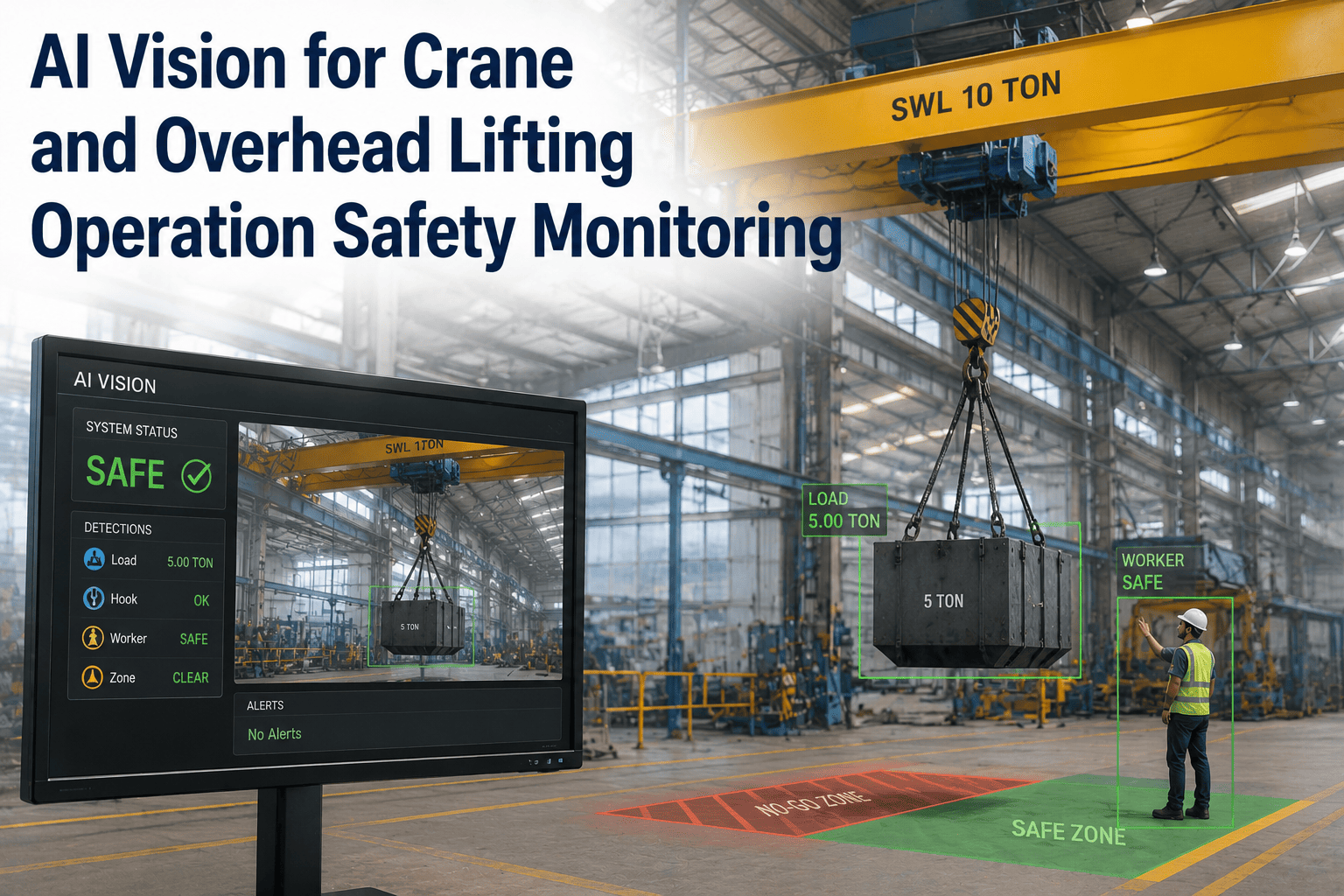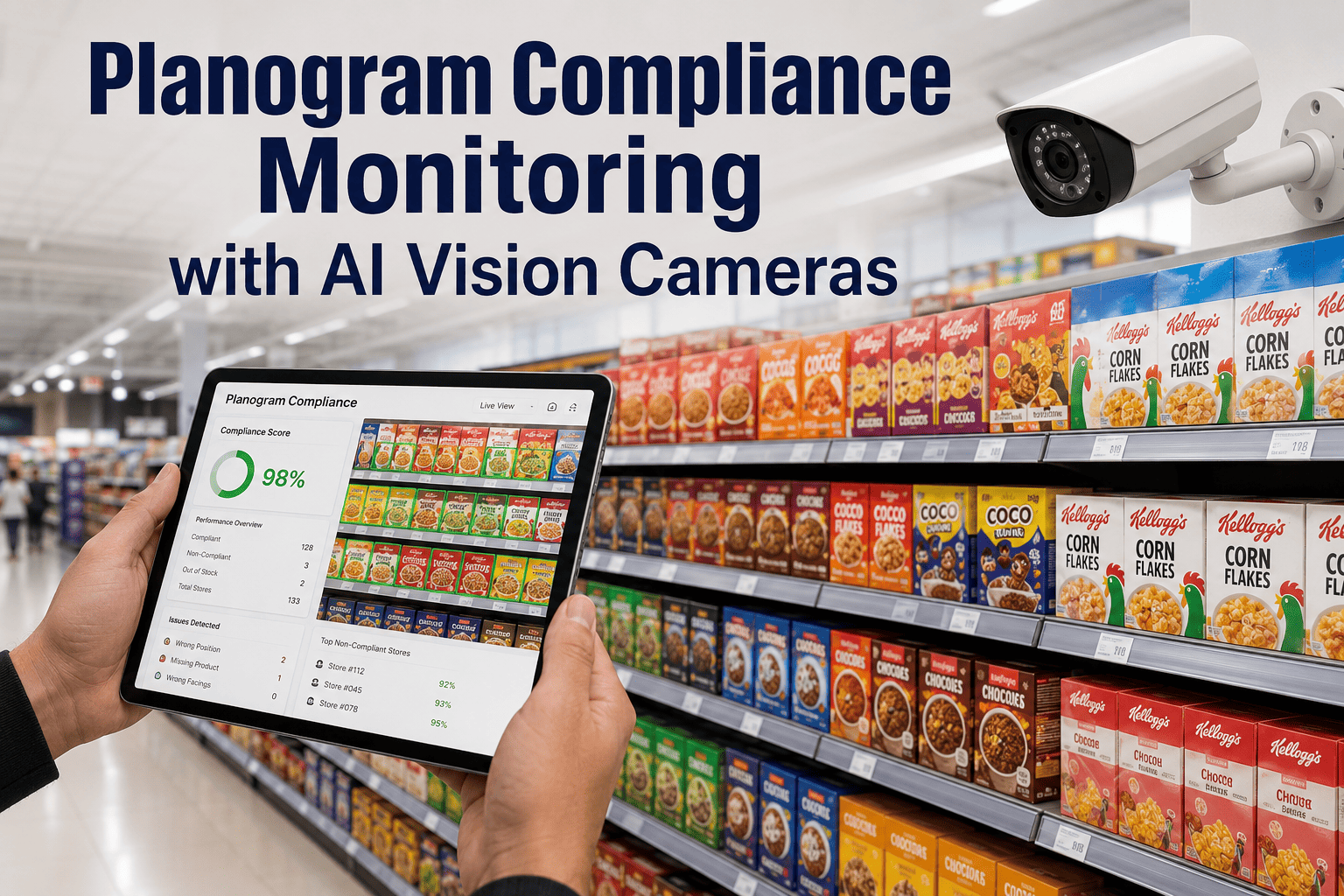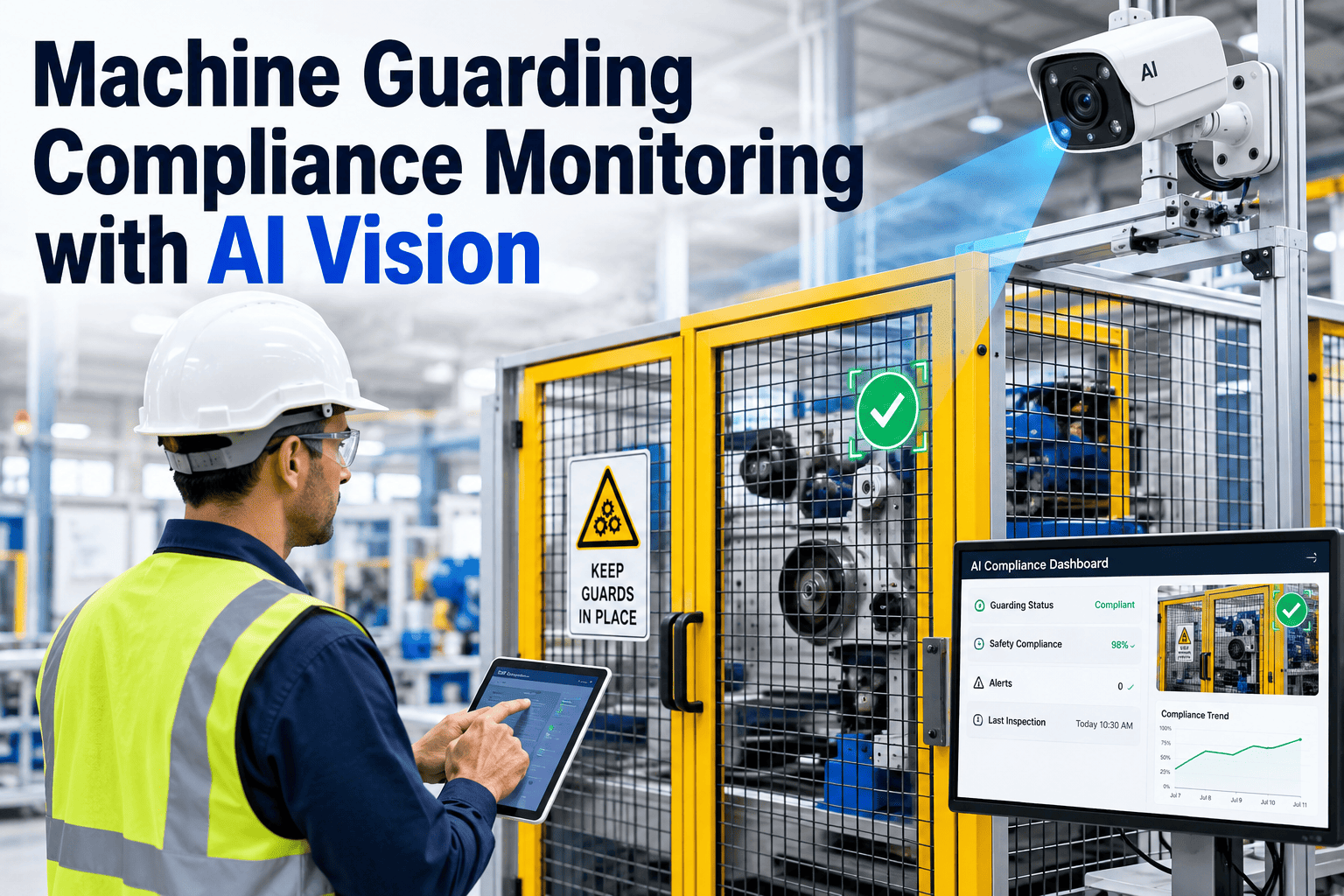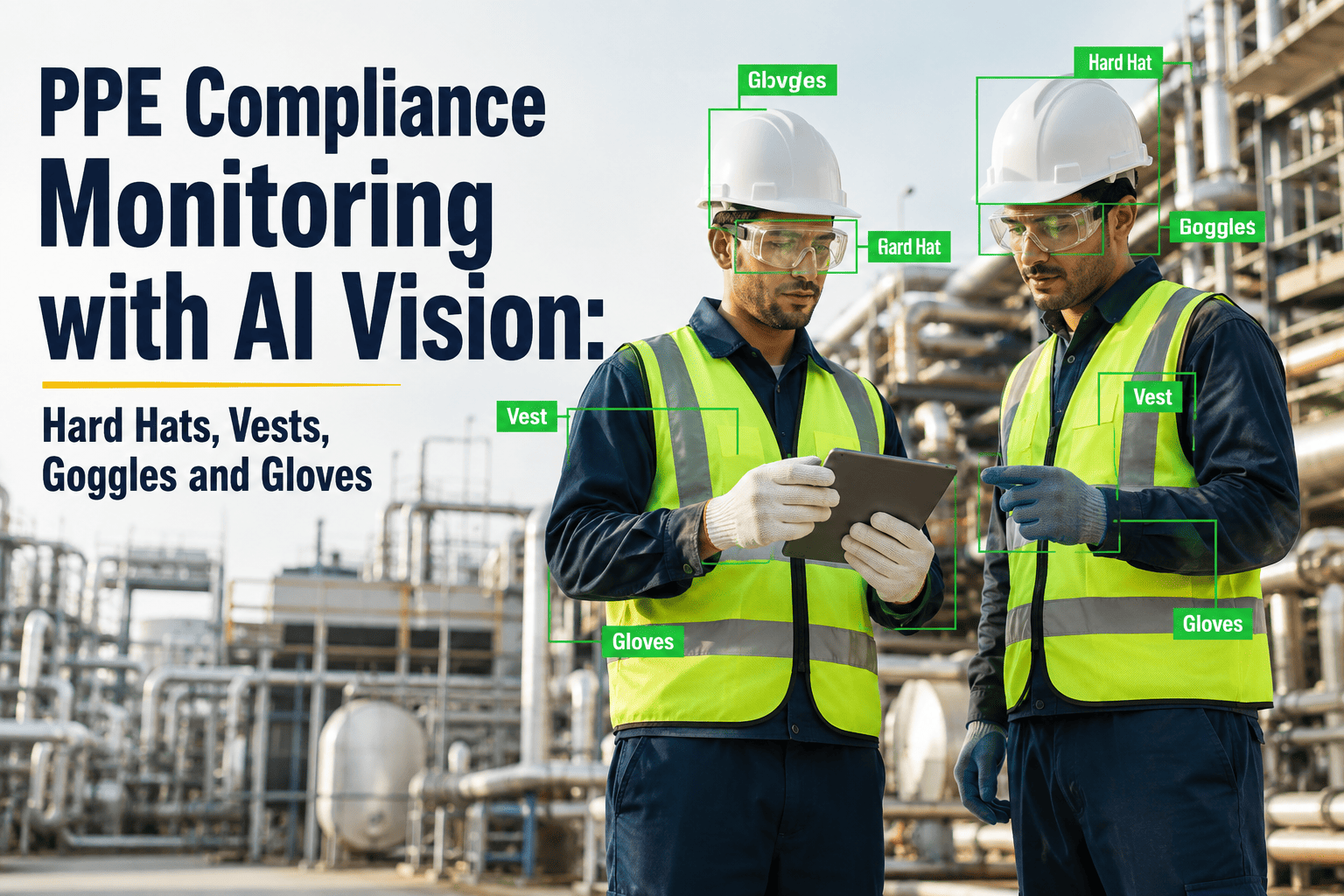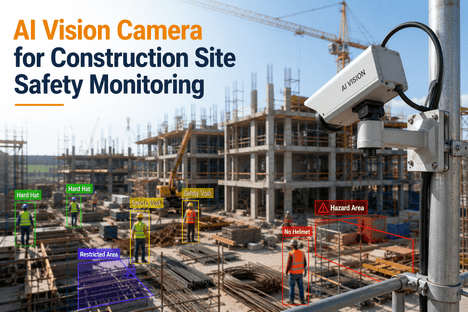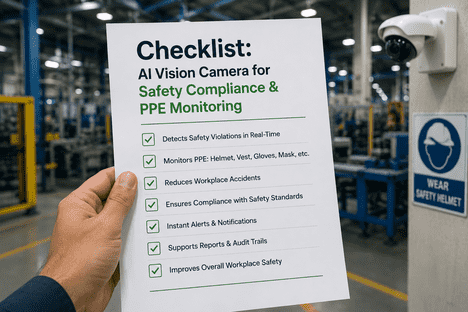
Every ISO 45001-certified facility eventually collides with the same operational reality: the standard demands ongoing, proactive hazard identification, but the safety team assigned to that identification is fatigued, thinly spread, and physically incapable of watching every meter of every shift. A safety officer with a clipboard sees a fraction of what actually happens in an eight-hour rotation, and a supervisor covering three lines cannot verify PPE compliance at each workstation continuously. AI vision closes that gap by converting existing camera infrastructure into a continuous observer that flags missing hard hats, exclusion zone breaches, and near-miss events in real time — mapping directly onto Clause 6.1.2 hazard identification, Clause 8.1.2 operational controls, and Clause 9 performance evaluation. See how iFactory turns your camera feeds into an audit-ready evidence engine with a Book a Demo.
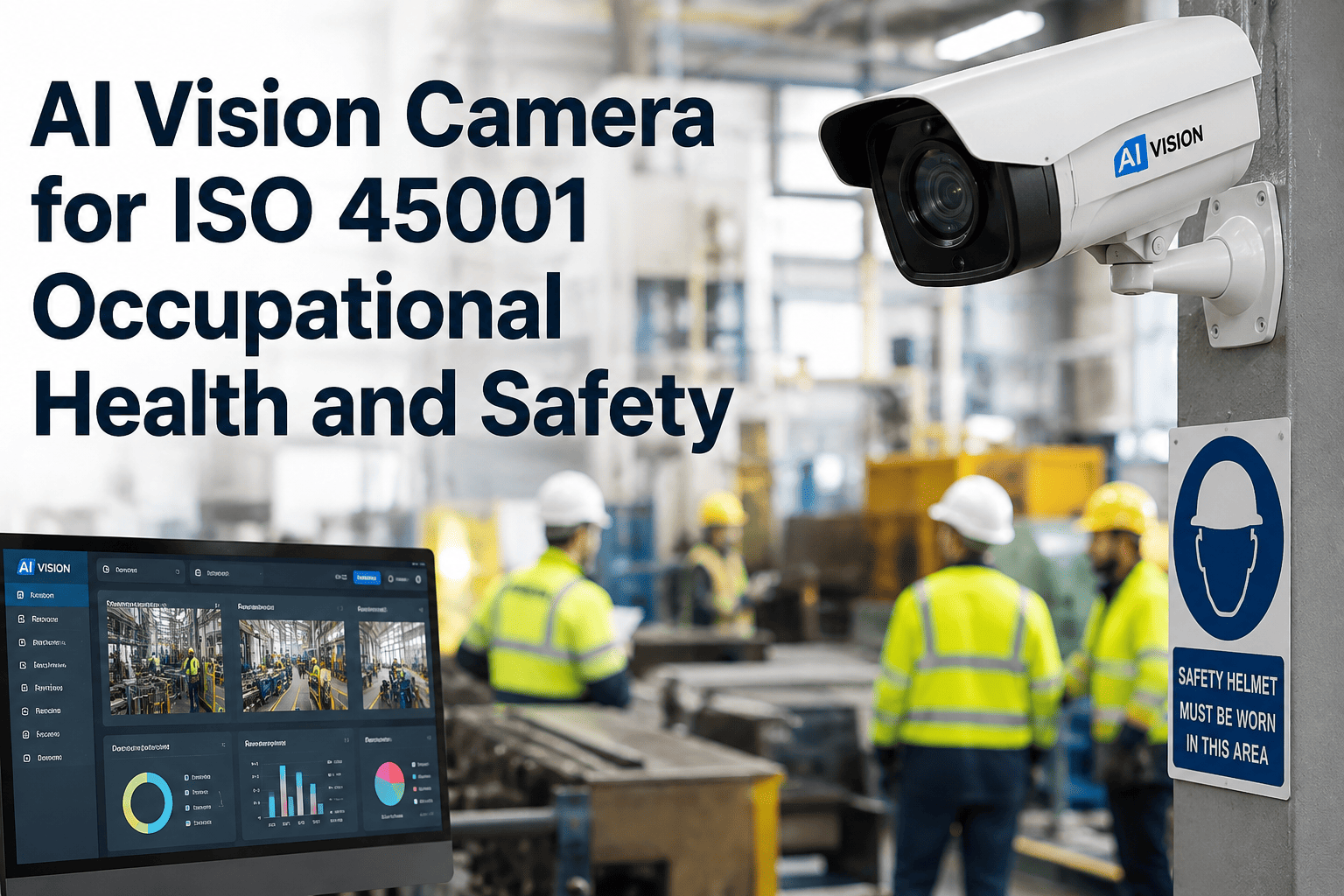
AI Vision Camera for ISO 45001 Occupational Health and Safety
Continuous automated hazard identification, real-time PPE compliance verification, and audit-ready evidence trails that align with ISO 45001:2018 requirements across every clause of the standard.
The Gap Between the Standard and the Shop Floor
ISO 45001:2018 requires organizations to establish a proactive, ongoing process for identifying hazards, assessing OH&S risks, and eliminating or controlling them across routine and non-routine activities. In practice, most facilities meet those requirements through scheduled inspections, monthly toolbox talks, and incident reports filed after the fact. That approach was the best available option before continuous machine perception existed. It is no longer.
A safety walkdown captures a snapshot. A near-miss report captures a memory. Neither captures the twelve unwitnessed PPE violations that happened in the intervening eight hours, and neither generates the leading-indicator data ISO 45001 Clause 9 asks facilities to monitor. AI vision does both, continuously, without adding headcount to the safety team.
How AI Vision Reinforces Every Phase of the ISO 45001 Cycle
ISO 45001 is built on the Plan-Do-Check-Act cycle, the continuous improvement engine every clause of the standard depends on. AI vision cameras contribute measurable inputs and outputs at each phase, transforming the cycle from a documentation exercise into a live operational feedback loop.
Plan
Historical AI vision data reveals the actual hazard hotspots across shifts, zones, and task types, replacing assumption-driven risk registers with evidence-based ones.
Do
Real-time alerts trigger immediate corrective action from supervisors and workers the moment a violation, exclusion zone breach, or unsafe behavior is detected.
Check
Automated logging produces the leading-indicator metrics auditors expect under Clause 9, including compliance rates, response times, and trend curves per site.
Act
Persistent-risk zones surface automatically, guiding targeted training refreshes, engineering control upgrades, or process redesign under Clause 10 improvement.
The Categories of Workplace Hazards AI Vision Continuously Monitors
Clause 6.1.2 requires that the hazard identification process consider routine and non-routine activities, human factors, past incidents, and changes to work processes or environment. AI vision extends coverage across these categories without adding to the safety team's inspection burden.
PPE Non-Compliance
Detects missing hard hats, safety vests, gloves, goggles, and steel-toe boots against zone-specific rules configured for chemical areas, welding bays, or general floor.
Exclusion Zone Breaches
Flags unauthorized entry into hot work zones, active forklift lanes, energized panel enclosures, or any restricted area mapped to a specific worker role or permit.
Pedestrian-Vehicle Proximity
Alerts on close encounters between workers and forklifts, mobile cranes, AGVs, or shuttle vehicles before contact happens, a leading indicator of struck-by incidents.
Ergonomic Risk Postures
Identifies repeated awkward lifts, prolonged overhead reaches, and non-neutral back positions that predict musculoskeletal injury and workers' compensation claims.
Blocked Egress and Fire Lanes
Detects pallets, drums, and materials obstructing emergency exits, sprinkler access, or eyewash stations, addressing a top-cited category during regulatory inspections.
Spills and Slip Hazards
Recognizes fluid spills, product drops, and wet floor conditions in real time so containment happens before a slip-trip-fall incident enters the injury log.
Move From Documented Hazards to Detected Ones
Bring us your existing camera feeds and see what iFactory identifies across a single shift — before you commit to a rollout.
Where AI Vision Fits Into the Five-Level Control Framework
ISO 45001 Clause 8.1.2 requires organizations to reduce risk by working top-down through the hierarchy of controls, exhausting each level before relying on the next. AI vision does not replace engineering controls or eliminate hazards on its own, but it strengthens administrative controls and dramatically improves PPE enforcement while surfacing data that guides higher-level control decisions.
Elimination
Remove the hazard entirely. AI vision heatmaps identify the exact zones and tasks where hazards concentrate, guiding process redesign that removes them at source.
Substitution
Replace with something less hazardous. Trend data on ergonomic injuries or exclusion zone breaches informs equipment substitution and material handling changes.
Engineering Controls
Isolate workers from the hazard through guarding, barriers, or interlocks. AI vision validates that engineering controls remain in place and are not bypassed over time.
Administrative Controls
This is where AI vision delivers its greatest value. Continuous monitoring enforces procedures, permits, zoning rules, and training compliance that clipboards cannot.
Personal Protective Equipment
Detects hard hat, vest, glove, and goggle presence per zone rules in real time, catching violations at the moment of exposure rather than in the incident report afterward.
Which ISO 45001 Clauses AI Vision Directly Supports
Auditors want to see documented evidence for each clause of the standard. AI vision generates that evidence automatically, aligned to the specific language and intent of the requirement.
| ISO 45001 Clause | Requirement Focus | AI Vision Contribution |
|---|---|---|
| Clause 6.1.2 | Ongoing proactive hazard identification | Continuous detection of PPE gaps, exclusion breaches, spills, ergonomic risks, and blocked egress |
| Clause 6.1.2.2 | Assessment of OH&S risks and opportunities | Frequency data per hazard type feeds quantitative risk scoring instead of subjective ratings |
| Clause 8.1.2 | Elimination of hazards and hierarchy of controls | Verifies administrative and PPE controls are being followed and flags where they are not |
| Clause 8.2 | Emergency preparedness and response | Detects blocked emergency exits, sprinkler access obstructions, and eyewash station blockages |
| Clause 9.1.1 | Monitoring, measurement, analysis, evaluation | Delivers leading indicators (near-miss counts, response times) not just lagging incident data |
| Clause 10.2 | Incident, nonconformity, and corrective action | Timestamped video evidence supports root cause investigation and corrective action verification |
The Real-Time Detection and Response Timeline
The value of continuous vision is not in the camera itself, it is in how quickly a detected event becomes a documented corrective action. Every step of the pipeline is measured in seconds, not shifts.
Event Occurs
A worker enters a designated high-noise zone without required hearing protection, or a forklift approaches a pedestrian in a shared lane.
Detection and Classification
The vision model classifies the event against the site's active rule set, filtering routine movements from actual hazard patterns before generating any alert.
Alert Routing
A push notification reaches the zone supervisor, the control room, and the site safety officer with a timestamped image and the exact camera location.
On-Site Intervention
The nearest supervisor addresses the situation directly, or an on-floor audio alert prompts the worker to correct the behavior before exposure continues.
Documentation and Logging
The event and its resolution are logged automatically, feeding Clause 9 monitoring dashboards and building the pattern history for future planning cycles.
Traditional Safety Programs vs. AI Vision Monitoring
Most ISO 45001-certified facilities meet the letter of the standard with manual programs. The gap between meeting it and delivering on its intent shows up in what each approach can actually detect, document, and improve.
Snapshot-Based Compliance
- Safety walkdowns cover under 5% of floor time and rely on the observer being present at the moment of violation.
- PPE compliance recorded by exception only, when a supervisor happens to witness a lapse and files a report.
- Near-misses documented at the discretion of the workforce, producing systematic underreporting of leading indicators.
- Audit evidence assembled reactively before certification visits, drawn from incomplete inspection logs and interviews.
- Corrective actions triggered after incidents, meaning the injury or property damage has already occurred.
Continuous Evidence Compliance
- Every camera-covered zone is monitored on every shift, producing full-coverage compliance data across the entire facility.
- PPE compliance quantified per zone, per shift, per worker role, revealing patterns that inform targeted training.
- Near-miss capture is automated and objective, giving the safety team the leading-indicator volume the standard expects.
- Audit evidence is always current, timestamped, and searchable, cutting preparation time before certification cycles.
- Corrective actions triggered by detection, addressing conditions before they escalate into recordable incidents.
ISO 45001 Facilities Already Deploying AI Vision Monitoring
Manufacturing Plants
Assembly lines, welding bays, and press shops where PPE rules vary by zone and violations happen fastest during shift transitions.
Warehousing and Logistics
Distribution centers with mixed pedestrian and forklift traffic where struck-by and struck-against are top OSHA-recordable categories.
Chemical and Process Plants
Facilities with strict zone-specific PPE requirements, exclusion zones around energized equipment, and mandatory permit-to-work areas.
Food and Beverage Production
Wet processing environments where slip hazards, hearing protection zones, and hygiene PPE all demand continuous verification.
Metals and Heavy Fabrication
Hot work environments where hard hats, welding masks, and fire-lane clearance are non-negotiable but hard to verify manually.
Construction and Field Sites
Dynamic environments where zone rules shift daily and mobile camera coverage extends AI monitoring to areas without fixed infrastructure.
Our ISO 45001 audits used to consume six weeks of preparation because the evidence was scattered across paper logs, incident reports, and supervisor interviews. With AI vision monitoring, the leading indicators the auditor asked for were already in a dashboard. More importantly, our recordable rate dropped by nearly a third in the first year because we stopped finding out about violations after the injury.
Frequently Asked Questions
Q: Does AI vision monitoring actually count as a control under ISO 45001, or is it just a monitoring tool?
AI vision functions as a strong administrative control under Clause 8.1.2 and as a monitoring mechanism under Clause 9.1.1 simultaneously. It enforces zone rules, permit conditions, and PPE requirements continuously, which is the definition of an administrative control in operation. The monitoring data it generates then feeds the performance evaluation and continual improvement clauses. Most auditors recognize it as both, though how it is documented in your OH&S manual matters. Our team can walk through the mapping to your specific certification scope during a Book a Demo.
Q: How does the system handle worker privacy concerns and union or works council questions?
The platform is designed around anonymization by default rather than individual identification. Detection focuses on behavior and PPE state, not who is wearing what, and configurable body-blurring options are standard for facilities with heightened privacy requirements. There is no facial recognition and no linkage to employee records unless explicitly configured. This positioning has helped facilities present the technology to workforce representatives as a leading-indicator tool rather than a surveillance tool, which typically shifts the conversation from resistance to engagement around continuous improvement.
Q: Can the system work with our existing IP cameras, or do we need to buy new hardware?
Most deployments use the facility's existing IP camera infrastructure, since the intelligence is delivered through AI models running on a pre-configured edge server rather than in the cameras themselves. Additional cameras are only added where genuine coverage gaps exist, typically at loading docks, PPE gates, or exclusion zone entries. This keeps capital expense low and lets facilities validate results against real footage from their own operation before expanding. Reach out through Support Contact for a compatibility check on your current camera model.
Q: How long does it take to deploy AI vision across a facility that is already ISO 45001 certified?
A full turnkey deployment typically runs six to twelve weeks depending on facility size, camera count, and the complexity of zone rules to be configured. Pilot programs on a single line or shift can go live in as little as six weeks. During that window the team installs the edge server, integrates with existing camera feeds, configures zone-specific rules against your current OH&S procedures, trains the safety and supervisor staff on the alert workflow, and runs a calibration period so that alerts land accurately from the first day of live operation.
Q: What kind of leading indicators does the system produce that we can present in a management review?
Standard output includes zone-level PPE compliance rates broken down by shift, near-miss counts per hazard category with trend curves, average detection-to-response time for supervisor interventions, exclusion zone breach frequency per role, and hazard hotspot heatmaps that show where risks concentrate over time. These are exactly the leading indicators ISO 45001 Clause 9.3 management reviews and internal audits look for, and they present cleanly in the boardroom slide format most EHS teams already use for their quarterly reporting.
Turn Your Cameras Into an ISO 45001 Compliance Engine
See real footage from your facility analyzed live — PPE gaps, near-miss patterns, and audit-ready evidence generated in a single working session.