Blocked exits kill more people than any other life safety violation, and every major mass-casualty fire of the last century — from the 1911 Triangle Shirtwaist Factory fire to the 2003 Station nightclub disaster — traces back to exits that occupants could not reach, could not open, or could not see. NFPA 101, the Life Safety Code, has been the enforcement backbone for exit clearance, emergency lighting, and fire equipment readiness across 40-plus U.S. states for decades, and CMS extends it to every hospital and long-term-care facility that accepts Medicare or Medicaid. Yet egress obstruction remains the single most-cited deficiency in fire marshal and CMS surveys year after year, because it develops silently between audits — a pallet leaned against an exit door on a Tuesday becomes a fully sealed exit by the following week, and no one on the floor is looking. AI vision monitoring turns every camera on your site into a continuous fire-code inspector that never blinks. Fire-safety leaders can book a working session with our team to scope a pilot.
Every exit, every extinguisher, every aisle — watched around the clock
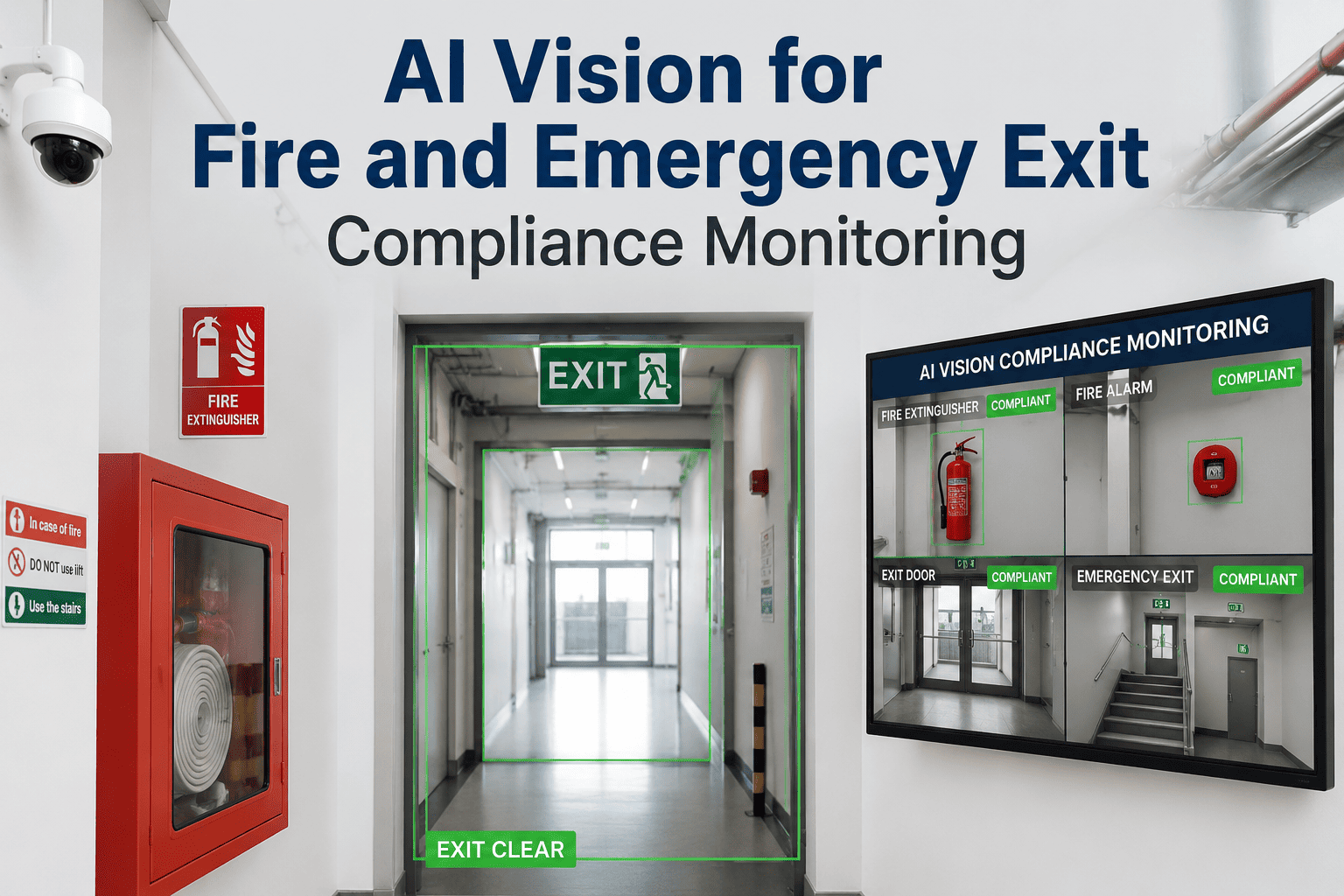
iFactory AI vision cameras verify exit clearance, aisle width, extinguisher presence, fire door position, and emergency lighting readiness continuously across your site. Fire marshal audit reports generate in one click. Turnkey deployment in 6 to 12 weeks.
Three NFPA standards, one AI vision layer that watches all of them
Fire-code enforcement in industrial facilities pivots around three interlocking NFPA standards. NFPA 101 governs the means of egress and life-safety features. NFPA 10 governs portable fire extinguisher presence, mounting, and inspection tags. NFPA 25 governs sprinkler and standpipe readiness, including the mandatory 18-inch clearance below every sprinkler head. Each is enforced by a different Authority Having Jurisdiction, but all three require the same evidence — proof that the equipment was in place and inspected on the cadence the code demands.
Governs exit access, exit discharge, corridor width (44-inch minimum), exit signage brightness, self-closing fire doors, and emergency lighting. Enforced by state fire marshals and CMS surveyors.
Requires monthly visual inspection and annual maintenance service tags. Governs extinguisher class, size, mounting height, and maximum travel distance to the nearest unit.
Mandates weekly visual sprinkler checks, quarterly functional tests, and continuous 18-inch minimum clearance beneath every sprinkler head to allow proper spray pattern.
The five NFPA 101 violations vision AI catches within seconds
SmartQHSE audit data and CMS survey findings converge on the same five NFPA 101 deficiencies as the most-cited year after year. Each one is a visual condition — meaning each one is detectable by a camera and a well-trained model, not just by a walking inspector.
Pallets, carts, equipment, or merchandise blocking exit doors or narrowing corridors below the 44-inch minimum. Blocked exits are the single most dangerous and most cited fire code violation, involved in every mass-casualty fire of the last century.
Unsealed penetrations for pipes, cables, and HVAC ducts through fire-rated walls. Found in 53% of commercial building inspections. Vision AI flags visible gaps during routine camera sweeps.
Fire doors propped open with wedges, straps, or objects. Self-closing doors that no longer latch. Vision detects any fire door held open beyond code-permitted duration and triggers a documented alert.
Extinguisher moved from its mounted location, obstructed by stored material, or with an expired monthly inspection tag visible on camera. Vision reads the tag and flags any unit past due.
Burned-out exit signs, dead battery backups, or exit signage that no longer meets the code-required brightness with 6-inch letters. Vision runs periodic dark-condition checks and reports failed units.
What every camera on your floor is now watching for
A single AI-enabled camera can enforce multiple fire-code obligations at once. Where a facility installed cameras for security or process monitoring five years ago, iFactory now runs six independent compliance zones against the same video stream — each producing its own audit-ready log.
A defined virtual boundary around every marked exit door. Any object entering that zone for more than a configurable window triggers a supervisor alert with photographic evidence.
Continuous check that primary aisles maintain the 44-inch minimum egress width, and 96 inches in healthcare corridors where stretcher movement is required by NFPA 101.
Verifies the fire extinguisher is on its mounting bracket, visible, unobstructed, and mounted within the code-permitted 3.5 to 5 foot height window from finished floor to top of unit.
Watches every fire-rated door for propped-open condition, missing door closer function, or any physical device wedging the door against its self-closing spec.
Enforces the NFPA 25 minimum 18-inch clearance beneath every sprinkler head. Racks stacked above the line, seasonal decorations, or misplaced equipment all trigger a documented alert.
Periodic verification that every visible exit sign is illuminated. Failed units, dead battery backups, and signs no longer meeting NFPA 101 brightness thresholds are flagged nightly.
Turn every camera you already own into a fire-code inspector
iFactory Fire & Emergency Exit AI ships as a pre-configured NVIDIA edge server, racked and ready. Cabling, PLC integration, camera onboarding, and operator training are included. Live in 6 to 12 weeks.
Fires that rewrote the Life Safety Code — and what they had in common
NFPA 101 exists in its current form because of a small number of catastrophic fires that exposed where earlier codes fell short. In every one of them, the failure was visible before the fire started — exits that were locked, blocked, or non-functional. AI vision is the modern answer to a very old problem.
146 workers killed in a fire where stairwell doors were locked from the outside and the single fire escape collapsed. Directly led to the founding of modern life-safety codes and the requirement that egress doors open from the inside without a key.
492 deaths in a nightclub where the main exit was a revolving door that jammed under crowd load, and secondary exits were locked or hidden behind decorative curtains. Codified the ban on revolving doors as sole exit.
165 deaths when occupants exceeded fire-code capacity by nearly four times and exit routes were insufficient for the actual crowd. Cemented the occupant load and exit capacity provisions in NFPA 101 today.
100 deaths after pyrotechnics ignited flammable interior finish. The main exit backed up in seconds while alternate exits were unfamiliar to patrons. Tightened interior finish flame-spread rules and reinforced exit visibility.
Manual walk-throughs versus continuous vision — the real coverage gap
A monthly fire-safety walk-around inspects each exit and extinguisher once every 30 days. Between those checks, the exposure window is 720 hours per obligation. Vision monitoring closes that window to seconds. The table compares practical inspection coverage across the categories most commonly cited by fire marshals and CMS surveyors.
| Compliance Point | Manual Cycle | AI Vision Cycle | Evidence Captured | Cited Code |
|---|---|---|---|---|
| Exit door clearance | Monthly walk-around | Every video frame | Time-stamped clip, floor map | NFPA 101 §7.1 |
| Aisle 44-inch minimum width | Occasional spot check | Continuous, per zone | Boundary overlay evidence | NFPA 101 §7.3 |
| Fire door propped open | Only when observed | Real-time state check | Door position log | NFPA 101 §7.2 |
| Extinguisher on bracket | Monthly inspection tag | Daily verification | Presence log with photo | NFPA 10 |
| Extinguisher tag validity | Manual tag reading | OCR every 24 hours | Tag date extracted | NFPA 10 |
| Sprinkler 18-inch clearance | Annual visual audit | Continuous zone monitor | Obstruction depth logged | NFPA 25 |
| Exit sign illuminated | Monthly button test | Nightly dark-check | Brightness measurement | NFPA 101 §7.10 |
| Emergency lighting active | Monthly 30-second test | Nightly automated check | Illumination confirmed | NFPA 101 §7.9 |
A blocked exit becomes a resolved corrective action in under one hour
A camera alert alone does not close a citation. iFactory routes every fire-code detection into a full corrective-action workflow — resolution verification, immutable audit stamp, and a one-click fire marshal report at the end. The full loop runs in under an hour for most detections.
Camera stream processed by the edge server. Object detector identifies obstruction and cross-references it against the compliance zone boundary for that camera.
Condition must persist across dwell time to filter transient events like a forklift passing through. Default dwell is 30 seconds for exit doors.
Alert delivered to on-shift supervisor via mobile with clip and specific NFPA reference. High-severity events also trigger on-site strobe or PA message.
Corrective action ticket auto-created and assigned. Resolution requires the vision model to re-verify the zone is clear before ticket can be closed.
Fire marshal or CMS surveyor requests audit trail. iFactory generates the full log with clip evidence in one click, aligned to the cited NFPA section.
Common questions from safety and facilities leaders
Does AI vision replace the fire marshal or the required NFPA-mandated inspections?
No. AI vision monitoring is a compliance-assurance layer that sits on top of the fire marshal's periodic inspection, the required monthly extinguisher checks under NFPA 10, and the sprinkler inspections mandated by NFPA 25. Physical inspections by qualified personnel remain the legal baseline in every jurisdiction. What vision AI adds is continuous evidence that the equipment, exits, and aisles stayed in compliance between those scheduled inspections — the gap where nearly every major fire event has occurred. Safety leaders can book a working session to see a live audit report before scoping deployment.
Can we use our existing CCTV cameras, or do we need to buy new hardware?
iFactory Fire & Emergency Exit AI works with any IP camera that produces a standard RTSP video stream, which covers the vast majority of security and surveillance cameras installed in industrial facilities in the last decade. During scoping, our team reviews your existing camera placement against the exits, extinguishers, and sprinkler locations that need coverage. In practice, 70 to 90 percent of required coverage is already present. Where new cameras are needed for a specific sightline, our team specifies and installs them as part of the turnkey delivery. A free camera-coverage assessment is available through our support team.
How does the system handle forklifts or people that briefly pass in front of an exit?
Transient movement in front of an exit is expected during normal operations and should not trigger a compliance alert. Every detection zone runs a dwell-time filter that requires the obstruction to persist across a configurable window before the alert fires. Defaults are 30 seconds for exit doors, 90 seconds for extinguisher obstruction, and 5 minutes for aisle-width narrowing — every threshold is tunable to your operating rhythm. In production, plants see 0.8 to 1.5 verified alerts per camera per day after tuning — a manageable review load for one shift supervisor.
What documentation does the system produce for a fire marshal or CMS survey?
The compliance log captures every detection event, response action, resolution timestamp, and evidence clip, indexed by the specific NFPA section relevant to the finding. When a fire marshal or CMS surveyor requests documentation of exit clearance, extinguisher inspection, or sprinkler clearance compliance, the report generates in one click and includes a video snippet for every flagged event along with the corrective action record. Retention defaults to five years to align with NFPA and OSHA record-keeping guidance. Facilities preparing for a scheduled survey often walk through a sample audit report ahead of the survey window.
How long does deployment take across a multi-site facility footprint?
A single-site deployment runs 6 to 12 weeks from purchase order to live plant-wide monitoring. The turnkey pathway includes camera onboarding, edge server installation, compliance zone configuration, dwell-time tuning, operator training, and the first fire marshal report cycle. Multi-site rollouts scale linearly — a five-site footprint typically reaches full coverage in 4 to 6 months, with each site inheriting compliance templates from the initial pilot. Facilities that want to validate the value on one site first choose the 6-week pilot pathway, credited toward full deployment. Planning starts with a support scoping call.
Stop treating fire-code compliance as a monthly walk-around
Every camera you already own becomes a continuous inspector for exit clearance, aisle width, extinguisher presence, fire door position, sprinkler clearance, and emergency lighting readiness. Fire marshal audit reports generate in one click. Turnkey delivery in 6 to 12 weeks across 1000+ deployed plants.