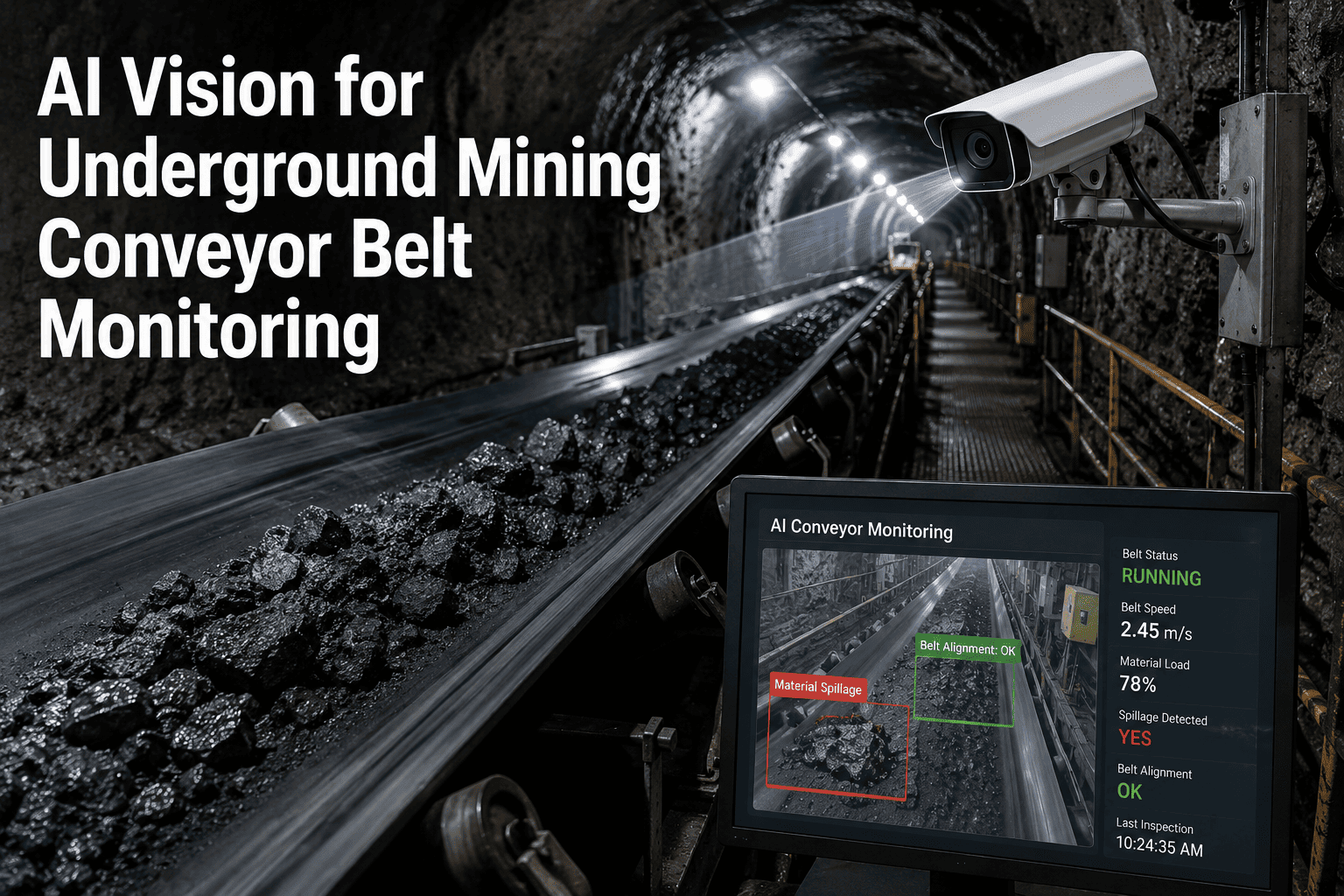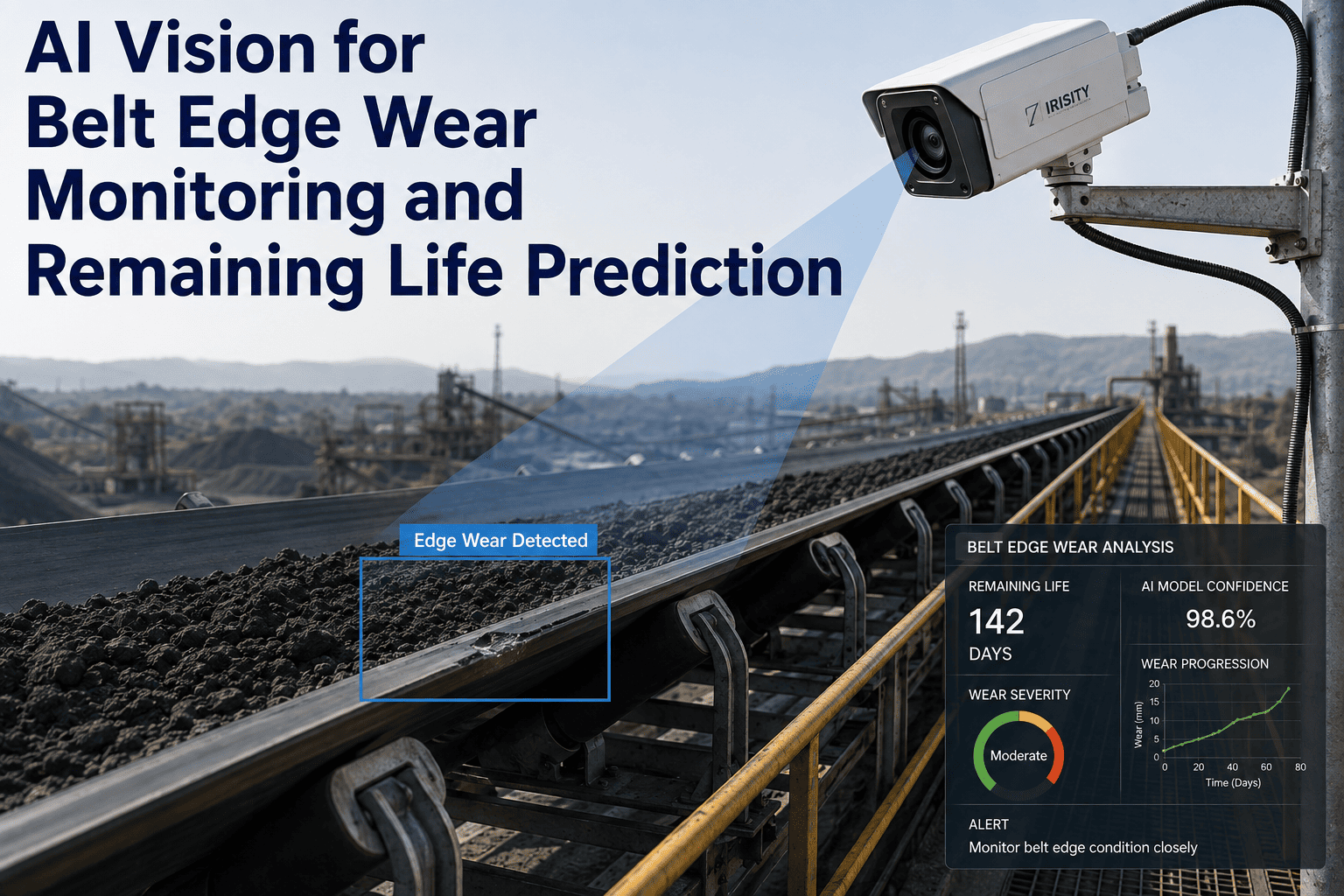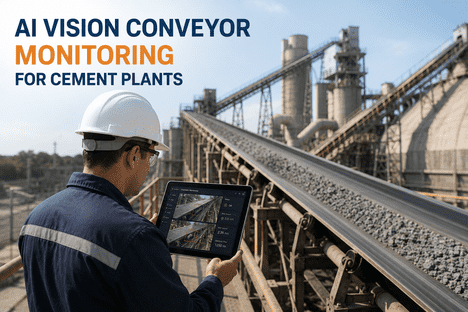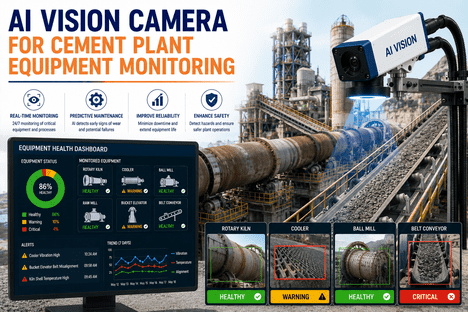
A cement plant's rotary kiln, conveyor network, and clinker cooler are simultaneously the highest-value and highest-consequence assets in the entire production chain. The kiln alone runs continuously at temperatures above 1,450°C in the burning zone, protected from catastrophic shell failure only by refractory brick that degrades with every rotation — and a single unplanned kiln shutdown costs between $500,000 and $1.5 million in lost production per day, before factoring in emergency relining, expedited brick procurement, and downstream process disruption. Conveyor belts handling abrasive clinker across 5 to 15 kilometres of plant infrastructure face belt tears, hot fragment ignition, misalignment, and splice failure modes that manual walkdowns — covering each belt line for 20 minutes once per shift — cannot reliably prevent. Human inspectors working 24/7 shifts catch roughly 80% of detectable defects on a good shift, and that number drops sharply with fatigue. iFactory's AI Vision Camera eliminates this detection gap by deploying combined thermal and visual deep learning models directly on edge hardware across kilns, conveyors, and clinker coolers — monitoring continuously at sub-200ms inference latency, generating automated CMMS work orders the instant an anomaly is detected, and operating 24/7 without fatigue, shift changes, or visibility limitations.
See How iFactory AI Monitors Your Kiln, Conveyors, and Cooler Around the Clock
iFactory's AI Vision Camera deploys thermal and visual monitoring across cement plant critical assets — detecting hot spots, belt tears, and refractory degradation in real time with automated CMMS work order generation and zero manual inspection overhead.
Rotary Kiln Shell and Refractory Degradation: Detecting Hot Spots 30+ Days Before Failure
The rotary kiln is the single most expensive, highest-consequence asset in any cement plant — and refractory failure is its most dangerous and costly failure mode. A hot spot that develops and reaches critical 380°C can escalate to a red kiln emergency within 72 hours. Monthly handheld pyrometer readings miss the entire degradation curve; your first signal becomes a red shell alarm by which point emergency action is already too late for a planned response. iFactory's AI thermal vision camera system provides full-field coverage of the entire kiln shell surface with a fixed installation, capturing thermal data at every pixel and processing it through deep learning models trained on labelled datasets of normal operation, coating loss, refractory thinning, and critical hot spot patterns. The system detects developing hot spots 30 or more days before they become emergencies, tracks refractory wear progression across the full campaign, and generates CMMS maintenance work orders for targeted zone repair — replacing the reactive emergency reline cycle with a condition-based programme that extends refractory campaign life by 30% and reduces unplanned shutdowns by 40 to 55%. Book a Demo to see how iFactory maps kiln shell thermal profiles on a live cement plant deployment.
Hot Spot Detection and Alerting
AI thermal models continuously scan every zone of the kiln shell — burning zone, transition zone, and inlet — alerting operators the instant shell temperatures trend above zone-specific thresholds. Temperature trend analysis distinguishes rapid escalation requiring immediate action from slow-developing wear that allows planned intervention scheduling, eliminating both false alarms and missed critical events.
Refractory Lining Wear Tracking
Convolutional neural network models correlate thermal surface patterns with refractory lining thickness across each kiln zone. Degradation rate trending provides remaining campaign life predictions that convert calendar-based reline schedules — which retire 15 to 25% of remaining brick life unnecessarily — to condition-based programmes timed to actual wear, saving $180,000 to $400,000 per zone per campaign cycle.
Coating Loss and Brick Spalling
Protective coating on refractory brick stabilises the lining and reduces heat transfer to the steel shell. Coating loss events — visible as localised temperature spikes over otherwise normal background — are detected within seconds of onset. AI models distinguish coating loss from ring formation, each of which requires a different operational response, reducing the risk of incorrect interventions that accelerate lining damage.
Shell Ovality and Deformation
Shell ovality above 0.5% of kiln diameter crushes refractory brick at tight spots, silently shortening lining life by months without any visible surface indication detectable by manual inspection. iFactory's thermal imaging combined with rotational position data tracks ovality progression and tyre creep across kiln rotations, providing the mechanical deformation intelligence that thermal data alone cannot supply.
Tyre and Riding Ring Condition
Kiln tyre misalignment, creep, and contact surface wear are primary contributors to both refractory damage and kiln drive system overloading. AI vision monitors tyre contact geometry and thermal patterns at the tyre-riding ring interface continuously — detecting tyre migration and contact irregularities that precede the accelerated brick damage and shell stress cracking that result from uncorrected tyre misalignment.
CMMS Integration and Work Order Automation
Every kiln anomaly detected by iFactory's thermal AI automatically generates a structured CMMS work order with zone location, current temperature, trend data, and recommended intervention — whether targeted refractory patch, operational load reduction, or scheduled shutdown planning. Maintenance teams act on data-driven work orders rather than operator intuition, with full thermal evidence attached for post-repair validation and campaign record documentation.
Kiln Monitoring Performance: Manual Inspection vs. iFactory AI Vision
Cement plants deploying iFactory AI Vision Camera for kiln shell monitoring document consistent improvements across the critical reliability KPIs that determine refractory campaign cost and unplanned shutdown frequency.
| Kiln Monitoring KPI | Manual / Pyrometer | iFactory AI Vision | Improvement |
|---|---|---|---|
| Hot Spot Detection Lead Time | 0–3 days (shift rounds) | 30+ days advance warning | 10× earlier detection |
| Refractory Campaign Life | Baseline | +30% extension | 30% longer campaigns |
| Unplanned Kiln Shutdowns | Baseline frequency | 40–55% reduction | ~50% fewer stoppages |
| Annual Energy Loss from Refractory Damage | Unmonitored | 5–8% annual reduction | Measurable energy saving |
| System Investment Payback Period | N/A | 6–9 months | Within first campaign |
Conveyor Belt AI Monitoring: Belt Tears, Hot Clinker, Misalignment, and Surface Wear
A cement plant's conveyor network is its circulatory system — limestone from the quarry, raw meal to the preheater, clinker from the cooler, and finished cement to the silo all pass through conveyors multiple times before leaving the plant. A single belt tear that goes undetected for 20 minutes can cascade into a full kiln feed interruption costing $50,000 to $200,000 in lost production, emergency belt repairs, and material waste. Hot clinker fragments discharging from the cooler onto the belt surface are the primary ignition source for conveyor belt fires — a risk that manual thermal scanning once per shift cannot prevent on a 24/7 plant. iFactory's AI Vision Camera deploys combined thermal and visual cameras above every critical conveyor span, monitoring belt movement, surface condition, and material temperature continuously — detecting misalignment, hot fragments, belt tears, splice degradation, and spillage patterns in real time with automated CMMS alerts dispatched before any condition escalates to a production stoppage.
Belt Tear and Longitudinal Split Detection
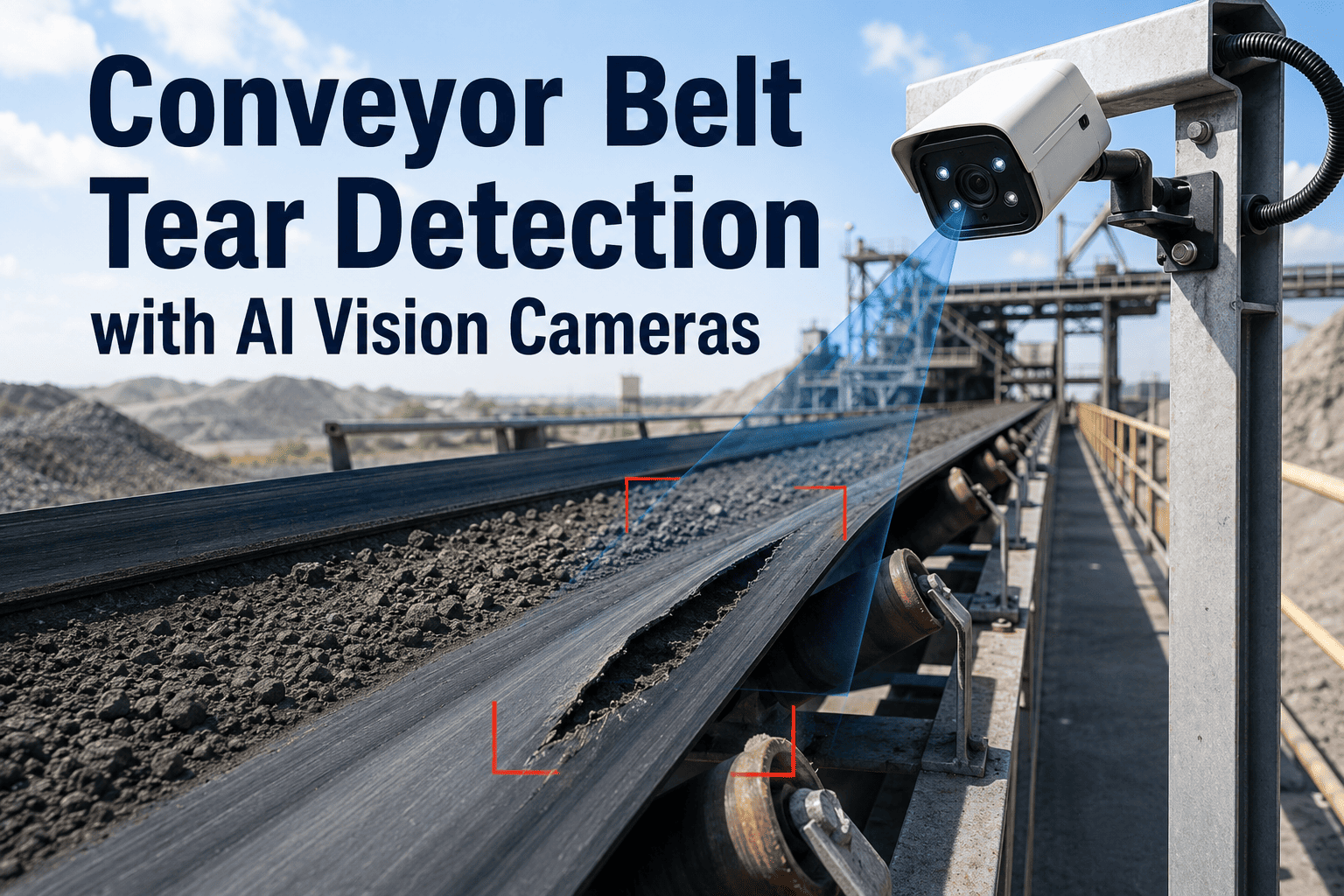
Deep learning vision models monitor belt surface texture and edge profiles continuously — detecting longitudinal tears, edge cracking, cord exposure, and surface gouges frame by frame at conveyor operating speed. A hairline longitudinal tear forming on the belt return side at night grows for hours before a morning walkdown catches it; AI vision catches it within the first frame of propagation and generates a maintenance alert before the damage extends beyond repair.
Hot Clinker Fragment Detection on Cooler Exit Conveyors
Combined thermal-visual AI identifies clinker fragments exceeding safe belt temperature thresholds as they discharge from the cooler onto the conveyor. Detection triggers immediate alerts to the control room for cooler adjustment before hot clinker accumulates on the belt surface and creates ignition conditions. This application is specific to the cooler exit conveyor — the highest fire-risk conveyor in the cement plant — where thermal monitoring alone without AI classification generates excessive false positives from ambient heat variation.
Belt Misalignment and Tracking Detection
Belt tracking failure — where the belt drifts laterally off the conveyor idler profile — is the leading cause of edge wear, belt contact with structure, and carryback accumulation on return rollers. AI vision monitors belt centreline position continuously, detecting mistracking trends before they reach the lateral displacement threshold that damages belt edges or causes material spillage. Automated alerts allow tracking adjustment during normal operation rather than emergency stoppage.
Idler Thermal Monitoring and Splice Condition Tracking
Thermal imaging identifies hot rollers from seized or failing bearings 2 to 4 weeks before failure — providing the intervention window that prevents a frozen idler from causing a belt friction fire. Vision models simultaneously monitor splice condition at vulcanised and mechanical splice points — the weakest link in any belt — tracking degradation from belt flex fatigue and impact loading that precedes sudden splice separation and immediate production stop.
Clinker Cooler AI Vision: Snowman Formation, Red River, and Cooler Efficiency Monitoring
The clinker cooler is the thermal interface between the kiln burning zone and the downstream conveyor and grinding circuit — and two of its most disruptive failure modes, snowman formation and red river, develop at the cooler inlet in conditions where direct human observation is impractical and periodic inspection completely ineffective. Snowman formation — a buildup of agglomerated clinker at the cooler inlet — progressively restricts clinker flow, reduces cooler efficiency, and creates uneven material distribution that increases thermal stress on cooler grates. Red river events — where incandescent clinker channels laterally across the cooler bed — indicate severe cooling airflow distribution failure and represent an immediate fire and mechanical damage risk. iFactory AI Vision Cameras mounted at cooler inlet and mid-cooler observation points detect the visual signatures of both conditions in real time — enabling operators to intervene at the process level through airflow adjustment and kiln feed rate modulation before the condition escalates to a cooler stoppage. Material spillage detection, grate wear monitoring, and cooler exit temperature trending complete the AI vision coverage of this critical asset. Book a Demo to see how iFactory monitors your clinker cooler in a live cement plant environment.
Cement Plant Equipment Coverage: iFactory AI Vision Monitoring Scope
iFactory AI Vision Camera monitoring spans the full range of high-consequence cement plant assets. The table below maps equipment types to the primary failure modes, AI detection capabilities, and operational outcomes specific to each application.
| Equipment | Primary Failure Modes Monitored | AI Camera Type | Operational Outcome |
|---|---|---|---|
| Rotary Kiln Shell | Hot spots, refractory thinning, coating loss, ovality, tyre misalignment | Thermal imaging — fixed full-shell coverage | 30+ day advance warning; 30% longer refractory campaigns; 40–55% fewer emergency shutdowns |
| Conveyor Belts | Belt tears, misalignment, splice wear, hot clinker fragments, idler failure, spillage | Combined thermal + visual — span and transfer point cameras | Real-time tear and fire risk detection; 14-day idler failure warning; zero missed events between walkdowns |
| Clinker Cooler | Snowman formation, red river events, grate wear, airflow distribution failure | Thermal + visual — inlet and mid-cooler observation points | Early snowman and red river detection; process intervention before cooler stoppage |
| Raw Mill and Cement Mill | Feed material oversized rocks and tramp metal, inlet blockages, shell thermal anomalies | Visual — feed belt and inlet inspection cameras | Tramp metal and oversize detection before crusher and mill damage; blockage prevention |
| Transfer Points and Chutes | Material buildup, spillage, chute blockages, dust emission exceedances | Visual — fixed point cameras at all major transfer stations | Blockage and spillage detected before complete transfer failure; environmental compliance monitoring |
How iFactory AI Vision Camera Deploys Across Cement Plant Critical Assets
The core advantage of iFactory's approach over traditional condition monitoring in cement plants is the combination of thermal and visual deep learning in a single platform — deployed on edge hardware that processes video feeds locally inside the plant environment without cloud dependency, integrates with existing PLCs and SCADA systems via standard OPC-UA and Modbus protocols, and connects directly to CMMS work-order queues to close the loop from detection to maintenance action without manual data entry. In the harsh cement plant environment — where clinker dust infiltrates every sensor housing, ambient temperatures near the kiln exceed 200°C, and heat shimmer creates visual noise that defeats conventional rule-based vision systems — iFactory's deep learning models are specifically trained on cement plant production imagery to maintain over 95% detection accuracy under these exact conditions.
Camera Installation Across Priority Assets
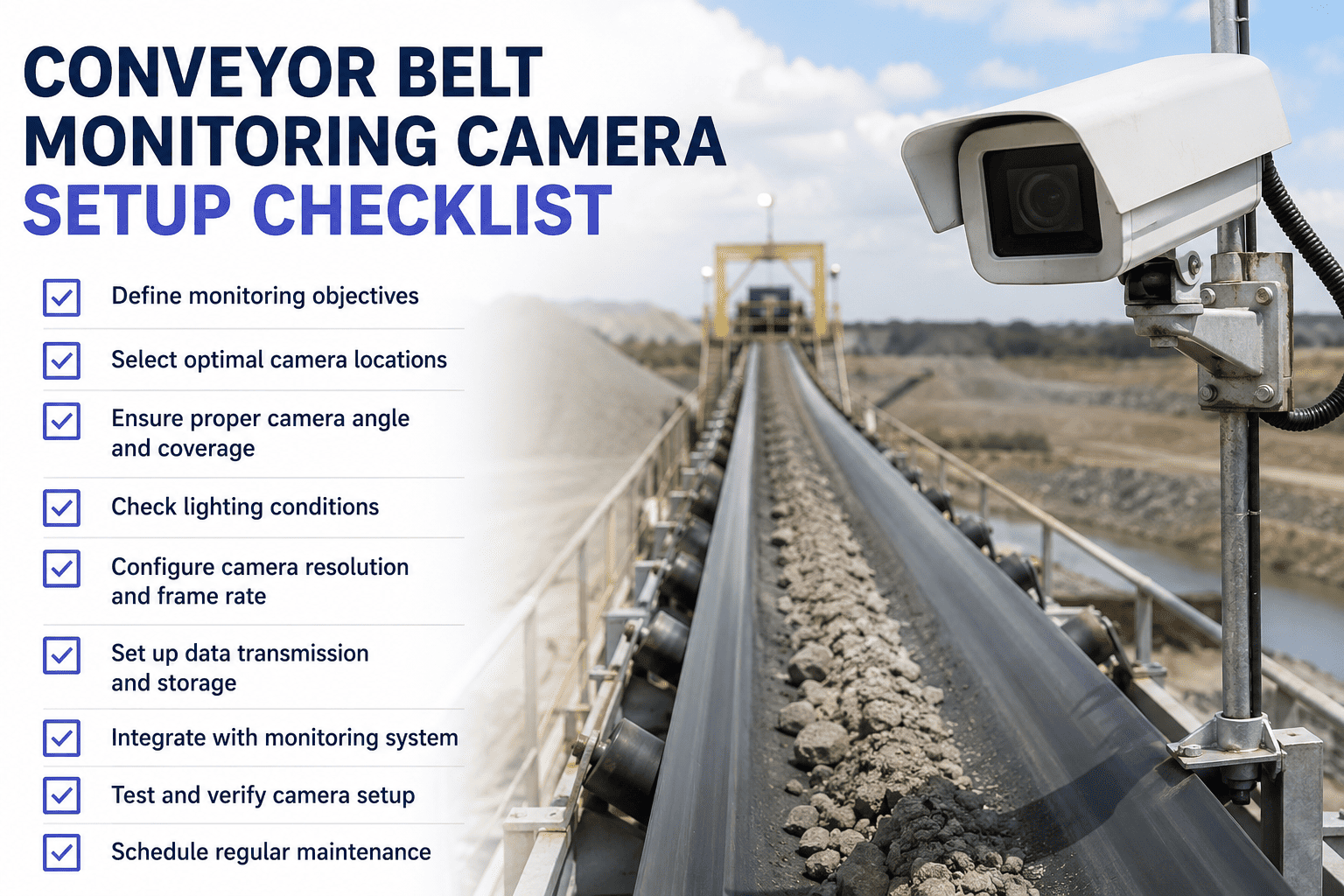
IP68-rated thermal and visual cameras with positive-pressure dustproof housings are installed at kiln observation points, conveyor span and transfer locations, and clinker cooler inlet positions. Installation uses existing plant access infrastructure and requires no process shutdown. Camera positioning is engineered for optimal coverage of the specific failure mode at each location — not generic mounting that misses the critical detection zone.
Edge AI Baseline Learning and Model Calibration
iFactory's pre-trained deep learning models — trained on cement plant-specific thermal and visual defect datasets — establish normal operating baselines for each asset within the first two to three weeks of continuous operation. Anomaly detection thresholds are calibrated against actual plant operating conditions, kiln zone temperatures, and belt speed parameters. Active learning from confirmed plant-specific anomalies continuously improves detection accuracy beyond the initial pre-trained baseline.
Real-Time Anomaly Detection and CMMS Work Order Generation
Once the baseline is established, every detected anomaly — kiln hot spot, belt tear, cooler snowman formation, hot idler — automatically generates a prioritised CMMS work order with asset ID, anomaly type, severity classification, thermal evidence image, and recommended action. Work orders are dispatched to maintenance teams via mobile alert and integrated into the plant's CMMS platform via standard API protocols. No manual step exists between detection and dispatch.
Campaign Analytics, Trend Reporting, and Compliance Documentation
iFactory continuously aggregates kiln shell thermal history, conveyor condition trends, and cooler performance data into per-asset campaign records — providing the long-term degradation rate intelligence that refractory scheduling decisions, belt replacement planning, and maintenance budget forecasting require. Full inspection history with timestamped visual and thermal evidence satisfies ISO 9001 and environmental compliance documentation requirements without any manual report aggregation overhead.
"Our kiln monitoring relied on manual thermal gun readings once per shift — and we discovered critical refractory wear patterns only after they had progressed to a red kiln alarm twice in 18 months. After deploying iFactory AI Vision Camera on the kiln shell, we received our first predictive hot spot alert 34 days before the affected zone would have required emergency intervention. We completed a targeted zone repair during our planned turnaround, avoided a $1.2 million emergency shutdown, and extended that campaign by four months. The platform paid for itself on that single event alone."
AI Vision Camera for Cement Plants: Common Questions
Q: Can iFactory AI Vision Camera operate reliably in the dusty, high-temperature environment of a cement plant?
Yes. iFactory cameras use IP68-rated housings with positive-pressure air purging that prevents clinker dust infiltration — the primary cause of standard IP65 sensor failure within months in cement environments. Deep learning models are specifically trained on cement plant imagery that includes dust haze, heat shimmer, and low-visibility conditions near the kiln and cooler, maintaining over 95% detection accuracy under these exact operating conditions.
Q: How does the kiln shell thermal monitoring differ from a standard infrared pyrometer line scanner?
Standard pyrometer line scanners provide single-line cross-sectional temperature profiles that require kiln rotation to build a surface map over time. iFactory's AI thermal vision camera captures full-field thermal imagery of the entire visible kiln shell surface simultaneously, feeding the complete temperature matrix through deep learning anomaly detection models in real time. This enables detection of developing hot spots at their earliest stage — before they appear in pyrometer trend data — with AI classification that distinguishes refractory thinning from coating loss and ring formation, each requiring a different operational response.
Q: Does iFactory AI Vision require new cameras to be installed, or can it use existing plant camera infrastructure?
iFactory's edge AI processing unit can connect to existing ONVIF-compatible IP cameras already installed on conveyor lines and process areas — adding AI detection intelligence to camera infrastructure the plant has already invested in. For kiln shell thermal monitoring and clinker cooler inspection, dedicated thermal imaging cameras are required, as standard visible-spectrum cameras cannot provide the temperature data these applications depend on. Retrofitting existing cameras for conveyor monitoring significantly reduces the total deployment investment for most cement plants.
Q: How does iFactory integrate with our existing CMMS and DCS systems?
iFactory integrates with CMMS platforms via standard REST API and webhook protocols — automatically creating prioritised work orders for every confirmed anomaly without manual data entry. DCS and SCADA integration is achieved via OPC-UA and Modbus protocols, enabling iFactory anomaly events to trigger control room alerts and optional automated process responses within existing plant control infrastructure. Integration with major CMMS platforms is typically complete within the first two weeks of deployment alongside camera installation.
Q: What is the typical ROI timeline for a cement plant deploying iFactory AI Vision Camera?
Most cement plant deployments achieve full system investment recovery within 6 to 9 months. Refractory material savings from targeted zone repair versus calendar-based wholesale reline account for 20 to 30% of the ROI calculation. Emergency shutdown avoidance — each prevented unplanned kiln stop saves $500,000 to $1.5 million — typically represents the largest single value driver and often recovers the entire investment on a single event. Conveyor belt fire prevention and belt life extension contribute additional savings that compound across the first operating year.
Q: How long does a full cement plant deployment take, and is production shutdown required?
A full cement plant deployment covering kiln, conveyor, and clinker cooler monitoring is typically complete within two to three weeks. Camera and edge hardware installation is scheduled during existing plant access windows and requires no production shutdown at any stage. The AI model is pre-trained on cement plant-specific imagery and begins generating classifications from the first day of operation, with site-specific baseline learning and active model refinement running continuously through the first month to reach optimal detection accuracy for each plant's specific operating conditions.
AI Vision Camera Is Now the Operational Standard for Cement Plant Critical Asset Monitoring
The rotary kiln, conveyor network, and clinker cooler are simultaneously the most capital-intensive and most failure-vulnerable assets in any cement plant. Manual inspection programmes — however diligently executed — cannot provide the continuous, fatigue-free, sub-200ms detection coverage that prevents the $500,000-plus production events that unplanned kiln shutdowns, conveyor belt fires, and cooler stoppages generate. iFactory's AI Vision Camera closes this gap with a platform purpose-built for the cement plant environment: thermal and visual deep learning models trained on cement production imagery, IP68-rated hardware built for clinker dust and kiln-zone heat, edge inference that requires no cloud connectivity, and direct CMMS integration that converts every detection into a maintenance work order without manual intervention. Cement plants deploying iFactory achieve 30% longer refractory campaigns, 40 to 55% fewer unplanned kiln shutdowns, real-time belt tear and fire risk detection, and a continuous audit-ready asset monitoring record — all within a 6 to 9 month investment payback window. For plant directors, reliability engineers, and maintenance managers serious about converting reactive emergency response into planned condition-based maintenance, the operational case is clear. Book a Demo with an iFactory specialist and receive a site-specific monitoring coverage plan and ROI estimate benchmarked against your kiln throughput, conveyor network, and current maintenance programme costs.
Ready to Monitor Your Kiln, Conveyors, and Clinker Cooler 24/7 with AI Vision?
Connect with an iFactory specialist today. Get a site-specific monitoring plan, a refractory campaign ROI estimate, and a deployment roadmap for your cement plant's critical assets — no obligation, no pressure.