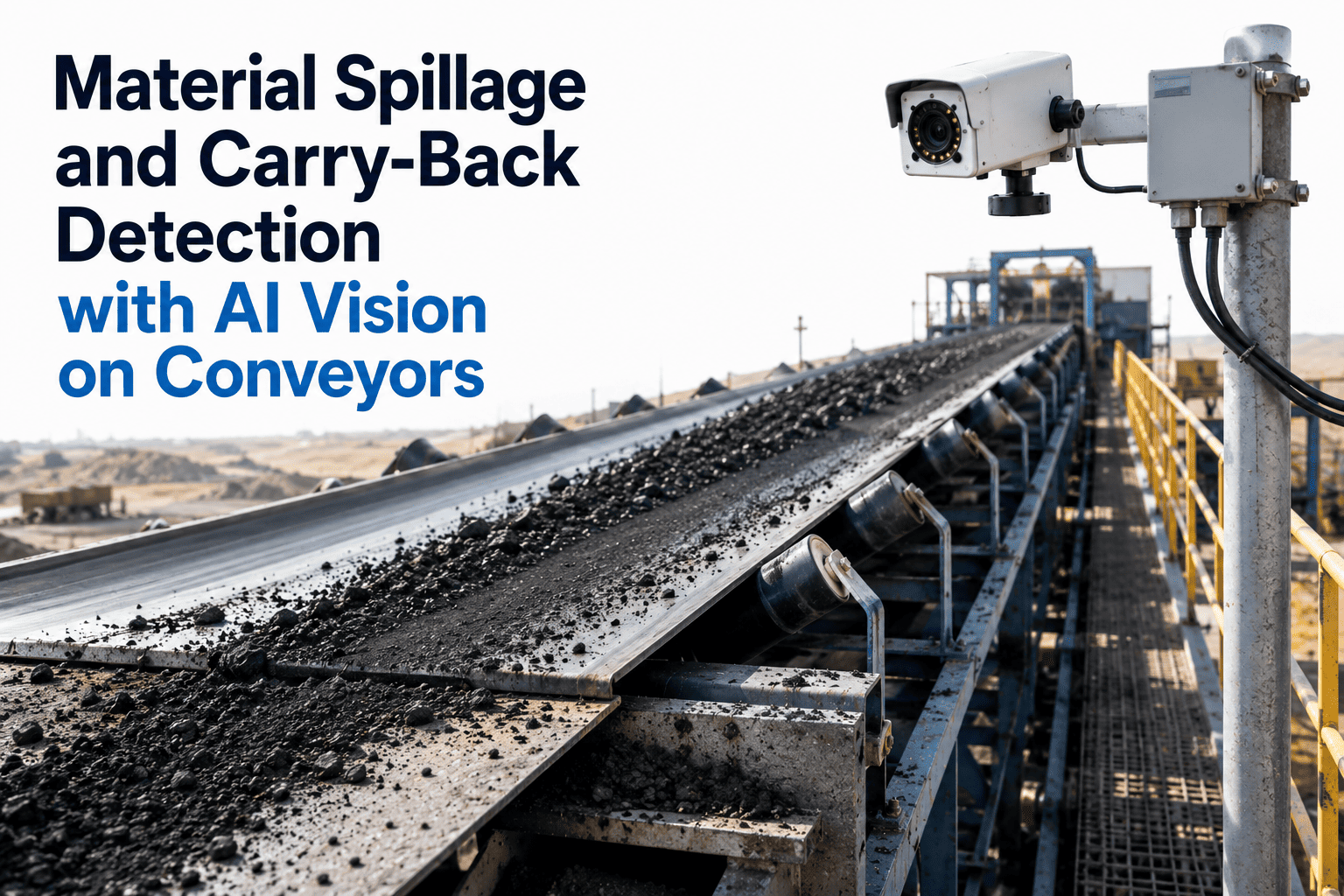
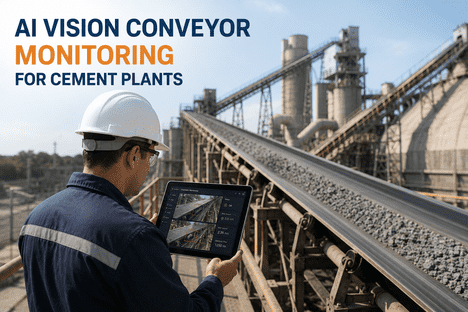
A cement conveyor rarely fails without warning. A belt that runs true for months starts drifting a few millimeters off-center, a clinker fragment leaves the cooler a little hotter than it should, dust builds up at a transfer point one shift at a time, and nobody notices until the belt edge frays, a fire starts, or the line stops mid-run. Manual thermal gun surveys and walk-by inspections catch these conditions only after they have already cost hours of output, because a human can check a belt once a shift while the belt itself runs continuously. Combined thermal-visual AI watches the entire belt width, every rotation, catching misalignment, hot clinker, spillage, and surface wear while they are still cheap to fix. Plant teams evaluating this can contact support to review it against their own conveyor layout.
CEMENT PLANT · CONVEYOR & MATERIAL FLOW AI
Watch Every Meter Of Belt, Every Rotation
Thermal-visual AI vision built for cement conveyors, catching belt misalignment, hot clinker, spillage, and surface wear before they become fires or stoppages.
Why Cement Conveyors Break Down Differently
Cement conveyors run in conditions that would destroy standard industrial equipment. Clinker exits the cooler at 100 to 200 degrees Celsius, dust infiltrates every bearing and roller within months, and material is one of the most abrasive substances any belt handles, wearing three to five times faster than in general manufacturing. On top of that, most cement conveyors run continuously across hundreds of meters outdoors, through weather extremes that manual inspection schedules were never designed to keep pace with.
A single belt replacement on a medium-length conveyor runs fifty thousand to two hundred thousand dollars in materials and labor, and the unscheduled downtime to swap it can exceed twenty four hours. Every one of those failures starts small enough for a camera to catch, days or weeks before it becomes a shutdown.
The Conveyor, Zone By Zone
A cement conveyor has four points where nearly every failure originates. Thermal-visual AI watches all four simultaneously, rather than relying on a technician to walk the full length and check each one in turn.
Zone 1
Cooler Discharge Point
Hot clinker fragments exit the cooler and land on the belt, where insufficiently cooled pieces can ignite the belt surface or nearby dust within minutes.
Belt Run & Idlers
Zone 2
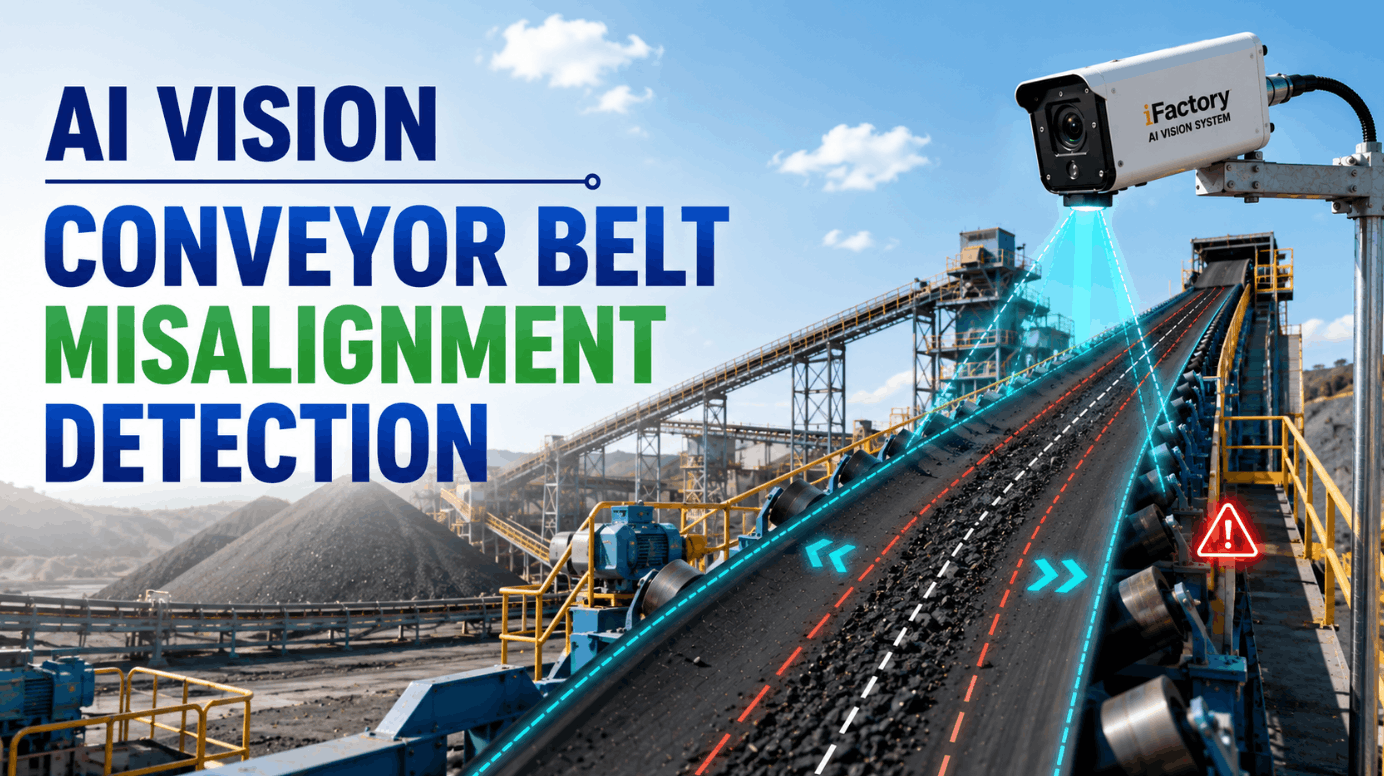
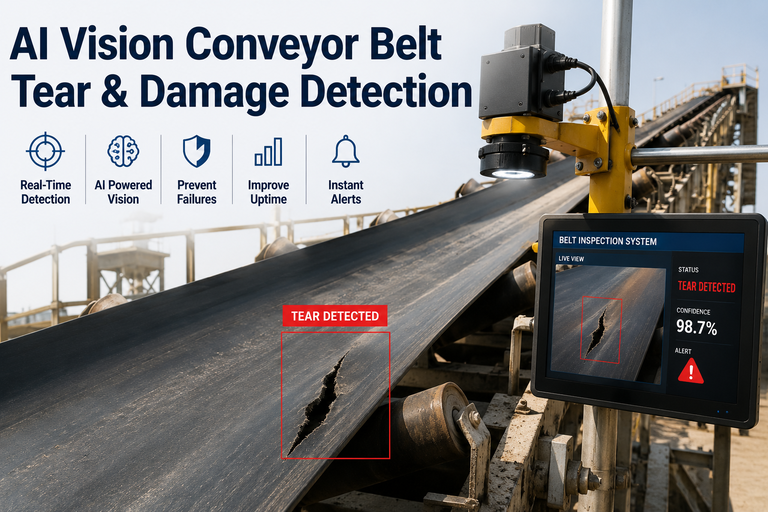
Tracking deviations, roller misalignment, and surface wear develop gradually across the belt run, worsening with every rotation if left uncorrected.
Zone 3
Transfer Points
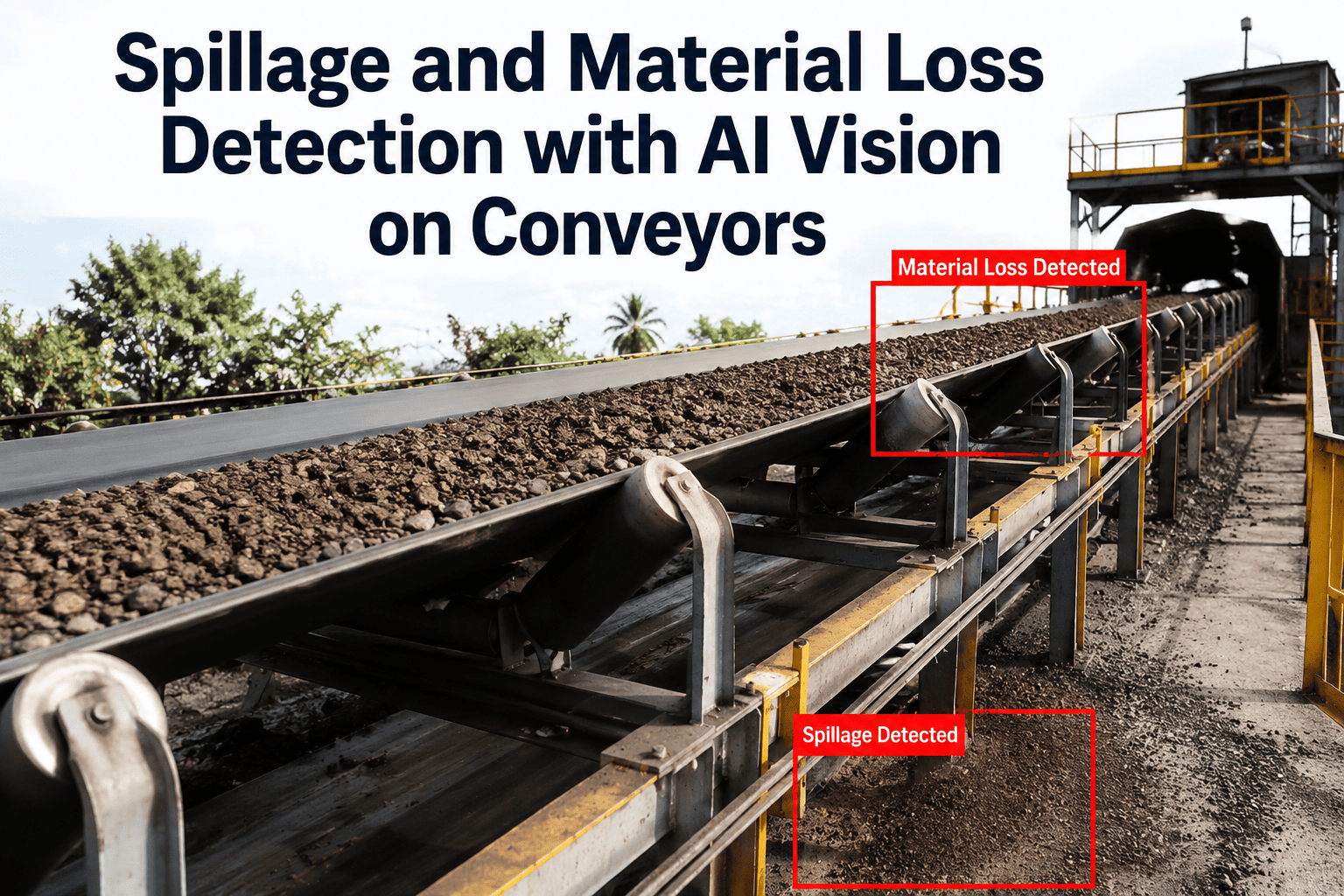
Material spillage accumulates fastest where one conveyor feeds another, creating housekeeping hazards and signaling upstream loading problems.
Zone 4
Return Rollers & Tail End
Carryback material and off-center loading at the tail end are the most common root causes of belt mistracking further down the line.
How A Belt Fire Actually Develops
Cement conveyor fires rarely start from nothing. They follow a recognizable progression, and each stage gives a widening window for a thermal-visual system to catch it before the next stage begins.
Stage 1 — Under-Cooled Fragment
A clinker fragment leaves the cooler above the safe belt temperature threshold, often too small for a single-point thermometer to catch across the full belt width.
Stage 2 — Residual Heat Transfer
Heat transfers into the belt surface and surrounding dust over several minutes of continued contact as the fragment travels along the belt.
Stage 3 — Smoldering Onset
Belt material or accumulated dust begins to smolder, often invisible to the naked eye until smoke becomes noticeable to nearby personnel.
Stage 4 — Open Flame
Flame can travel along a belt at speeds exceeding one hundred meters in minutes, threatening structure, cabling, and adjacent equipment.
THERMAL-VISUAL FIRE PREVENTION
Catch It At Stage 1, Not Stage 4
See how combined thermal and visual detection flags an under-cooled clinker fragment the moment it discharges onto the belt.
Four Failure Modes, One Camera System
Why Thermal Alone, Or Visual Alone, Falls Short
Single-point infrared thermometers measure only a narrow strip near the center of the belt and can miss small hot fragments traveling along the edges. Visual-only cameras, meanwhile, cannot distinguish a genuinely hot clinker fragment from ordinary dark material under dusty lighting conditions. Combining both sensing modes closes that gap, letting the system confirm a real thermal anomaly against what the camera sees happening on the belt surface, rather than triggering false alarms on shadow or dust alone.
Thermal Layer
Full-width scanning instead of a single center point
Flags fragments exceeding safe belt temperature
Detects residual heat before ignition begins
Visual Layer
Tracks belt edge position and tracking drift
Measures spillage volume at transfer points
Identifies surface fraying and wear patterns
Built To Survive Cement Plant Conditions
Standard industrial cameras fail fast in a cement environment, so deployment matters as much as the model behind it. Camera housings use positive-pressure enclosures that blow filtered air across the lens to keep cement dust from settling on the glass, and the AI models themselves are trained to compensate for dust-obscured frames rather than assuming a clean line of sight. A typical rollout runs on turnkey NVIDIA edge hardware sized to conveyor length and camera count, installed without a production shutdown, and validated against real belt conditions over a six to twelve week deployment roadmap.
What Plant Reliability Teams Are Saying
We used to find hot spots the same way we always had, someone walking the gallery with a handheld thermal gun once a shift. That gap is exactly where a fire starts. Since the cameras went in, we catch fragments the gun would have missed entirely, and our maintenance team stopped getting surprised.
Reliability Manager, Integrated Cement Plant
CONVEYOR & MATERIAL FLOW MONITORING
See Your Own Conveyor Zones Mapped
Walk through how thermal-visual AI would monitor your specific cooler discharge, belt run, and transfer points.
Frequently Asked Questions
How does the system tell a hot clinker fragment from ordinary dark material?
The thermal layer measures actual surface temperature across the full belt width rather than relying on visual color or shading, so a genuinely hot fragment is confirmed against a defined safe temperature threshold rather than guessed at from appearance. The visual layer then cross-references the same location to rule out shadows, dust clouds, or lighting artifacts that could otherwise trigger a false alarm. This combination is specifically why thermal-only and visual-only systems each fall short on their own in a dusty, high-heat cement environment.
Can this detect belt misalignment before it causes visible edge damage?
Yes, tracking deviations as small as fifteen millimeters can be identified well before the belt edge makes contact with the structure or begins fraying. Because the system tracks edge position continuously across every rotation rather than during a periodic walkdown, developing misalignment shows up as a trend over hours or days, giving maintenance teams time to schedule a correction during a planned stop instead of reacting to belt damage that has already occurred.
How does the camera housing survive the dust and heat in a cement plant?
Camera enclosures are built with positive-pressure housings that continuously blow filtered air across the lens surface, preventing cement dust from settling and obscuring the view over time, which is the primary failure point for standard industrial cameras in this environment. Enclosures also carry high ingress-protection ratings suited to outdoor, high-dust conditions, and the underlying AI models are trained specifically to remain accurate even when frames include some residual dust haze. Teams can review housing specifications for their specific zones through
support.
Does this replace our existing thermal gun surveys entirely?
Most plants transition gradually rather than removing manual surveys on day one. Continuous camera coverage catches conditions between shifts that a periodic walkdown structurally cannot, since a human can only check a belt once every few hours while the belt itself never stops moving. Many teams keep manual surveys in place initially as a secondary check, then scale back their frequency once the camera system has demonstrated it reliably catches the same conditions earlier and with full-width coverage rather than a single center-line reading.
How long does deployment take across a full conveyor network?
A pilot on one or two critical conveyors, typically the clinker transport and primary crusher discharge lines, is usually live within two to four weeks, since these carry the highest fire and wear risk and give the clearest validation of accuracy. Full deployment across an entire conveyor network generally follows a six to twelve week roadmap, scaled by total belt length and camera count, and installation is designed to avoid requiring a full production shutdown. Plant teams can
book a demo to see a rollout plan scoped to their own conveyor layout.
AI VISION CONVEYOR MONITORING
Stop Losing Belts To Damage You Could Have Seen Coming
Get a walkthrough of thermal-visual AI running against your own conveyor's cooler discharge, belt run, and transfer points.