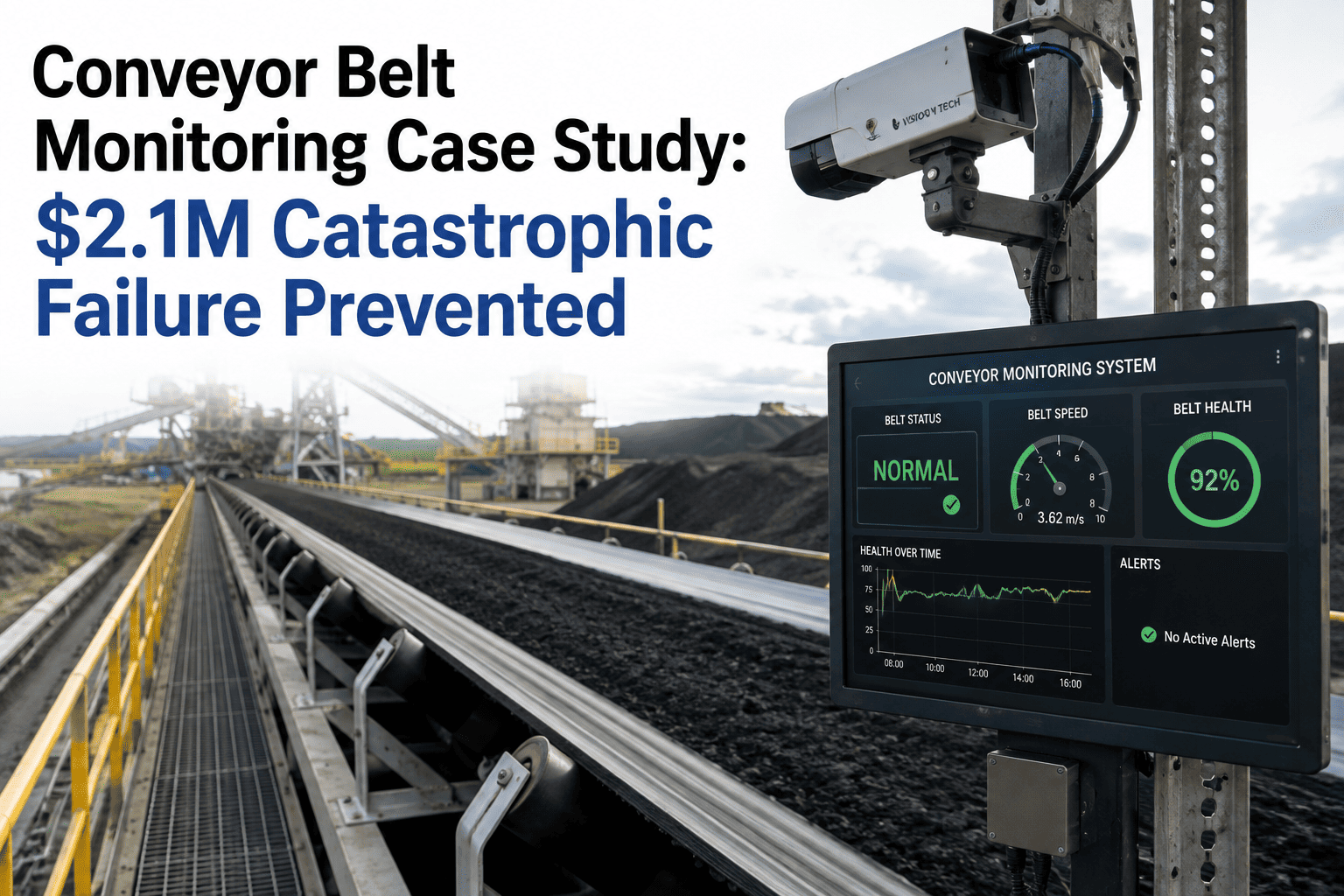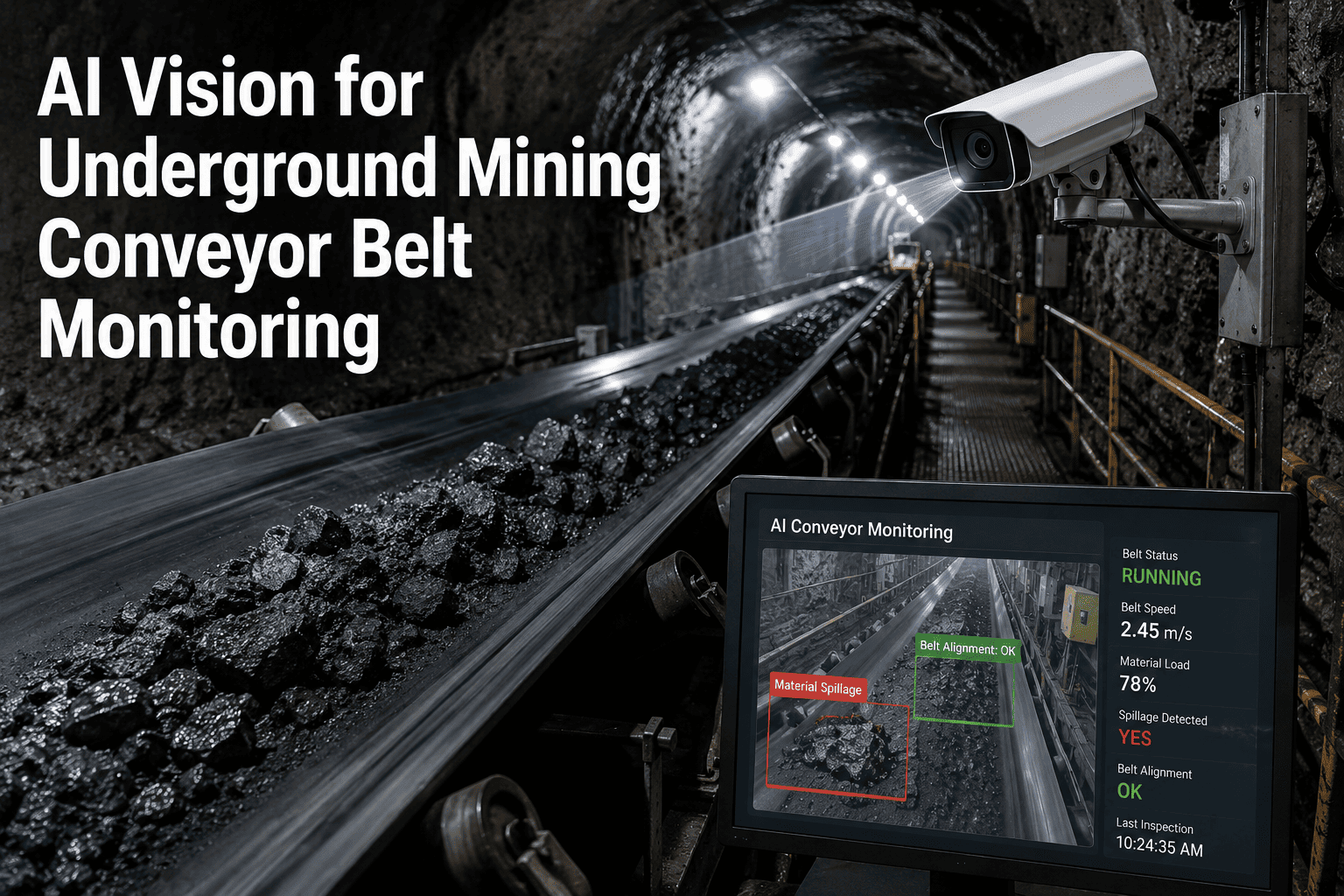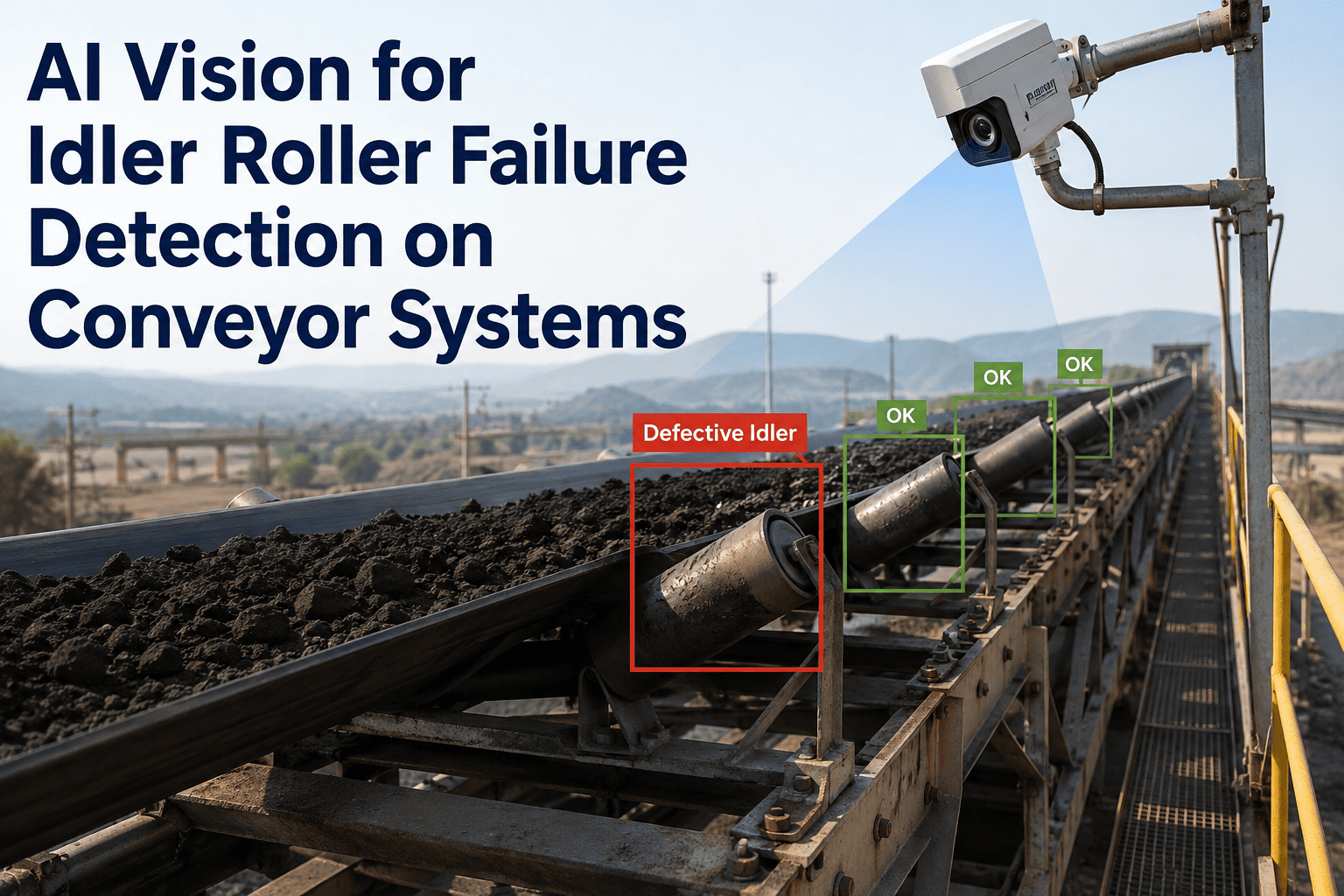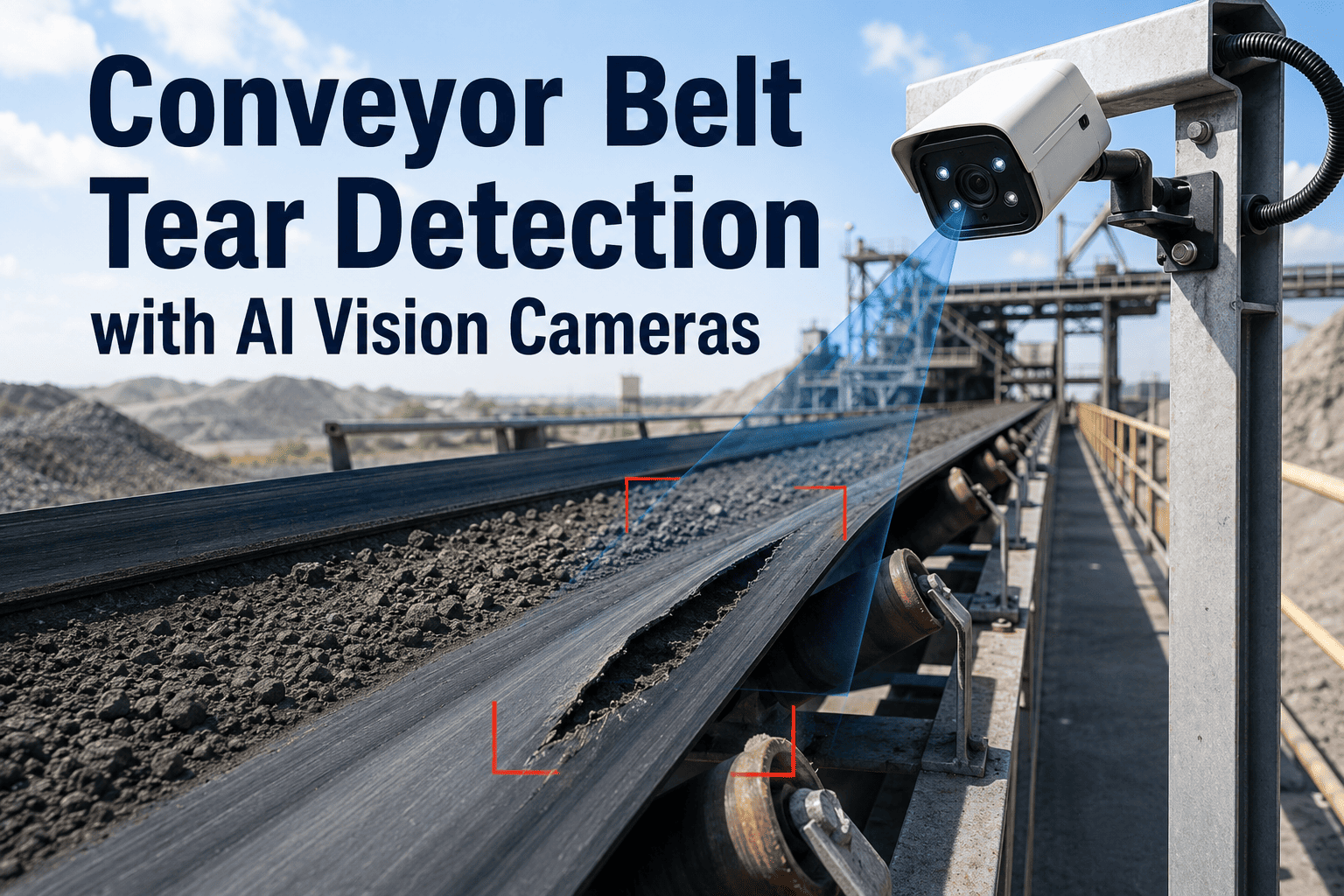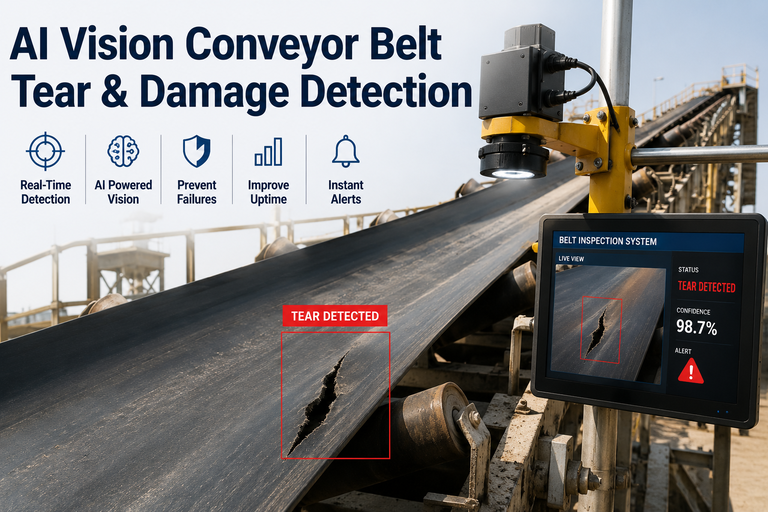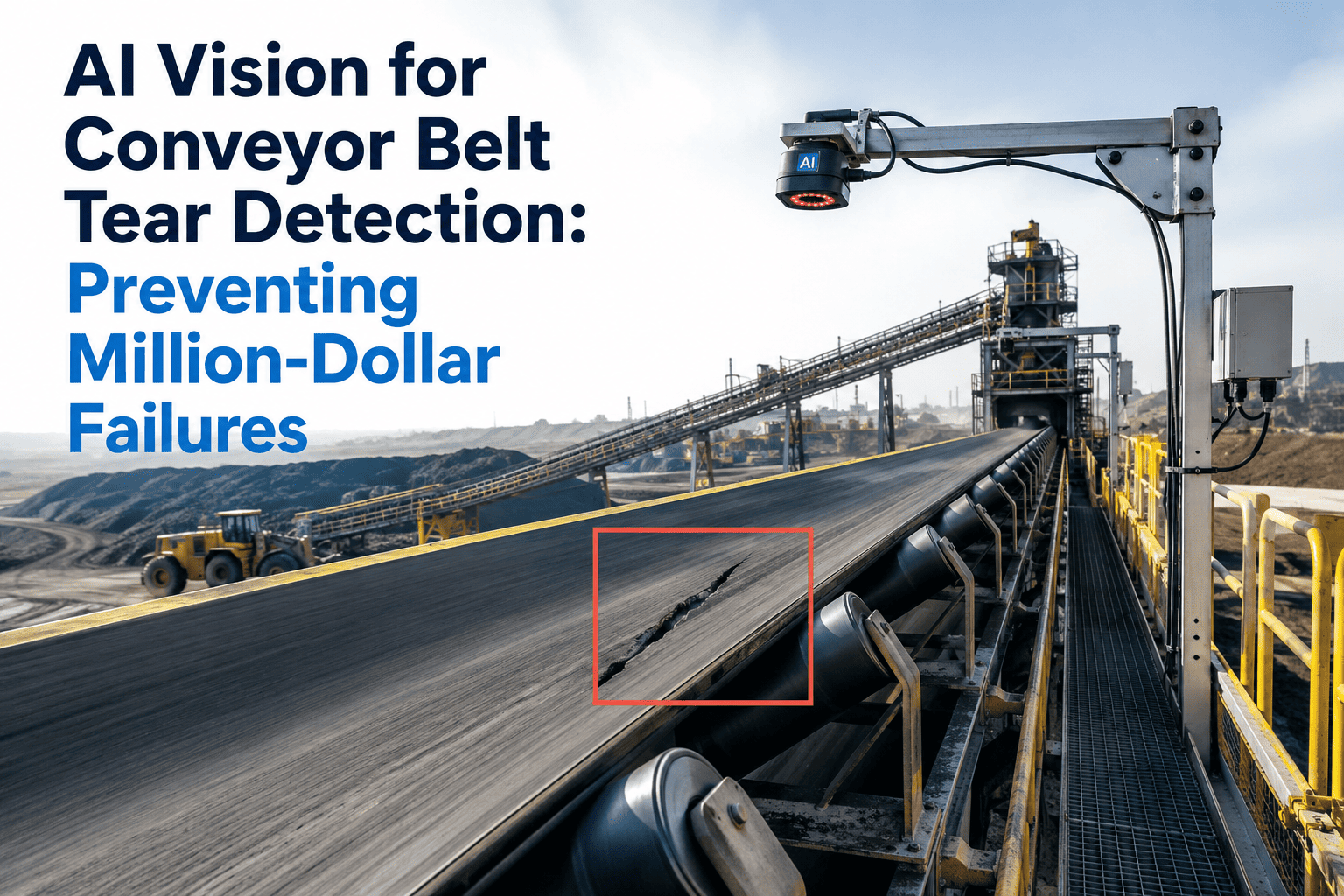
Conveyor belt tears are among the most financially devastating failures in mining, cement, steel, and bulk material handling operations, yet the vast majority of them develop slowly between scheduled inspection windows where no human eye is watching. A longitudinal tear can grow from a few centimeters to several meters in a single shift, and by the time an operator notices material spilling from the underside of the belt, the damage has already cascaded into a full belt replacement, emergency shutdown, and production losses that dwarf the cost of the belt itself. Traditional detection methods — mechanical limit switches, embedded sensors, and periodic walk-around inspections — catch tears only after they have become structurally significant, leaving operations exposed to failures that cost anywhere from $50,000 for a short belt section to well over $2 million when a primary overland conveyor goes down at a high-throughput mine. AI vision camera systems change this equation entirely by monitoring the belt surface continuously, frame by frame, detecting the earliest visual signatures of longitudinal and transverse tears in real time before they reach the point of no return, and you can book a demo to see how this works on your own conveyor infrastructure.
Your Conveyor Belt Is Tearing Right Now. The Question Is Whether You Know About It.
iFactory's AI vision platform watches every meter of belt surface 24/7, detects longitudinal and transverse tears at the earliest visible stage, and triggers maintenance action before a minor defect becomes a million-dollar shutdown.
The Inspection Gap That Turns Minor Damage Into Major Shutdowns
Conveyor belts in mining and heavy industry run continuously for 16 to 24 hours a day, often spanning distances of several kilometers through environments filled with dust, moisture, vibration, and extreme temperatures. A sharp piece of tramp metal lodged at a transfer point or an oversized rock caught between the belt and an idler roller can initiate a longitudinal tear that propagates with every belt revolution. The challenge is not whether tears will occur — they will — but whether the tear is caught when it is 10 centimeters long and repairable in a planned maintenance window, or when it is 10 meters long and the belt is splitting apart under load.
A technician walking a 3-kilometer conveyor route covers each section once per shift at best. Tears forming on the return side, inside covered sections, or during the gap between rounds grow unchecked for hours before anyone physically sees them.
Installed at fixed points along the belt, limit switches detect a tear only after it has grown wide enough to trigger a physical mechanism. By that point, the tear has already propagated well beyond the early stage where a simple vulcanized patch would have been sufficient.
Sensor loops embedded in the belt carcass detect longitudinal rips when the loop circuit is broken. While effective for catastrophic events, they do not detect surface-level tears, edge fraying, or transverse damage that has not yet penetrated the carcass.
Stopping a conveyor for visual inspection means halting production entirely. Many operations defer these shutdowns to maximize throughput, creating multi-week windows where a small tear can grow into a belt replacement event costing hundreds of thousands of dollars.
Financial Damage Goes Far Beyond the Belt Itself
Operations frequently underestimate belt tear costs because they calculate only the replacement belt and labor. The full financial picture includes lost production throughput during the unplanned shutdown, emergency procurement premiums for expedited belt delivery, idle equipment and crew costs across upstream and downstream processes, material spillage cleanup, environmental remediation if material enters waterways, and potential regulatory penalties if the failure causes a safety incident. At high-capacity operations, losing even a single hour of throughput on a primary conveyor represents revenue that cannot be recovered.
Calculate What an Undetected Tear Would Cost Your Operation
iFactory maps your conveyor network, estimates downtime exposure per belt, and shows where AI vision monitoring delivers the highest return.
Longitudinal, Transverse, Edge, and Surface Damage — All in Real Time
The most destructive tear type in conveyor operations, longitudinal tears run parallel to the belt's travel direction and can propagate meters per hour if undetected. They are typically caused by sharp objects trapped at transfer points or protruding idler components. AI vision detects the dark pixel signature of a forming rip along the belt surface before it penetrates the full carcass.
Cuts running across the belt width, often caused by impact damage from heavy or sharp material drops at loading zones. Transverse tears weaken belt integrity and can lead to belt breakage under tension. The AI model identifies cross-belt anomalies that differ from normal splice lines and material streaks.
Belt mistracking causes progressive edge wear that exposes internal plies and reduces effective belt width. Edge damage is a leading indicator of future structural failure. Vision models trained on belt geometry detect narrowing and irregular edge profiles in real time.
Deep gouges from abrasive material or trapped objects compromise the protective cover layer and expose the belt carcass to moisture and further abrasion. AI vision quantifies gouge depth and area to prioritize repairs before cover failure leads to carcass penetration.
How AI Vision Stacks Up Against Legacy Belt Monitoring
| Capability | Walk-Around Inspection | Mechanical Sensors | Embedded Loop Detectors | AI Vision Cameras |
|---|---|---|---|---|
| Detection Coverage | Spot checks, 1-2 times per shift | Fixed points only | Longitudinal rips only | Full belt surface, every revolution |
| Earliest Detectable Stage | Visible large tears | Belt width change | Full carcass penetration | Surface-level micro-tears |
| Response Speed | Hours to next round | Seconds after trigger | Seconds after loop break | Sub-200ms per frame |
| Transverse Tear Detection | If visible during walk | Not designed for this | Not designed for this | Yes, across full width |
| Edge Damage Monitoring | If noticed during walk | Not designed for this | Not designed for this | Continuous edge profile tracking |
| Works in Dust and Low Light | Visibility-dependent | Yes | Yes | Yes, trained for harsh conditions |
| Infrastructure Change Required | None | Conveyor-side installation | Belt replacement with embedded loops | Camera mounting, no belt modification |
From Camera Feed to Maintenance Action in Under 60 Seconds
Continuous Frame Capture
Industrial cameras mounted at strategic points along the conveyor capture high-resolution frames of the belt surface on every revolution, including the carry side, return side, and edge zones. The system operates in all lighting conditions including complete darkness using IR illumination.
Deep Learning Analysis
Each frame is processed by convolutional neural networks trained specifically on belt damage patterns — tears, gouges, edge wear, splice degradation — across thousands of labeled examples from mining, cement, and steel environments. The model distinguishes between normal belt features like splices and material residue and actual defects with over 95% accuracy.
Severity Classification
Detected defects are classified by type (longitudinal, transverse, edge, surface), size, growth rate, and proximity to splices or load zones. This classification determines whether the defect is flagged as monitor-only, plan-for-repair, or stop-belt-urgent, preventing false emergency stops while ensuring genuine threats are escalated immediately.
Automated Maintenance Trigger
Classified defects generate a work order in the connected CMMS with the camera frame attached as visual evidence, the defect location mapped to the belt's physical position, and the recommended repair action pre-populated. The right maintenance crew receives the alert with the right context before the tear has time to grow.
What Operations Report After Deploying AI Belt Tear Detection
What It Takes to Get AI Vision Running on Your Conveyors
AI conveyor vision monitoring does not require replacing your existing belt or conveyor infrastructure. The system is designed as an add-on solution that integrates with existing camera setups and industrial networks. Most operations are fully operational within a 6 to 12 week deployment window.
Industrial-grade cameras are mounted at key positions along the conveyor — typically at transfer points, head pulleys, and return-side inspection zones. Existing CCTV cameras can be leveraged where image quality meets minimum resolution requirements. New camera installations use standard industrial mounting hardware.
AI inference runs on ruggedized edge computing units installed in local control rooms or field enclosures near the conveyor. These units process camera feeds locally, eliminating the need to stream high-resolution video to a remote data center and ensuring sub-200ms response times even in remote locations with limited connectivity.
Detection events are routed to your existing CMMS via standard API connections, and to PLCs via MQTT or OPC-UA protocols for automated belt-stop triggers on critical severity events. The integration layer is configured during deployment to match your existing maintenance workflow.
Deep learning models arrive pre-trained on industry-standard belt damage datasets and are fine-tuned during deployment using imagery from your specific belt type, material, and environment. This calibration period typically runs 2 to 4 weeks and progressively improves detection accuracy as the model learns your operational baseline.
Common Questions About AI Vision Belt Tear Detection
Your Belt Is Running Right Now. Is Anything Watching It?
iFactory gives every meter of conveyor belt a dedicated AI inspector that never takes a break, never misses a shift, and catches tears before they become shutdowns.