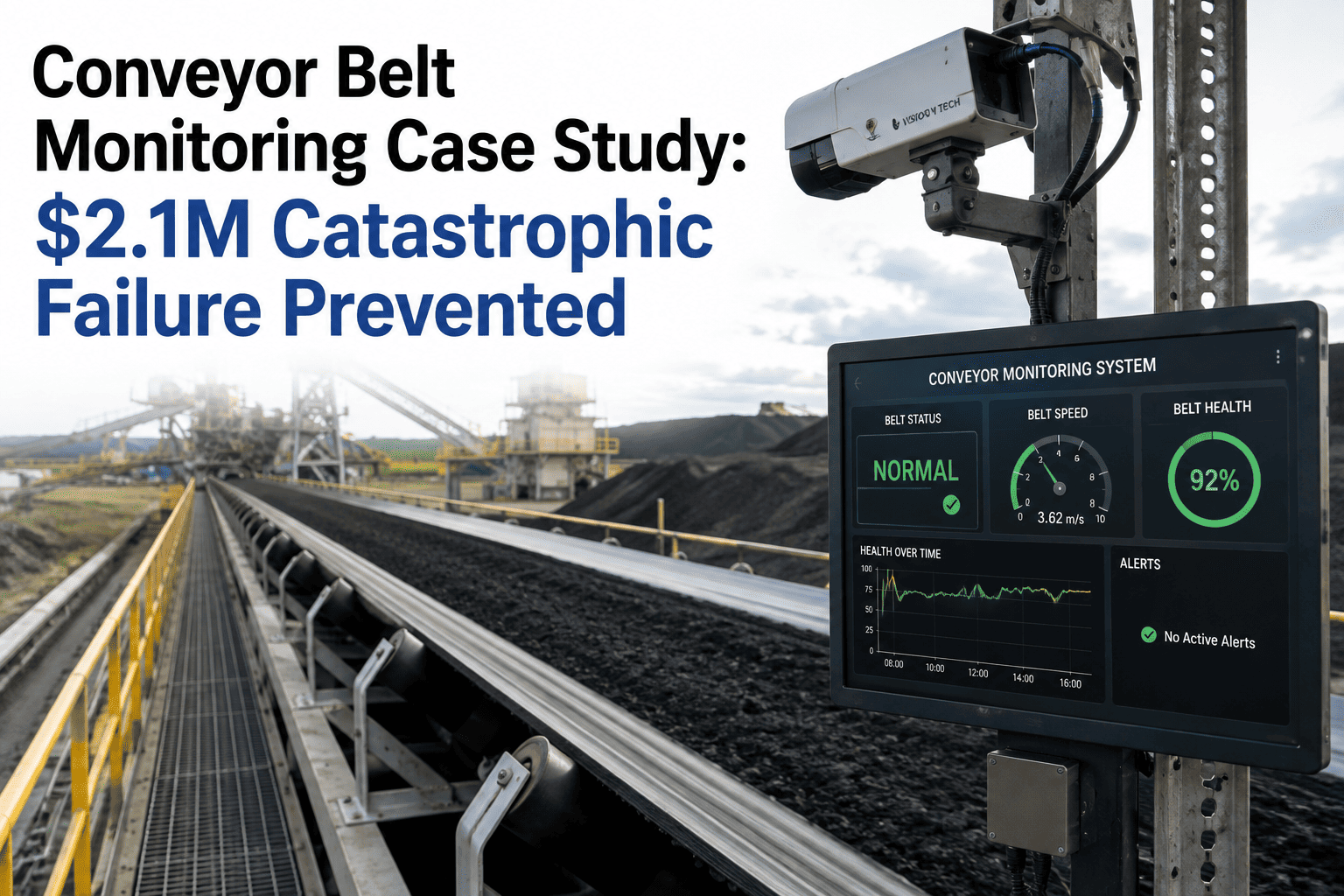
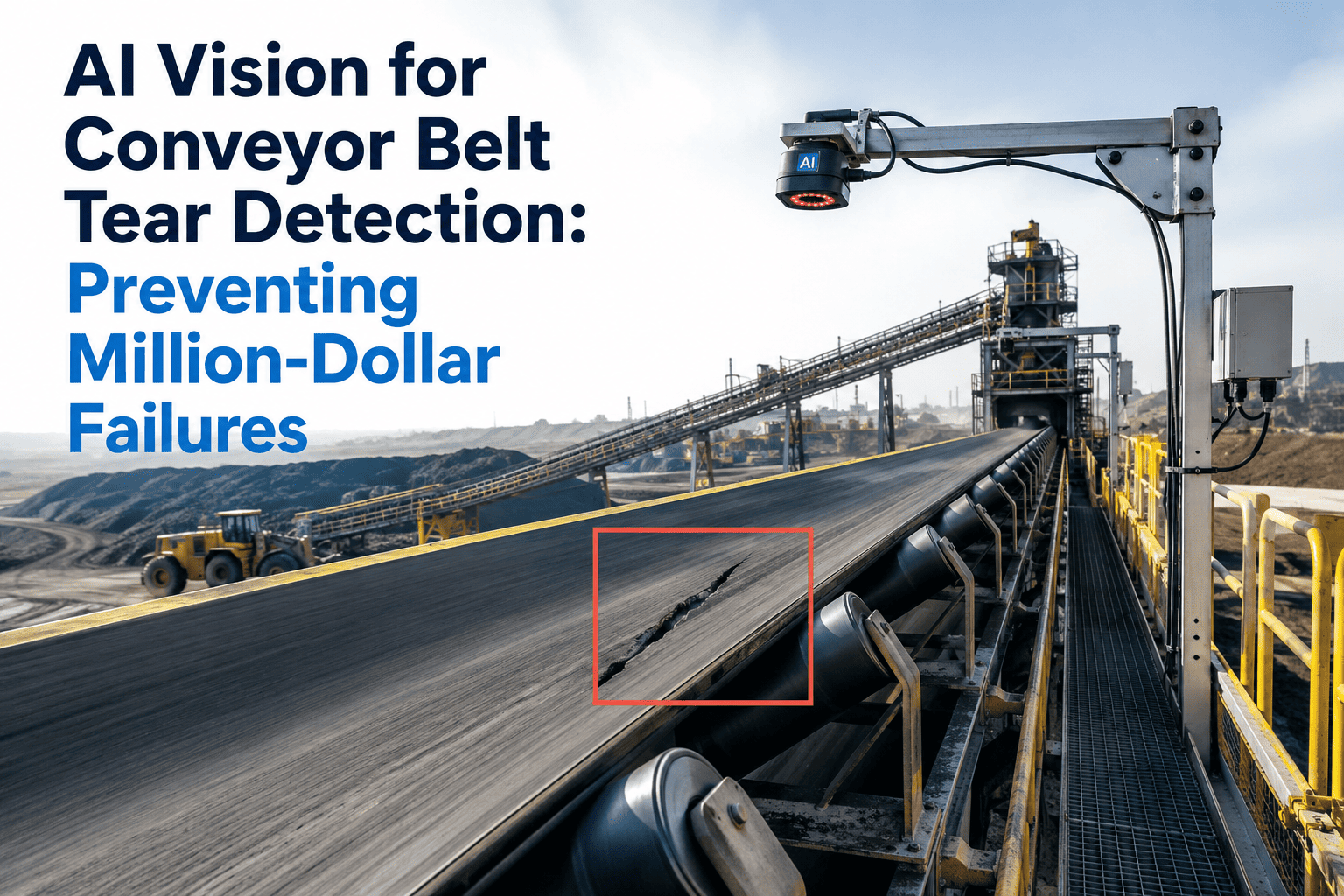
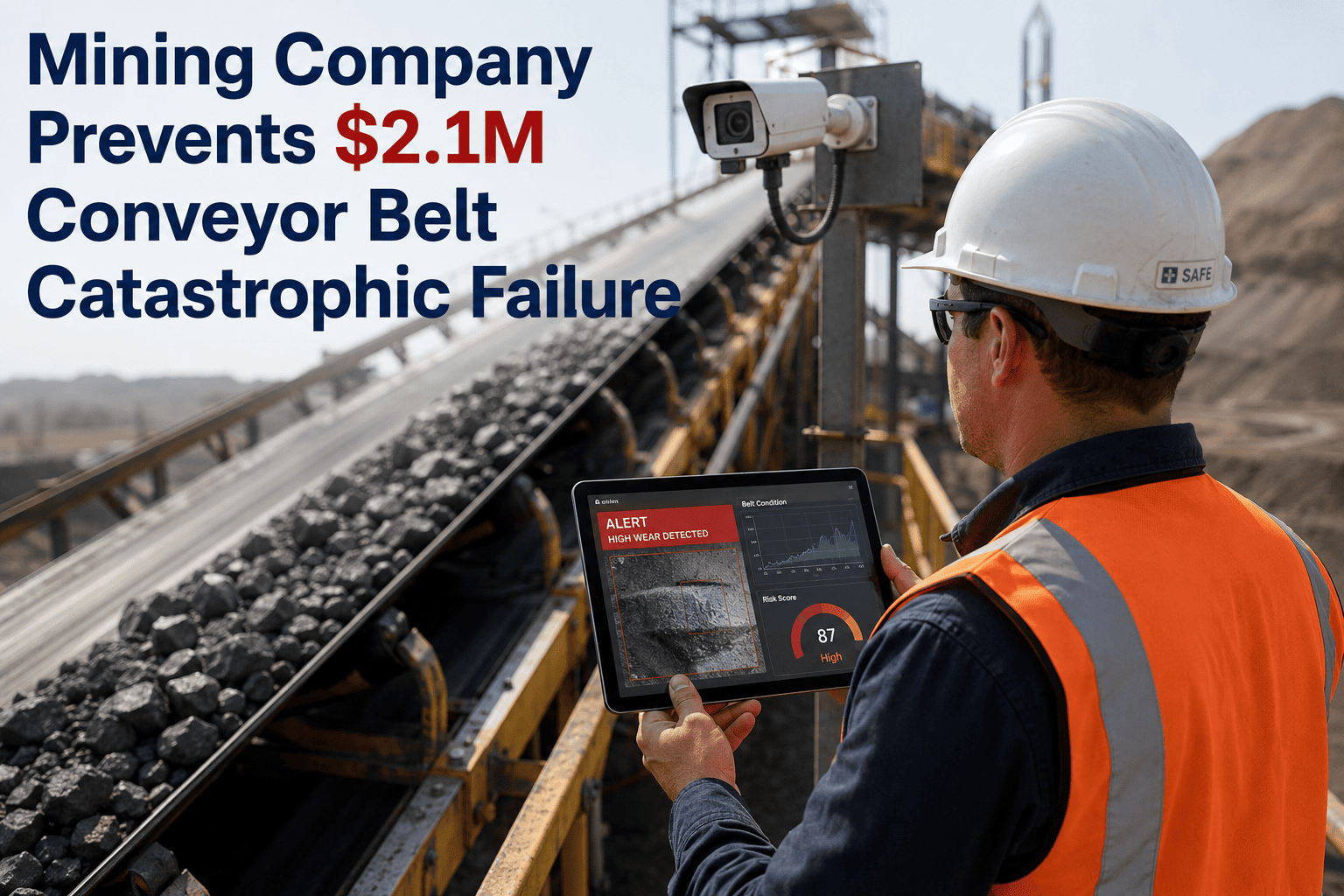
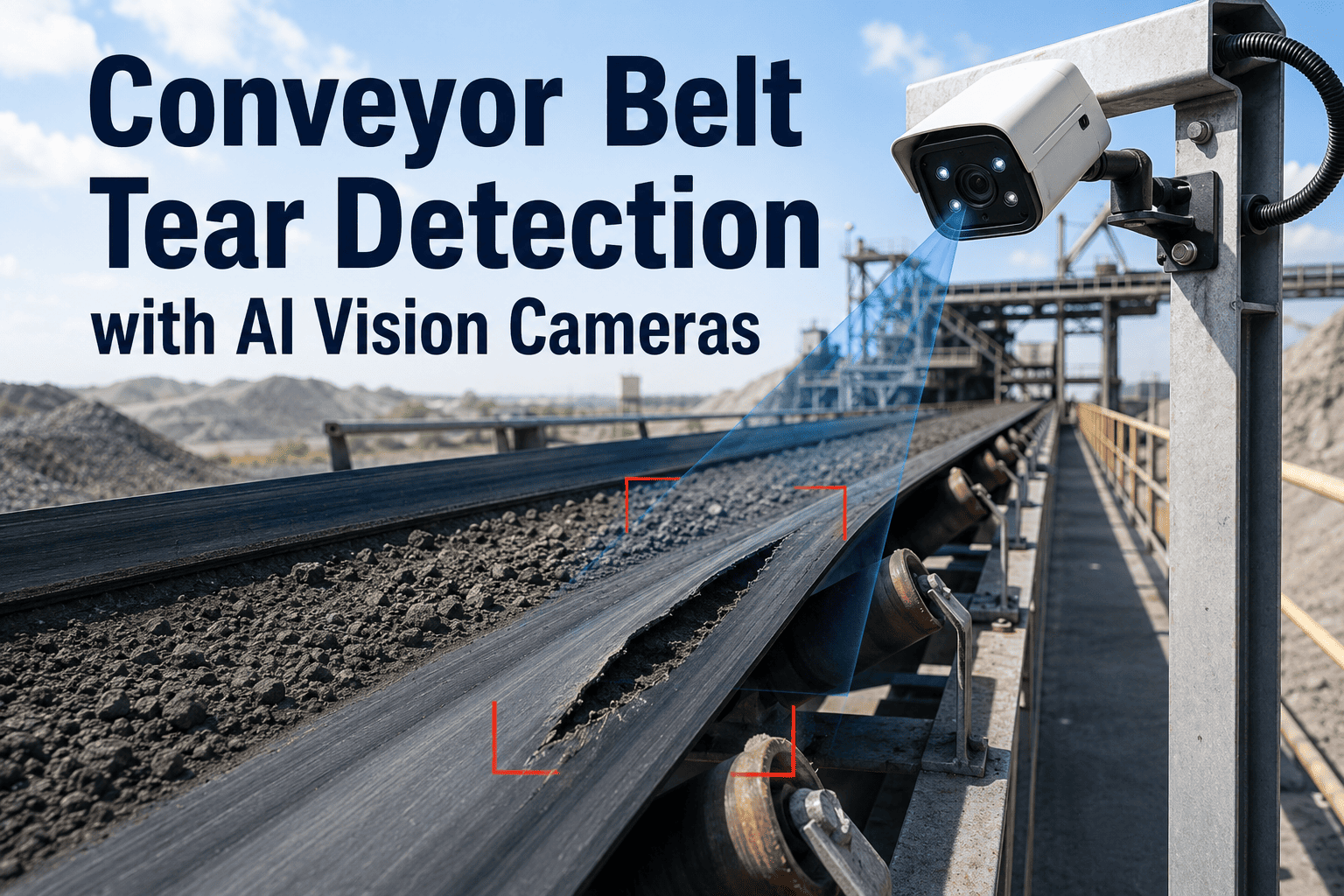
A 15 centimeter longitudinal tear does not announce itself. It starts as a foreign object lodged against a fixed point on the belt line, grinding a shallow groove that widens with every rotation. On an overland conveyor moving ore around the clock, that groove can run from hairline to catastrophic in under an hour, and by the time it is visible to a human eye on a walk-around, the belt is usually already lost. This case study covers one mine's near-miss with exactly that failure, how an AI vision system flagged the tear while it was still 15cm long, and the difference between a $45,000 planned splice and the $2.1 million replacement that was avoided.
Case Study — Conveyor Monitoring
The Tear That Never Became a Shutdown
A 15cm longitudinal tear was caught on the main overland conveyor before it propagated. Here is the incident timeline, the cost comparison, and what changed on site afterward.
$2.1Mestimated cost of a full belt replacement and 3-week rebuild
$45Kactual cost of the planned splice repair that was performed instead
6 hrstotal downtime for the splice, scheduled inside a maintenance window
Why This Belt Mattered
The main overland conveyor at the site in question is the single path ore takes from the primary crusher to the stockpile. There is no parallel line and no bypass route. A failure here does not slow one process, it stops the entire site, because every downstream stage from crushing to loadout depends on material arriving on this belt. That single-point-of-failure design is common on long overland systems, where the capital cost of a redundant line rarely pencils out against the probability of a catastrophic tear. The tradeoff is that when something does go wrong on a belt like this, the exposure is total rather than partial.
Belts of this class typically run 3 to 5 years under normal maintenance before requiring replacement, and a single unplanned failure on a line this critical commonly costs mining operations between $50,000 and $500,000 in lost production per incident, before counting the physical repair itself. A full-length replacement, as opposed to a spot repair, moves that number into seven figures once belt material, splicing crews, rigging, and idle site labor are all counted.
Over 60 percent of mining belt failures investigated across the industry originate at splice points rather than the belt body itself, but longitudinal tears caused by foreign objects are the failure mode that turns a routine maintenance event into an emergency shutdown. A tear does not respect a maintenance schedule. It starts the moment a sharp object lodges against a fixed frame point, and every additional minute of belt travel at full speed extends the damaged section further, which is exactly why the detection-to-alert window matters more on this failure mode than almost any other conveyor issue.
Incident Timeline: Detection to Resolution
02:14
Anomaly Flagged on Return Side
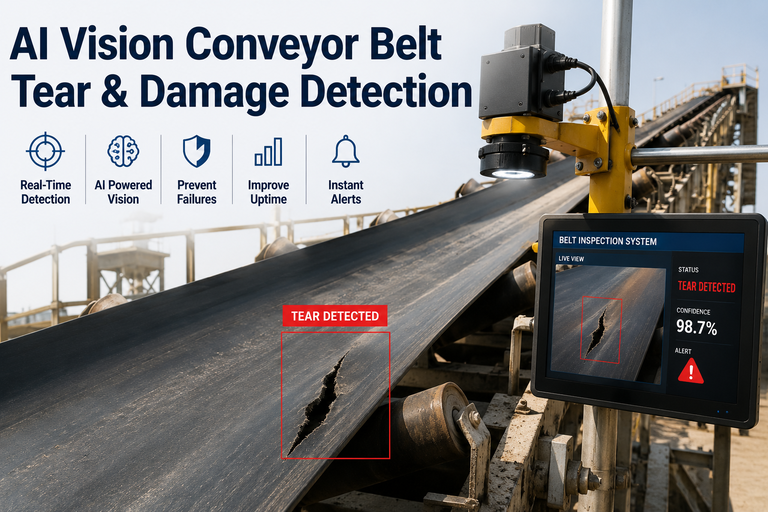
Frame-by-frame vision analysis on the return run detected a groove forming where a foreign object had lodged against the frame. Belt surface deviation crossed the alert threshold and a structured fault event was logged automatically.
02:15
Work Order Auto-Created
The vision system pushed a structured payload identifying fault type, location, and severity directly into the maintenance platform, which auto-generated a work order and attached the camera frame image showing the tear.
02:19
On-Shift Crew Notified
A mobile push notification reached the on-shift maintenance lead within five minutes of the initial detection, well inside the window needed to intervene before a 15cm tear could extend further under continued belt travel.
03:40
Belt Inspected and Confirmed
Physical inspection confirmed the tear length and location matched the flagged frame almost exactly, and confirmed the tear had not propagated further since detection because the belt had been slowed pending the walk-down.
Day 2
Splice Repair Scheduled
Because the tear was caught small, the fix was a planned vulcanized splice rather than an emergency full-length replacement, scheduled into an existing maintenance window instead of forcing an unplanned production stop.
Day 2, +6 hrs
Belt Back in Service
The splice was completed and tested in six hours, and the conveyor returned to full production speed the same shift, with no material backlog at the crusher and no missed loadout commitments.
What the Tear Would Have Cost Left Undetected
Longitudinal tears do not stay 15cm long. Left running at belt speed, a tear at this stage can propagate to full belt length within an hour, at which point spot repair is no longer an option and the only fix is a complete replacement. The table below compares what actually happened against the counterfactual of the same tear going undetected until a scheduled walk-around caught it hours later.
Most longitudinal tears begin with a foreign object nobody saw drop onto the belt. A vision system watching the full belt surface around the clock catches what a walk-around schedule structurally cannot.
Why Detection Worked Here and Fails Elsewhere
Traditional belt protection relies on mechanical trip switches, embedded conductive wires, or a fixed inspection schedule. All three share the same structural weakness: they catch damage only after it has grown large enough to trip a physical sensor, or only if a human happens to be looking at the right section of belt at the right time. On a conveyor running continuously, that leaves long unmonitored windows where a small tear can become an unrecoverable one.
This site had cameras mounted above the conveyor line before this incident, which is common at operations of this scale. What changed was not the hardware but the analysis layer sitting on top of the footage. Recorded video that nobody reviews in real time provides no protection at 2 AM, and a walk-around schedule built around shift changes leaves exactly the kind of multi-hour gap that a tear needs to become unrecoverable. Closing that gap between footage existing and footage being acted on is the difference this case study documents.
Continuous Surface Coverage
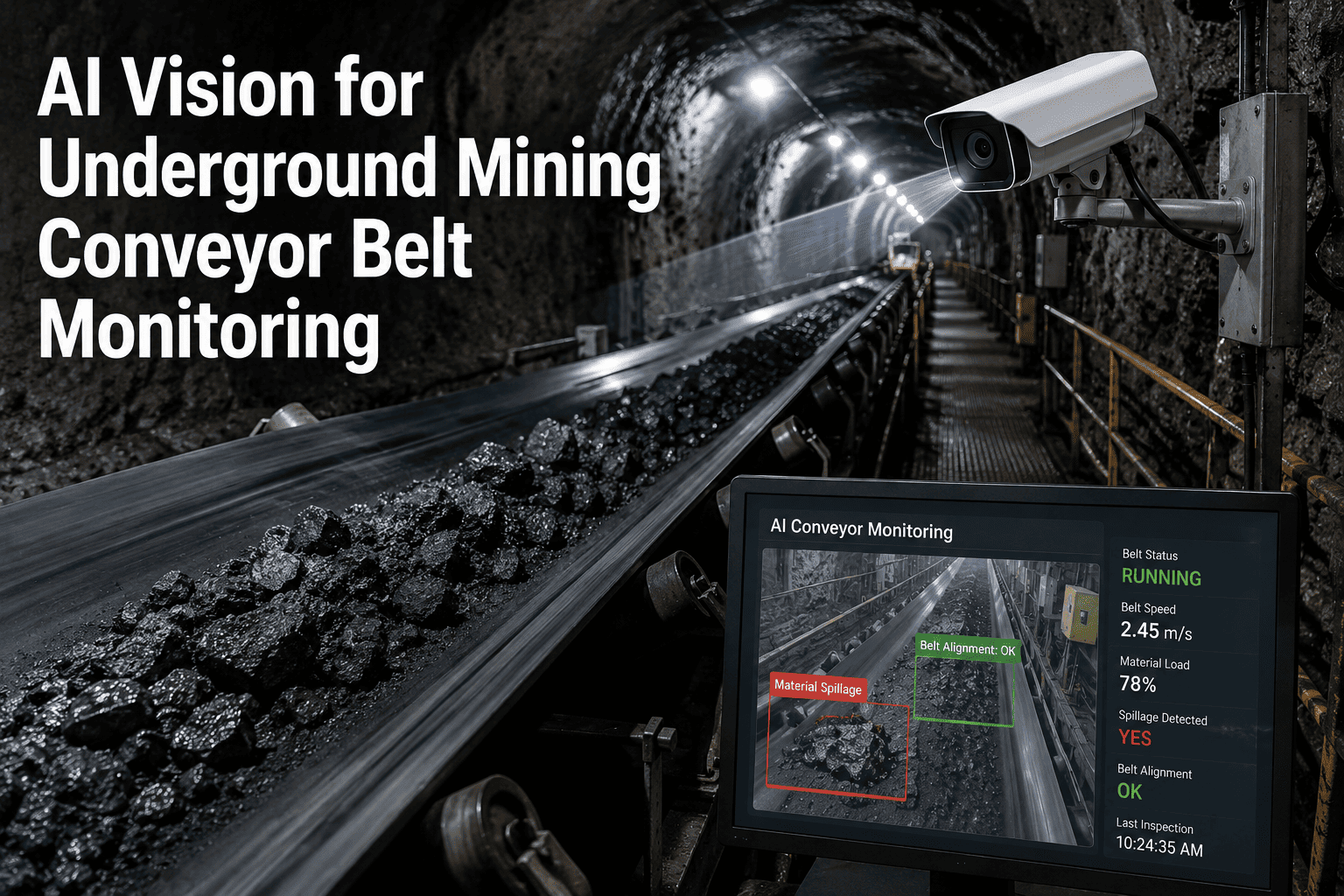
The vision system analyzes the full belt surface on both the carry and return sides every rotation, not on a fixed inspection interval, so a defect forming between scheduled walk-arounds is still caught in near real time.
Foreign Object Flagging
Because most longitudinal tears originate with a foreign object lodging against a fixed point, flagging the object before it causes damage prevents the tear from starting rather than only catching it after the fact.
Structured Alert Routing
A detected fault does not sit in a dashboard waiting to be noticed. It becomes a work order with the responsible crew notified directly, cutting the gap between detection and human action to minutes.
Edge Inference Speed
Processing happens on a device located at the conveyor rather than in a remote cloud pipeline, which keeps the detection-to-alert window short enough to matter on a belt where minutes decide the outcome.
What Changed on Site After This Incident
01Alert thresholds were tightened on the return-side cameras specifically, since that is where this and prior minor defects had originated on this belt.
02Splice inventory was pre-staged so that when a future fault is flagged, the repair crew is not waiting on material lead time before starting work.
03Notification routing was expanded to include a backup on-call lead, closing the gap that exists if the primary contact is unreachable during off-hours.
04Camera coverage was reviewed site-wide to confirm every conveyor carrying primary-path material had the same monitoring in place, not only the line that had the incident.
Frequently Asked Questions
How was the tear length confirmed if the belt was still moving?
The vision system's flagged frame captured the tear at the moment of detection, giving an initial size estimate from the image itself. The maintenance crew then slowed the belt to a safe inspection speed and performed a physical walk-down to confirm the exact length and depth before deciding on a repair method. The two measurements were within a close margin of each other, which is typical when detection happens early and the tear has not had time to distort under continued load.
Book a demo to see how detection frames are used to plan a physical inspection.
Why was a splice possible instead of a full replacement?
A vulcanized splice repair is only viable while the damage is localized and the surrounding belt material is still structurally sound. Once a longitudinal tear extends far enough, the belt loses tensile integrity across too much of its length for a splice to hold under load, and full replacement becomes the only safe option. Catching this tear at 15cm meant the damaged section was small enough to cut out and splice cleanly, which is the entire reason early detection changes the outcome so dramatically.
Does this kind of system also detect problems besides tears?
Yes. The same continuous surface monitoring that caught this tear also covers belt mistracking, edge damage from frame contact, carryback buildup on the return run, and foreign material sitting on the belt surface before it reaches a pinch point.
Contact support to review the full set of fault types monitored for a specific conveyor configuration.
How does this compare to the vibration sensors already installed on our drives?
Vibration sensors on drive motors are built to catch bearing degradation and imbalance in rotating components, and they do that well, but they have no visibility into the belt surface itself. A growing tear, a lateral drift, or a splice joint starting to separate produces no vibration signature until the problem is already severe. Vision monitoring and vibration monitoring cover different failure modes and work best combined into a single health view rather than treated as substitutes for each other.
What would it take to set this up on our own overland conveyor?
Most sites already have cameras mounted above major conveyor lines for general visibility, and the gap is typically not hardware but the analysis layer sitting on top of that footage. A site walk to confirm camera placement and lighting conditions, followed by threshold calibration specific to the belt and material being moved, is usually enough to get monitoring live. Timelines vary by site complexity and how many lines are in scope for the first phase.
A $45,000 Splice Beats a $2.1M Rebuild Every Time
The difference between the two outcomes in this case study was minutes of detection lead time. See what that same coverage would look like on your conveyor lines.