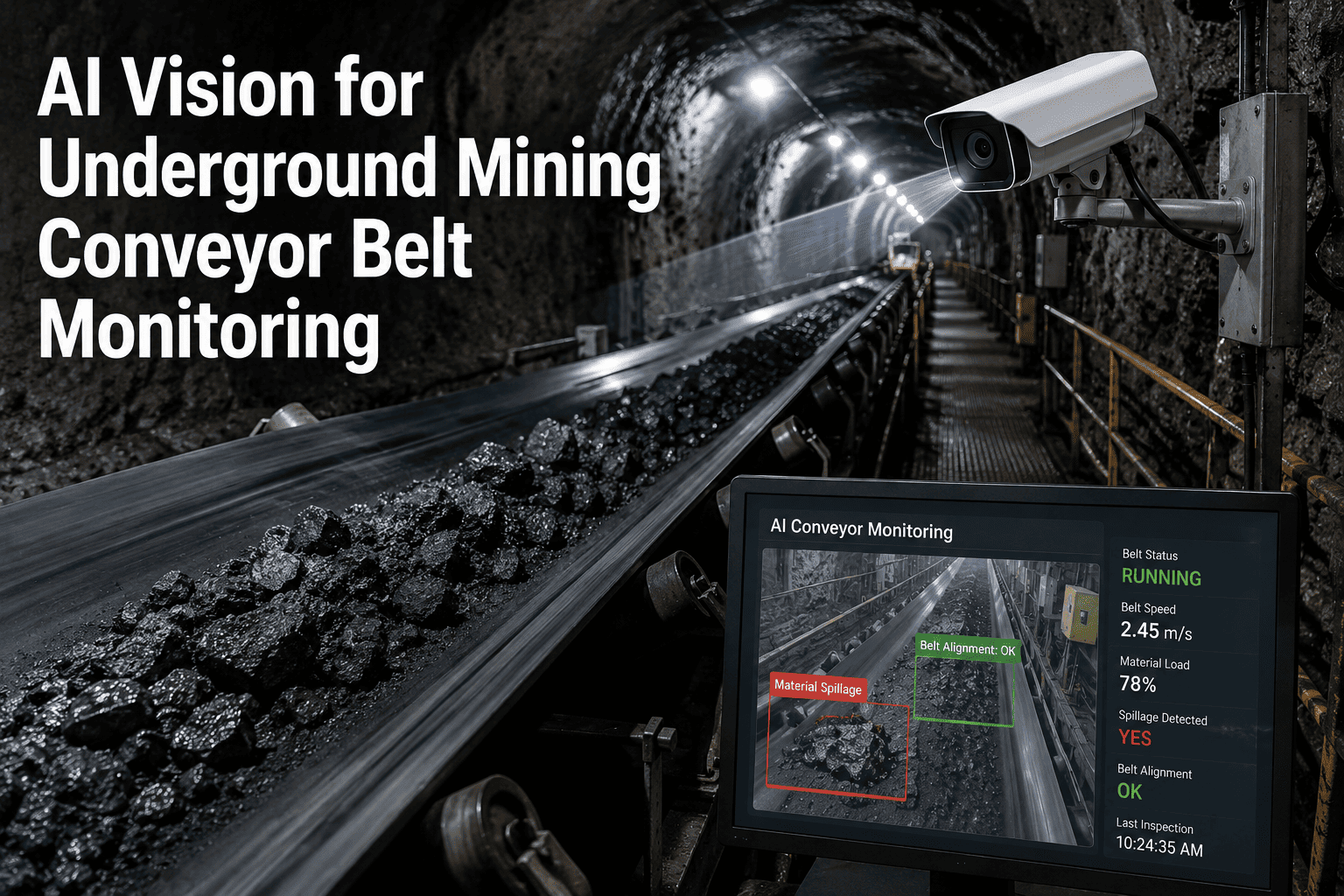
A conveyor belt running eight hundred meters below surface doesn't fail the way a surface belt does. There's no daylight to catch a fraying edge, no clean air to keep a lens clear, and no operator walking the line every hour because the ventilation, heat, and rock dust make that walk something you schedule, not something you do casually. By the time a belt splice lets go or a idler seizes and starts a fire, the warning signs were usually visible on camera for shifts beforehand — if anyone had been watching, and if the camera could actually see through the dust. iFactory's underground vision platform is built specifically for that environment.
Dust, Darkness, and Vibration Break Ordinary Cameras. Underground Conveyors Need a Different System.
Standard industrial cameras are built for climate-controlled plants with stable lighting. Underground haulage drifts have none of that — and the belt failures that matter most tend to start exactly where visibility is worst.
Why Underground Changes Everything About Camera-Based Monitoring
A surface conveyor camera lives in a relatively forgiving world: ambient light, moderate temperature swings, and dust that settles rather than hangs in the air. Underground, none of that holds. Airborne rock dust scatters light and coats lenses within hours. Humidity from ventilation systems fogs housings. Vibration from adjacent haulage and blasting works enclosures loose over months, not years. A monitoring system designed for a surface plant and simply lowered into a shaft will degrade fast enough that operators stop trusting it — and an unwatched camera is functionally the same as no camera.
Airborne rock dust scatters and absorbs light, degrading image contrast within a single shift if lenses aren't protected and lighting isn't matched to the particulate density in that specific drift.
Fixed mine lighting is inconsistent belt to belt, and many haulage ways rely on cap lamps and spot lighting rather than continuous illumination, which standard camera exposure settings handle poorly.
Idler rollers, transfer points, and adjacent equipment generate constant low-frequency vibration that loosens standard mounts and introduces motion blur into anything not ruggedized for the application.
Long haulage drifts mean a technician responding to a failed camera or a fouled lens is a significant time and safety cost, so uptime and self-diagnosis matter more than in an open plant.
What the Camera Actually Needs to See
Underground conveyor failures rarely happen without warning — they happen without anyone positioned to catch the warning. A belt mistracking toward a structure will rub for shifts before it tears. A splice under repeated flex stress will show early separation at the edges long before it lets go completely. A bearing running hot on an idler will glow faintly on a thermal channel well before it seizes and becomes a fire risk in a confined space where fire is the single most dangerous failure mode underground.
Belt Mistracking & Edge Wear
Continuous visual tracking of belt centerline position against structure, flagging drift before it becomes a rub point that damages the belt edge or ignites material buildup.
Splice & Cover Damage
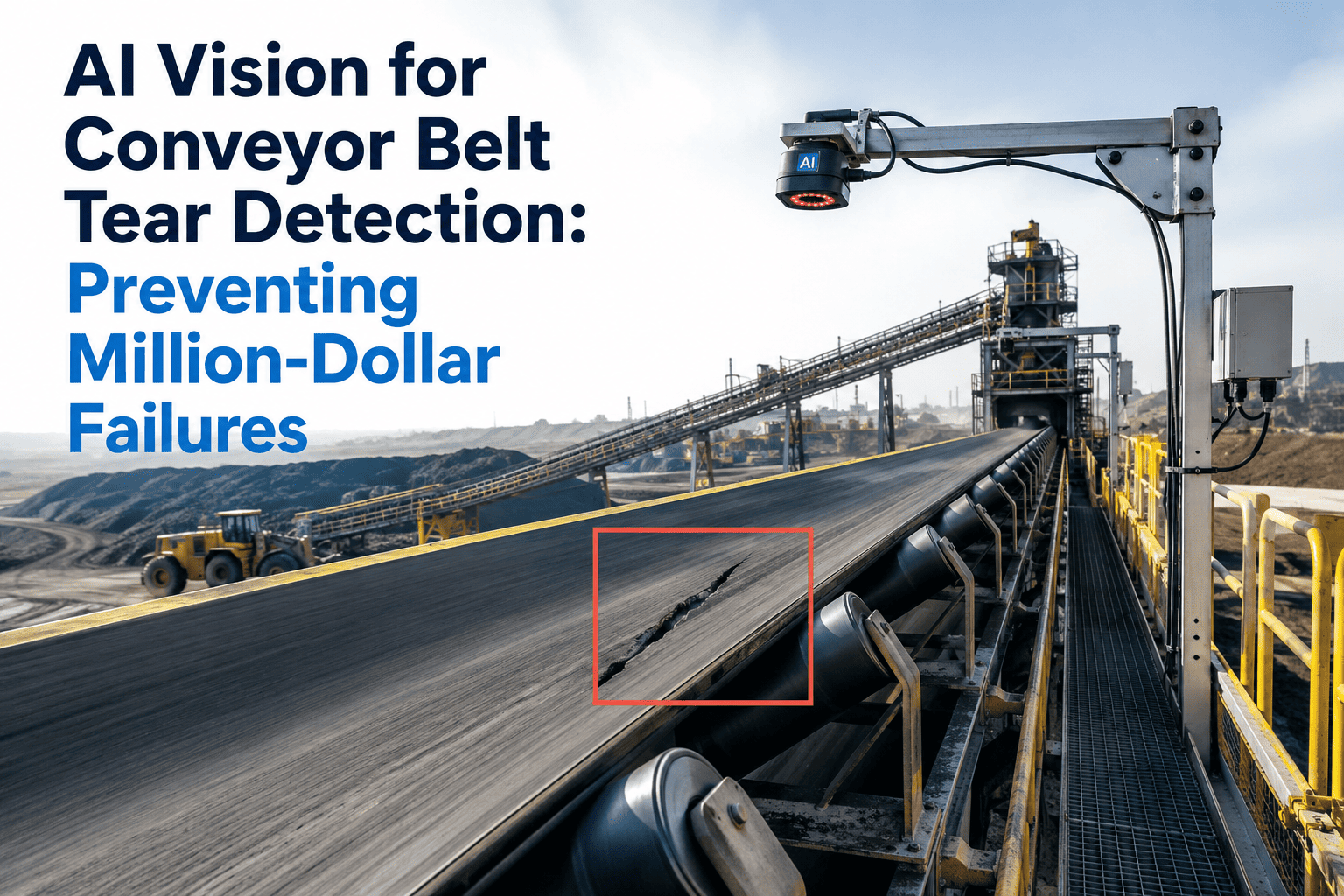
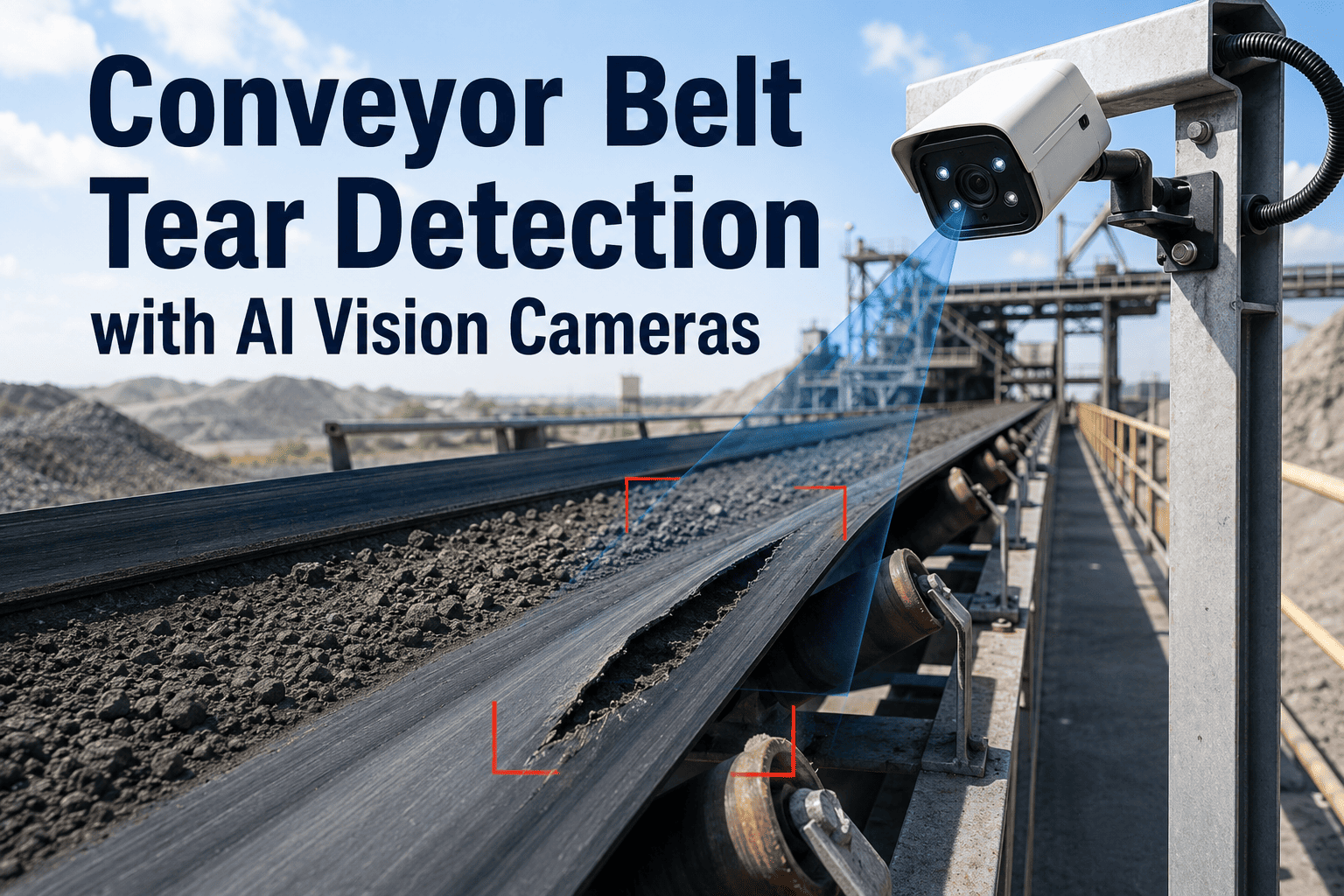
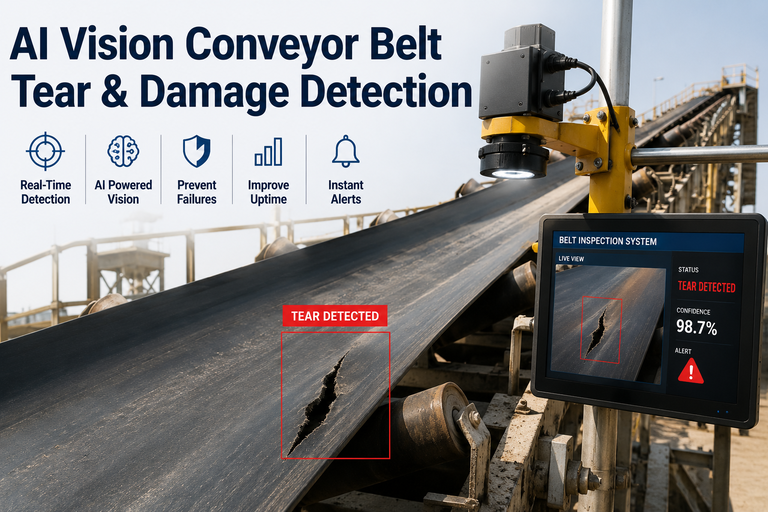
AI-assisted image comparison spots developing splice separation, cover gouges, and longitudinal tears against a healthy baseline, rather than waiting for a visible rip to appear.
Idler & Structure Fouling
Detects material buildup and spillage around idlers and transfer points that, left unaddressed underground, becomes both a fire fuel source and a housekeeping hazard.
Thermal Signatures
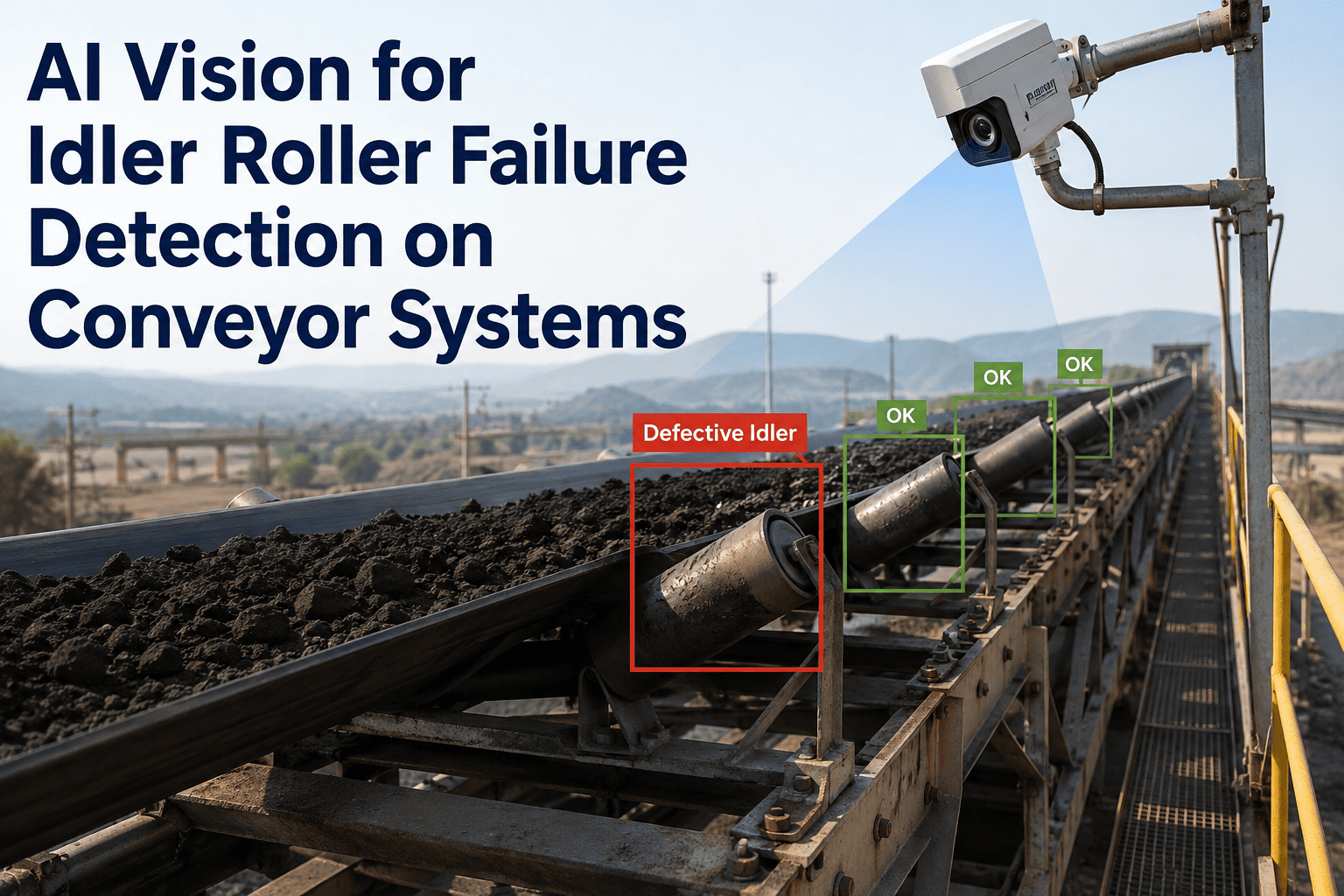
Paired thermal sensing flags a hot idler bearing or frictional heating on a stalled roller — the earliest available signal ahead of a smoldering belt event underground.
Ruggedization: What Actually Survives a Haulage Drift
Most vendors describe their hardware as "industrial grade" without specifying which industrial environment it was actually tested against. Underground mining is a materially harder environment than a dry goods warehouse or an automotive line, and the difference shows up fast when a housing rated for one turns out not to be rated for the other.
| Requirement | Surface Plant Camera | Underground-Rated System |
|---|---|---|
| Ingress Protection | Typically IP65 | IP67 or higher, sealed against fine particulate and washdown |
| Illumination | Assumes ambient light | Integrated IR or matched-spectrum lighting independent of mine lighting |
| Mounting | Standard bracket | Vibration-isolated mounts rated for continuous low-frequency shock |
| Certification | General purpose | Intrinsically safe / explosion-proof rating where methane or coal dust is present |
| Self-Diagnostics | Manual fault reporting | Automated lens-fouling and connectivity alerts to reduce underground service trips |
A Camera That Can't See Through Dust Isn't Monitoring Anything
iFactory pairs computer vision with underground-rated hardware so belt monitoring actually works in the environment it's deployed in, not just in the vendor's demo video.
From Detection to Action: Closing the Loop Underground
Detection alone doesn't stop a belt fire or prevent a mistracking failure — the alert has to reach the right person, fast enough to matter, with enough context that they don't need to travel underground just to find out what triggered it. That's the difference between a camera system and an operational safety layer.
Real-Time Control Room Alerts
Anomalies surface immediately on the surface control room dashboard with a timestamped image or clip, so the operator sees exactly what the system saw before deciding on a response.
Automatic Work Order Generation
Confirmed defects — a developing splice tear, a persistently hot idler — generate a maintenance work order automatically, tagged to the exact belt segment and structure ID.
Trend History Per Asset
Every belt segment accumulates a visual history, so a maintenance planner can see whether a wear pattern is new or has been slowly developing across weeks of shifts.
Reduced Manual Walk Frequency
Continuous camera coverage lets underground inspection crews focus manual walks on confirmed anomalies rather than blanket routine sweeps of belts that haven't changed.
A Composite Scenario: Catching a Mistracking Belt Before It Becomes a Fire
Consider a mid-size underground metals operation running a main haulage conveyor roughly two kilometers long, feeding ore from three production levels to the surface crusher. Six weeks after an AI vision system went live along a known problem section near a transfer point, the system flagged a gradual lateral drift in the belt — roughly four millimeters per shift, invisible to a technician glancing at it during a routine walk, but clearly trending across a week of logged images.
The system generated a work order tagged to that exact structure segment before the drift reached the point of rubbing against the transfer chute steelwork. A maintenance crew adjusted the training idlers during the next scheduled downtime window — a twenty-minute fix. Left uncaught, that same drift pattern, extrapolated against the site's own incident history, was the same signature that had preceded a belt rub fire on a different level two years earlier. The cost difference between the two outcomes wasn't the camera; it was catching a four-millimeter trend before it became a four-centimeter problem.
Metrics That Show the System Is Actually Working
A vision system that generates alerts nobody trusts isn't delivering value, no matter how sophisticated the underlying model is. The metrics below are what separate a monitoring deployment that's genuinely reducing risk from one that's just adding another dashboard to the control room wall.
Confirmed vs. False Alert Ratio
Tracking how many flagged events are confirmed as genuine anomalies versus dismissed tells you whether the model is tuned correctly for that specific belt section and lighting condition.
Mean Time From Detection to Response
How quickly a flagged mistracking or thermal event turns into a scheduled maintenance action reflects whether the alert routing and control room workflow are actually closing the loop.
Belt Section Downtime Trend
Comparing unplanned downtime on monitored belt sections against unmonitored sections over the same period isolates the impact of continuous detection versus periodic manual inspection.
Repeat Failure Locations
Structure IDs that generate recurring anomaly alerts point to a systemic issue — a persistent misalignment or a chronically underperforming idler — worth a deeper engineering review rather than repeated point fixes.
Frequently Asked Questions
Can these cameras handle explosion-proof or intrinsically safe requirements?
Yes — for underground coal or any environment with methane or combustible dust classifications, hardware needs to meet the relevant intrinsic safety or explosion-proof certification for that specific zone, and this is one of the first things assessed during a site survey before any deployment plan is finalized. Metal mines without gassy conditions typically require a lower certification tier, which changes both cost and hardware options. Visit support for zone-specific certification guidance.
How does the system maintain image quality when mine lighting is inconsistent?
Rather than relying on ambient mine lighting, underground-rated units carry integrated illumination matched to the specific dust density and drift conditions at each install point, so image quality stays consistent whether a section is well-lit or running on minimal fixed lighting. Exposure and gain settings are also tuned per location rather than using a single global camera profile across the whole belt network.
What happens when a lens gets fouled by dust between service visits?
The system continuously self-monitors image clarity and flags degraded visibility as a fault condition rather than silently continuing to "watch" a fouled lens and missing real events. That alert gets scheduled into the next planned underground service run instead of triggering an unplanned trip, which keeps maintenance travel efficient in a confined-access environment.
Does this replace manual belt inspection walks entirely?
No — it changes what those walks are for. Continuous camera coverage handles the routine, repetitive watching that's hardest to sustain reliably shift after shift, while manual walks shift toward confirming and physically resolving the specific anomalies the system flags, along with checks that require hands-on assessment cameras can't perform, like belt tension or splice integrity by feel.
How is this deployed across an existing underground haulage network without major shutdown?
Installation is typically staged by section during planned maintenance windows rather than requiring a network-wide shutdown, starting with the highest-risk transfer points and known problem segments identified from incident history before expanding coverage outward. Book a demo to walk through a staged rollout plan for your specific layout.
The Belt Failure You Can't See Coming Is the One That Costs the Most
iFactory builds vision systems for the environment underground haulage actually is — dusty, dark, and vibrating — so detection works on shift one, not just in a clean-air demo.