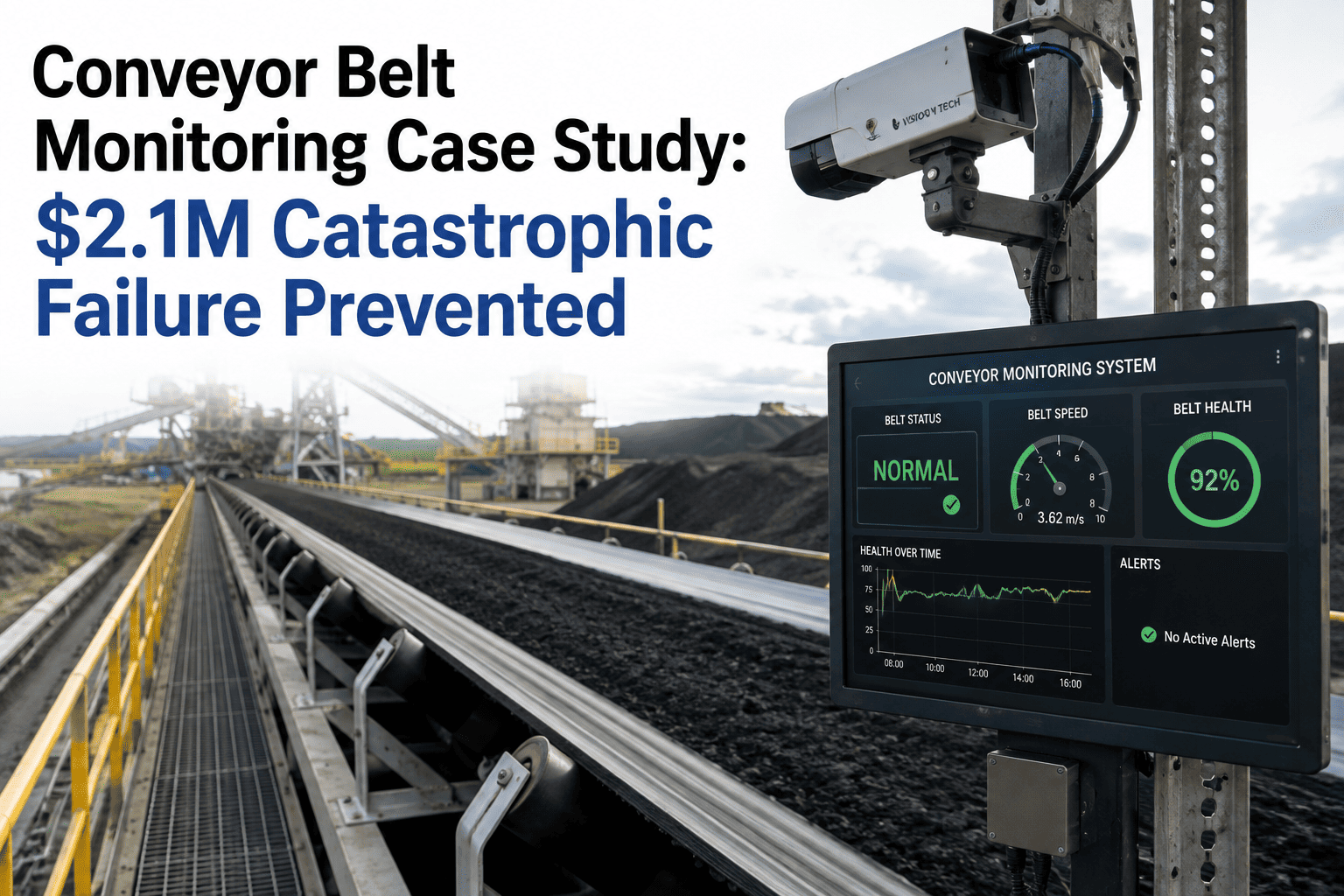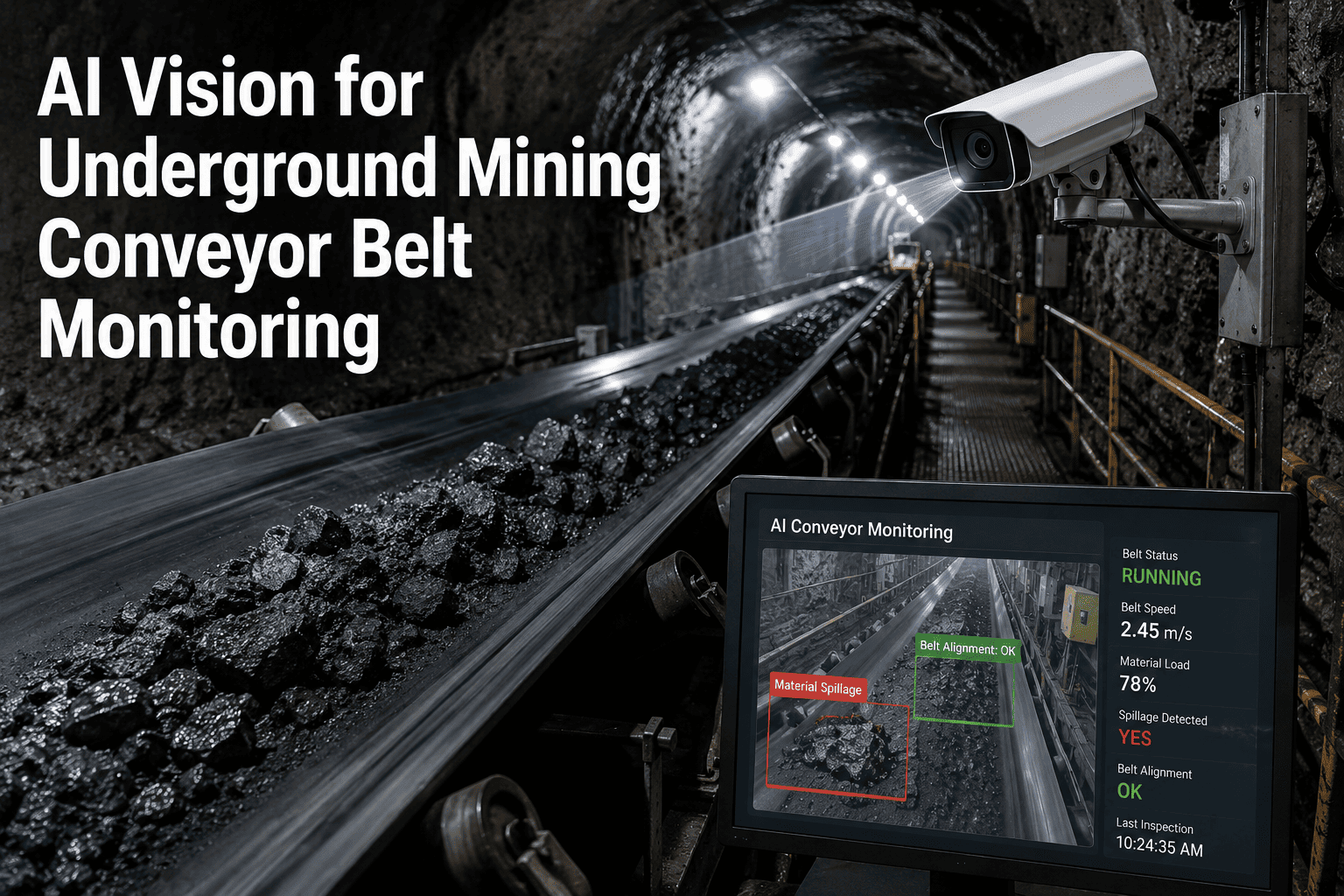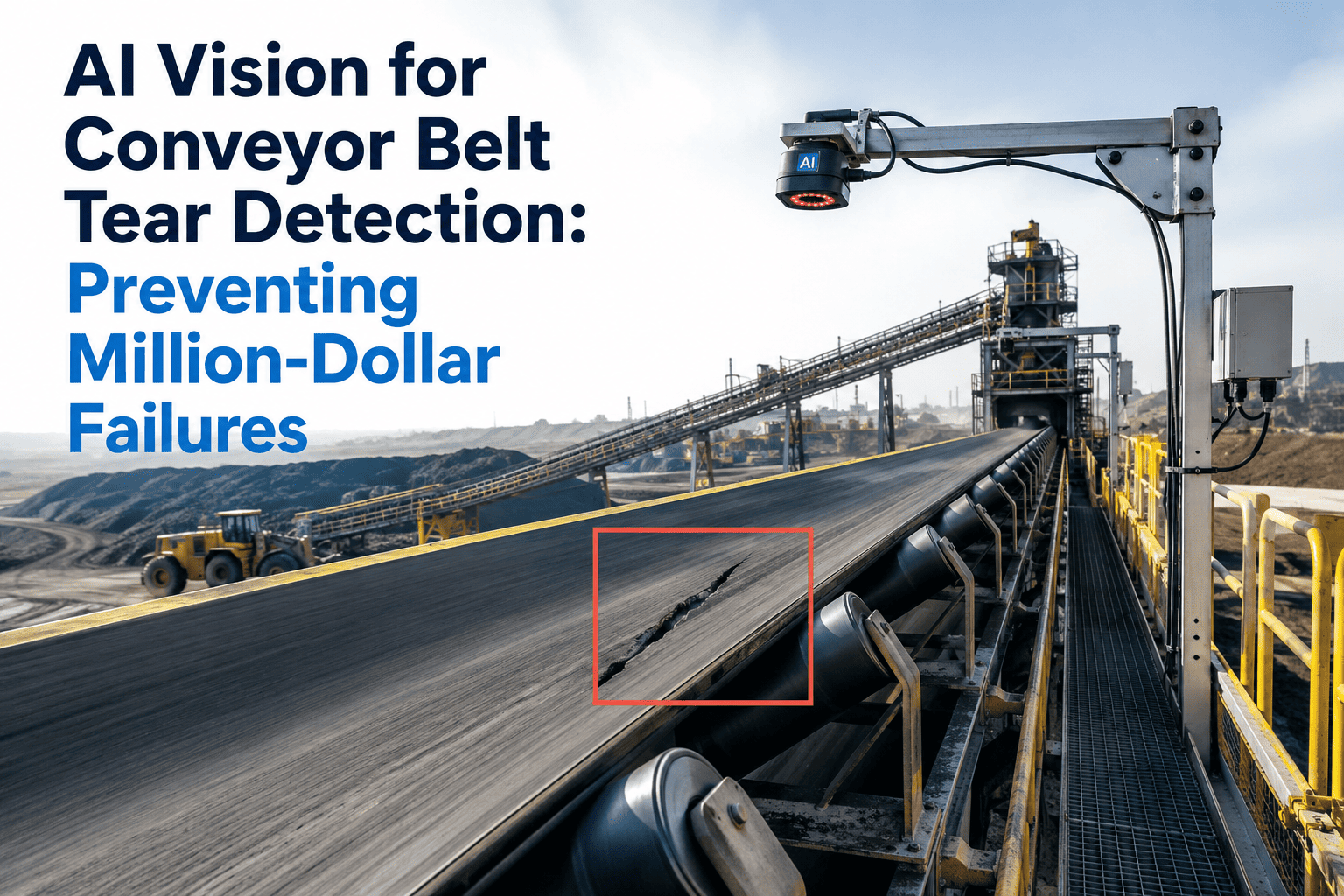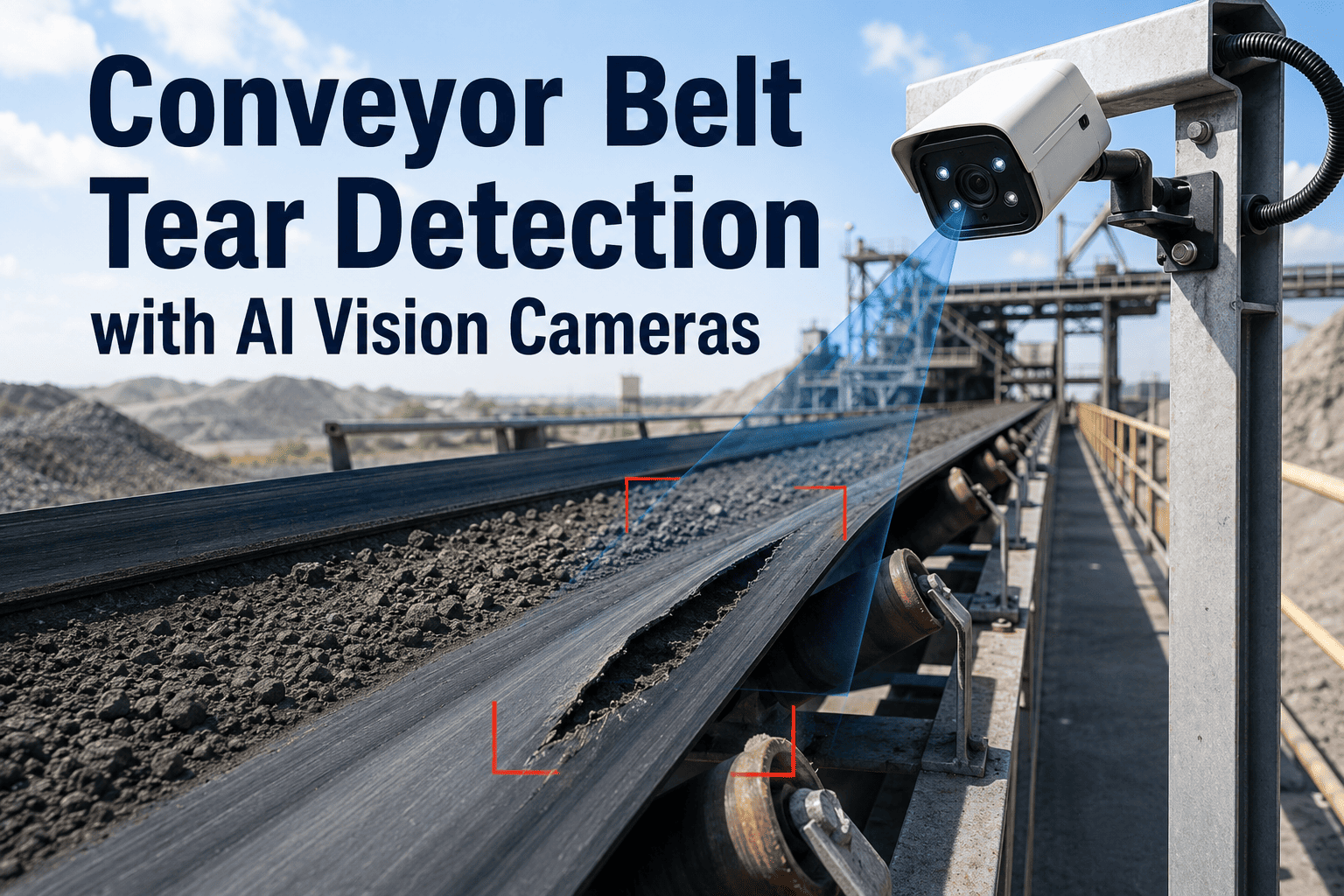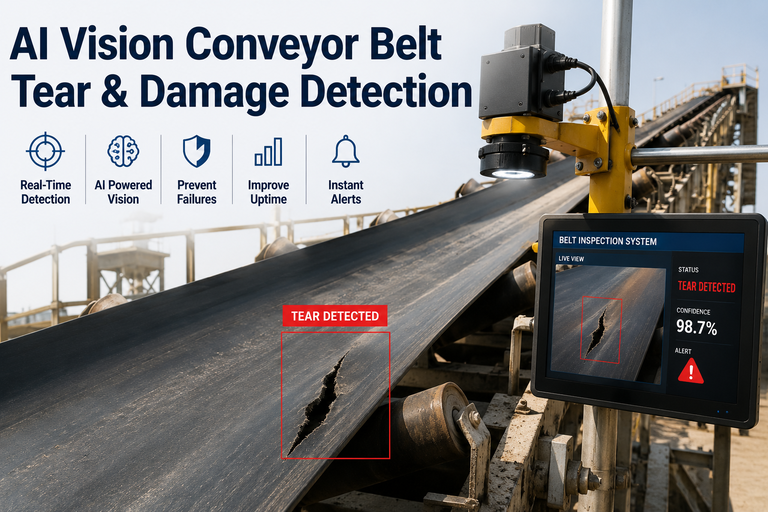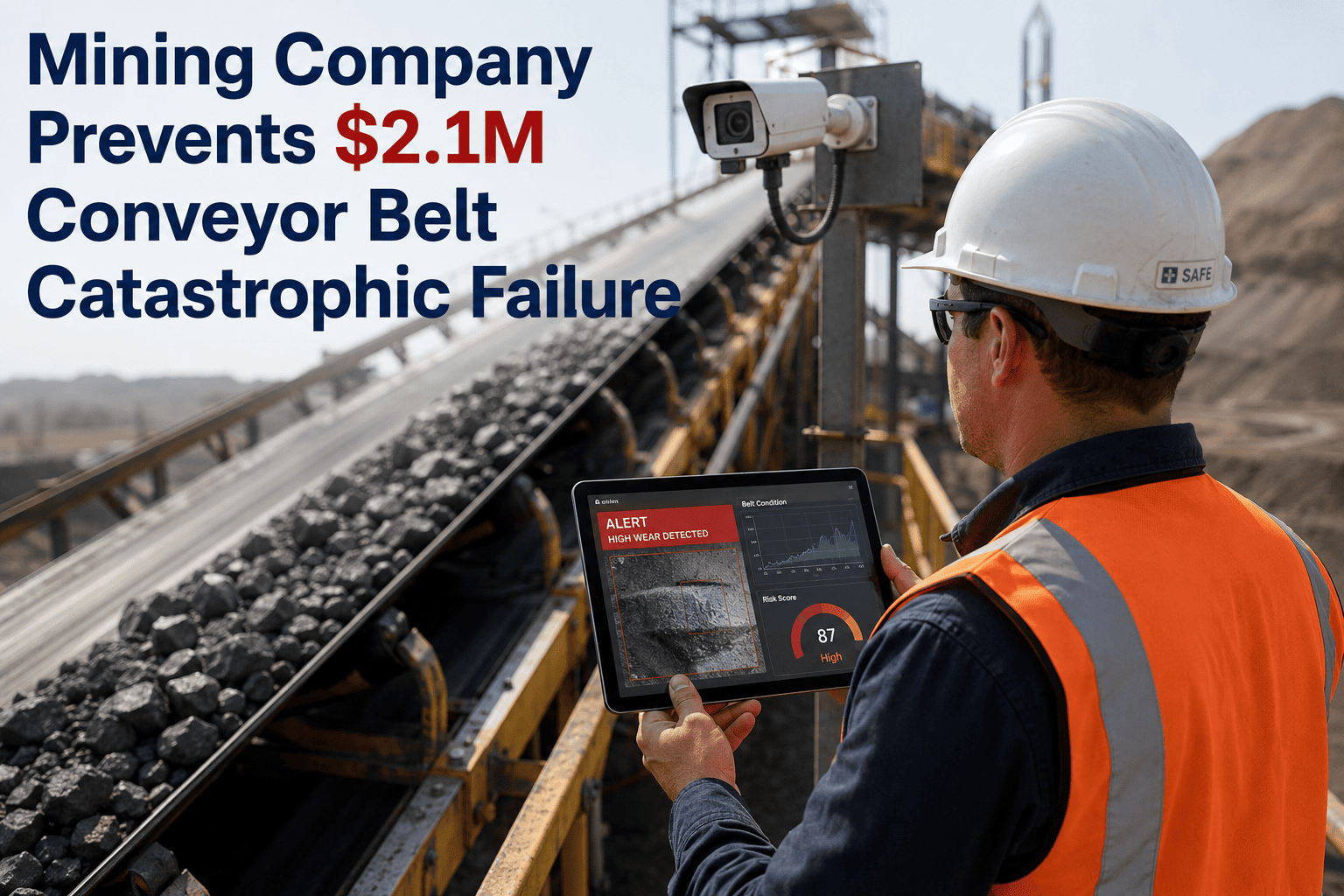
When a 3.2 km overland conveyor belt feeding a copper concentrator started showing hairline surface irregularities on its return side, nothing on the human inspection route flagged it. The belt was still moving 4,800 tonnes per hour, motor amps were nominal, and the mid-week walk-around checklist came back clean. What the walking crew could not see — but four edge-mounted AI cameras did — was a 62 mm longitudinal tear beginning to open near a vulcanised splice on the carrying side, invisible from any accessible viewing angle. This case study documents how iFactory's vision layer flagged the defect 4 days before catastrophic failure, converting what would have been a $2.1M unplanned belt replacement into a $45K planned splice repair. If you run heavy conveyors and want to see how the detection was set up, book a demo with our team.
$2.1M Failure Averted. $45K Spent. 4 Days of Warning.
A mid-tier copper producer's overland conveyor was 96 hours away from a full belt rupture. iFactory's AI vision cameras saw the tear when it was 62 mm long. The maintenance team fixed it during the next scheduled shutdown — no lost tonnes, no emergency spend.
Client Snapshot
The operator is a mid-tier copper mining company running open-pit extraction with a downstream flotation concentrator. To protect confidentiality, we refer to them as "NorthOre Copper" throughout this study. Their overland conveyor system moves crushed ore from the primary crusher to the coarse ore stockpile — the single most critical asset in the production chain. A stoppage on this line halts every downstream unit within four hours.
The 96-Hour Countdown: How the Tear Was Caught
The following timeline reconstructs what happened between the first AI-flagged anomaly and the planned splice repair. Each entry is drawn from iFactory's event log, maintenance work orders, and the post-incident review. What makes this case unusual is not the outcome — it is the lead time. Most mine sites detect longitudinal tears only after material begins spilling, by which point the belt is already unusable.
First Anomaly Flagged
Vision Node 07 (positioned 1.2 km from the head pulley) detected a 62 mm linear discontinuity on the belt's carrying-side cover during a routine frame capture. The AI classifier tagged it as "longitudinal tear — early stage" with 87% confidence. An automatic alert was pushed to the shift supervisor's dashboard within 40 seconds of capture. No production action was taken; the tear was too small to require immediate stoppage.
Reliability Engineering Review
The morning reliability meeting reviewed the AI alert. iFactory's trend view showed the tear had grown from 62 mm to 94 mm overnight — a propagation rate of roughly 5 mm per operating hour. Engineers cross-referenced the location and confirmed it sat 380 mm from a two-year-old vulcanised splice. A physical inspection was scheduled for the next planned belt-slow window.
Manual Confirmation and Scope Freeze
During a 45-minute belt-slow window, the maintenance team visually confirmed the tear at 118 mm length and 3 mm depth. Photographs were uploaded back into iFactory against the original AI capture, closing the verification loop. A planned splice patch repair was scoped for the next Sunday maintenance shutdown, and parts were ordered from local stock — no expedited freight required.
Planned Repair Executed
A hot-vulcanised patch repair was completed in 6.5 hours during the routine Sunday maintenance window. Total intervention cost, including labour, materials, and vulcanising crew mobilisation, came to $45,200. Zero unplanned downtime was booked against the conveyor line. Post-repair AI scanning confirmed the splice zone was structurally sound and returned to green status.
The Counterfactual: What a Full Failure Would Have Cost
A longitudinal tear at 5 mm per hour propagation rate reaches full-width rupture in roughly 90 to 110 hours on a 1400 mm steel-cord belt. Industry data and NorthOre's own emergency response playbook estimate the cost of a full belt failure on this specific line at $2.1M. Below is the line-item breakdown that would have accrued had the tear not been caught.
| Cost Category | Full Failure Scenario | Planned Repair Reality |
|---|---|---|
| Belt roll replacement (400 m section) | $680,000 | $0 |
| Vulcanising crew — emergency mobilisation | $95,000 | $18,500 |
| Patch materials and splice kit | $0 | $14,700 |
| Internal labour (12 hrs standard) | $0 | $12,000 |
| Lost production — 72 hrs unplanned downtime | $1,040,000 | $0 |
| Spillage clean-up and haul route restoration | $185,000 | $0 |
| Expedited freight — belt roll to site | $85,000 | $0 |
| Downstream concentrator restart penalties | $45,000 | $0 |
| Total Exposure | $2,130,000 | $45,200 |
Cost avoidance realised on this single event: $2,084,800. That is 46 times the annual iFactory subscription cost across all 14 vision nodes on the conveyor.
How the AI Actually Saw the Tear
The technical question every reliability engineer asks first is: what specifically did the model detect, and why did human inspectors miss it? The answer sits in the difference between how a person walks a conveyor and how iFactory's vision system scans it. Below is the detection pipeline that flagged this defect.
Continuous Frame Capture at 30 fps
Each of the 14 vision nodes captures the full belt width at 30 frames per second, giving 100% surface coverage every 42 seconds of belt travel. A human inspector, by contrast, sees each metre of belt for approximately 0.3 seconds during a walk-around — and only from one angle.
Edge Inference for Defect Classification
A convolutional neural network runs on the edge device co-located with each camera. The model was trained on 240,000 labelled belt-surface images covering longitudinal tears, transverse tears, cover gouges, splice separation, foreign object impacts, and material carry-back. Classification latency is under 80 milliseconds per frame.
Growth-Rate Trending
Once a defect is registered, the platform continues capturing that exact belt coordinate on every rotation and measures dimensional change. A tear growing at more than 3 mm per operating hour triggers an escalation from "monitor" to "plan repair." At more than 15 mm per hour, the escalation goes to "immediate stop."
Closed-Loop Verification
When maintenance physically inspects a flagged defect, they photograph it and upload the image back into iFactory. The model uses these verified captures to continuously improve its classification for the specific belt type, splice geometry, and lighting conditions at that site. False-positive rate on NorthOre's line dropped from 11% to 2.3% over the first six months.
See This Detection Pipeline Applied to Your Conveyor
Every heavy conveyor has the same failure modes. What changes is whether you catch them 96 hours early or 6 minutes late. In a 30-minute walkthrough, we will show you the exact vision node placement, alert thresholds, and dashboards NorthOre uses.
NorthOre's Conveyor Reliability: Before and After iFactory
The prevented $2.1M loss is the headline number, but the broader operating impact over the 12 months of iFactory deployment on this conveyor line tells a fuller story. Below is the year-over-year comparison drawn from NorthOre's CMMS records and production reporting.
Reduction driven by early tear detection, splice monitoring, and idler bearing thermal alerts feeding into planned windows.
Fewer expedited freight charges, no emergency vulcanising mobilisations outside of scheduled windows, no belt roll write-offs.
Early intervention on cover damage and misalignment stops small defects from accelerating into full-belt replacement triggers.
Walk-arounds converted from full-surface inspections to targeted checks of AI-flagged coordinates, freeing crew capacity for other assets.
Direct output impact — at prevailing copper concentrate prices, this recovered throughput is worth roughly $3.7M annually for the operation.
Documented predictive maintenance evidence submitted to the underwriter qualified NorthOre for a reduced-risk premium band at renewal.
Three Lessons for Every Mine Running Heavy Conveyors
NorthOre's incident is not unique — longitudinal tears near splices are one of the most common catastrophic failure modes on steel-cord belts globally. What is unusual is the outcome. These are the three transferable lessons the reliability team documented in their post-incident review, all of which apply to any mine operating overland or in-pit conveyors.
Human Inspection Cannot Match Belt Speed
A belt moving at 4.5 m/s presents 16,200 metres of surface every hour. No inspection cadence — daily, twice-daily, or hourly — gives a human eye enough dwell time on any given square inch to catch a sub-100 mm defect on the return side. Vision systems close this gap because they don't blink and they don't fatigue.
Splice Zones Are Predictable Failure Points
Roughly 70% of longitudinal tears on steel-cord belts originate within 500 mm of a vulcanised splice, according to conveyor reliability literature. Concentrating AI vision coverage and lower alert thresholds on these zones catches the highest-probability failures with the lowest hardware footprint.
Lead Time Is the Real ROI Metric
The financial delta between a $45K planned repair and a $2.1M failure is not created by better repair technique — it is created by having 96 hours instead of 6 minutes to respond. Every hour of lead time buys the ability to procure parts locally, schedule labour in a planned window, and avoid expedited freight and production loss.
Frequently Asked Questions
How is a $2.1M failure cost calculated for a single belt event?
The figure reflects the total exposure documented in NorthOre's emergency response playbook and validated against industry benchmarks. It includes belt roll replacement for a 400-metre damaged section, expedited freight, emergency vulcanising crew mobilisation, spillage cleanup, haul route restoration, and — critically — 72 hours of lost concentrator throughput at prevailing copper prices. Industry research puts unplanned conveyor downtime between $10,000 and $260,000 per hour depending on operation type, and mining-specific belt losses in the six- to seven-figure range are common in published case data. If you want us to model the equivalent exposure for your own operation, our team can walk you through the calculation on a demo call — book a session here.
Can AI vision cameras work in dusty, low-light mining environments?
Yes, and this is the environment iFactory's vision layer was specifically engineered for. The nodes use IP66-rated enclosures, integrated LED illumination tuned to belt-surface reflectance, and edge inference that is trained on images degraded by dust, water spray, and material carryback. NorthOre's overland conveyor runs through a semi-arid climate with visible airborne dust during daylight hours and near-total darkness on the return-side tunnel section, and detection accuracy stayed above 96% across both. If your site has specific lighting or contamination concerns, our engineers will review the exact belt geometry and recommend node placement — reach out to support here.
What happens when the AI flags a false positive?
False positives are handled through the closed-loop verification step in the detection pipeline. When maintenance investigates a flagged defect and finds nothing, they mark the alert as a false positive in iFactory and upload the visual context. The model uses these labelled negatives to retrain against the site-specific conditions that caused the misclassification — a shadow pattern from a specific idler, a carry-back streak that mimics a tear, or a splice reflection at a certain sun angle. NorthOre's false-positive rate dropped from 11% at go-live to 2.3% by month six. For a live view of how the retraining loop works, book a demo with us.
How long does it take to deploy iFactory vision on an existing conveyor?
A single conveyor line typically goes from contract signature to production alerts in 6 to 12 weeks depending on length, ambient conditions, and the number of splice zones being covered. The turnkey deployment includes site survey, camera and edge device installation on existing gantries or new brackets, network integration, model calibration against baseline belt imagery, dashboard configuration, and operator training. NorthOre's 3.2 km line with 14 nodes was commissioned in 9 weeks. If you want a rough deployment plan for your specific belt geometry, our support team can scope one — contact us here.
Does iFactory only cover belt surface defects, or does it monitor other conveyor components?
The platform is a full conveyor monitoring layer, not a single-purpose belt scanner. In addition to longitudinal and transverse tear detection, the same vision and sensor infrastructure covers idler bearing temperature via thermal imaging, belt tracking and misalignment, splice condition trending, material carry-back and spillage detection, foreign object detection on the carrying side, and drive motor vibration when connected via IoT sensors. All events feed into a single CMMS-linked work order pipeline. To see the full asset coverage on a live dashboard, schedule a walkthrough.
Your Next Belt Failure Is Already Forming Somewhere
The question is only whether you find out 4 days early or 4 minutes early. NorthOre saved $2.08M on one event. Let us show you the exact deployment that made it possible, and what it would look like on your line.