A confined space fatality is almost never the first thing that goes wrong. It is the seventh, or the tenth, or the fifteenth — a permit not fully signed, a gas monitor not zeroed, an attendant who stepped away for two minutes to answer a radio call. OSHA's own data indicates roughly 60 percent of confined space deaths involve rescuers, not the original entrant, because a partial procedural breakdown becomes total the moment someone reacts instead of following protocol. In August 2024, Wayne Transports received a single $621,600 citation for ten confined space violations tied to one fatality. AI vision cameras verify each step of an entry procedure independently and continuously — attendant presence at the manhole, entrant PPE at the moment of descent, gas detector on the entrant's person, and rescue equipment staged at the opening. See it running against your own site footage with a Book a Demo.
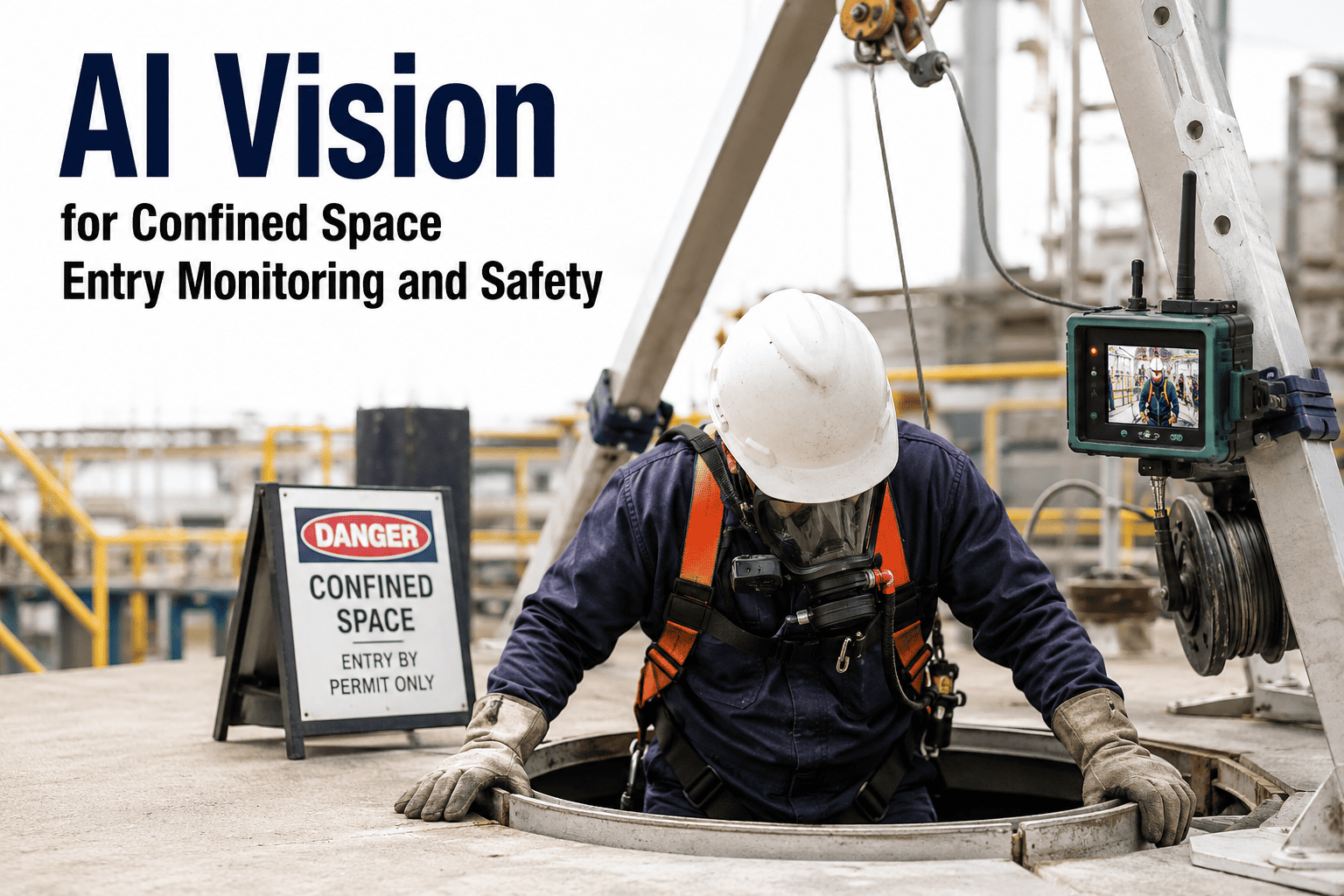
AI Vision for Confined Space Entry Monitoring and Safety
Continuous camera verification of attendant presence, entrant PPE, gas detector deployment, and rescue equipment staging — the four permit conditions that most often break down between the paperwork and the manhole.
What Actually Qualifies as a Permit-Required Confined Space
OSHA 29 CFR 1910.146 sets three tests for a confined space and four additional conditions that push it into permit-required status. A space that qualifies as permit-required cannot be entered without a written permit, an attendant stationed outside, atmospheric testing, and documented rescue provisions.
The Four Compliance Failure Points AI Vision Was Built to Watch
Confined space incident investigations almost always trace back to one or more of the same four preventable procedural breakdowns. Each of them is visible on camera. Each of them is invisible to a paper permit.
No Attendant Outside the Space
The single most cited failure mode in OSHA confined space enforcement. The attendant walks away to answer a radio, take a call, or grab a tool — and the entrant is alone at the exact moment atmospheric conditions change or a rescue is needed.
Skipped or Incomplete Atmospheric Testing
Pre-entry tests were assumed rather than performed, or performed in the wrong order (LEL before O₂, invalidating the reading). Continuous monitoring during entry is skipped when the entry is described as short.
Missing or Unstaged Rescue Equipment
Retrieval harness, tripod, or SCBA is on site but not at the opening. In an emergency, retrieving equipment from a truck 200 feet away costs the minutes between recoverable and fatal exposure.
Unauthorized Rescuer Entry
The failure that turns a single fatality into a double or triple one. A coworker or attendant enters the space without rescue equipment, becoming the majority of the 60 percent rescuer-fatality figure OSHA publishes.
The Mandated Sequence — And Why AI Verifies It Happened Before Entry
OSHA specifies the order in which the atmosphere must be tested because the physics of gas detection depends on it. AI vision confirms that the gas monitor was actually held at the opening, run for the required sample time, and read before the entrant descended.
Oxygen (O₂)
Combustible gas sensors need adequate oxygen to give accurate readings. Testing LEL before confirming O₂ can produce a dangerously false-negative flammability result.
Combustible Gases (LEL)
Lower Explosive Limit reading identifies flammable vapor concentration. Anything at or above 10 percent of LFL disqualifies the space until ventilated and re-tested.
Toxic Gases
H₂S, CO, and any contaminant identified during evaluation testing. The 10 ppm 8-hour TWA threshold for hydrogen sulfide is the most commonly enforced toxic reading.
Catch the Procedural Breakdown Before the Fatality
Bring us footage from a real confined space entry at your site and we'll show you exactly which permit conditions the AI can verify and log automatically.
How AI Vision Reinforces Each Person in the Permit Space Program
OSHA 1910.146 defines three roles that together form what safety practitioners call the critical link between workers inside a hazardous space and the emergency infrastructure outside it. AI vision does not replace any of them — it verifies that each role is actually performing their assigned duties throughout the entry.
Authorized Entrant
The worker who enters the permit space to perform the assigned task. Must be trained on hazards, wear specified PPE, use assigned atmospheric monitors, communicate continuously with the attendant, and self-evacuate at the first warning sign or alarm.
Attendant
Stationed outside the permit space for the entire duration of the entry. Never enters the space, even to help pass tools. Maintains constant awareness of entrant status, monitors atmospheric readings, and has authority to order evacuation the moment any hazard indicator appears.
Entry Supervisor
Ultimate responsibility for the entry. Verifies atmospheric testing, confirms availability of required equipment, signs the permit before entry begins, and terminates the permit when work is complete or conditions change beyond acceptable limits.
The Ten Permit Conditions AI Vision Actively Watches For
Every permit space entry runs against a checklist. Most of that checklist is verifiable visually. The camera-visible items below get logged automatically, with timestamps and image evidence, and are attached to the permit record for audit retention.
One Fatality. Ten Serious Violations. $621,600.
In August 2024, Minnesota OSHA issued a $621,600 citation to Wayne Transports after a worker fatality inside a tanker trailer. The investigation identified ten serious violations of 29 CFR 1910.146, including failure to test atmospheric conditions before entry, failure to provide an attendant outside the space, and failure to identify and evaluate hazards before entry. The company had 74 years without prior citations, and that history did not reduce the penalty. The worker was inspecting a tanker for cleanliness. Witnesses reported a gasoline-like odor near the opening. There was no gas monitor reading. No one was outside the space.
Industries With the Highest Confined Space Exposure
Chemical & Petrochemical
Reactors, storage tanks, and process vessels where cleaning and inspection entries happen weekly and atmospheric hazards are the primary risk.
Food & Beverage
Silos, fermenters, and CIP-serviced tanks with engulfment risk from bulk product and CO₂ atmospheres in fermentation cellars.
Water & Wastewater
Manholes, wet wells, and digesters with H₂S exposure and inrush hazards — one of the highest fatality rate categories in the sector.
Oil & Gas
Frac tanks, separators, and mud pits with flammable atmosphere exposure and the largest per-incident penalty history under 1910.146.
Power Generation
Boilers, condensers, cooling towers, and ash silos where entries are scheduled around planned outages and errors compound under time pressure.
Manufacturing & Fabrication
Paint booths, quench tanks, hot ducts, and process pits with mixed atmospheric and mechanical hazards inside a single facility.
We had a near-miss last spring where an attendant stepped away for what he thought was a minute to grab a wrench. The entrant reported a metallic taste at the same moment and we had no one at the opening. After that, we brought AI vision into the entry program. Now the attendant knows the camera is watching too, and the log of attendant presence during every entry has become the single strongest piece of evidence in our safety audits.
Frequently Asked Questions
Q: Does AI vision replace the attendant, or is it a supplement?
AI vision does not replace the attendant, and OSHA 1910.146 does not currently allow an unmanned attendant role. What AI vision does is verify continuously that the attendant is present at the opening, flag any absence exceeding the configured threshold, and generate the timestamped log that proves attendant presence for the full duration of the entry. Facilities typically use this to catch the specific failure mode where an attendant briefly walks away — the incident category that historically produces the highest per-event penalties. Walk through the exact configuration for your entries with a Book a Demo.
Q: How does the camera verify that atmospheric testing actually happened before entry?
The system recognizes the gas detector in the tester's hand, confirms it was held at the opening for the configured sample time, and timestamps that event against the permit record. It does not read the gas monitor's numerical output directly, but it does prove the physical act of testing occurred at the required stage of the procedure. Some sites pair the vision system with a gas monitor that publishes readings digitally, which lets the combined record show both the test occurring and the values recorded — creating a complete pre-entry evidence trail without any manual documentation step.
Q: Can the system be deployed for outdoor permit spaces like manholes or excavations?
Yes, mobile and pole-mounted camera units are used specifically for outdoor permit spaces where fixed infrastructure does not exist. Common deployments include utility manholes, excavation shafts, and temporary work zones around tanker vehicles. The mobile unit is set up at the entry point, connects wirelessly to the site network or the on-truck edge server, and provides the same permit condition verification as a fixed installation. For persistent outdoor entry programs, permanent pole mounts near frequently accessed manholes give the safety team an always-available verification asset.
Q: What happens with the recorded footage — is it retained, and for how long?
Retention is fully configurable per site policy and typically aligns with the one-year canceled-permit retention requirement in 1910.146. Facilities often keep entry-related footage for 12 to 24 months so that it remains available across an OSHA inspection cycle and any subsequent incident review. Video not associated with a permit entry can be aged out sooner. Privacy configuration is built in — worker anonymization, redaction of adjacent activity, and role-based access to entry-related footage — and can be reviewed in detail through Support Contact.
Q: How long does it take to add AI vision monitoring to an existing confined space program?
A typical rollout runs six to twelve weeks for a facility with multiple permit spaces, and a pilot program on one to three high-frequency entry points can go live in as little as six weeks. Deployment includes site assessment to identify the permit spaces and camera placement, edge server installation, integration with your existing permit software if applicable, configuration of the verification checklist against your current site procedures, and a calibration period so alerts are accurate from the first live entry. Ongoing tuning happens through the first month of operation.
Turn Every Confined Space Entry Into a Documented Compliance Record
See continuous permit verification running on real entry footage — attendant presence, PPE, gas detector, rescue staging, and permit posting all logged automatically.